

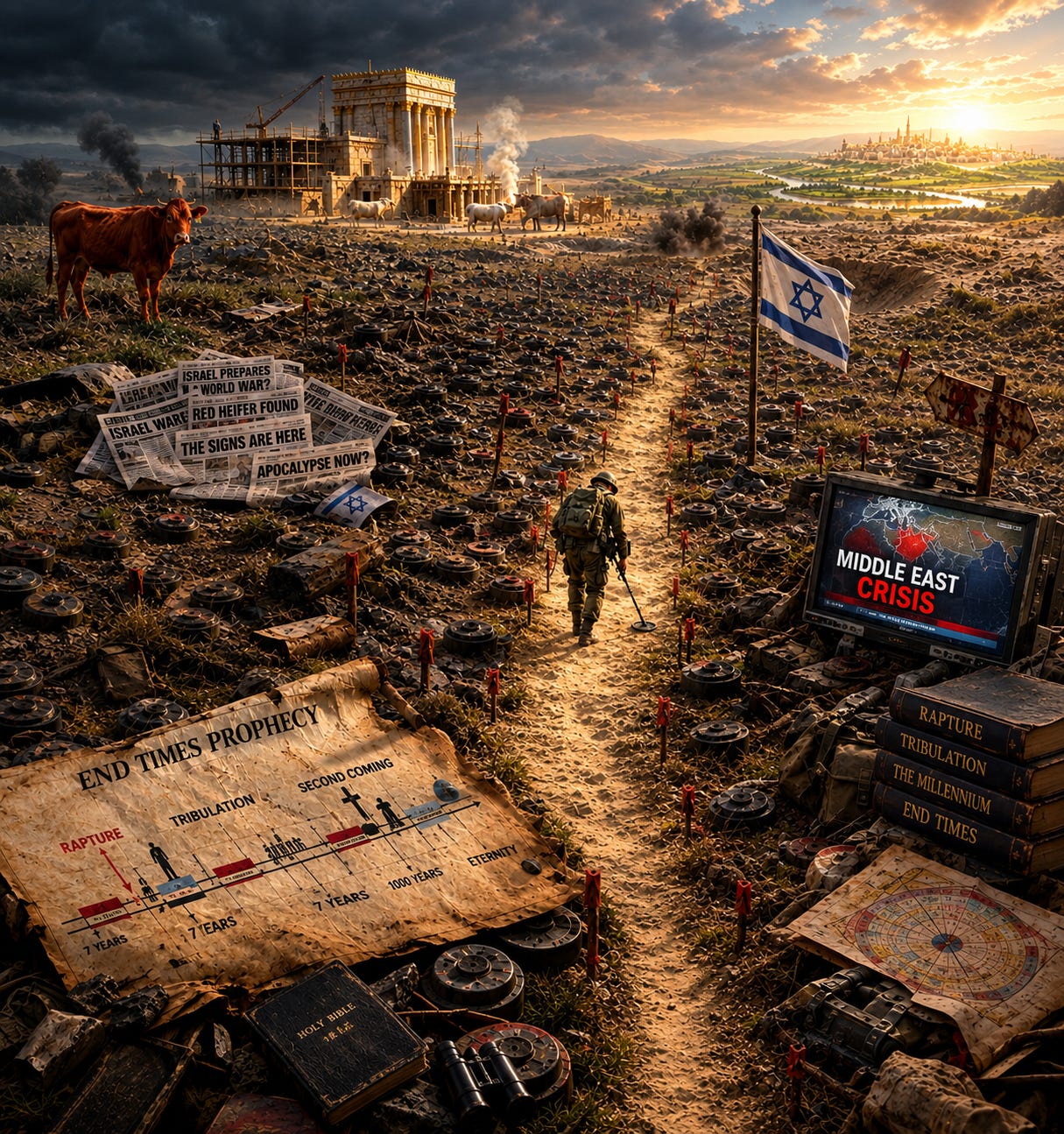
“Did you ever regret the absence of the burnt offering, or the red heifer, or any one of the sacrifices and rites of the Jews? Did you ever pine for the Feast of Tabernacles, or the dedication? No, because, though these were like the old heavens and earth to the Jewish believers, they have passed away, and we now live under the new heavens and a new earth, so far as the dispensation of divine teaching is concerned. The substance is come, and the shadow has gone; and we do not remember it.” -Charles Haddon Spurgeon, Metropolitan Tabernacle Pulpit, vol. 37 (1865)
For some of you, my post thus far has been a review. For others, it has created nothing short of a blown cranial head gasket. This chapter is for the latter — for those who feel you might (emphasis on ‘might’) be buying into what I’ve written thus far.
However…
You need to know up front that changing your systematic theology, including your end-times beliefs, has consequences. And while none of these consequences are bad, it would behoove you to know about them up front, lest you venture unprepared into an unmarked minefield of theological and eschatological revisionism. The minefield is there, regardless, and you will have to traverse it to get to the truth. The mission, though, will be easier with the sapper’s map in your back pocket.
We’ll look at some of the most obvious of these consequences, but to understand why there are consequences in the first place — why this discussion is even necessary — we must understand the novel theology created by J. N. Darby, promoted through Scofield’s bible, and adopted by a significant segment of the American church (particularly evangelicals). A theology that, interestingly enough, the rest of the world rejects.
For starters, the 1800s were characterized by a veritable explosion of interest in spiritualism / “folk magic” and the prophetic…
While I strongly disagree with his end-times positions, Tim LaHaye hit the nail on the head explaining why Darby’s ideas — many of which were completely unheard of prior to his teachings — managed to stick. From 1999’s Are We Living in the End Times?
“In the 19th century... prophecy was in the air.”
Despite LaHaye’s numerous failed predictions, he was spot on with this simple assessment.
The 1800s were dominated by prophecy and restorationist movements, each claiming mankind was teetering on the precipice of the end of the age, and each claiming to be God’s unique vessel to restore apostolic New Testament Christianity in the last days.
Which, by the way, is the hallmark of all small-c “christian” cults, and/or Christian groups with varying degrees of cult-like qualities…
We alone have recovered the lost truths of the 1st-century church, and we alone have access to the restoration.
The institutional church intentionally corrupted these truths over the past eighteen centuries and has been intentionally hiding them from you.
But God handed our prophet (insert name-of-choice here________________) the truth, and our group (insert group-of-choice here________________) stands alone as God’s instrument for proclaiming it to the world.
All of it proof that adherents are living in the last days; the urgency always built into the restorationist claim itself. Same template every time, which is why LaHaye’s observation landed.
Here were some of the major players in the movement…
J.N. Darby (Darbyites)
Edward Irving & Lady Powerscourt (Irvingites)
William Miller (Millerites — spawned Ellen White/SDA & influenced early JWs)
Joseph Smith (Mormonism — unarguably the wildest story of the lot, an honest-to-goodness rabbit hole of intrigue)
Barton Stone & Alexander Campbell ( Campbellites — believed they could usher in the millennium by restoring apostolic Christianity)
John Thomas (Christadelphians, spun off from Stone-Campbell)
The Holiness Movement & its 20th-century offspring, Pentecostalism (explicitly claiming recovery of apostolic gifts and power in the “Latter Rain”). BTW, I am not a strict cessationist, a problematic position for those with a ‘blurry,’ ‘fringe,’ or ‘haunted’ worldview.
Plenty of similar movements today. None of the above have gone completely away, with new groups added regularly.
SIDE NOTE ON THE BURNED OVER DISTRICT: It’s important to note how many of these movements were birthed in the “Burned-Over District” of western New York, a region scorched by relentless revivals driven by untrained preachers — one of several rotten fruits of what has come to be known as the Second Great Awakening (link, link, link, link, link). IMPORTANT SIDE NOTE TO THE SIDE NOTE: Do not confuse the second ‘Great Awakening’ with the first.
SIDE NOTE ON FIRST-CENTURY RESTORATION MOVEMENTS: Don’t forget that the Early Church operated in a unique transition period (see earlier chapter) and was riddled with the very problems Paul spent most of the space in his letters correcting. In other words, the first-century church was frequently not the model of perfection envisioned by utopians, and in some cases was an abject disaster.
By the time the modern restoration era was in full swing (the mid-1800s), centuries of brilliant theological minds had already mapped the terrain exhaustively. The restoration movements weren’t discovering anything new; they were cherry-picking from a fully catalogued menu while claiming apostolic recovery.
There was nothing new under the sun, and the harsh reality is that the various movements claiming to restore apostolic Christianity looked nothing like a perfected New Testament church — see earlier links on the Second Great Awakening.
Look closely at the proof texts used by those who would restore the trappings of Israel, whether today or in a future millennium (Exodus 12:49; Exodus 31:16-17; Leviticus 23; Numbers 15:15-16; Isaiah 66:22-23; Jeremiah 31:31-33; Ezekiel 40-48; Zechariah 14:16-19; Matthew 5:17-20; Matthew 7:21-23; Matthew 24:20; John 14:15, 21; John 15:10; Acts 15:19-21, 28-29; Acts 21:20-24; Romans 3:31; Romans 7:12, 22; Romans 8:4; Romans 11:17-24; Ephesians 2:12, 19; Colossians 2:16-17; 1 John 2:3-6; 1 John 3:4; 1 John 5:2-3; Revelation 12:17; Revelation 14:12; Revelation 22:14).
Nearly every one is either a snapshot of the forty-year transition or prophecy pushed into a speculative future. Either way, their case hinges on erasing AD 70 as a covenantal event. Miss what the Temple’s fall meant (Hebrews 7-12), and the shadows start looking like substance again.
Darby didn’t invent the revisionist prophetic impulse — he just rode the wave; his successors managing to systematize his version of ‘the restoration’ better than White, Miller, Stone, or the others.
From there, a number of factors converged, creating a Perfect Storm — a storm that would eventually usher in Darby’s teachings as gospel truth. His views, as taught by the biggest mouthpieces for his system, still considered equal to the chief tenets of the historic Christian faith (inerrancy of scripture, the virgin birth, the deity of Christ, salvation by Christ alone, etc), in thousands upon thousands of American churches.
In other words, in many circles, dispensational beliefs, the biggest of which is the separation of Israel and the Church, are a test of Christian orthodoxy…
“This is an appropriate place to assure the reader that, in common with Dr. Scofield and his associates in the original work, every member of the committee of revision believes in and teaches the plenary inspiration and inerrancy of the Scriptures; the triune Godhead composed of the Father, the Son, and the Holy Spirit; the virgin birth and the deity of Christ; the necessity and efficacy of His atoning work; Christ’s bodily resurrection and ascension; His imminent coming for His Church and His visible, premillennial return to earth; the everlasting felicity of the redeemed and the everlasting punishment of the lost. Aware of the problems of Biblical criticism, the committee is unshaken in its adherence to the authority of the infallible word of God in respect to both faith and practice.” -Schuyler English speaking on behalf of 1967’s Editorial Committee for The New Scofield Reference Bible, taken from the preface of my copy
Not only is Christ’s visible return to earth touted by the committee as a core Christian doctrine (which it should be), but it must be premillennial. By yoking premillennialism to the Virgin Birth and the Atonement in a single doctrinal statement, the committee didn’t authenticate a novel eschatology; they laundered it.
“The Scofield Reference Bible became the Bible of fundamentalism, and the theology of the notes approached confessional (creedal) status in many Bible Schools, institutes, and seminaries, established in the early decades of the 20th century.” -Craig Blaising, Senior Professor of Systematic Theology at Dallas Theological Seminary
What had been Darby’s speculative system became, in the minds of millions of evangelicals, simply “what orthodox Christians believe.” And what do you call a church member who steps outside the boundaries of orthodoxy?
Can anyone say heretic?
This is why so many dispensationalists treat rejection of Darby’s novelties as heresy — on par with Jehovah’s Witnesses, Christian Science, or Smith’s LDS. It’s a rhetorical con. Build your theological innovation into “the foundational doctrines of the faith” tightly enough, and denying said innovation gets conflated with denying the Resurrection.
That’s not theology — that’s branding (it’s also an old debate trick known as The Package Deal Fallacy). Proof in point from one of the system’s early promoters, decrying those who don’t interpret the Scriptures through the lens of “Consistent Literalism,” which we will discuss momentarily…
“In sheer fantastical imagination, this method surpasses Russellism, Eddyism, and Seventh Day Adventism, since the plain, grammatical meaning of language is abandoned and simple terms are diverted in their course and end in anything the interpreter wishes.” -Louis Sperry Chafer, founder of Dallas Theological Seminary, from page 281-282 of his 4th volume of Eschatology
As you may be starting to see, there is more to the ‘perfect storm’ that ushered in Darby’s ideas — much more…
DISPENSATIONALISM AND EDUCATION
“Would the Puritans have founded institutions like Princeton, Harvard, Yale, and other great institutions that were established for the advancement of the kingdom of Christ if they thought theirs was the very last generation?” -Jerry Newcombe, quoting D. James Kennedy in 1999’s Coming Again
The turn of the century saw the culmination of a problem that had been brewing for at least a century — the secularization of higher education. The result was a backlash against creeping liberalism in America’s universities — universities created under distinctly Christian auspices, but whose distinctives were being abandoned in favor of ‘enlightenment ideology’.
Realizing that “backlashes” often dramatically overshoot their mark, what did this particular backlash look like? For starters, like biblical literalism cloaked in the language of biblical inerrancy…
Labeling themselves “fundamentalists” (mostly evangelical / mostly dispensational), their #1 distinctive in the arena of biblical hermeneutics (the methodology of interpretation) was claiming to interpret all scripture — even prophecy — literally, anointing what they termed “consistent literalism” as the sole test of textual faithfulness.
The problem is, every theological system interprets the bible with significant idiom — it’s impossible not to. The difference is that dispensationalists rigged the game so that their idiom was considered “literal,” while other groups’ was filed under “heretical”…
“John Darby advocated dispensationalism. The basis of this view was a strict literalism in the interpretation of the Bible, especially its prophetic parts. Henry Morris claims his commentary on Revelation ‘could possibly be the most literal.’ Although he thinks ‘most of Revelation is to be taken literally,’ throughout the commentary he points out symbols which he thinks should not be taken literally. All literal interpreters are inconsistent… Dispensationalism literalizes prophecy and allegorizes history.” -Dr Vic Reasoner from his article on biblical hermeneutics, Principles of Bible Interpretation
And unfortunately, “allegorizing history” (or simply choosing to ignore it) leads to some textually dark places — places that make little theological sense, drawing adherents into the ‘trifecta’ we’ll discuss imminently…
“I do not want history to tell me that Nineveh or Babylon is ruined, or that Jerusalem is in the hands of the Gentiles. I do not admit history to be, in any sense, necessary to the understanding of prophecy.” -Oswald Allis, Prophecy and the Church (1945), attributed to J.N. Darby
“Dispensationalism teaches that the Old Testament must be interpreted within its own context. This is, in my opinion, the most important belief of a dispensationalist because it leads to the rest. The core teaching of dispensationalism is that the Old Testament must be interpreted according to its own context, and the New Testament cannot reinterpret or change the meaning of a passage. In other words, one does not need the New Testament in order to know the true meaning of an Old Testament passage. The New Testament is crucial to our understanding of the unfolding revelation of God, but a dispensationalist is adamant that the New Testament does not reinterpret the Old.” -From Peter Gorman’s Bible Sojurner site (What is Dispensationalism? A Concise Explanation)
Let me show you one of hundreds of examples of the myth of consistent literalism, expounding on a concept I dealt with in the previous chapter — the fact that Paul not only claimed to have preached to the ‘whole world’ repeatedly, but in doing so fulfilled one of many conditions of the Olivet Discourse (Romans 1:8, Romans 10:18, Romans 16:25-26, Colossians 1:6, Colossians 1:23, 1 Timothy 3:16).
The dispensationalists violate their “consistently literal” hermeneutic by claiming this has not happened yet, ignoring a significant number of passages showing that identical language is common throughout Scripture (Ezra 1:2, Luke 2:1, 1 Kings 10:24, Genesis 41:57, Daniel 4:1, Acts 2:5, John 12:19, Acts 17:6).
Unable to defend their “consistently literal” hermeneutic on exegetical grounds, dispensationalists instead chose to institutionalize it…
The result of the battle against liberalism was that fundamentalists / dispensationalists created their own colleges, universities, and bible colleges, with the flagship being Dallas Theological Seminary — an institution created in 1924 for the express purpose of disseminating the teachings of Darby and Scofield.
There were many others that either followed suit or actually predated DTS slightly (Moody Bible Institute, Biola, Bob Jones University, Liberty University, Grace College, Cairn University, Maranatha, Pensacola Christian College, The Master’s), along with too many others to list.
But the fundamentalist backlash was only one side of the coin…
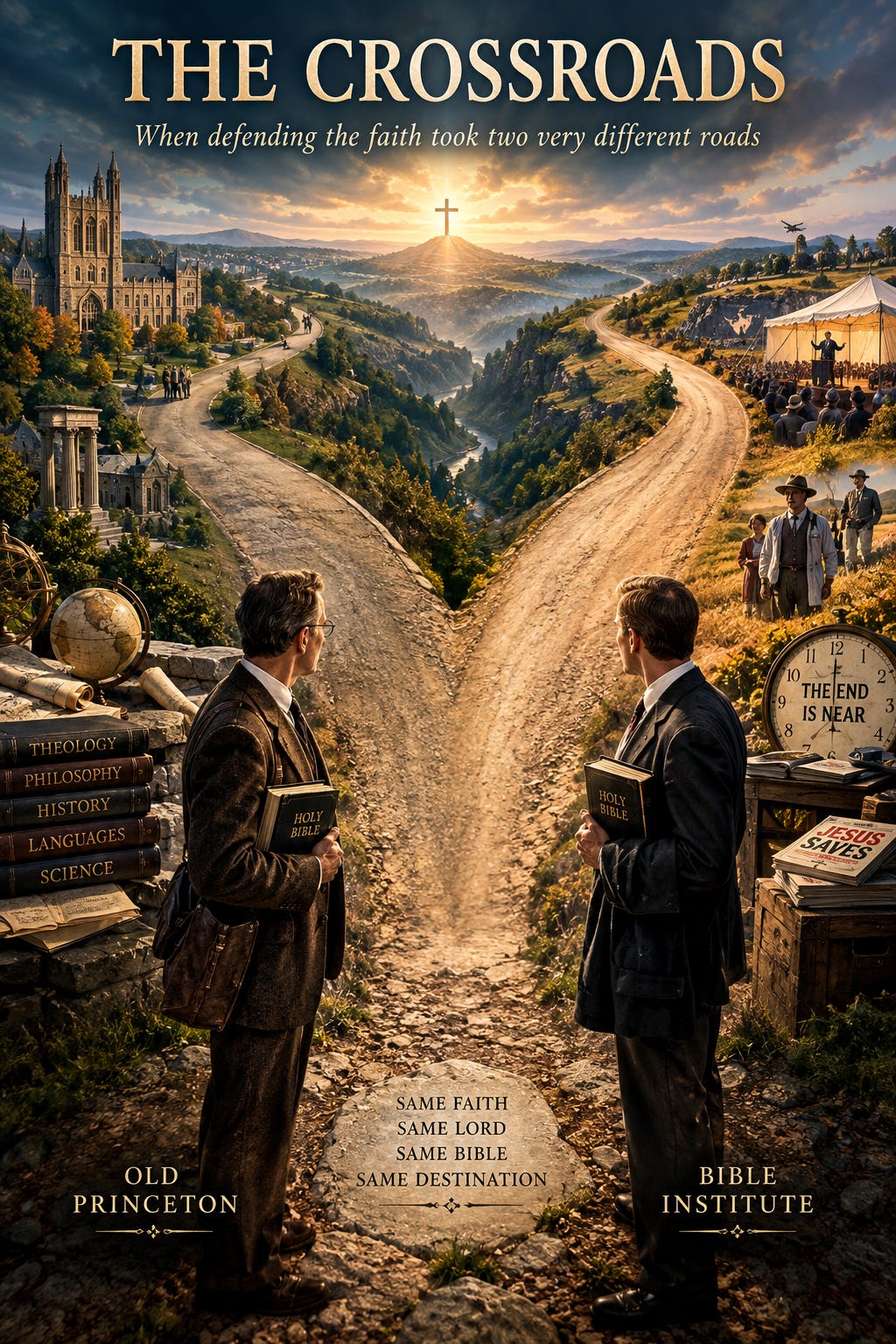
The same war against liberalism in higher education was being waged at Princeton University at the same time. Only this battle was being fought by a group of elite Reformed scholars.
Eventually, its leaders, J. Gresham Machen, BB Warfield, and A.A. Hodge (son of Charles), along with a myriad of others, realized that by staying they were fighting a losing battle. So they left Princeton en masse and started Westminster Theological Seminary in 1929…
And here is the difference between the two groups — the point where American higher education reached the crossroads…
As already discussed, America’s increasingly secularized university system reclassified religious claims as private or nonacademic matters (something that had already occurred in Europe). Old Princeton’s Reformed tradition, represented by the aforementioned men, answered not by lowering academic standards, but by preserving serious scholarship within a distinctly Christian intellectual framework.
By defending a rigorously intellectual Christianity in which Scripture, doctrine, history, literature, philosophy, languages, and the sciences — all academic disciplines — stood under the lordship of Christ…
Their larger vision was that Christian education was never merely preparation for a profession, whether religious or secular, because Christ is Lord of all truth and all life. Christian education should teach a comprehensive faith-based worldview — the framework of beliefs and assumptions through which a person interprets all of reality, biblically determining what is true and good.
Their goal was that education would instruct Christians how to answer life’s single most important question beyond salvation. How Should We Then Live?
Their idea was both simple and ancient. Intellectual formation, personal devotion, sanctification, and one’s vocation belong together as inseparable forms of faithful service to God…
Machen expressed the all-of-life principle plainly: Christian convictions must underlie not merely one part, but the whole curriculum, because “true learning and true piety go hand in hand” and “Christianity embraces the whole of life.”
And because it’s relevant to this discussion, I cannot help but note the non-coincidence that Princeton’s Theology Department and later Westminster Theological Seminary were distinctly postmillennial in their eschatology…
“What is today a matter of academic speculation begins tomorrow to move armies and pull down empires.” -J. Gresham Machen, from “Christianity and Culture”
Surely we shall not wish to measure the saving work of God by what has already been accomplished in these unripe days in which our lot is cast. The sands of time have not yet run out. And before us stretch, not merely the reaches of the ages, but the infinitely resourceful reaches of the promise of God. Are not the saints to inherit the earth? Is not the re-created earth theirs? Are not the kingdoms of the world to become the kingdom of God? Is not the knowledge of the glory of God to cover the earth as the waters cover the sea? Shall not the day dawn when no man need say to his neighbour, “Know the Lord,” for all shall know Him from the least to the greatest? Oh, raise your eyes, raise your eyes, I beseech you, to the far horizon: let them rest nowhere short of the extreme limit of the divine purpose of grace. And tell me what you see there. Is it not the supreme, the glorious, issue of that love of God which loved, not one here and there only in the world, but the world in its organic completeness; and gave His Son, not to judge the world, but that the world through Him should be saved? -B.B. Warfield from “God’s Immeasurable Love”
“Sometimes we hear that ten minutes on your knees will give you a truer, deeper, more operative knowledge of God than ten hours over your books… Why should you turn from God when you turn to your books, or feel you must turn from your books in order to turn to God? If learning and devotion are as antagonistic as that, then the intellectual life is in itself accursed.” -B. B. Warfield, “The Religious Life of Theological Students”
“This whole process of education is to be religious, and not only religious, but Christian. And as Christianity is the only true religion, and God, in Christ, the only true God, the only possible means of profitable education is the nurture and admonition of the Lord.” -Charles Hodge, Commentary on the Epistle to the Ephesians
“A Christian boy or girl can learn mathematics, for example, from a teacher who is not a Christian; and truth is truth however learned. But while truth is truth however learned, the bearing of truth, the meaning of truth, the purpose of truth, even in the sphere of mathematics, seem entirely different to the Christian from that which they seem to the non-Christian; and that is why a truly Christian education is possible only when Christian conviction underlies not a part but all of the curriculum of the school.” -J. Gresham Machen, Education, Christianity, and the State (1926)
“Christian religion flourishes not in the darkness but in the light. Intellectual slothfulness is but a quack remedy for unbelief; the true remedy is consecration of intellectual powers to the service of the Lord Jesus Christ.” -J. Gresham Machen from “Christian Scholarship and the Defense of Faith”
The respective responses to educational liberalism from the two conservative camps, the Bible-institute fundamentalists and the Old Princeton tradition of Reformed scholarship, could not have been more different. But don’t miss the bigger point. Machen founding Westminster was not a rejection of evangelism replaced with learning. It was the insistence that evangelism and learning belong together.
Scofield’s reference system gave fundamentalism the feeling of rigorous scholarship (prophecy charts, ‘consistent literalism,’ prophetic certainty) while the organizing principles of ‘immediatism’ — the expectation of an any-day-now end, the urgency of soul-winning sans urgency for discipleship, the demand for immediate doctrinal closure — quietly made sustained intellectual rigor appear optional, and even suspect.
Old Princeton reached the opposite conclusion of the fundamentalists…
The modernist crisis did not excuse Christians from rigorous study of languages, history, doctrine, philosophy, and the wider world. In fact, it made such study all the more imperative (go back and look at the links on The Second Great Awakening if you’ve not done so).
The decisive divide, therefore, was not between Christians who believed the Bible and Christians who did not, but between two competing theological visions of what fidelity to the Bible required…
Rapid mobilization for a looming emergency.
Or…
Patient cultivation of a Christian mind capable of defending and applying the faith across the whole of life, and intended to be passed on generationally.
Both sides were sincere. Both believed they were defending Scripture. Both were genuinely concerned for the lost…
But the culture built around dispensationalism’s urgency rewarded speed and certainty over depth and maturity. That reward structure — not the system’s inherent capacity (or more correctly, incapacity) — is what metastasized into evangelical anti-intellectualism (go back and look at the links on The Second Great Awakening if you’ve not done so).
The fundamentalists, alarmed by modernism and animated by the urgency of evangelism and Christ’s imminent return, often bypassed the long classical and theological preparation associated with established seminaries in favor of short, practical, English-Bible-centered courses for evangelists, missionaries, and lay workers. While not all bad (DL Moody, for instance), there were unseen consequences to decreased (and devalued) academic rigor, much of it eventually manifesting in our nation’s tax-funded government schools.
The result was not simply a disagreement over end-times charts, though there certainly was that (link, link). It was a disagreement over the very nature of Christian learning itself: whether the Church should cultivate a comprehensive, disciplined Christian intellect capable of engaging the whole body of knowledge, or prioritize immediate Bible instruction and ‘rescue-oriented ministry’ in an age seen to be, in the immortal words of that great American philosopher, Merle Haggard, headed downhill like a snowball that’s headed for hell (see J. Vernon McGee’s infamous statement).
As a reassessment of Mark Noll’s The Scandal of the Evangelical Mind Thirty Years Later observes, the resulting evangelical intellectual deficit has proved remarkably persistent — in some ways, disastrously persistent…
The intellectual catastrophe that began when fundamentalist leaders traded rigorous theological preparation for expedited Bible-institute training has curdled into the evangelical consciousness itself. What started as a pragmatic ‘wartime’ measure — prioritizing immediate evangelism and Christ’s imminent return over the long classical and theological discipline of established seminaries became, within three generations, a cultural virtue.
Far too many of today’s evangelical parents have been taught to view academic rigor with suspicion. The anti-liberalism movement that once produced theologians capable of taking on all secular comers across the spectrum of academic disciplines, too often produces congregants incapable of thinking beyond slogans. And let’s be honest — evangelical congregants are more likely than Reformed congregants to be both dispensational (fundamentalist) and the product of public schools.
SIDE NOTE: After reading numerous articles on the subject from both sides since Y2K, I can assure you that no matter how harsh it sounds, the claims of the previous paragraph have the theological, historical, and statistical muscle to back them up.
It’s not just that anti-intellectualism is no longer a liability in evangelicalism — it is far too frequently seen as a sign of spiritual authenticity. The cruelest irony is that it has taken explicitly Reformed movements — Classical Conversations and similar initiatives like our very own NCS, rooted in the very intellectual traditions that fundamentalism rejected — to begin training students to reclaim ground that evangelicalism abandoned.
Voluntarily abandoned…
Evangelicals did not lose their minds to modernism or secularism. They deliberately traded them away for speed and certainty, and now must watch as those pesky Calvinists (and a loose alliance of others) rebuild what Scofield’s intellectual offspring and the Bible institutes tore down (article, article, article).
PROPHECY CONFERENCES & THE SCOFIELD BIBLE
But the problem did not end with education. As these educational and theological currents converged, another piece of the Perfect Storm was gathering on the horizon...
This same period in history also happened to be the launching pad for a veritable explosion of prophecy conferences not only in America, but in Britain as well (the Niagara Conference was the biggest, although there were others). Speakers presented charts, promoted studies, and sold books touting current events as the unfolding timetable of the end — much like today.
The appeal was immediate and emotionally powerful, offering certainty in uncertain times, as well as the promise that ‘attentive’ believers could read the signs of the times — much like today…
“We live in the last time. This is undeniable, if one accepts God’s Word. It is indisputable to anyone who holds the Bible as truth.” -Terry James from his monthly column on RaptureReady.com (April 2007)
“The astute in the evangelical church are expecting Jesus to come back soon... THIS IS THE GENERATION that will see the promise of the coming of Jesus fulfilled.” Don K from the RaptureReady.com message boards (April 2007):
But “attentiveness” to the prophetic wasn’t all this group was pushing…
Below are some examples of where these ideas lead from my unpublished manuscript, Apocalypse When? Realize I could’ve given you hundreds more, straight from the experts’ mouths.
It’s not a stretch to say that dispensationalism is an anti-intellectual movement that promotes The Trifecta™ of wackiness, date-setting/wild speculation, and pessimism for the gospel being able to convert the world.
Prove me wrong…
1897 — C.I. Scofield, sermon at the Niagara Prophetic Conference, The Return of the Lord: “The signs and portents of the end-time are now so many and so ominous that men of vision everywhere... are taking note of them... the age ends in disaster, in ruin, in the great, final, world-catastrophe and for this we have been branded pessimists.”
1949 — The Weekly Evangel (May 21, 1949), page 2: “Atomic war will start on, before, or at least by January 1953.”
1970 — Hal Lindsey, The Late Great Planet Earth: “What has happened and what is happening right now to Israel is significant in the entire prophetic picture. Men who have studied events that were to occur shortly before the great holocaust known as Armageddon are amazed as they see them happening before their very eyes.”
1971 — Bob Fraley, describing a 1971 revelation, The Last Days In America: “The Lord revealed to Charles that the two ‘horns’ of the second beast were the positive and negative power charges of electricity. My brother’s revelation about electricity and the computer came in 1971.”
1972 — Tim LaHaye, The Beginning of the End, page 172: “Pardon my pessimism, but when I think of China’s nuclear development in light of their past, I see no future for the known world beyond the year 2000.”
1973 — Hal Lindsey, There’s a New World Coming, page 306: “To the skeptic who says that Christ is not coming soon, I would ask him to put the book of Revelation in one hand and the daily newspaper in the other, and then sincerely ask God to show us where we are on his prophetic time-clock.” Back Cover: “The Late Great Planet Earth was written to show that God’s prophetic Word is as up-to-date as today’s newspaper.”
1973 — Salem Kirban, 20 Reasons Why This Present Earth May Not Last Another 20 Years: “I predict that by 1977, marijuana will be legalized and sold through cigarette companies; that by 1982, 8,500 Israelis will die in road accidents, it will become evident that life does exist somewhere else besides the earth, and that the mystery of flying saucers will be solved; that by 1985, the three-day work week will be introduced; and that by 1991, The United States will join the free European nations into what will become known as UNITED STATES EUROPE.”
1974 — Zola Levitt and Thomas McCall, The Coming Russian Invasion of Israel: “This book has been exceedingly difficult to write, because the events the authors intended to ‘predict’ kept virtually coming to pass during the writing. Until the coming Russian invasion of Israel, ‘The truth shall make you free’.”
1977 — Raymond Schafer, After the Rapture: “Depending on which 666 formula is used, at any given moment there are several hundred thousand people throughout the world whose names add up to 666.”
1977 — John Benson, The Showdown that will Rock the World, page 107: “The glorified saints will not make their residence on the millennial earth but will all live in the New Jerusalem. Some suggest the likelihood that this eternal city will circle the earth as a satellite throughout the millennial age. The glorified saints of all the former ages will rule over the earth, will have access to the earth, and will have social intercourse with the residents of the earth, but the proper home of the glorified saints is the city that lies four-square. It may be that the unglorified saints have access to the New Jerusalem in space.”
1978 — Salem Kirban, The Rise of Antichrist, pages 172-173: “If the number 7 represents perfection and the number six represents imperfection, what if A = 6, B = 12, C = 18, D = 24, E = 30, G = 36, etc. Using this numbering system... COMPUTER = 666… Will Antichrist have a head transplant?”
1980 — Hal Lindsey, The 1980’s: Countdown to Armageddon, page 46: “This Soviet invasion is certainly foreseeable now. Russia’s attack on Afghanistan was the first step into the pages of Ezekiel, chapter 38.”
1981 — Pat Robertson, from a 700 Club broadcast: “The onrush of events toward the end of the year may see the world in flames… I guarantee you that by the fall of 1982, there is going to be a judgment on the world.”
1984 — The Final Chapter, Maxwell Coder (1984), page 97: “Hebrew is a language of word pictures. The word for ‘arrow’ means a piercing missile, and the word for ‘bow’ means a launching device for such a missile. If we use the word pictures instead of what was meant in ancient times, the verse translates, ‘And I will smite thy launcher out of thy left hand, and will cause thy missiles to fall out of thy right hand’. The word pictures can describe modern weapons just as accurately as they described those in use twenty-five hundred years ago.”
1985 — Dave Hunt, The Seduction of Christianity: Spiritual Discernment in the Last Days, (1985), pages 36-38: “There can be no reasonable doubt that the Bible describes the ‘last days’ with the obvious intent that some generation at some time will be able to ‘recognize that he is near, right at the door’. It is our responsibility to determine whether we are that generation or not. We must make this determination not on the views of ‘new revelation,’ personal bias, or a desire to always be ‘positive,’ but by taking Bible prophecies at face value and then examining the evidence.”
1987 — Jack Van Impe, 11:59…And Counting!, pages 106-107: “The number ‘6’ in Roman Numerals is made up of the letters ‘VI’... he found that the composition of the number ‘666’ spells the word ‘VISA’.”
1988 — Colin Deal, The Day and Hour Jesus Will Return, pages 29 and introduction: “Armageddon is on the horizon! The Holy Scriptures produce a mass of evidence to verify when this apocalyptic battle will transpire... there are Scriptures that challenge us to know the day and the hour for this event to occur.”
1990 — Dave Hunt, Global Peace and the Rise of Antichrist: “Somewhere, at this very moment, on planet earth, the Antichrist is almost certainly alive — biding his time, awaiting his cue. That likelihood is based upon a sober evaluation of current events in relation to Bible prophecy… No generation has ever had solid Biblical reason for believing that it was living in the last days preceding The Second Coming of Christ—no generation until ours.
1994 — Arno Froese’s forerunner text, Earth’s Final Days: Essays in Apocalypse III, introduction: “The hour is late... prayerfully considering just how near we are to the hour which will catapult billions of earth’s inhabitants into the darkest time of human history.”
1996 — John Walvoord, Raging into Apocalypse: Essays in Apocalypse IV: “Many attempts have been made to date the Rapture and all of them have failed... Probably a sensible conclusion is that while the date of the Rapture is not revealed, for the first time in history, we have some solid evidence that the Rapture could be very soon.”
1996 — David Allen Lewis (Springfield, MO), Prophecy Watch International, Special Edition 3: “This is it! We are living in the final era of earth’s history.”
1996 — Harold Sevener, Israel’s Glorious Future: The Prophecies & Promises of God Revealed: “It would appear that throughout the Kingdom Age, the earth will be covered or shaded, by a surrounding canopy that will protect the earth and its inhabitants from the ultraviolet rays and intense heat of the sun.”
1998 — Grant Jeffrey, The Millennium Meltdown, page 5: “Around the world, hundreds of millions of computers will also make the transition from the old year to the new, from 1999 to 2000. And when they do, many of these engines of modern society will begin to crash or malfunction, precipitating a global crisis, the scope we have not experienced since WWII.
1998 — Tabor College’s Dr. Richard Kyle from The Last Days are Here Again: “A fascination with the apocalypse has been persistent in Western thinking. In part, this is because doomsday ideas have become so adaptable. As historical situations have changed, so have apocalyptic ideas, at times demonstrating a chameleon-like quality.”
2006 — Joel Rosenberg, Leading Edge column, Homelife Magazine: “Q: Is there a chance that we are not living in the last days? A: No….I don’t think that there is any question that we are not living in the end times.”
2007 — Arno Froese, Preparing for the Mark of the Beast: “The Mark of the Beast has long been the subject of heated debate and even outrageous sensationalism... Did you know that the world is being prepared even now for its implementation?”
Whew — dispen-sensationalism leaves me plum tuckered out!
If this sounds all too familiar, stay tuned because believe it or not, this is the sequelae of the perfect storm, not its crescendo. To understand the crescendo, you need to understand where this way of thinking was systematized, a bit over a century ago…
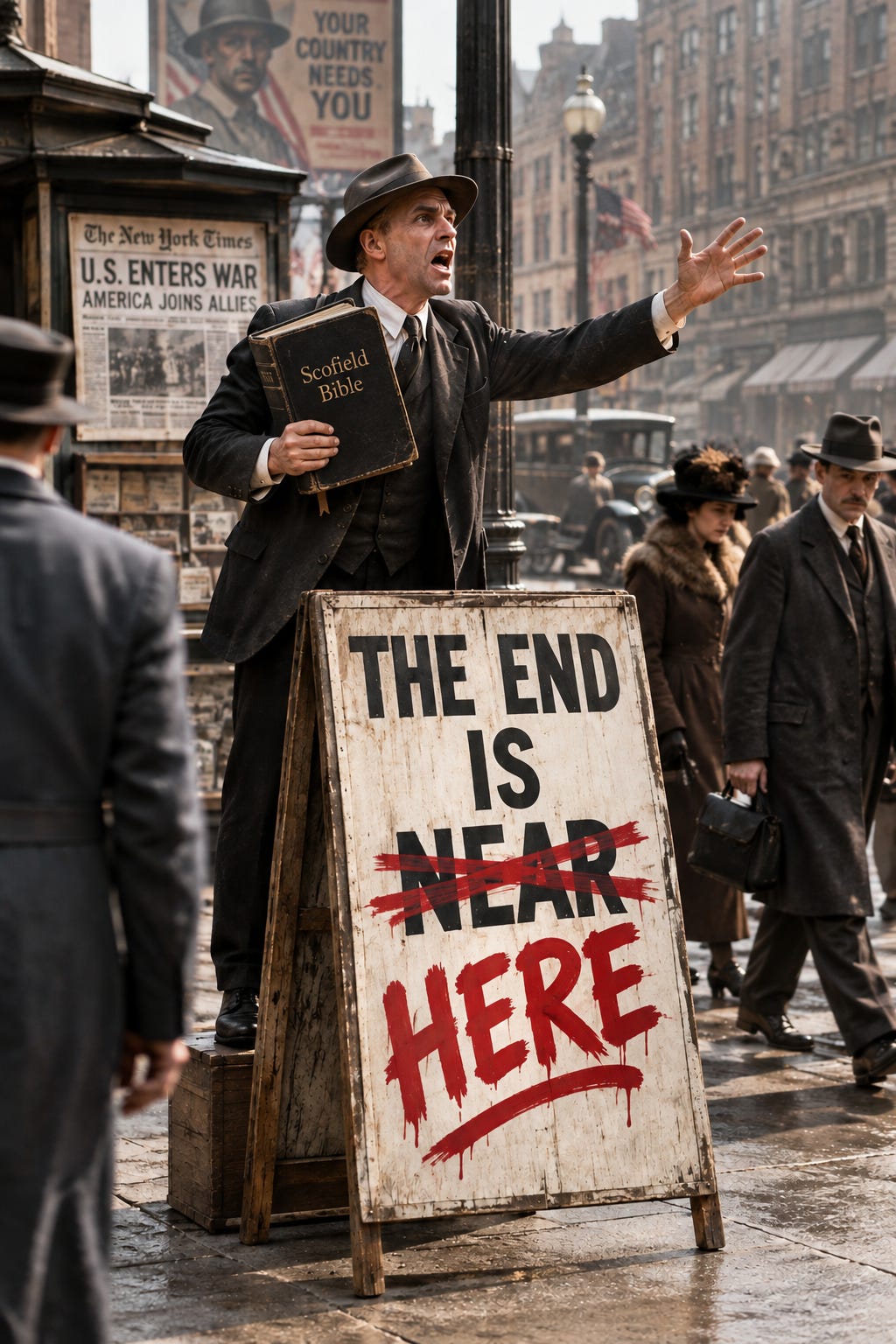
The big event — the radioactive, chart-strewn, prophecy-conference-fed, Queen Mother’s Granddaddy, end-times supernova — from which a century of evangelical speculation would explode was the movement’s modern prophet publishing his book, the Scofield Reference Bible, in 1909. Complete with his notes / commentary written directly onto the page alongside Scripture, as though it were truth itself.
The storm erupted as Scofield’s predictions of the looming end of the age appeared to be coming true before readers’ very eyes when WWI started five short years later, with WWII following on its heels…
1916 — C.I. Scofield, Does the Bible Throw Light on this War? from The Sunday School Times: “So far as the prophetic Word has spoken, there is not the least warrant for the expectation that the nations engaged in the present gigantic struggle will or can make a permanent peace.”
1945 — Donald Grey Barnhouse, editorial, Eternity magazine: “It is already too late. The threads of inevitability have been caught in the mesh of the hidden gears of history and the divine plan moves toward the inexorable fulfillment.”
I am not going to spend time on Scofield here, but for the die-hard history buff, I would urge you to read Joseph Canfield’s The Incredible Scofield and His Book. WARNING: It’s frequently polemic and at times even vitriolic. But as a history lesson, it’s nothing short of jaw-dropping (and free online).
Canfield (1919-2012) attended the Bible Institute of Pennsylvania in the 1930s, absorbing the dispensational teachings popularized by Scofield. Decades later, troubled by the authority many Christians gave Scofield’s notes, he turned to archival research and wrote the definitive challenge to both Scofield and the bible that made him famous.
A quote I pulled from my copy…
“When I get rich, I am going to have three homes — one in a winter apartment on Washington Heights, N.Y. City, one at Crestwood, and one at Sorrento Italy. I shall have a large lecture room in The Carnegie Institute, and hold forth to all & sundry who will come for biblical instruction, say three afternoons and three evenings in the week. I shall write books — un peu — but mostly loaf and invite my soul.” -C.I. Scofield, Letter to his daughter by his first wife, Helene (1909) — from The Incredible Scofield and his Book
What led Scofield and the system’s followers — a small minority of American Christians (link, link, link) — to buy into what the system’s founder, J. N. Darby, was selling? Despite being a relatively small group, they were vocal. And if a Christian believes knows the world is ending any day, they are obligated by said belief to warn Christians and non-Christians alike…
Whatever else you think of him, John Nelson Darby was brilliant. He was educated at London’s Westminster School and graduated from Trinity College in Dublin at eighteen as its Gold Medalist in the classics.
Called to the Irish bar, he abandoned law almost immediately, judging it incompatible with his faith. He became a formidable linguist, fluent in Latin, Greek, and Hebrew, eventually producing his own Bible translation. He was also known as a gifted hymn writer, as well as a mesmerizing speaker who carried his novel system, later named dispensationalism, across Europe, North America, and as far as New Zealand.
Around 1828, the same time he was formulating that system, Darby emerged as the dominant figure in a small circle of believers meeting in Dublin, the movement that became the Plymouth Brethren…
The Brethren grew rapidly but fractured almost as fast, beset by infighting, splits, and excommunications. The most notorious came in 1848, when Darby cut off George Müller (another of my heroes), the celebrated Bristol orphanage founder, along with his Bethesda congregation, for refusing to shun a fellow group tied to a teacher Darby had already condemned.
With the background out of the way, we can start moving into the meat of this chapter, answering a simple question, albeit one with huge ramifications. What are some of the consequences of rejecting Darby’s / Scofield’s unique ideas…
Eschatological Urgency Collapse: If the ‘signs of the times’ point to 1st-century events (see earlier chapters), and Christ Himself said that “no man knows the day or the hour,” it puts an abrupt end to treating every geopolitical event — especially those in the Middle East — as prophetic fingerprints. The Gnostic-like interpretive adrenaline of “this is really it” vanishes, and the constant scanning for end-times markers is revealed as a reading habit as opposed to a ‘spiritual discipline’ (link, link, link, link, link). The freedom from this sort of brow-beating (and redefined) “imminence” is a breath of fresh air.
Fractured Community Standing: Realize that you will likely become the ‘heretic’ in your own tribe — at least here in the bible belt. You will be leaving the majority position — a position widely promoted on TV, radio, websites, podcasts, books, newsletters, etc. Don’t be surprised if you are given the side-eye and maybe even called a “last days scoffer” for your efforts.
Generational / multi-Generational Thinking Returns: Although there will always be new converts to the Christian faith, the Western Church is dying, thanks to a mass exodus of youth and young Christian families intentionally not having babies (something I routinely hear in my clinic). But most American evangelicals have no idea the worldwide Church is experiencing explosive growth elsewhere — a fact that should reframe everything about multigenerational responsibility. A church convinced it’s the terminal generation has little reason to plan for the next one. Reject Darby and the horizon stretches out, making multigenerational thinking anything but optional. Not to mention the realization that if your pastor, favorite radio preacher, or TV prophecy teacher is wrong about this, what else might they be wrong about? A question whose answer becomes corrosive both downstream and up.
Political Engagement is Not Optional: Shifting one’s beliefs can create a reckoning with long-term Christian responsibility that goes far beyond simply voting — the idea that not only might we not be earth’s final generation, but there might be many more to follow. Failing to grasp this leads to withdrawing from the political arena because A.) bad things are prophesied, meaning the defeat of the Kingdom of God on earth is nothing less than prophetic inevitability. Or B.) Godly men retreating from politics can help create the self-fulfilling doom-loop, actually hastening the end times (and no, I did not make that up, although there are several versions).
Reframing Persecution: No more thinking that the church will be raptured out before the trouble begins. Remove Darby’s system, and suffering becomes normative across Christian history, not anomalous, which changes how Christians perceive trials (count it all joy -vs- name-it-claim-it-I-rebuke-that — American Christians are not supposed to go through trials).
A Shift in Rapture Positions: As anyone who’s made it this far knows, rapture positions abound. Pre-trib, post-trib, mid-trib, pre-wrath, partial, double, etc (yes, double rapture is a thing). It’s the wrong debate — see previous chapter for clarification. The Church’s historic eschatology is simple (here is a Protestant Confession from 1530). The Last Day, whenever it comes (there are no signs for it), will be characterized by three distinct events. The Second Coming, the Resurrection from the Dead, and the Final Judgment.
Authority Sources Change: The pastors and commentaries you’ve trusted for decades are suddenly suspect. Most modern prophecy books, study Bible notes, and popular commentaries become unusable for serious work and study. If you’ve made it this far, you already understand why. And moving forward in this chapter is only going to compound the problem. The important thing to realize is that Darby’s framework (dispensationalism) is not just about end times — it is a systematic theology. And while Darby’s unique brand of theology had many previously unheard-of distinctives, the biggest by far was his view on Israel. Which leads us straight into the final bullet, the subject of today’s post…
Israel Framework Inverts: The #1 distinctive of Darby’s theology — ‘God-has-two-chosen peoples,’ Israel and the Church — disappears. Former adherents must rebuild their entire framework of promise, fulfillment, and covenant with that wall no longer load-bearing. This can be terrifying for people who grew up routinely hearing this message delivered from the pulpit — And I will bless them that bless thee, and curse him that curseth thee: and in thee shall all families of the earth be blessed — but having no grasp of the bigger picture. And just how big that picture really is...
Darby’s Theology of Israel: Revisionist History, Revisionist Theology, Revisionist Eschatology
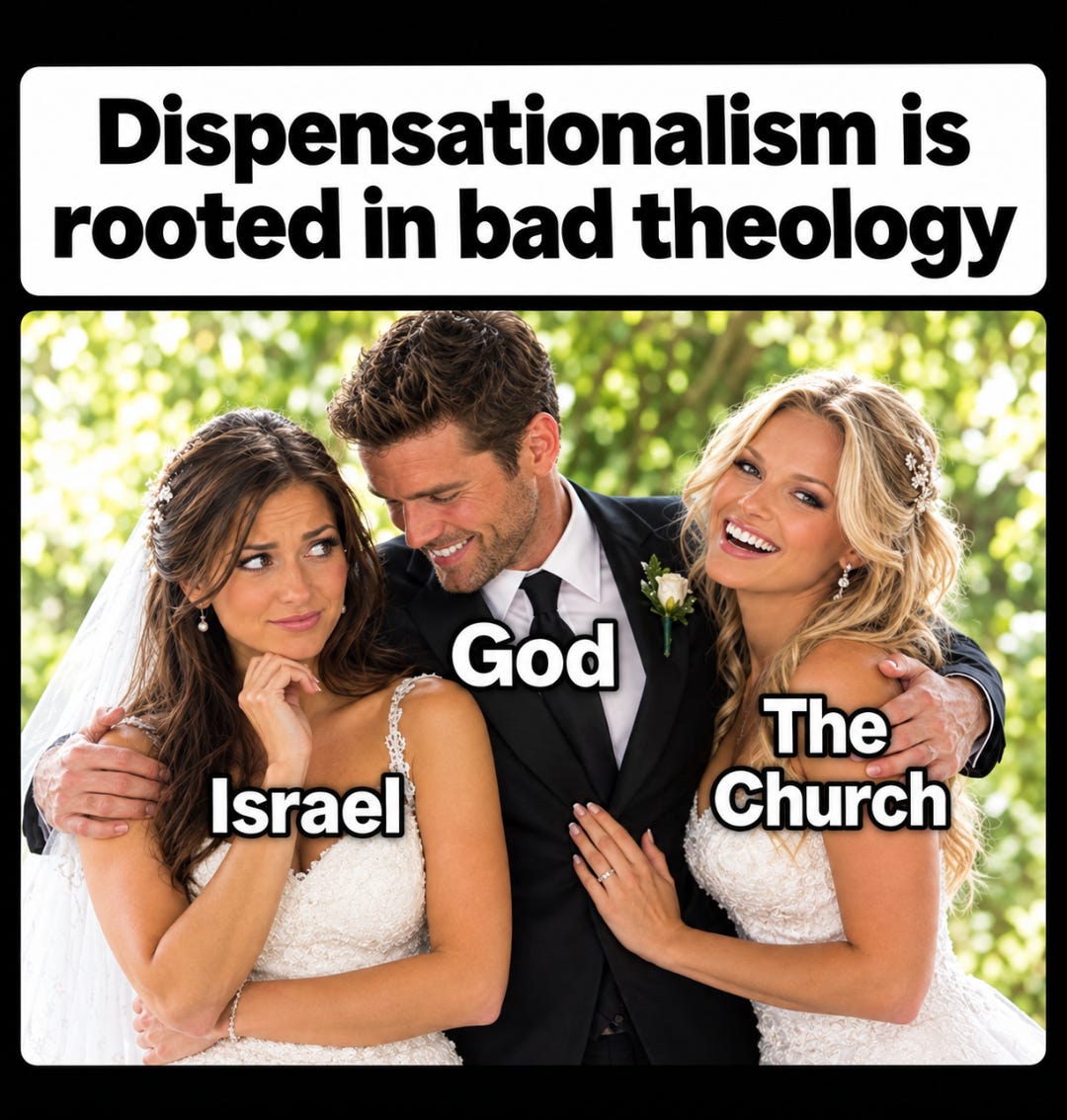
God has always and forever had one chosen, called-out, set-aside, covenantal, elect people; and only one chosen, called-out, set-aside, covenantal, elect people. And until less than a century ago, this idea was not at all controversial. Unless by controversial, one means “stupid”…
“Distinctions have been drawn by certain exceedingly wise men (measured by their own estimate of themselves), between the people of God who lived before the coming of Christ and those who lived afterwards. We have even heard it asserted that those who lived before the coming of Christ do not belong to the Church of God! We never know what we shall hear next, and perhaps it is a mercy that these absurdities are revealed one at a time, in order that we may be able to endure their stupidity without dying of amazement.
Why, every child of God in every place stands on the same footing! The Lord has not some children best beloved, some second-rate offspring and others whom He hardly cares about. These who saw Christ’s day before it came had a great difference as to what they knew and, perhaps, in the same measure a difference as to what they enjoyed while on earth in meditating upon Christ. But they were all washed in the same blood, all redeemed with the same ransom price and made members of the same body!
Israel in the Covenant of Grace is not natural Israel, but all Believers in all ages.
Before the first Advent, all the types and shadows all pointed one way—they pointed to Christ—and to Him all the saints looked with hope. Those who lived before Christ were not saved with a different salvation to that which shall come to us! They exercised faith as we must. That faith struggled as ours struggles and that faith obtained its reward as ours shall. As like as a man’s face to that which he sees in a glass is the spiritual life of David to the spiritual life of the Believer now.
Take the book of Psalms in your hand and, forgetting, for an instant, that you have the representation of the life of one of the olden time, you might suppose that David wrote but yesterday. Even in what he writes of Christ, he seems as though he lived after Christ instead of before, and both in what he sees of himself and in what he sees of his Savior, he appears to be rather a Christian writer than a Jew. I mean that living before Christ he has the same hopes and the same fears, the same joys and the same sorrows—the same estimate of his blessed Redeemer which you and I have in these times.
Jesus was the same yesterday as an anointed Savior to His people as He is today, and they under Him received like precious gifts.”
-Charles Spurgeon, “Jesus Christ Immutable,” Metropolitan Tabernacle Pulpit, Vol. 15, No. 848, January 3, 1869
I will expound on this throughout the chapter, but it’s important to understand the accusation dispensationalists bring against this historical Christian doctrine (the highlight above) so that you recognize it when you see it — supersessionism, otherwise called replacement theology. It will often be referred to as heresy — outside of Christian orthodoxy — a sin worthy of hell (article, article, article, article, article, article, article, article, article).
Today’s numerous Christian Zionist ministries have rebranded the ancient typological Christian understanding as not merely false doctrine, but as a gateway to antisemitism and hellish deception…
By equating theological disagreement with Hitler’s anointing and satanic hatred, they have weaponized morality itself — transforming what should be a rigorous biblical debate into an institutional enforcement mechanism where to question their Israel-1st theology is to be branded an enemy of the Jewish people — a Hitler-loving Jew hater, in the same vein as those in the Christian Identity movement or modern-day “groypers”.
This architecture of theological power depends entirely on history forgetting what the Church actually taught for most of two millennia — before Scofield’s footnotes rewrote Christian doctrine.
SIDE NOTE: This chapter will not delve into whether or not the United States should be allied with Israel for military / geopolitical reasons — a question for another day. Today we are looking only at whether God has two chosen peoples.
Over the past five decades, a network of evangelical ministries has sprung up promoting Darby’s theological framework regarding the modern state of Israel, putting it at odds with historic Christian theology.
This movement frames contemporary geopolitical support for Israel as biblically mandated and interprets Middle Eastern events as imminent apocalyptic fulfillment — premises at odds with Roman Catholic, Orthodox, Mainline Protestant, and arguably, the majority of evangelical Christian traditions.
While the theological foundations were laid in the nineteenth century and C.I. Scofield’s Bible (1909) gave Darby’s ideas canonical form, the doctrine remained a distinctly minority opinion until the 1950s, after the creation of modern national Israel in 1948. And exploding in popularity after the Six-Days War, three months after I was born.
Despite early dispensationalists teaching that Israel’s return to the land must occur in belief and not unbelief, the establishment of modern Israel converted dispensational eschatology from abstract speculation into current events interpretation…
“Most nineteenth-century dispensationalists had believed that the Jewish state would not be restored in Palestine until after the tribulation, when Jesus returned and was enthroned as Messiah. Thus, Jews would only return to Palestine ‘in belief.’ … many dispensationalists argued that Jews would return to Palestine ‘in unbelief’ … Statehood brought this debate to its climax, with most dispensationalists eventually deciding that the return of Jews to Palestine ‘in unbelief’ was in fact the beginning of prophetic fulfillment.” -From a doctoral thesis, Dispensationalism, Israel, and Christian Zionism
Regardless of being forced to create significant changes to their theological parameters for a Jewish return to the land, if 1948 was the dispensationalist’s “supersign” of prophetic fulfillment, there were many others close on its heels that accelerated dispensational expansion…
The Six-Day War of 1967, Hal Lindsey’s 40 million-copy bestseller “The Late Great Planet Earth” three short years later in 1970, and another wave of prophecy conferences were also helping push prophetic tension to a fever pitch.
SIDE NOTE: While Israel loves dispensational theology and the massive amount of support the evangelical church provides (Israel’s own leadership calls it the backbone of its American support), they privately think it’s ridiculous.
For more on how a small-time fundamentalist preacher, with no higher education, theological or otherwise (his doctorate was self-conferred), was able to get the world’s most prestigious publishing house — Oxford University Press — to publish his book, chapter 29 of Canfield’s book (Accepted by Oxford) is a must-read…
By 1980, a theological position that earlier in the century had been viewed suspiciously as ‘fringe’ had achieved near-dominance within American evangelicalism through a loose network known as ‘The Religious Right.
The most well-known organizations under this blanket included Falwell’s Moral Majority and LaHaye’s CWA, reaching tens of millions, including prominent politicians such as former president Ronald Reagan and cabinet members Casper Weinberger and James Watt...
“For the first time ever, everything is in place for the battle of Armageddon and the second coming of Christ… It can’t be long now. Ezekiel says that fire and brimstone will be rained upon the enemies of God’s people. That must mean that they’ll be destroyed by nuclear weapons. They exist now, and they never did in the past.” -California Governor Ronald Reagan (1971), as quoted by Senate president pro tem, James R. Mills, in an LA Times article
“Any teaching of peace before Christ returns is heresy. It’s against the word of God; it’s heresy.” -James Robinson, invocation at 1984 Republican National Convention
The core conviction animating these Christian Zionist ministries transcends traditional Christian evangelism. They frame unwavering political and military support for the modern state of Israel as both a moral and theological obligation, binding on both individual believers and nations alike.
Modern examples (John Hagee, Jan Markell, David Jeremiah, Amir Tsarfati, David Reagan, Tim Moore, Gary Stearman & Mondo Gonzales, and Jonathan Cahn are some of the biggest and most influential) present Christian geopolitical alignment with Israeli interests as biblically non-negotiable — I will bless those that bless you, and curse those that curse you. And let’s be honest — who wants to incur God’s curses?
With this background, you can begin to understand why not buying into dispensationalism is often referred to by adherents as heresy…
John Hagee (CUFI) — Calls replacement theology an “old heresy” and “idolatry,” and claims replacement theologians are now carrying Hitler’s anointing and his message
Amir Tsarfati (Behold Israel) — In a Christ in Prophecy interview, said those who believe in replacement theology hold “false teaching” and can be filled with a satanic kind of anti-Semitism
David Reagan (Lamb & Lion) — Repeatedly speaks of “the evil of Replacement Theology” in his programming, framing it as teaching the Church to despise the Jewish people
Tim Moore (Lamb & Lion) — Defines apostasy as drifting away from standard orthodox biblical Christianity, and heresy as a specific doctrine one totally misconstrues — applying this framework to replacement theology critics
Read Moore’s statement again, because he has historic Christianity’s thinking about Israel 180 degrees backwards…
It’s the ideas of the groups above that represent a fundamental departure not merely from historic Christian theology but from the distinction between Christian missionary concern and Christian political allegiance to a secular nation-state. What these and hundreds of similar ministries market is religious sanction for geopolitical alignment — dissent recast as apostasy, and historic Christian theology as heresy.
This happened at least partly because, beyond ‘consistent literalism,’ Scofield applied another hermeneutical method of interpretation, which was also the title of a small book he wrote on the subject — Rightly Dividing the Word of Truth. His reinterpretation of 2 Timothy 2:15.
Presented not as a theological choice but as the newly revealed scientific, systematic approach for deciphering Scripture — the way the Bible must be read — his framework built dispensational interpretation into the text as a test of orthodoxy. Scofield’s method of “rightly dividing the word of truth” was his specific partition scheme — the New Testament written in layers to segregated audiences…
“The Sermon on the Mount has a twofold application: (1) literally to the kingdom… In this sense the Sermon on the Mount is pure law… For these reasons, the Sermon on the Mount in its primary application gives neither the privilege nor the duty of the Church.” -C.I. Scofield, The Scofield Reference Bible
And while there were ten chapters in Scofield’s little book, it was the first that set the framework…
Some chapters / passages of the NT are meant only for Jews.
Some chapters / passages of the NT are meant only for Gentiles.
Some chapters / passages of the NT are meant for both.
Your interpretive duty — if you want God’s approval as a diligent worker, unashamed of your efforts — is to “rightly divide,” determining which is which.
This created an unsolvable textual problem that only his bible’s annotations could resolve. Mostly because even among dispensationalists there is major disagreement (not to mention major pushback from outside their camp) as to which is which.
The marketing genius for Scofield’s system was structural…
You couldn’t read Scripture without first knowing Scofield’s partition map because the framework didn’t just offer an interpretation; it constructed a hermeneutical necessity. Students didn’t learn dispensationalism simply as theology; they learned it as the technique for unlocking Scripture’s true meaning. By the time they encountered passages that seemed to contradict each other, they already possessed the tool: one must be Jewish, one must be Gentile.
Generations of American Christians internalized the partition logic without anyone telling them it was 100% revisionist. Dispensationalism didn’t need to win the debate because it had created a method to de facto settle every question, turning its own interpretive grid into the only valid lens through which Scripture could be viewed.
With this background, let’s backtrack and briefly discuss why the Christian Zionist ministries are so vehement that supersessionism is a heresy of the worst sort. Below is arguably the craziest of dozens of examples…
“I am not trying to convert the Jewish people to the Christian faith. I believe that every Jewish person who lives in the light of the Torah, which is the word of God, has a relationship with God and will come to redemption. In fact, trying to convert Jews is a waste of time. They already have a faith structure. Everyone else, whether Buddhist or Baha’i, needs to believe in Jesus. But not Jews. The Jews already have a covenant which has never been replaced by Christianity.” -John Hagee from a 1988 interview carried in The Houston Chronicle
Where might have Hagee gotten ideas like this?
I give you John Walvoord, past president of Dallas Theological Seminary, editor of The Tim LaHaye Study Bible, and the person LaHaye called “the dean of living prophecy experts”…
“Most premillenarians (Darby excepted) would agree that a new covenant has been provided for The Church, but not the new covenant for Israel.” -From page 214 of 1959’s The Millennial Kingdom.…
Even though he later retracted this idea, otherwise known as “Dual Covenant Theology,” think about what Walvoord wrote and why he wrote it. If you read Hebrews 8 — four verses of which are imported verbatim from Jeremiah 31 — the controversy becomes crystal clear (HINT: who is the New Covenant written for according to these passages?)…
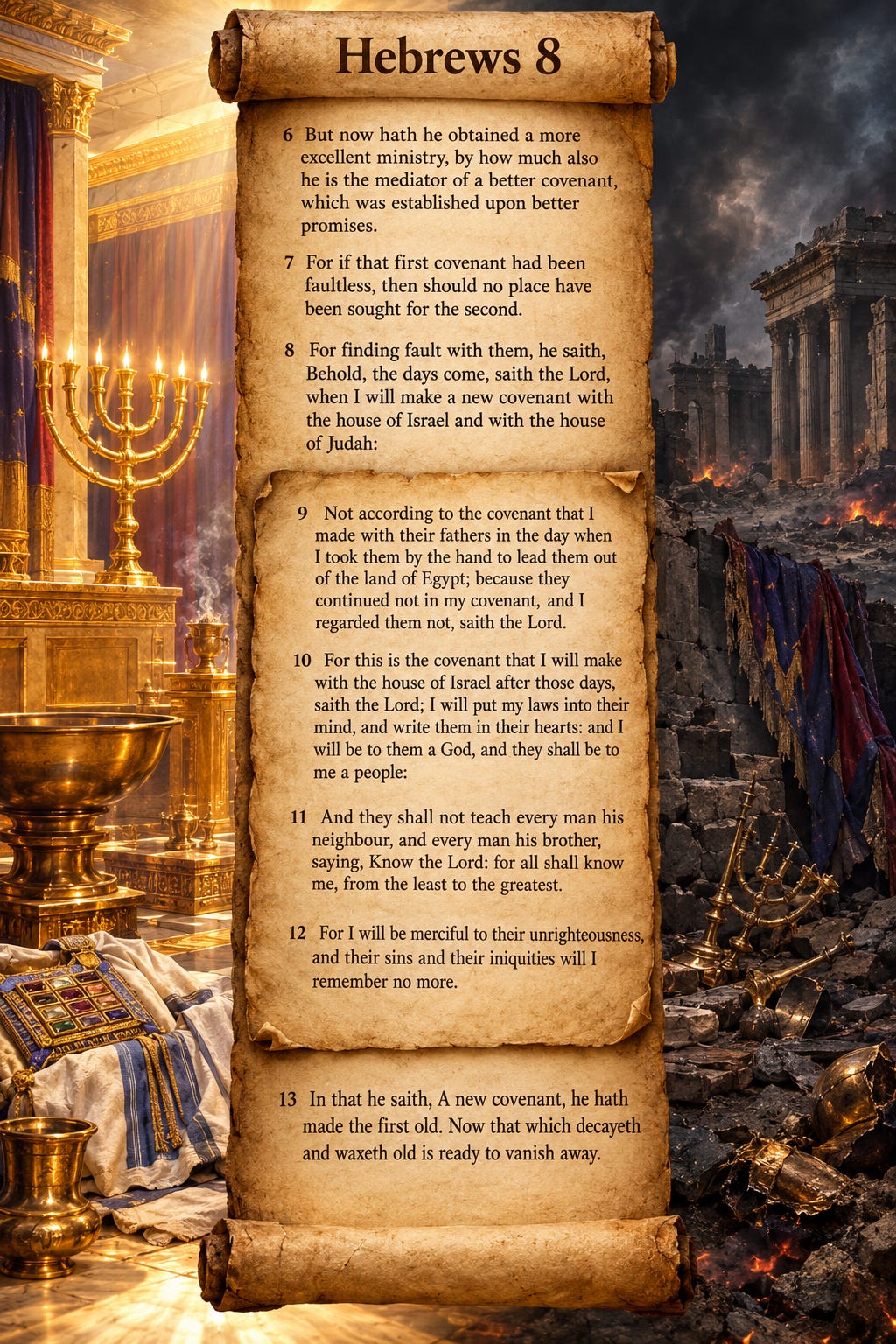
I am not going to answer that question here (who is the New Covenant for?), but in today’s politically supercharged environment, you need to be able to do just that — it’s not difficult. And if you don’t grasp how big a theological issue this is, re-read the passage until you do, because answering correctly is the crux of the debate…
Interestingly, but not surprisingly considering what we’ve learned thus far, no one realized there was a debate until very recently in history, when Darby and his theological offspring turned it into one. Furthermore, if you can’t answer this question correctly, it will distort deep biblical truths from Genesis through Revelation…
What follows is not a contribution to contemporary geopolitical debate, nor an argument for or against the modern nation-state founded in 1948. Rather, from here forward this chapter becomes a straightforward hermeneutical task. Examining what the New Testament actually teaches about the relationship between the Jewish people, the Gentile nations, and the people of God in the age of Christ — a people often referred to in scripture as “the elect”.
A biblical term itself distorted by dispensational thinking…
“Gentiles come to Christ by the propagation of the Gospel… This is not true of the Jewish people, who have been judiciously blinded to the identity of Messiah… So how do Jewish people from the time of Christ until today come to recognize the true identity of Christ? The answer is those that recognize Christ as Messiah do so through divine revelation… The doctrine of divine election is, without doubt, the most controversial concept in Scripture… It is obvious that divine election is taught in Scripture. The question is: To whom is divine election offered? In my opinion, divine election is offered only to the nation of Israel. Consider what divine election actually means. It means that a loving and gracious God has decided to have some elected and allow others to be lost for eternity in the fires of hell. Now you can understand the gravity of the controversy.” -John Hagee from 2006’s Jerusalem Countdown
For eighteen centuries the church read its Bible and saw one people of God. One olive tree. One household of Abraham. One covenant of grace, administered first through types and shadows, then through the Messiah those shadows pointed to (article, article, article).
Then came Darby. The first systematic expression of dispensationalism was formulated by J. N. Darby around 1830. What it replaced was not vague…
In 1653, a century and a half before Darby was born, 120 of Europe’s greatest minds finished their decade-long theological collaboration (approximately 1,300 meetings) known as the Westminster Confession of Faith, weighing in on the Hebrews 8 / Jeremiah 31 issue by stating unequivocally that the Old and New Testaments are “not therefore two covenants of grace, differing in substance, but one and the same, under various dispensations”.
Westminster used “dispensations” to mean administrations of a single unified covenant (aka Covenant Theology). Darby took the d-word and used it to divide what the Westminster had joined...
Darby’s division was problematic because the apostolic writers, particularly Paul, made the abolition of the barrier between Jew and Gentile a hallmark of Christ’s redemptive work (Acts 10:15, Acts 10:34-35, Acts 10:47, Acts 11:17, Acts 11:18, Acts 15:7-10, Acts 15:11, Acts 15:28-29, Romans 3:29-30, Romans 10:12, Romans 11:11, Romans 11:17-20, Romans 14:1-4, 1 Corinthians 12:13, Galatians 2:14, Galatians 3:26-29, Ephesians 2:14-16, Ephesians 3:6, Colossians 3:11).
For instance, in Ephesians 2, the dividing wall is not restored; it remains ‘broken down’. In Galatians 3 — the dispensationalist’s nightmare chapter — the distinction that once mattered is declared obsolete in Christ with the words “neither Jew nor Gentile”. The final sentence providing the basis for that oh-so-simple child’s song, which contains more truth in its chorus than a truckload of prophecy paperbacks; Father Abraham.
To insist that God maintains two distinct covenantal peoples with separate theologies and end-times destinies is to resurrect precisely the types and shadows the New Testament presents as transcended and fulfilled. This error is compounded by incessant promotion of a return to Old Covenant rituals in the form of temple worship and animal sacrifices, throwing the book of Hebrews under the bus in the process…
And here’s the irony…
Modern dispensationalists market themselves as biblical literalists (🏆🏆🏆their badge of honor🏆🏆🏆) — as restorers and defenders of the ‘ancient faith,’ battling against the “allegorical / spiritualization” of the Reformers. They have it exactly backward.
The one-people view is the ancient view. The two-peoples view is the modern novelty…
“Until brought to the fore through the writings and preaching and teaching of a distinguished ex-clergyman, Mr. J. N. Darby, in the early part of the last century, it is scarcely to be found in a single book or sermon through the period of 1,600 years. If any doubt this statement, let them search, as the writer has in measure done, the remarks of the so called fathers, both pre and post Nicene; the theological treatises of the theological divines; Roman Catholic writers of all shades of thought; the literature of the reformation; the sermons and expositions of the Puritans; and the general theological works of the day. He will find the ‘mystery’ conspicuous by its absence.” -Dispensational author, H.A. Ironside, The Mysteries of God, (1946), page 55
“As a system of theology, dispensationalism is recent in origin.” -Charles Ryrie, from 1999’s Dispensationalism Today
“The fact that something was taught in the first century does not make it right, and the fact that something was not taught until the nineteenth century does not make it wrong. After all, the ultimate question is not ‘Is dispensationalism—or any other teaching for that matter, historic? but, is it Scriptural’.” -Charles Ryrie, from 1995’s Dispensationalism
And when you read Scripture through the lens of Deuteronomy 32’s small ‘g’ gods — the framework the biblical writers actually inhabited — the one-people view becomes unavoidable.
One People Always — Always One People
Jesus as Israel, Gentiles as Heirs: A Deuteronomy 32 Worldview Restoration
Jesus Is Israel
Let’s start where the New Testament starts. Not with the church, but with Christ.
When Matthew recorded Jesus’ family’s return from Egypt, he said it fulfilled what the Lord spoke through the prophet…
“Out of Egypt I called my son” (Matthew 2:15)
Now turn to the 11th chapter of Hosea and pay close attention...
“When Israel was a child, I loved him, and out of Egypt I called my son.” (Hosea 11:1)
The son is Israel…
Hosea is remembering the Exodus, not predicting a Messiah. Matthew is not misreading Hosea. He is telling you who Jesus is: Israel, God’s son, retracing the nation’s story in His own body.
Matthew keeps going. Jesus passes through the waters in baptism, then into the wilderness for forty days as Israel wandered forty years, and He is tested exactly where Israel failed…
Every answer He gave Satan comes from Deuteronomy 6–8, the chapters where Moses reviews Israel’s wilderness failures (Matthew 4:1–11; Deuteronomy 8:3; 6:16; 6:13). Israel grumbled for bread, put God to the test, and bowed to idols. The true Son did none of that, showing that He alone could perfectly fulfill all aspects of the law. Then He went up on a mountain and delivered the “new” law (Matthew 5:1–2).
Realize that, in context, new does not mean brand-spanking new as in straight off the showroom floor or straight off the press (neos - νέος), but instead points to something that has been fulfilled, restored, and made perfect (kainos - καινός) — in Christ. Kind of like, despite our incessant battles with the flesh, if we are in Christ, we are nonetheless “new” creatures.
The hinge is Christ, not ethnicity…
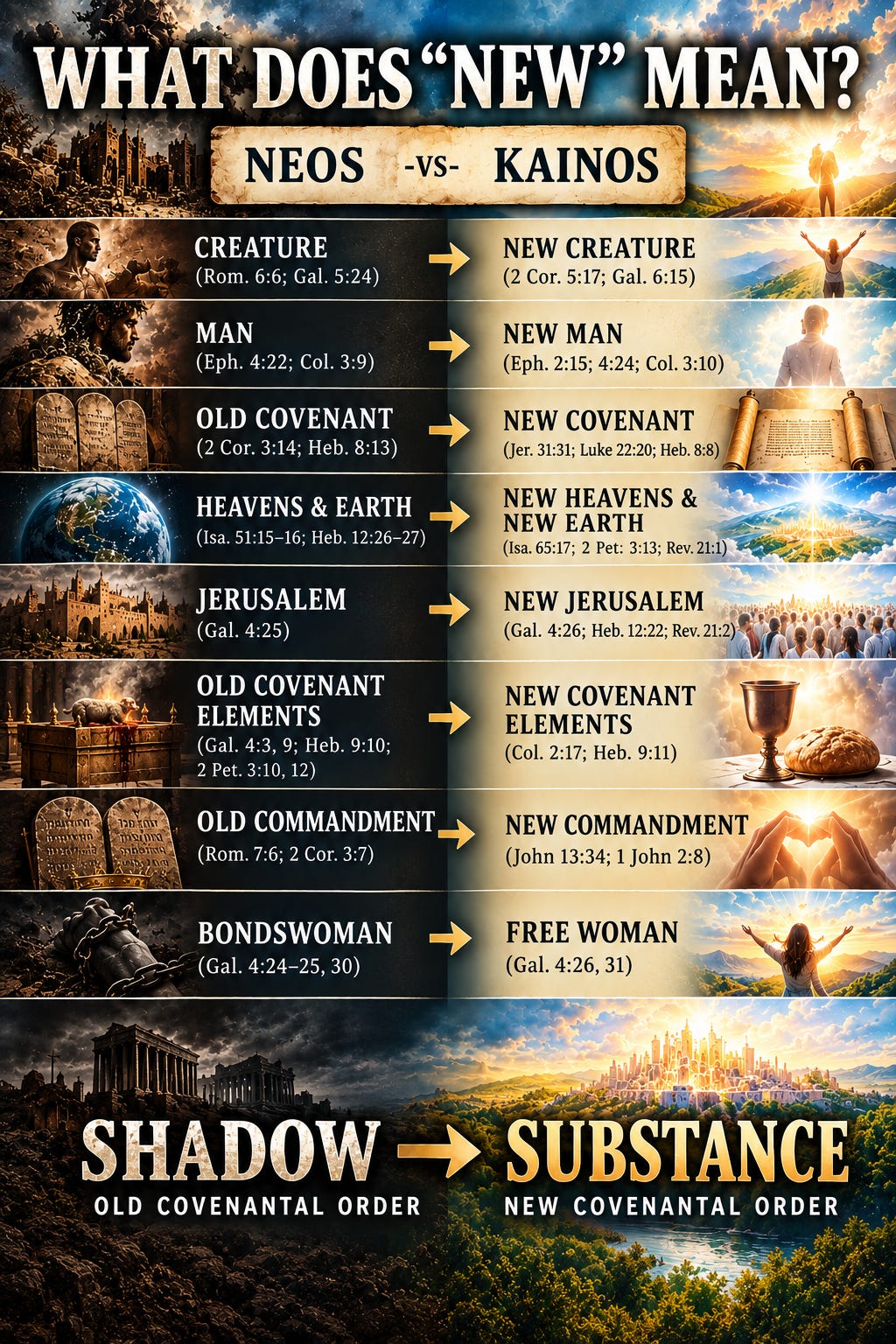
The hinge is Christ, not ethnicity.
Isaiah makes this explicit. In the second Servant Song, God says…
“You are my servant, Israel, in whom I will be glorified” (Isaiah 49:3)
Two verses later, this Servant named Israel has a mission to Israel, “to bring Jacob back to him,” and beyond Israel: “I will make you as a light for the nations, that my salvation may reach to the end of the earth”. An individual named Israel would restore Israel and carry salvation to the Gentiles. Only one person in history fits that job description.
Justin Martyr saw it in the second century…
Listing the names Scripture gives to Christ, he noted in Dialogue with Trypho that Isaiah calls Him “Jacob and Israel,” drawing the conclusion: “all who through Him have fled for refuge to the Father, constitute the blessed Israel”.
First, if you have not listened to sermons on the four “Servant Songs” do so immediately without passing Go. Second, do not miss the importance of the preceding paragraph — Jesus claimed the title Himself…
Israel was God’s vine, brought out of Egypt and planted, and it yielded wild / sour grapes (compare Psalm 80:8–16; Isaiah 5:1–7). In the upper room, Jesus said, “I am the true vine”. Not a replacement for the vine. The vine. Finally bearing the fruit it was planted to bear before the fall. Abide in Christ, or you are not in the vine at all.
Then Paul sets the hinge on which the entire question turns concerning the recipients of God’s promises….
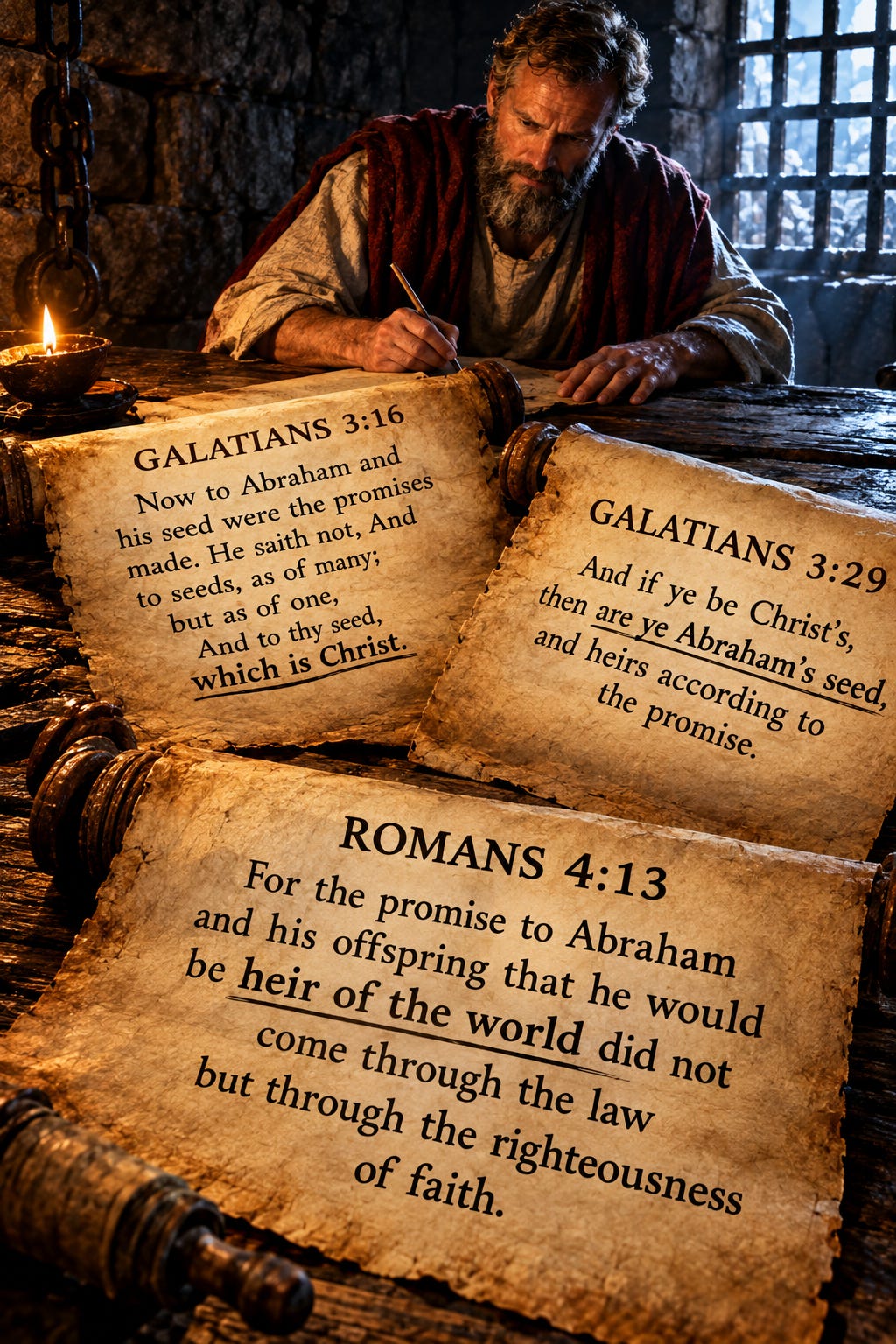
Now the promises were made to Abraham and to his offspring. It does not say, “And to offsprings,” referring to many, but referring to one, “And to your offspring,” who is Christ. (Galatians 3:16).
One seed. One heir. Every Abrahamic promise converges to a singularity in the person of Jesus Christ. Only then does Paul write the passage everyone loves to quote…
For in Christ Jesus you are all sons of God, through faith. For as many of you as were baptized into Christ have put on Christ. There is neither Jew nor Greek, there is neither slave nor free, there is no male and female, for you are all one in Christ Jesus. And if you are Christ’s, then you are Abraham’s offspring, heirs according to promise. (Galatians 3:26-29)
Ahhhh, the incredible truths of the fun child’s song, Father Abraham, going right over the heads of generations of modern evangelicals. You do not become Abraham’s seed by being attached to a second program — a “Plan B” — a “Great Unprophesied Parenthesis”…
You become Abraham’s seed by being in “The Seed”. G. K. Beale describes believers sharing Israel’s promised blessings by “identifying with Jesus, the true Israel and true seed of Abraham,” regardless of ethnicity or race. The only Jewish blood that matters is Christ’s.
This is why “replacement theology” is the wrong label, and why dispensationalists keep swinging at a strawman. Nobody replaced Israel…
The promises were never transferred away from Israel to somebody else. They landed on Israel: on Israel’s King, the one faithful Israelite. Everyone united to Him, Jew or Gentile, shares His inheritance. That is not supersession. It is Christology. Christ as God incarnate — the Son who fulfilled all covenants, satisfied the whole of the law, redeemed all of history’s elect, and is the center of redemptive history (and the 70th Week — see earlier infographic).
In other words, It’s Not Replacement — it’s Expansion!
2. The Apostles’ Catalog
Membership in Israel was never a matter of blood alone. If Jesus is Israel, the way the apostles talked makes perfect sense. And that is how they talked.
Constantly…
An uncircumcised son of Abraham was ‘cut off from his people’. So was the Israelite who ate leaven at Passover or sinned ‘with a high hand’. Meanwhile a circumcised foreigner could keep the Passover and ‘be as a native of the land’. Rahab the Canaanite and Ruth the Moabite entered Israel by faith and ended up in the Messiah’s genealogy. Paul stated the principle Moses built in from the start: ‘not all who are descended from Israel belong to Israel’. A Jew is one inwardly, and circumcision is of the heart. And as we discussed earlier, Abraham is the father of all who believe, circumcised or not.
With that settled, watch what the apostles do with Israel’s titles, Israel’s prophecies, and Israel’s laws…
Israel’s Titles: At Sinai, God called Israel “a kingdom of priests and a holy nation”. Peter handed the church the entire package, “a chosen race, a royal priesthood, a holy nation, a people for his own possession,” writing to people who “once were not a people, but are now the people of God”. He addressed them in the language of the diaspora, as “elect exiles of the dispersion”.
Inferring / transferring Old Covenant language and blessings meant specifically for Israel onto the New Testament Church was not an uncommon phenomenon…
James wrote likewise, addressing his letter “to the twelve tribes in the Dispersion”. The Apostle Paul told Gentile Philippians, “we who worship by the Spirit of God[a] and glory in Christ Jesus are the circumcision”. He told Gentile Ephesians they were once “alienated from the commonwealth of Israel,” which means nothing unless they are now part of Israel. The Hebrew told believers they have already come “to Mount Zion... the heavenly Jerusalem.”
Are you seeing why “rightly dividing” is so critical to the dispensationalist’s program?
Israel’s Prophecies: Hosea foretold that the northern kingdom, disowned as “Not My People,” would again be called “children of the living God”. Paul applied it to Gentile believers…
Even us whom he has called, not from the Jews only but also from the Gentiles? As indeed he says in Hosea,
“Those who were not my people I will call ‘my people,’
and her who was not beloved I will call ‘beloved.’”
“And in the very place where it was said to them, ‘You are not my people,’
there they will be called ‘sons of the living God.’” (Romans 9:24–26)
Peter did the exact same thing, using nearly identical language...
And when the Jerusalem Council had to decide whether Gentile believers would need to be circumcised, James settled it with Amos 9. God is rebuilding “the tent of David that has fallen” so that the Gentiles may seek the Lord. James did not read Amos as a future millennial construction project. He read it as something happening there among them.
Paul stacked Leviticus 26:12, Ezekiel 37:27, Isaiah 52:11, and 2 Samuel 7:14 onto the church at Corinth…
What agreement has the temple of God with idols? For we are the temple of the living God; as God said,
“I will make my dwelling among them and walk among them,
and I will be their God,
and they shall be my people.
Therefore go out from their midst,
and be separate from them, says the Lord,
and touch no unclean thing;
then I will welcome you,
and I will be a father to you,
and you shall be sons and daughters to me,
says the Lord Almighty.” (2 Corinthians 6:16–18)
And as author, scholar, pastor, and professor, Kenneth Gentry points out: when Paul told Gentiles who were ‘far off’ that they had been ‘brought near,’ the congregation would have immediately recognized he was quoting Isaiah 57:19, a promise addressed to Zion.
Israel’s Laws: Israel was told to be holy, for I am holy. Peter admonished the church to do the same. Deuteronomy’s command to purge the evil from your midst became Paul’s instruction for church discipline in ungodly Corinth.
Paul calls the Exodus generation ‘our fathers,’ writing to Gentiles. And in Ephesians 6:3 he quoted the fifth commandment’s promise of long life, but dropped the clause that tied it to Canaan, which the LORD your God is giving you. The KJV, NKJV, and NASB rightly render what is left: long life ‘on the earth’. The promised land has swollen to the size of the globe.
The same concept seen in Rom 4:13…
For the promise to Abraham and his offspring that he would be heir of the world did not come through the law but through the righteousness of faith.
Then there is Galatians 6:16, where Paul pronounces peace and mercy “upon the Israel of God.” Honesty requires telling you this verse is contested at the level of Greek syntax…
Dr Jonathan Pratt, writing in the Detroit Baptist Seminary Journal, argued the phrase means Jewish believers. But even he concedes that interpreting it as ‘The Church’ is the majority view, and his own footnote lists a host of renowned commentators, including Calvin and Lightfoot, on that side.
The case does not need 6:16 to carry the load. After six chapters arguing that circumcision counts for nothing and faith in Christ for everything, Paul would have had to blow up his own letter in its final sentence to bless an ethnic subset. The concept discussed thus far does not hang on one disputed kai (‘and’).
Justin Martyr, writing around AD 160, did not find it complicated… “For the true spiritual Israel, and descendants of Judah, Jacob, Isaac, and Abraham... are we who have been led to God through this crucified Christ”.
Paul’s summary is Ephesians 2:14-16…
For he himself is our peace, who has made us both one and has broken down in his flesh the dividing wall of hostility by abolishing the law of commandments expressed in ordinances, that he might create in himself one new man in place of the two, so making peace, and might reconcile us both to God in one body through the cross, thereby killing the hostility.
Dr Gentry’s verdict on the dispensational alternative is as exact as it is daming. It’s the sin of the Judaizers — an attempt to return to Old Covenant types and shadows. An attempt to repair the barrier wall that Christ broke down. Don’t forget that in the Judaizers, Paul was warring against a heresy, not warning against legalism (link, link, link, link, link).
Before moving on, let me say that what one believes about the Judaizers says a great deal about one’s theology. In my experience (which I realize is subjective), dispensationalists and dispensational sources tend to view the sin of the Judaizers as legalism — a moral problem as opposed to a heresy.
The problem is that’s not how Paul, who literally shit (skubala) on all his own Judaistic credentials, saw it. Paul pronounced “anathema” on those foolish Galatians who had been ‘bewitched’ to the point they were promoting and buying in to another gospel…
I am astonished that you are so quickly deserting him who called you in the grace of Christ and are turning to a different gospel—not that there is another one, but there are some who trouble you and want to distort the gospel of Christ. But even if we or an angel from heaven should preach to you a gospel contrary to the one we preached to you, let him be accursed. As we have said before, so now I say again: If anyone is preaching to you a gospel contrary to the one you received, let him be anathema. (Gal 1:6-9)
Accursed. But not for legalism. Because some within the church were touting a competing soteriology (doctrine of salvation) that denies Christ’s sufficiency. I refer to these ‘competing soteriologies’ as the “Jesus-plus” doctrines.
Dispensationalism, which completely fails to understand the 37-year transition time I discussed at length in a previous chapter (including a helpful infographic), reframes this as legalism (see the Scofield, Ryrie, and Wiersbe notes). But when Paul condemns false teachers offering an alternative salvation formula, it’s not mere moral failure; it’s damnation (anathema).
Dispensationalism’s separation of eschatology from soteriology misses the crux…
Paul’s realized eschatology makes justification itself the dividing line. That’s why Galatians isn’t a lecture on legalism. The Judaizers weren’t overdoing their devotion; they were preaching a different gospel, one that made Christ insufficient without the shadows he had just fulfilled.
Paul aims his anathema at the message and at the men peddling it (“those who trouble you”), not at every ‘bewitched’ Galatian who parroted it…
He writes to those Galatians as a mother in labor “until Christ is formed in you,” confident they will “take no other view”. So none of this is the unpardonable sin; Paul himself had been the most zealous Judaizer of them all before Damascus.
But it is damnable if held to, because a gospel that requires circumcision doesn’t save anyone…
Paul was essentially saying, Hey you foolish Galatians, you had better get a handle on this, because returning to the weak and beggarly elements of Old Covenant worship is not only bad, it’s damnably bad (anathema)!
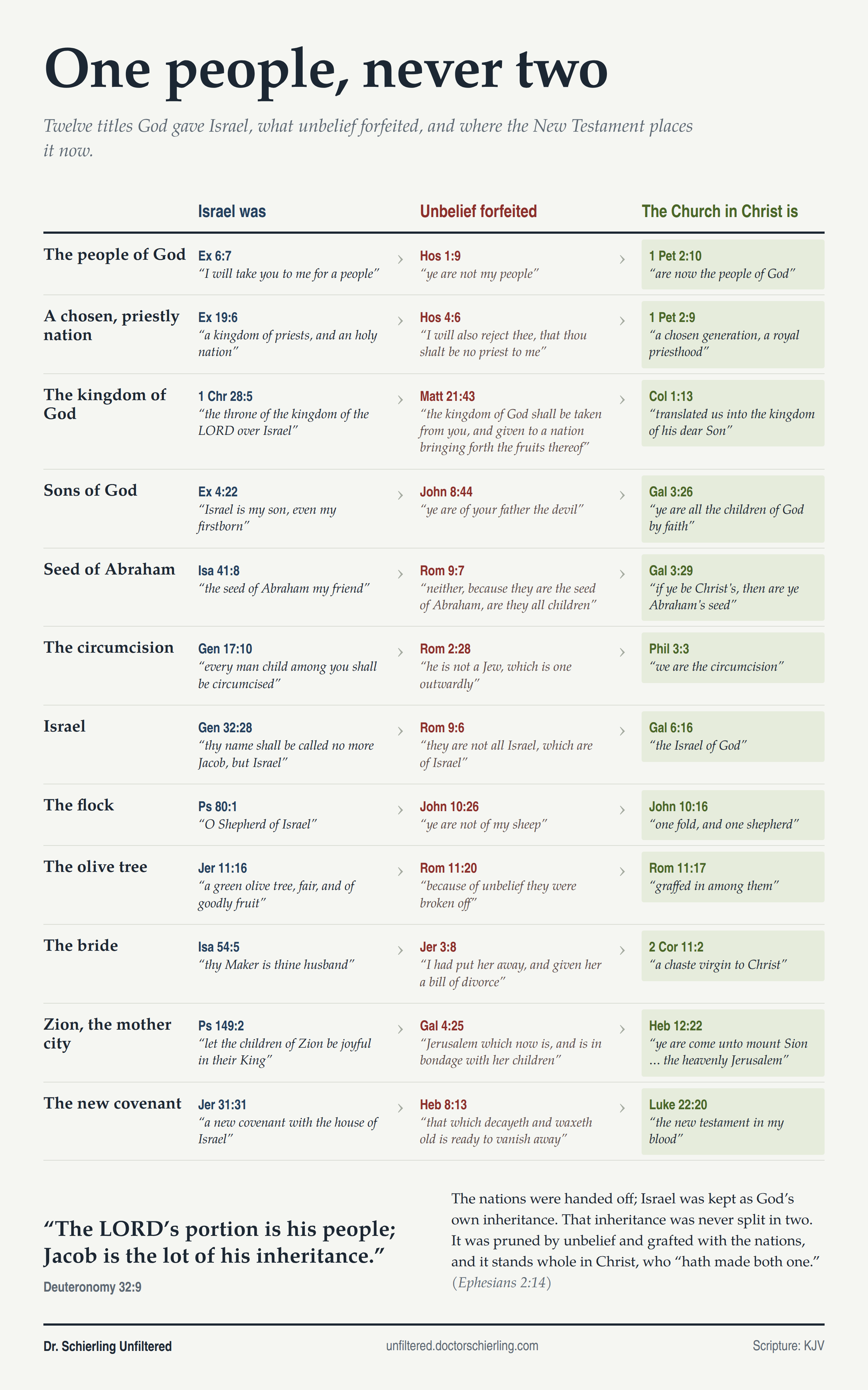
3. The Deuteronomy 32 Worldview: Why Israel Was Exceptional
Now the part dispensationalists skip, and frankly most Reformed writers skip it to. Why was Israel set apart at all? And what happens to that setting-apart when the Messiah comes?
The answer turns on a single textual variant…
The King James and most of its descendants render Deuteronomy 32:8 to say that when the Most High divided the nations, He fixed their borders “according to the number of the sons of Israel.” The Dead Sea Scrolls and the Septuagint preserve the older reading: “according to the number of the sons of God.”
Put Deuteronomy 32:8–9 in the NASB and ESV side by side, and you are looking at two different worldviews. One reads the Bible as a single, unified story. The other ‘rightly divides’ it until nothing whole is left…
For those not interested in the whole nine yards, here’s a summary (most of this was in the original post — the first chapter). Read it, then scroll to the next break…
For two thousand years, the Bible’s oldest commentaries — Jewish and Christian alike — read the “sons of God” in Genesis 6 and Deuteronomy 32 as exactly what the words say: heavenly beings. Fifty ancient sources agree, including Enoch, the Dead Sea Scrolls, Josephus, and the earliest church fathers. And the New Testament assumes the same story when Peter and Jude write of angels chained for abandoning their place.
Then, in the generation after the Bar Kokhba War, Rabbi Simeon bar Yochai (c. 140–160 AD) renamed the sons of God, cursing anyone who read the text plainly…
New Jewish translations followed, and a handful of specific passages started shifting in one direction — away from a plurality of small ‘g’ gods, away from a second Yahweh (Jesus Christ), and away from the very texts the apostles used to prove Christ’s deity and supremacy over the gods.
Deuteronomy 32:8 became “sons of Israel” instead of “sons of God,” verse 43 lost the line Hebrews quotes about the Son, and Psalm 82’s council of gods became a roomful of human judges. Christians inherited the damage two centuries later and never went back to check.
Doeden’s 442-page dissertation confirmed it: there are no adequate grounds for making the sons of God human.
In 2001, Michael Heiser tore down the case for the Masoretic reading in Deuteronomy 32:8 and the Sons of God, arguing that its presumed superiority is a dogma, not a finding. He published it in Bibliotheca Sacra, Dallas Theological Seminary’s flagship journal.
Four years earlier, David Stevens had defended “sons of Israel” in the same journal. By 2000 he had abandoned that position, and he did it in a footnote to an article on territorial spirits in Daniel 10. The #1 journal used to theologically promote (as opposed to hype) American dispensationalism published both the defense and its quiet surrender.
It matters because the “sons of Seth” (Sethite) reading most of us inherited is not the ancient interpretation of Genesis 6 at all. It’s the latecomer. Pastor Doug Van Dorn counts at least seventeen Jewish sources before the second century and at least thirty-three others before the fifth.
Every one of those fifty sources explains the sons of God as heavenly beings…
They include the Book of the Watchers (1st Enoch), Jubilees, the Qumran scrolls, Philo, Josephus, Justin Martyr, Irenaeus, Athenagoras, Tertullian, and Clement of Alexandria. The New Testament assumes the same story. Peter writes of angels chained for judgment, Jude of angels who abandoned their proper dwelling, and Luke calls the resurrected “equal to angels” and “sons of God” in the same breath.
The first Christian to propose the Sethite view was Julius Africanus around 220 AD, and even he hedged. However, Chrysostom and Augustine turned his suggestion into orthodoxy nearly two centuries later. Luther and Calvin inherited it. None of them found it in the text.
The Jewish world abandoned the angelic reading first, and it did not do so through exegesis. It did so through a curse…
In the generation after Bar Kokhba — the messianic claimant whose uprising against Rome was crushed in AD 135 — Rabbi Simeon bar Yochai renamed the sons of God “sons of the nobles” and cursed anyone who called them what the Hebrew plainly calls them. The new Jewish Greek translations of that century followed suit, with Symmachus rendering them “sons of the powerful.”
The goal of the Jewish scribes was to turn Jesus into a mere man. The Church Fathers watched it happening in real time…
Justin Martyr told Trypho that the rabbis had removed passages from the Seventy’s translation and would have cut more had they understood them. Irenaeus said that if the Jews had known how Christians would use their scriptures, they wouldn’t have hesitated to burn them. When a rabbi has to curse people for reading Scripture, Scripture was never the problem. The problem was where the Scripture led.
They led to Christ, and Deuteronomy 32 shows it…
At Babel, the Most High divided the nations “according to the number of the sons of God,” as the Dead Sea Scrolls read and the Septuagint confirms. Then, in verse 9, “the LORD’s portion is his people.” Inheritance language describes sons, and Israel’s God takes his own portion alongside the sons of God who received theirs.
The Masoretic Text changed “sons of God” to “sons of Israel,” a reading that makes no sense at Babel, centuries before Israel existed…
Yet the Jewish Targum Pseudo-Jonathan still remembered the original meaning: God cast lots with “seventy angels, the leaders of the nations.” In verse 43, the Qumran text commands “bow down to him, all gods” and the Septuagint reads “let all the angels of God worship him.” The Masoretic Text drops the line entirely. Hebrews 1:6 quotes that missing line and applies it to the Son. No scribe mistakes elohim for Israel, and no scribe ‘accidentally’ (cough cough) loses the verse the apostles used to prove Jesus’ deity.
Psalm 82 was never altered in Hebrew, so it was neutralized through interpretation. God stands in the divine council, judges the elohim, and sentences them to “die like men,” a sentence that means nothing when spoken to men…
Before Christ, the Qumran community read the psalm supernaturally, with a heavenly Melchizedek judging among the heavenly beings (the debate over Melchizedek, Chritophany -vs- a human priestly “type,” is significant). Later Jewish translators turned those elohim into “the mighty” and “rulers,” and Christian translations and lexicons followed.
Jesus built his defense in John 10 on this psalm — He did not answer the charge of blasphemy by lowering his claim to a merely human level…
After saying, “I and the Father are one”, he grounded his reply in Psalm 82:6: “I said, you are gods.” On the human-judges reading, the reply becomes, in effect, “others can be called gods, so why object if I am?” But on the divine-council reading, Jesus invokes the psalm in which God stands among the gods to condemn their injustice, identifies himself as the uniquely consecrated and sent Son, and stands within the Scriptural pattern of the royal Son to whom the Father says, “I will surely give the nations as Your inheritance”.
The Pharisees understood him perfectly, which is why they reached for stones…
None of this means the Old Testament is unreliable. It means a small, specific set of texts, concerning the sons of God, divine plurality (do not confuse this for what it is — God ruling over the gods), and Melchizedek, show the fingerprints of deliberate revision. Seventy going down to Egypt, where the Septuagint, a Qumran Exodus scroll, and Stephen’s sermon all say seventy-five, gives a tidy “seventy sons of Israel” for Deuteronomy 32:8.
Six hundred fifty years missing from the post-flood genealogy keep Shem alive in Abraham’s day, just in time for the rabbinic tradition that Shem was Melchizedek. That tradition turned the priest-king whom Qumran treated as heavenly, and Hebrews applied to Christ, into a mere man. Any one change can be explained away. Together they form a pattern, and the pattern runs in one direction: away from the second Yahweh that the first-century church preached from these very texts.
The strongest confirmation comes from outside ‘the fringe’…
In 2013 the Reformed scholar Jaap Doedens produced a 442-page doctoral study at the Theological University of Kampen, later published by Brill as The Sons of God in Genesis 6:1–4: Analysis and History of Interpretation. He examined the Hebrew, the ancient Near Eastern parallels, the translations, the Scrolls, the rabbis, and two thousand years of commentary. His conclusions? There are no adequate grounds for making the sons of God human, whether kings or Sethites. They are heavenly beings.
He traced the Sethite reading to a slippery Greek rendering of Genesis 4:26, and he placed the Jewish break squarely with Simeon bar Yochai’s curse. Doedens himself attributed the shift to pastoral worries about assimilation rather than to a Jewish plot to destroy Jesus’ deity, but in the second century, after Bar Kokhba, the assimilation the rabbis feared most wore a Christian face.
The problem as I see it: ‘Pastoral worry’ explains why a reading proves useful. It does not explain why a rabbi must curse the plain words of the text.
I remember the first time I encountered this debate in a four-part series by Gary DeMar, Who Are the Nephilim: Aliens, Demons, or Just Plain Folk?, finding it persuasive at the time.
Reading it again after doing this deep dive, I can see what he was really fighting. He wasn’t fighting the ancient Jewish and Christian reading of Genesis 6. He was fighting von Däniken’s ancient astronauts and Chuck Missler, whose Alien Encounters he took to task in Part 3, which dismisses the fallen-angel view as extrabiblical sensationalism.
Missler was a brilliant engineer with a genuine gift for pattern and detail. But like many others in his camp, his dispensationalism clouded his conclusions on many things. Because Missler’s reading had claimed the supernatural, DeMar (whose judgment has likewise been clouded) treated it as contaminated and threw it out.
What replaced it was a hybrid…
Seth’s godly line, compromised through bad marriages, fused with Meredith Kline’s thesis that the sons of God were tyrant-kings. That required reading Psalm 82’s elohim as human rulers, and Part 4 argues exactly that, making the sons of God unjust human judges.
The bigger problem…?
DeMar never reckoned with the sons of God who shouted for joy at the foundation of the earth, before any man existed. Nor did he address the angels Peter and Jude say God cast into chains of gloomy darkness because they left their proper dwelling to go after ‘strange flesh’ — a clear reference to the first four verses of Genesis 6.
The deeper irony of DeMar’s series is that the divine council reading is postmillennial to the bone — the position he’s aptly defended for nearly five decades…
The nations were handed over to rebel sons of God at Babel. Those sons were then judged and sentenced to die like men in Psalm 82, which ends with God inheriting all the nations. And the Great Commission is Christ reclaiming that inheritance. The postmillennialists handed the dispensationalists a worldview that was ours all along.
Now, back to my original thought…
Put Deuteronomy 32:8–9 in the NASB and ESV side by side, and you are looking at two different worldviews. Read with “sons of God,” the passage snaps into focus…
At Babel humanity rebelled, and God scattered the nations, seventy of them in the Table of Nations (Genesis 10–11). He handed them over to the lesser elohim of His council, the host of heaven He “allotted to all the peoples under the whole heaven”. Except one…
“But the LORD’s portion is his people, Jacob his allotted heritage”. The nations went to the sons of God. Yahweh kept one people for Himself, beginning with one man He called out of Ur — in the very next chapter.
The author of Psalm 82 (Asaph) shows how that arrangement went…
God stood in the divine council, indicting the gods for corrupt rule over the nations, sentencing them to die like men, and closing with “Arise, O God, judge the earth; for you shall inherit all the nations!” The disinheritance at Babel was never meant to be permanent. God always intended to take the nations back — the very purpose of the gospel, seen throughout the entirety of the New Testament.
That tells you what Israel’s exceptionalism was for. It was real, and it was functional. Israel was Yahweh’s beachhead in occupied territory: “a kingdom of priests” exists to mediate for others.
The promise to Abraham had the nations in view from the first sentence: “in you all the families of the earth shall be blessed”. Israel was never the terminal point of God’s plan. Israel was the channel through which the disinherited nations would come home. Dr Palmer Robertson builds this case at length in The Israel of God: the nation existed for the sake of the Messiah who would come from it. His 145-page book can be boiled down to a single sentence on page 148…
“Not one’s ethnic origin, but one’s faith in the Messiah who has come, determines one’s participation in the eternal kingdom of Christ.”
As opposed to modern dispensationalism’s interpretation…
In a recent book, John Hagee rattled off a large number of Jews who he claims, in fulfillment of Genesis 12:3, have blessed the world. In one of the most blatant displays of theological stupidity ever witnessed, Hagee lists numerous prominent Hollywood stars such as Goldie Hawn, Dustin Hoffman, Barbara Streisand, Adam Sandler, Sammy Davis Junior (a proselyte), Steven Spielberg, and various others, missing the boat yet again in bizarre fashion. This promise was fulfilled in the person of Jesus Christ and His offspring, not “The Waterboy”. -From Apocalypse When?
Now watch what Paul did with the Song of Moses. Where the Deuteronomy 32 worldview stopped being background and became Paul’s explicit argument…
In Deuteronomy 32:21, God answered Israel’s idolatry thusly: “They have made me jealous with what is no god... So I will make them jealous with those who are no people.” Paul quoted it in Romans 10:19. Moses himself foretold that God would use Gentiles, a “no people,” to provoke Israel.
Paul built Romans 11 on the same verse…
Through Israel’s trespass, Romans 11:11 reveals that “salvation has come to the Gentiles, so as to make Israel jealous,” and Paul magnifies his Gentile ministry “in order somehow to make my fellow Jews jealous, and thus save some of them”. Notice the link to Hosea. The “no people” of Deuteronomy 32 are the “not my people” who become “my people.”
Then, in the letter’s closing argument, Paul quoted the Song’s final movement — “Rejoice, O Gentiles, with his people”. Not alongside His people in a separate program. With.
The Song of Moses ends with the nations joining Yahweh’s portion in worship. And Hebrews 1:6 takes the Greek text of that same verse, “Let all God’s angels worship him,” and applies it to the Son’s entrance into the world. The Song that describes the nations being carved up among the sons of God ends with the sons of God bowing before the Son, and the nations rejoicing with Israel.
Luke wrote the reversal into history…
At Pentecost the Spirit fell, and the apostles spoke in the languages of the scattered nations. Luke even supplied a table of nations. Babel confused the tongues; Pentecost undid it. In Athens, Paul tells pagans that God “made from one man every nation of mankind... having determined allotted periods and the boundaries of their dwelling place”. That is Deuteronomy 32:8 in Greek dress. He then announced that the times of ignorance are over and God “commands all people everywhere to repent”. The allotment is being revoked.
The powers lose their grip in the same stroke…
Christ “disarmed the rulers and authorities and put them to open shame, by triumphing over them”. Through the church, God’s manifold wisdom is now made known “to the rulers and authorities in the heavenly places”. Paul tells Gentile Galatians that before Christ they “were enslaved to those that by nature are not gods”. Deuteronomy 32 language, from Paul, addressed to Gentiles.
In the ancient world, allegiance was cosmic. Every nation answered one question, in its altars, its festivals, and its marks on hand and forehead: Whose am I? Israel answered it with the Shema, bound on the hand and between the eyes (see the previous chapter on the beast). The gospel carries Israel’s answer out to nations that had been answering wrongly since Babel.
Now imagine the dispensationalist’s two-peoples model inside this framework and watch it collapse…
Deuteronomy 32 reserves one portion to Yahweh: Jacob, His allotted heritage. The nations were disinherited. The New Testament shows the nations being brought back, and not into a second, parallel inheritance. They come into Yahweh’s portion, rejoicing with His people. There is no second portion anywhere in the Song of Moses. There are Yahweh’s people, and there are the nations under the sons of God.
When the nations come home, they come home to Israel, through Israel’s King. A two-peoples theology would need a Deuteronomy 32 with two divine inheritances. The text has but one.
4. Romans 11 and AD 70: The Future Is Inside the Tree
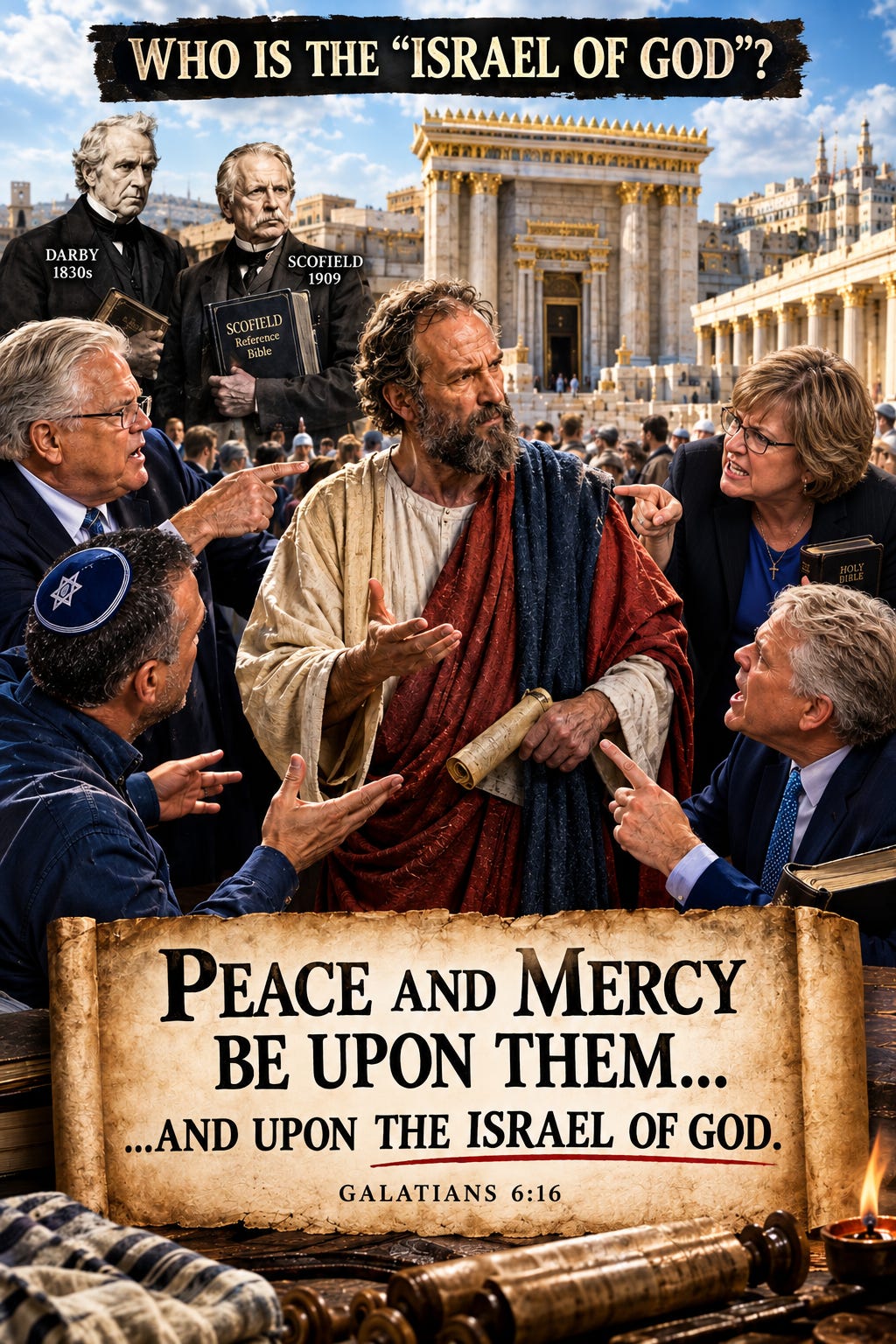
After referring to ‘replacement theology’ as a “caricature” in a recent episode of the Reformed Fringe (The Oath Before the Garden), Pastor Douglas VanDorn stated the following when discussing this stalwart accusation of dispensationalism — the object of their collective wrath, similar to Emmanuel Goldstein as the subject of the daily “Two Minutes Hate” in Orwell’s 1984…
There is nobody being replaced in covenant theology…
National Israel is still national Israel, and if God wants to deal with national Israel sometime in the future and save them all — as it very much hints at in Romans chapter 11 — he can most certainly do that. The church is not a replacement for national Israel. The church simply is spiritual Israel.
This side of the cross, Paul makes it clear in Romans 9:6 that there have always been two Israels, not one, and not all who are descended from Israel are Israel…
There is a biological people, and there is a spiritual people. And those spiritual people came through the nation once the nation was brought into existence through Abraham and then Jacob. But people in the Old Testament were saved prior to Israel. And they were part of this same church, this same Israel that’s not the biological people.
There were Gentiles that were saved in the Old Testament. Naman is a great example of a Gentile who was saved. He never had to become a Jew, but he was saved as one of these spiritual Israelites. Most of those people became physical Israelites and were adopted into those covenant privileges because that’s the way that worked in the Old Testament. But this is not a replacement. As I said, the word ekklesia that Jesus uses for church is found throughout the Septuagint for the people of Israel [about 100 times, with 77 in of them in the canon — I point that out because of this].
It’s not a new idea, and it’s not a replacement…
It is simply fulfillment of what Israel should have been. And if you want to think about where the fulfillment comes from, the one true Israel is Jesus Christ. And everybody who comes into Jesus Christ becomes part of that spiritual Israel.
Romans 11 is where every dispensationalist runs to first…
Paul’s image is one olive tree (Romans 11:17–24). The root is the patriarchs. Unbelieving Israelites were broken off. Believing Gentiles, wild branches, were grafted in among the others to share the root’s richness. One tree. Not an Israel tree and a church tree. And Paul warns Gentiles against arrogance, because God is able to graft the natural branches back in: “how much more will these, the natural branches, be grafted back into their own olive tree”.
Their own olive tree. Not a second one…
Then: “a partial hardening has come upon Israel, until the fullness of the Gentiles has come in. And in this way all Israel will be saved”. As regards the gospel, they are enemies, but “as regards election, they are beloved for the sake of their forefathers. For the gifts and the calling of God are irrevocable”.
Here is what most dispensationalists don’t know, and what many critics of Reformed theology don’t either: historic postmillennialism has always read that passage as a promise...
The Westminster Larger Catechism (Q. 191) teaches believers to pray for “the Jews called, the fulness of the Gentiles brought in.” The Puritans, whose story Iain Murray tells in The Puritan Hope, expected a large-scale conversion of the Jewish people that would be “life from the dead” for the world, and they prayed and labored toward it. Gentry holds the same line today. Answering a reader’s question, he wrote that postmillennialism expects the mass of Jews to be saved, and that what saves them is their relation to Christ, not to Abraham.
Israel. Fulfilled in the person of Jesus Christ. A far bigger promise than a small, dusty piece of land in the Middle East.
For the promise to Abraham and his offspring that he would be heir of the world did not come through the law but through the righteousness of faith. -Rom 4:13
That is the difference between one-people theology and replacement theology…
Replacement says God is finished with the Jews. One-people theology says God is not finished with anyone, Jew or Gentile, and that everyone who comes home, comes home the same way — into the same tree, through the same Messiah. There is no future for ethnic Israel outside Christ, but there is a glorious future for Jews inside Him.
No rebuilt-temple program. No second covenant. No postponed kingdom. Natural branches, regrafted into their own tree.
What, then, ended in the first century? Not Israel. The Old Covenant administration…
Hebrews, written while the temple still stood, called the first covenant “obsolete and growing old... ready to vanish away” — not surprising considering the author told his readers in the letter’s very first sentence that they were living in that administration’s “last days”.
Jesus told His own generation that not one stone of the temple would be left on another before “this generation” passed (Matthew 24:2, 34). In AD 70, it happened. The sacrifices stopped. The priesthood ended. Gentry’s Before Jerusalem Fell and He Shall Have Dominion lay out the case that the judgment on Jerusalem formally closed the Old Covenant age.
And for those who use Luke 21 as their ‘proof-text’ for the rebirth of the secular nation of Israel in 1948, don’t forget that Christ Himself cursed the olive tree — forever.
The Seventieth Week: Dispensational Mouthpiece, Randall Price, Inadvertently Spills the Beans
I do not consider myself an expert on much of anything. I am, however, fairly well-versed in the prophecy of the Seventy Weeks. And most particularly, its Seventieth Week — a topic I’ve written and taught on extensively over the past two-plus decades.
I am not going to rehash that here. If you are interested, I covered some of the basics in an earlier chapter (infographic below — feel free to compare to the myriad of Left Behind charts)…
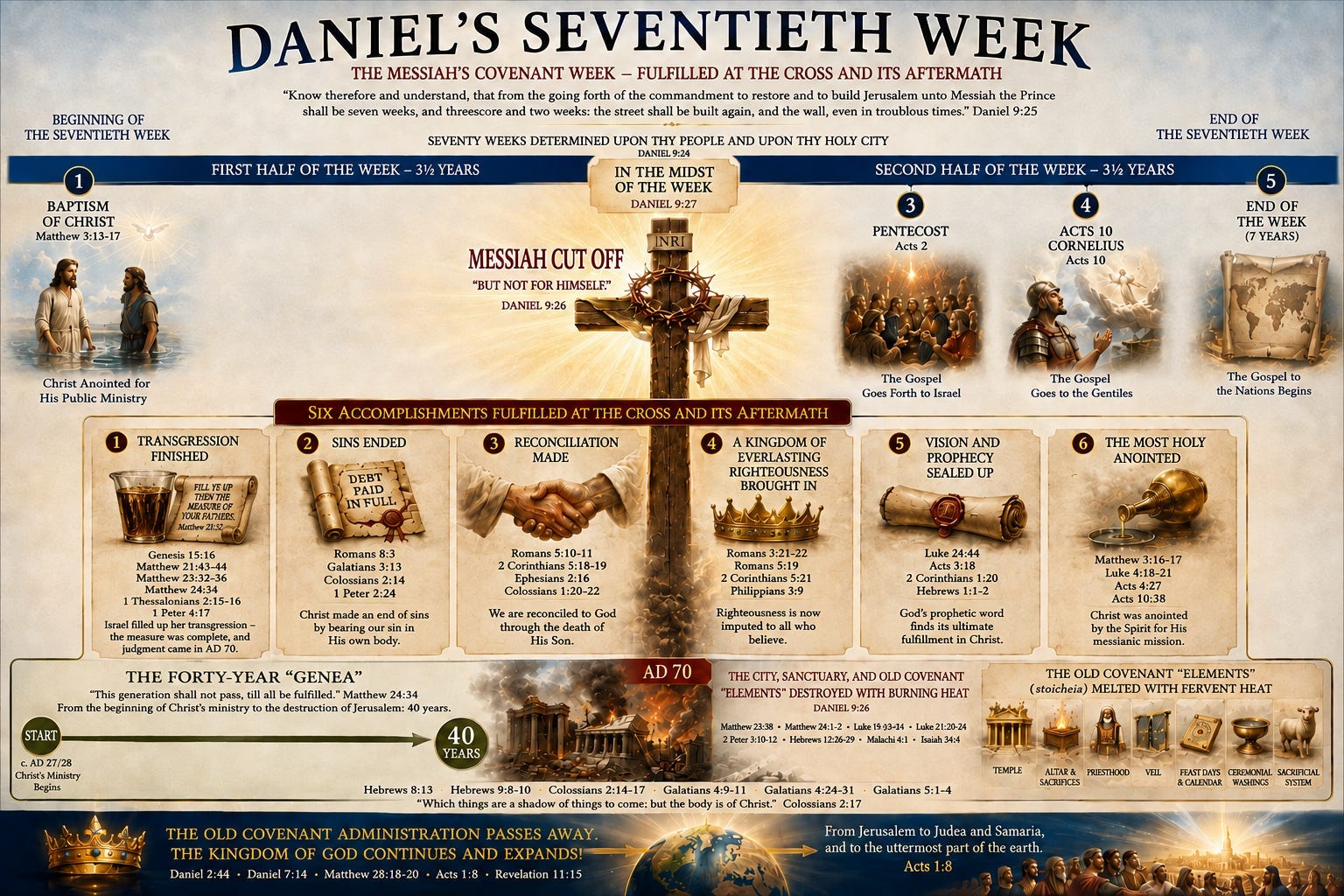
Seventieth week immediate future, seventieth week distant past… Why does it matter and who really cares?
The debate over the Seventieth Week is significant because if the dispensationalists are correct, it pertains to antichrist and/or a millennial temple. And if everyone else in Christendom is correct, it is all about Christ.
Which brings me to Randall Price…
Dr Randall Price is one of dispensationalism’s leading scholars. He’s also a guy I’m guessing I would love hanging out with. Maybe a day on the Current River with Randall, my brother, and a few close friends — eating some “skillet” and tipping back a couple of RaR’s while discussing Daniel’s prophecies. And, of course, spending at least part of the day snorkeling for treasure…
Price is dispensationalism’s most credentialed archaeologist, with over 120 trips to Israel. A Th.M. from Dallas Theological Seminary and Ph.D. in Middle Eastern Studies from the University of Texas at Austin, and post-graduate work at Hebrew University in Jerusalem. He served as Distinguished Research Professor of Biblical and Judaic Studies at Liberty University from 2007 until his retirement in 2022, running the Center for Judaic Studies and directing excavations on the Qumran Plateau for a decade. He founded World of the Bible Ministries and sits on the boards of Jan Markell’s Olive Tree Ministries and the Pre-Trib Research Center. Of the ready-to-rebuild-the-temple movement, he is their leading authority.
I mention Price because he was one of 50 contributors to 1996’s Dictionary of Premillennial Theology — one of the hundreds of books I purchased for pennies on the dollar to write Apocalypse When? — my unpublished mess of a manuscript written to help me wrap my head around a theology / eschatology completely opposite of what I was raised in, but that made sense to me the first time I heard it taught.
If you’ve been paying attention, this chapter has been about “The Restoration”™ from the very first sentence. Price’s statement was written three decades ago, and it is as true today as the day he wrote it…
“If the Seventieth Week immediately succeeds the sixty-ninth week historically, then the expected restoration must be applied spiritually to the Church as the New Israel. The dispensational view depends on the validity of interpreting the Seventieth Week eschatologically.”
In case you are not picking up what Price is laying down, let me spell it out for you — reread it until you grasp what he is saying…
“If the Seventieth Week immediately succeeds the sixty-ninth week historically [without a 2,000 year pause / gap / parethesis], then the expected restoration must be applied spiritually to the Church as the New Israel. The dispensational view [Biblical Israel and the Church are two separate and distinct entities; the most distinguishing principle of the system] depends on the validity [or non-validity] of interpreting the Seventieth Week eschatologically [futuristically].”
Read Price’s sentence one more time, because it is not an argument. It is, as my AI Censorship Interrogations were built on, an if/then statement based on the laws of logic. And he wrote the ‘if’ himself…
If the Seventieth Week follows the sixty-ninth the way every other week in the prophecy follows the one before it, then The Restoration is Christ’s and the Church’s, meaning dispensationalism is finished. Not wounded. Finished. Dead. Deep sixed. And notice what has to happen for it not to be finished. The clock — “God’s Prophetic Time Clock” — has to stop.
2,000 years and counting…
“I share the same sort of frustration with people who say, ‘If it was supposed to be soon, why hasn’t it happened in 2,000 years?’” Tim LaHaye’s co-author for the Left Behind series, Jerry Jenkins, quoted from www.LeftBehind.com (April 20, 2006)
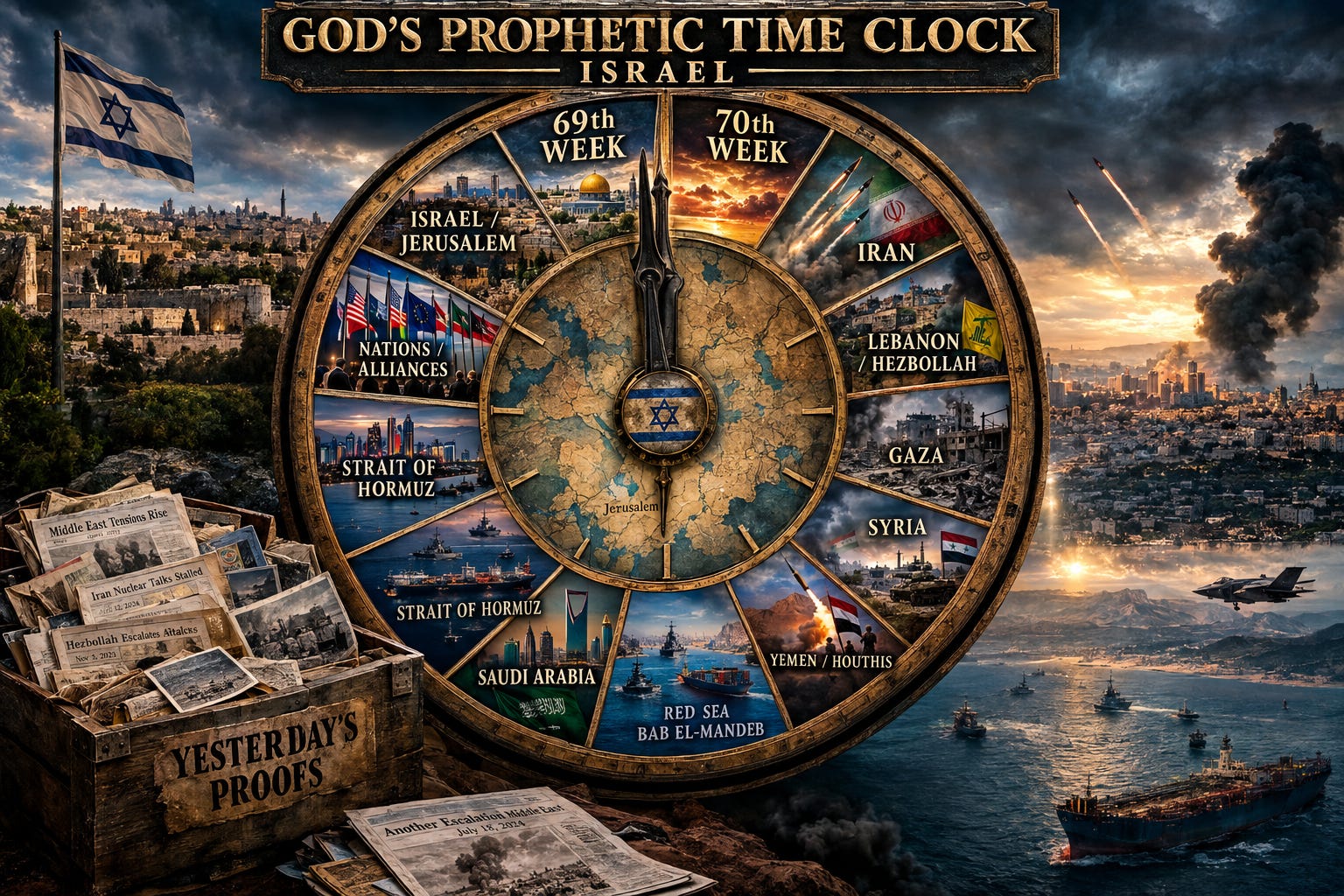
The image above is not my caricature of their system; it is their own favorite metaphor…
Israel as God’s prophetic timepiece, God’s alarm clock, the hand on the dial that tells you how late the hour is — and the entire apparatus requires that the hand freeze after 69 and hang there, motionless, for two thousand years, while God runs a different people on a different track, waiting for Antichrist to sign a peace treaty with Israel (an honest-to-goodness bastardization of what it means to “confirm the Covenant with many”). Or the rapture — there is debate over which event will actually kick off the dispensationalist’s final week.
And then jerk forward seven more years once the Church is raptured out of the way for a very specific reason. Because don’t forget that according to their model, the Church must be removed, because God cannot work His prophetic plan on the two groups at the same time.
Everything hangs on that frozen hand — according to Darby’s disciples, teetering now for two millennia…
Two peoples, two programs, two returns, a postponed kingdom, a rebuilt temple, a seven-year countdown, a pre-trib escape hatch. And that frozen hand is not in Daniel’s text, not in Christ’s words, not in Paul’s letters, not in Augustine, not in Calvin, not in Luther, not in the Westminster divines, not in...
It showed up, as if by magic, in Ireland in the early 1830s, at Lady Powerscourt’s prophecy conferences, out of the mouth of John Nelson Darby — her close friend, the man who nearly married her, and the man who took the meetings over — and nowhere before that.
Eighteen centuries of Christians read this prophecy as “Messianic” — fulfilled in Christ. And then POW — all of a sudden one of history’s greatest and most specific prophecies of both the mission and timing of Jesus Christ becomes a prophecy about a future Millennium? Or worse yet, Antichrist? Ponder the sheer magnitude of theolgical / eschatological revisionism from people who will call you a last days scoffer or heretic if you doubt them.
Don’t ask me how I know…
Price’s ‘if’ is not hypothetical. It is the inadvertent confession that the load-bearing beam of his entire system was invented during the ‘prophecy & restoration’ craze of the 19th century.
Dangers of the System & Historic Christian Beliefs About the Jews

“Doug Wilson — not often a pronounceable name in dispensational circles — has made this point a number of times. For example: ‘The Bible, taken as a whole, does indicate that there is a role to play for the Jewish people, yet to come, in Israel — again, Romans 11. And, incidentally (apart from dispensationalism), this has been the historic Reformed position from the time of the Reformation down. Over and over and over again, Reformed scholars, preachers, theologians, have affirmed the future conversion of the Jews, which is a Reformed distinctive.’” -Christopher Preston from The Powerfully Misleading Danger of “Dispensationalism (Jul 05, 2025)
“However, a number of teachers have lately taught that discarding dispensationalism inherently involves discarding the Jews as a unique people, along with the expectation of their future national conversion to Christ. But this is far from true. Many Reformed men across various eschatological views have held to a futurist understanding of Romans 9–11, imitating the Apostle Paul’s ‘desire and prayer to God for Israel that they may be saved’ (Rom. 10:1)”. -From the April 20, 2026 edition of CrossPolitic Studios (Don’t Discard the Jews with Dispensationalism: Four Reformed Fathers on the Conversion of the Jews)
Antisemitism? Hitleresque hatred?
While there have always been varying degrees of anti-Jewish thought and action inside the Church, it can be broken down into two different camps…
The first group I would refer to as “anti-Judaistic,” which views Judaism not as a competing religion but as a false religion. Similar to the way the New Testament authors described it, particularly the nearer the apostolic letter was written in relation to the end of the age — the end of the Old Covenant sacrificial economy (Galatians 4:3–10, Galatians 4:21–31, 1 Thessalonians 2:14–16, 2 Corinthians 3:6–16, Romans 2:28–29, Romans 9:6–8, Matthew 21:43, Matthew 23:29–38, Philippians 3:2–3, Colossians 2:8–23, Acts 28:25–28, 1 Timothy 1:3–7, Titus 1:10–16, Titus 3:9, 2 Timothy 3:5–8, John 8:39–47, 1 John 2:18–23, Hebrews 8:13, Hebrews 10:26–31, Hebrews 12:18–29, Hebrews 13:10–14, Revelation 2:9, Revelation 3:9, Revelation 11:8).
The second camp, antisemitism, is kind of like anti-Judaism on steroids. But then again, not really — it involves much more than that…
Antisemitism goes beyond opposition to a religion to opposition to a race, whether or not said Jews have converted to Christianity. It’s a deep-seated hatred of Jews simply for being Jews — a hatred that sometimes results in violence or even murder. And while Catholicism and Protestantism both contain varying degrees of each in their histories, it’s not difficult to argue that, even including Luther’s rabid screeds (link, link, link, link), Catholicism contains significantly more of the latter.
I would likewise argue that the Reformation introduced into Christian thought the widespread expectation that as the gospel took over the earth, there would be a massive conversion of the Jews. And that it would happen in time and history, not merely as an eschatological event at the end of time.
Contrary to what certain histories teach, the Puritans didn’t invent it…
The Puritans did not originate the expectation of a future, broad conversion of the Jews. Continental Reformers such as Beza, Peter Martyr Vermigli, and Martin Bucer taught it from Romans 11, and it reached England through Geneva exiles, biblical annotation, translations, and university networks, with Martyr and Bucer carrying it straight into Oxford and Cambridge under Edward VI. Ironically, Bucer, author of the harsh 1538 Hessian recommendations against the Jews, helped seed the most philosemitic eschatology in Protestant history.
But it was the Puritans — who, within little more than a century of Luther nailing his 95 Theses to the door of Wittenberg’s Castle Church, became the dominant force in English Protestantism. The group that made this idea commonplace...
“The casting off of the Jews was our Calling; but the Calling of the Jews shall not be our casting off, but our greater enriching in grace, and that in two ways: First in regards to the company of believers, when the thousands of Israel shall come in [to The Church], which shall doubtless cause many Gentiles which lie in ignorance, error, and doubt, to receive the Gospel and join with them. The world shall then be a golden world, rich in golden men, saith Ambrose. Secondly, in respect of the graces, which shall then in more abundance be rained down upon the Church.” -Elnathan Parr, The Works of Elnathan Parr, 3rd ed., 1633 (page 175)
“There is nothing here for the point in hand: we grant willingly that the nation of the Jews shall be converted to the faith of Christ; and that the fullness of the Gentiles is to come in with them to the Christian Church; also that the quickening of that dead and rotten member shall be a matter of exceeding joy to the whole Church. But that the converted Jews shall return to Canaan to build Jerusalem, that Christ shall come from heaven to reign among them for a thousand years, there is no such thing intimated in the Scriptures in hand.” -A Dissuasive From the Errours of Time, 1645, chapter 11, “The Thousand Years of Christ his visible reign upon earth is against Scripture.”
“Of the Jews concerning the flesh, Christ came; to them first was the gospel preached, and from them it was received by the Gentiles: which should teach us not to hate the Jews only because they are Jews, which name is among many so odious than that they think they cannot call a man worse than to call him a Jew; but, beloved, this ought not to be so, for we are bound to love and honour the Jews, as being the ancient people of God, to wish them well, and to be earnest in prayer to God for their conversion.” -Edward Elton, writing on page 36 of 1653’s The Great Mystery of Godliness Opened, Being an Exposition on Romans 9.
“There will come a time when the generality of mankind, both Jew and Gentile, shall come to Jesus Christ. He hath had but little takings of the world yet, but He will have before He hath done.” -Thomas Goodwin, The Complete Works Of Thomas Goodwin, Vol. 1, (1861), page 520
“Even in the present time there are some within the Church who simply cannot believe that the old dispensation has been terminated. They still look for a temporal Jewish kingdom whose capitol, Jerusalem, will hold sway over all the earth. This was the carnal conception of this kingdom which Christ fought and the apostles opposed, and against which His Church must still fight. It is true we look forward to the conversion of the Jewish nation, and that the whole world will be blessed by this conversion. But that is something entirely different from the idea of a temporal Jewish Kingdom holding sway over the nations of the world.” -J. Marcellus Kik (1948)
“There awaits the Gentiles, in their distinctive identity as such, gospel blessing far surpassing anything experienced during the period of Israel’s apostasy [their unbelief], and this unprecedented enrichment will be occasioned by the conversion of Israel on a scale commensurate with that of their earlier disobedience.” -John Murray from his Epistle to the Romans (1965)
“‘The faithful Jews rejoiced to think of the calling of the Gentiles; and why should not we joy to think of the calling of the Jews?’ This note of joy is significant if a widespread conversion of the Jews was yet to occur on the earth, then the horizons of history were not, as Luther feared, wholly dark…. From the first quarter of the seventeenth century, belief in a future conversion of the Jews became commonplace among the English Puritans. In the late 1630’s, the subject was not infrequently mentioned by Puritan Leaders.” -Iain Murray, from 1971’s The Puritan Hope
“This same belief concerning the future of the Jews is to be found very widely in seventeenth-century Puritan literature. It appears in the works of such well-known Puritans as John Owen, Thomas Manton, and John Flavel, although the indices of nineteenth-century reprints of their works do not always indicate this. It is also handled in a rich array of commentaries, both folios and quartos------David Dickson on the Psalms, George Hutcheson on the Minor Prophets, Jeremiah Burroughs on Hosea, William Greenhill on Ezekiel, Elnathan Parr on Romans, and James Durham on Revelation: a list which could be greatly extended.” -Ian Murray, Ibid
“Actually, the complete verse of Psalms 122:6 says: ‘Pray for the peace of Jerusalem! May they be secure who love you!’ This begs the question as to the identity of Jerusalem, as well as ‘God’s chosen people’. The New Testament gives us two Jerusalems, the earthly Jerusalem, the cursed fig tree, which is in slavery with her children, and the new, heavenly Jerusalem, which is the free and the mother of all the saints. Which Jerusalem can rightly be described as those who know God?” -Scott Kessler, Who are God’s Chosen People?, (December 2006)
I could continue, as I have collected large numbers of similar over the past 25 years…
When Christian Zionist ministries brand Reformed believers as ‘antisemitic’ or ‘replacement theology heretics’ for rejecting a dispensational end-times timetable, history doesn’t cooperate.
For four centuries the Reformed and Puritan tradition preached, prayed, and wrote in joyful expectation of a vast ingathering of Jews into the Church, urging believers to ‘love and honour the Jews’ while rejecting the fallacy of a physical Jewish kingdom. That isn’t hatred of the Jewish people; it’s the covenantal hope of Romans 11. The charge of heresy against it says far more about the accuser’s eschatology than about the accused.
Think about it…
If supersessionism / replacement theology is a strawman (and I’ve proven that it is), the threat that non-dispensational theology — specifically Reformed Theology — poses to Jews is not only overstated; it simply does not exist.
However, there is a liability that does require discussion as we end this chapter — a problem woven into the fabric of the theology itself. What is the real danger of dispensationalism and its premillennial pretribulational rapture?
As I have shown you, the historic Church, both Catholic and Protestant, has always taught that on the Last Day living believers will meet Christ in the air as He returns to earth in His Second Coming. Resurrected from the dead and given some sort of “glorified” human bodies, the saints are raised to live with Christ forever on a fully consummated New Heaven and New Earth, while unbelievers are eternally damned to hell and the lake of fire / bottomless pit.
In the broad historic Christian and creedal understanding — shared in substance by Catholic, Orthodox, Lutheran, Reformed, Anglican, as well as a significant and growing number of evangelicals (link, link, link) — the “Last Day” is not a multi-stage dispensational timetable…
Christ returns visibly and gloriously; the dead are raised; the living are transformed; all humanity stands before Christ; and the final, public judgment separates the righteous from the wicked into their eternal destinies. Both are then recompensed in varying degrees according to their works: the righteous rewarded, the wicked punished. The precise sequence is not a long interval of separate events, but one climactic complex of events at the end of time.
Compared to the complexities of premillennial pretribulationism (link, link, link, link, link), what does the simple historic view of orthodox Christian eschatology look like?
The doctrine of the Last Day…
At the end of time, Jesus Christ will return once, openly, bodily, and in glory with his angels, not secretly or in stages (Matthew 24:30–31; Acts 1:9–11). His appearing summons the dead and transforms the living…
The dead in Christ rise first, the living are changed, and together they meet the descending Lord (1 Thessalonians 4:13–18; 1 Corinthians 15:51–54). That meeting (apantēsis) evokes the civic welcome of an arriving King, with citizens going out to escort him in, not escaping with him (Acts 28:15). Nor are the wicked raised a thousand years later. In one “hour” all in the tombs come forth, some to life and others to judgment (John 5:28–29; Acts 24:14–15).
All stand before Christ, who separates the sheep from the goats into eternal life and eternal punishment (the Bema Seat and Great White Throne are different imagery of the same judgment). Then death is destroyed, and the New Heavens and New Earth appear in their physical form (Matthew 25:31–46; 1 Corinthians 15:23–26; Revelation 21:1).
This is the historic creedal and confessional account, which the Nicene Creed (325 AD) compresses into a single line: Christ “will come again in glory to judge the living and the dead.” One appearing, one resurrection, one judgment. That is precisely the unity Darby / Scofield two-stage return and millennial interval divide and deny.
So, what makes this more than simply another “in-house” debate between competing endtime views?
If you want to understand why the Darby / Scofield version of eschatology is not just bad theology, but ultimately dangerous, and even deadly — spiritually deadly, capable of leading people to hell — let’s pull out our sapper’s map one final time and make some notes…
Dispensationalism splits Daniel’s final (70th) week from the other 69 by a gap of 2,000 years and counting.
They tell us that the rapture will kick off the 70th week (restarting ‘the prophetic timeclock’), with the antichrist’s peace treaty with Israel (confirming the covenant) following closely on its heels (or vise versa).
Their 70th week — the final seven years of the 490 — is also their Tribulation.
The Second Coming ends the 70th week / Great Tribulation.
There is much more — feel free to go back and view the links associated with the “complexities of premillennial pretribulationism” mentioned earlier.
Timelines abound, but one of the biggest themes of this view is the idea touted by the title of the first of the well-known series of books (80,000,000 sold) written by Tim LaHaye & Jerry Jenkins in 1995 — Left Behind…
Non-Christians are ‘left behind’ when Christians are raptured. A theme promoted by the system from its earliest days — at least two decades before LaHaye was born in 1926, and carried forward to the modern day with ever-increasing fervor (link, link, link, link, link, link, link, link, link, link, ad infinitum).
And here’s the rub, because many people will roll their eyes, yawn, and glance at their watch, while perturbededly asking why this debate even matters…
It matters because if the historical Christian eschatological position is correct, then there is no “signs of the times” → rapture → seven-year tribulation → Armageddon → Second Coming → rebuilt temple → Gog / Magog rebellion → Great White Throne → etc. There is simply a Second Coming. Period.
No signs. No warning. And no second chances…
The loving God who wants all to come to Him, offering amnesty and eternal life to all who bend the knee now, will be revealed as the God of vengeance, riding a white horse, the sword of His Word preceding from His mouth, stacking up corpses as He turns rivers to blood and kings to carrion at His return.
There is no “left behind” — no seven-year period of ‘second chances’ for unbelievers. There is only the Last Day. And how many days come after the last?
What We Recover by Discarding Darby’s Fractured Ideas
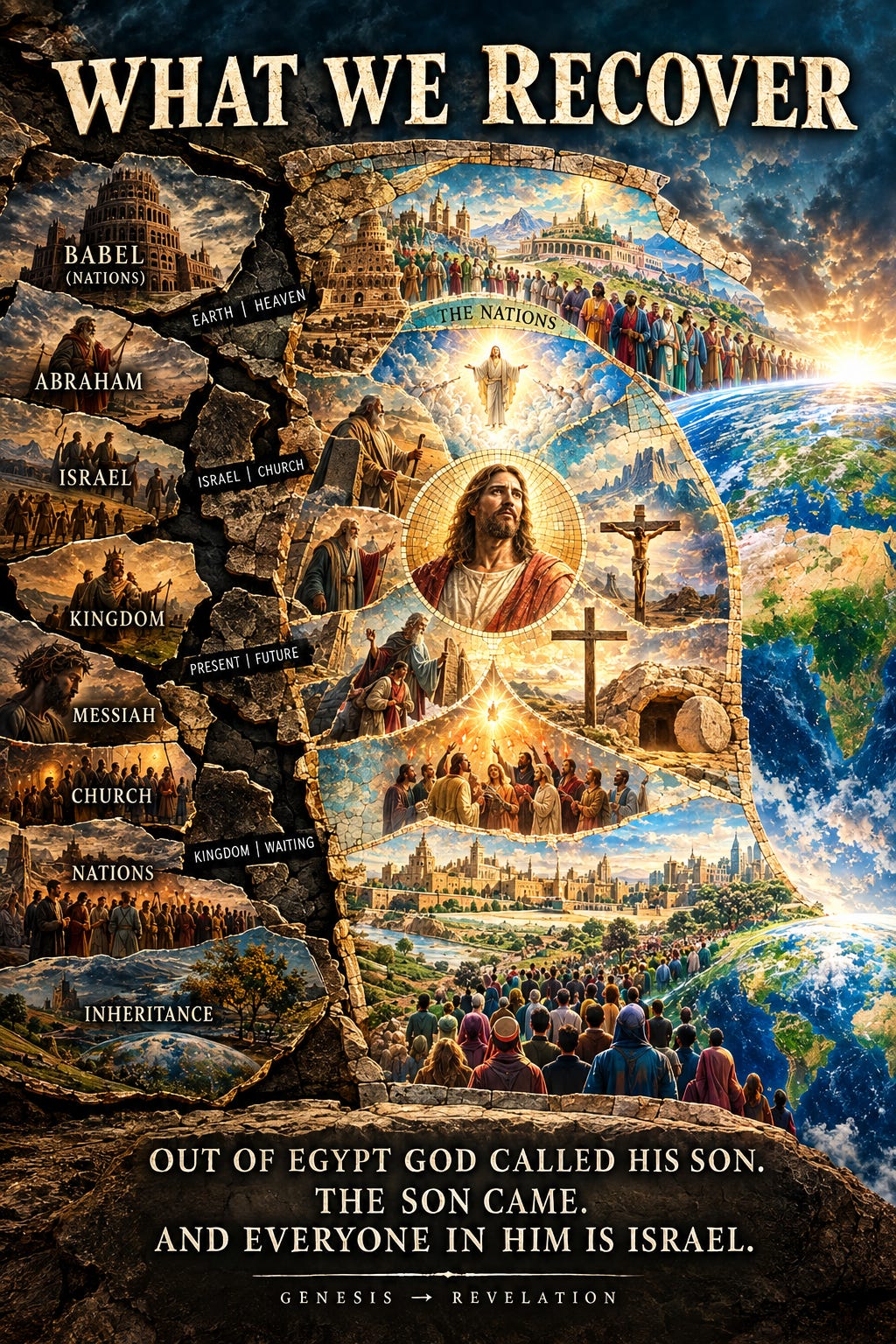
Darby did not only split God’s people. He split God’s plan from God’s world. His system grew out of the conviction that the church was in ruins — a lost cause, if you will…
“What we are about to consider will tend to show that, instead of permitting ourselves to hope for a continued progress of good, we must expect a progress of evil; and that the hope of the earth being filled with the knowledge of The Lord is delusive.
We are to expect evil, until it becomes so flagrant that the Lord will find it necessary to judge it. Truly, Christendom has become completely corrupted, the dispensation of the Gentiles has been found unfaithful: Can it be restored? No! Impossible!
I am afraid that many a cherished feeling, dear to the children of God, has been shocked this evening; I mean their hope that the gospel will spread by itself over the whole earth over the actual dispensation.” -J.N. Darby, The Prophetic Writings of J.N. Darby, No. 1 Volume I, Speech in Geneva Switzerland (1840)
A ruined church awaiting evacuation does not disciple nations. Prophecy charts replace the Great Commission, and newspaper headlines replace multi-geneational covenant faithfulness. Why plant an orchard if the rapture is coming Tuesday?
Put the pieces back together, and the picture is coherent from Genesis to Revelation, with the Deuteronomy 32 worldview filling in one theological void after another…
Since Babel, the nations have lived under rebellious powers, which is why the world looks the way it does and why evil proves so stubborn. Yahweh reserved a portion, and from that portion came the Seed who disarmed the powers and received the nations as His inheritance (Psalm 2:8; Matthew 28:18–20). It explains the church — the nations coming home into Yahweh’s one portion, rejoicing with His people.
And it explains the future…
The land promised in the fifth commandment (Exodus 20:12) becomes, in Paul’s hands, the earth (Ephesians 6:3). He simply drops “which the LORD thy God giveth thee.” Jesus does the same with Psalm 37: the meek inherit not Canaan but the earth (Matthew 5:5). No wonder Paul’s explanation of ‘Father Abraham’ was so expansive, telling his first-century readers that his seed would be “heir of the world” (Romans 4:13).
Geerhardus Vos, the father of Reformed biblical theology, supplied the structure that holds it together…
The age to come has already broken into this one through Christ’s Resurrection, and the church lives in Israel’s promises now, not in a waiting room while a second people waits its turn. Postmillennialists and optimistic amillennialists (little difference between the two groups) disagree over how much of the harvest comes before the end. Neither needs a second Israel.
That is The Restoration…
Gentiles are not second-class additions to someone else’s covenant. They are full heirs of Abraham. Jewish believers are not displaced guests in a Gentile church. They are natural branches in their own tree, and the rest of their kinsmen are not written off but prayed for. God’s covenant was never postponed, never parenthesized, and never split.
For eighteen centuries the church knew this. Darby’s break was an innovation dressed up as literalism and sold through footnotes and paperbacks. The answer is not in a newer system, but in the older reading, the one Moses sang and Paul quoted.
Out of Egypt, God called His Son. The Son came. And everyone in Him is Israel.