


Today’s post is a departure…
After two decades of blogging, it’s the first time I’ve written publicly on a theological topic. Not to worry; my next post returns to the sort of subject matter you subscribed for in the first place — Part II of something I started back in 2015, Vaccine Wars are on the Horizon.
Three things led me to break ‘new’ ground...
The first was a Saturday evening Bible study I led a couple weeks ago on the Kingdom of God, where the questions kept running past my outline. I touched on some of this, hopefully whetting appetites and not just confusing people.
The second was my long-standing realization that once you ‘see’ the unseen realm in the Bible, you’ll realize it’s absolutely everywhere, including eschatology. Especially eschatology. And unfortunately, if one doesn’t understand the nature of ‘the end,’ it’s likely that one will miss the nature of the beginning and middle as well.
The third was hearing Pastor Josh Howerton cover this territory early in his recent conversation with Shawn Ryan (click below and listen to the first intermission)…
The post itself is a deep dive. Don’t try and read it in one sitting. It is broken down into a prologue and several chapters. A great study for the next week or so. Enjoy…
Still Trying to Make Sense of the Bible Without a Deuteronomy 32 Worldview?
There are a significant number of familiar events in both the Old and New Testaments I would argue make little sense without a “Deuteronomy 32” worldview (paying particular attention to verses 7-9). We will take a bigger bite shortly, but follow me for a moment while you chew on this tiny morsel.
One such event I have always struggled to understand concerns the third of Christ's temptations. When Satan took Jesus up on a high mountain to show Him “all the kingdoms of the world,” promising that they could all be His if He would bow down and worship, my pea-brain used to have a meltdown. I thought Christ, as creator of the universe, already owned all those kingdoms?
And it gets even more interesting when you read Luke’s version and notice the detail Matthew left out…
“And the devil, taking him up into an high mountain, shewed unto him all the kingdoms of the world in a moment of time. And the devil said unto him, All this power will I give thee, and the glory of them: for that is delivered unto me; and to whomsoever I will I give it.” (Luke 4:5-6)
For that is delivered unto me… Delivered? By whom?
Think about it — although Jesus refused Satan’s offer, He did not dispute the claim. He never said the offer was a lie or a bluff. Instead, He quoted Deuteronomy 6:13 at the enemy and moved on. This means that if the kingdoms were not actually Satan’s to hand over, the temptation would have been no temptation at all. In other words, you can’t be tempted by an empty box.
So there are only two possibilities…
Either the devil was lying, and Christ heard the lie but failed to address it. Or the kingdoms really were Satan’s to hand over to “whomsoever he will”. Meaning someone had put the world in his hands long before Christ stood with him on that mountain.
But that’s just the beginning — one of a host of similar. In fact, there are almost too many other passages to count. Passages we all too often gloss over, in many cases because we are on autopilot due to familiarity. Passages that, if we were to actually stop and ponder, make little sense without viewing them in light of those three verses of Deuteronomy 32 (7-9).
For instance, when looking at the Exodus, why would God tell Moses that the plagues were aimed at specific small ‘g’ gods (plural)?
“For I will pass through the land of Egypt this night, and will smite all the firstborn in the land of Egypt, both man and beast; and against all the gods of Egypt I will execute judgment: I am the LORD.” (Exodus 12:12)
Against all the gods of Egypt…
Until recently, I was under the assumption that the ten plagues were merely demonstrations of God’s raw power to a stubborn Pharaoh — greater displays of power than Egypt’s occult sorcerers could muster. The text indicates, however, that they were judicial proceedings against convicted defendants.
Imaginary entities do not warrant judgment…
“A subtle but dangerous mistake: When most people think about idols, they picture statues—carved wood, molded metal, or some ancient object of superstition. But Scripture presents a much deeper—and more dangerous—reality. The Bible doesn’t confuse an idol with the god it represents. It repeatedly distinguishes between the two. An idol is not the god itself, but an access point—a spiritual portal of presence and power.” -Pastor Jon Moffit from an article on the Reformed Fringe blog titled The Key to Idolatry: Why Access to Other gods Still Matters
In other words, the danger isn’t in the wood, stone, or gold itself. It’s in what the wood, stone, or gold connects you to.
If you follow The Reformed Fringe podcast, which you should, you will see over and over that small ‘g’ gods are not only real, but they have considerable power. This is why the very first commandment God handed to Moses was written — Thou shalt have no other gods before Me. Not because Joe Sports Nut might make football an idol (episode, episode, episode), but because real gods exist beyond the idols they represent and are worshiped through.
Let’s roll through some related Q & A…
Why did a Syrian general haul dirt home in saddlebags?
“And Naaman said, Shall there not then, I pray thee, be given to thy servant two mules’ burden of earth? for thy servant will henceforth offer neither burnt offering nor sacrifice unto other gods, but unto the LORD.” (2 Kings 5:17)
Naaman had just been healed of one of the most dreaded diseases of the ancient world, leprosy. And his instinct — obviously, immediately, without anyone correcting him — was that worshiping Israel’s God back in Damascus required a patch of Israel’s ground to stand on. Elisha’s response? “Go in peace.”
Why did David think exile meant forced idolatry?
“…they have driven me out this day from abiding in the inheritance of the LORD, saying, Go, serve other gods.” (1 Samuel 26:19)
Nobody said that to David. No one handed him an idol. He is describing what it meant to be pushed outside the boundaries of the LORD’s inheritance. Cross the line, and you are in somebody else’s jurisdiction.
Why did Jephthah argue territory by deity?
“Wilt not thou possess that which Chemosh thy god giveth thee to possess? So whomsoever the LORD our God shall drive out from before us, them will we possess.” (Judges 11:24)
Pay attention because Jephthah, judge of Israel, in the middle of a diplomatic exchange, treated land allotment as a matter in which the deed is held by a god.
Why did the Syrians think elevation mattered?
“And the servants of the king of Syria said unto him, Their gods are gods of the hills; therefore they were stronger than we; but let us fight against them in the plain, and surely we shall be stronger than they.” (1 Kings 20:23)
The Syrians lost. But notice the assumption everyone in the ancient Near East shared… Nobody argued about spiritual authority having physical addresses.
Why did a legion of demons beg to stay put?
“And he besought him much that he would not send them away out of the country.” (Mark 5:10)
Not “don’t destroy us.” Not “don’t send us to the abyss” — though Luke records that plea too. Don’t send us out of the region. Whatever a legion of unclean spirits is, it apparently had an address. And when the trade came, they took it. Remember this because you will soon see how much it matters.
Why did one of God’s angels get held up for three weeks? Who fought him to an almost month-long standstill?
“But the prince of the kingdom of Persia withstood me one and twenty days: but, lo, Michael, one of the chief princes, came to help me.” (Daniel 10:13)
A prince of Persia strong enough to delay a heavenly messenger, and another prince — the archangel Michael — assigned to Israel, having to come to his aid. Nations with spiritual princes (aka principalities). Princes who battle each other. A war going on behind the scenes, in the spiritual realm.
And why, when Paul stood up on Mars Hill, did he describe the entire pagan history of the world as a period God deliberately let slide?
“And the times of this ignorance God winked at; but now commandeth all men everywhere to repent.” (Acts 17:30)
Winked at. Overlooked. Passed by. Why would God overlook the nations for centuries and then, suddenly, at a specific point in history, command all men everywhere to repent?
What changed in the unseen realm with Christ’s death, burial, resurrection, and subsequent ascension to the right hand of the Father?
Any one of these can be explained away on its own. A metaphor here, a cultural accommodation there, or a bit of ancient superstition that modern (enlightened) Christians can safely discard because it doesn’t fit our theology.
But that’s the problem in a nutshell — they don’t appear on their own. They are literally everywhere…
They appear consistently; across two testaments, and in narrative, law, poetry, prophecy, and letters — from Moses to Paul to John the Revelator. And they all assume the same thing. They assume the nations of the earth are under spiritual authority. Not God’s direct authority, but somebody else’s. However, they all teach that this is a situation God Himself established, with the intention of one day reversing.
This reversal is the very point of the Bible / Gospel — the way God’s Kingdom is both established and expanded...
Prophesied first in Genesis 3:15 — the reversal has a name and an address. It was stated by Moses in the Song (Song of Moses) he was commanded to teach Israel as a witness against them, and it is arguably the single most consequential concept in the Bible that most Christians have never had explained to them, or in many cases, never heard of…
The Divine Council of Deuteronomy 32:8.
We are going to start at the beginning — with a rebellion in a garden, a descent on a mountain, and a tower on a plain — and follow it forward until we are standing on a hillside outside Jerusalem, watching the Son of Man ascend into a cloud, listening to His disciples ask a question about borders and hearing Him answer with the whole world.
By the end you should be able to say what the Kingdom of God is, when it started, why it did not look the way anyone expected, what exactly was bound in Revelation 20, and why the church has been advancing ever since, against gates that were never designed to hold it back.
PART I — THE REBELLIONS AND THE ALLOTMENT
The Question Nobody Expected
Forty days after His resurrection, standing on a hillside outside Jerusalem with the risen Christ standing in front of them, the disciples asked a question that has confounded commentators for two thousand years…
“Lord, wilt thou at this time restore again the kingdom to Israel?” (Acts 1:6)
They had watched Him die. They had seen the empty tomb. They had eaten with Him. He had spent the better part of six weeks explaining, in His own words, “the things pertaining to the kingdom of God” (Acts 1:3). And at the end of all that instruction, their question was still about borders. Still about Rome. Still about getting the land back.
The standard read on this is that the disciples were just plain stupid. That they had missed the point so completely that Jesus had to redirect them one last time before departing.
That read is too quick.
Jesus did not tell them the question is wrong. He told them the timing was not theirs to know…
“And he said unto them, It is not for you to know the times or the seasons, which the Father hath put in his own power.” (Acts 1:7)
He then gave them something better than an answer. He gave them a map…
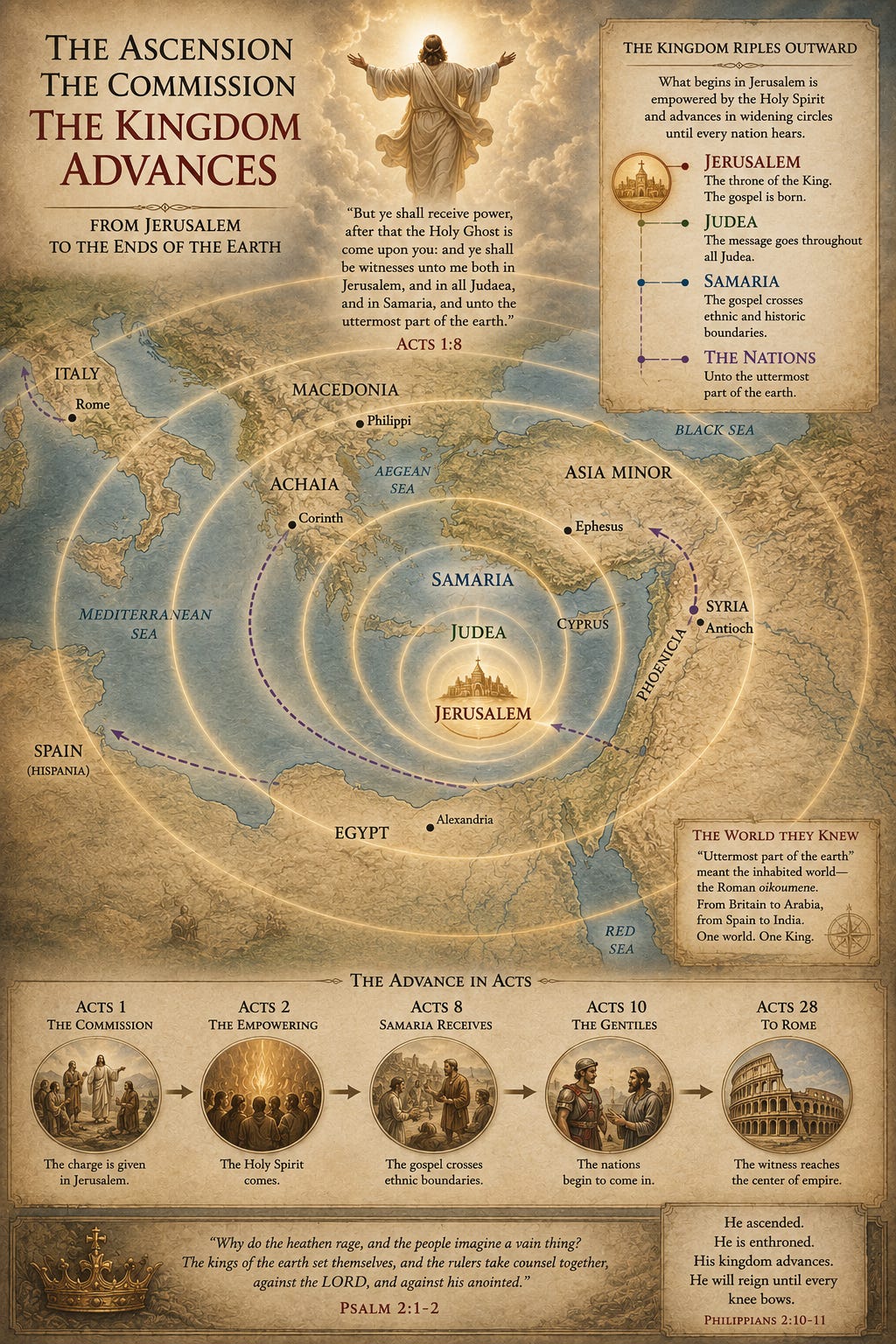
“But ye shall receive power, after that the Holy Ghost is come upon you: and ye shall be witnesses unto me both in Jerusalem, and in all Judaea, and in Samaria, and unto the uttermost part of the earth.” (Acts 1:8)
Jerusalem. Judaea. Samaria. The uttermost part of the earth. The disciples asked about one nation. Jesus answered about all of them…
The full weight of that answer only makes sense if you know what happened to the nations in the first place. And to know that, you have to go back much further than Acts. Further than the Gospels. Further even than Sinai and Abraham.
You have to go back to a courtroom in heaven, a mountain in the north, and a tower on a plain in the fertile crescent named Shinar.
The Bible Assumes We Know What We Don’t
Here is the difficulty with our modern American pea-brains trying to grasp the context of the writings of the ancients…
The bible’s writers held a set of assumptions about the unseen world that they never bothered to explain. Why not? Because their readers already shared them. It was common knowledge. Nobody explains what everybody already knows, as stated by Dr Jeff Barlatier in his piece, The Unseen Council…
Scripture interrupts that framework at every level. Not loudly. Not systemically. But persistently. It assumes — without apology — that reality is not exhausted by what is seen. That behind kings stand princes. Behind systems stand powers. Behind history stands a conflict that is neither metaphorical nor optional. The Bible does not argue for the existence of the unseen realm. It presupposes it. And not merely as a background atmosphere, but as a structured, inhabited, and active dimension that overlaps with human existence.
An “enlightened” world does not share those assumptions...
Two thousand years of theological development, a Reformation fluent in the unseen realm but with heirs who aren’t, an Enlightenment, and a century of both liberal demythologizing and dispensational chart-making have left the modern Christian reader — including the modern conservative Christian reader — with an arrangement of mental furniture the bible’s authors would not recognize.
So when we hit passages that presuppose that framework, we do one of three things. We skip them. We spiritualize them away. Or we force them into a structure built centuries later and retrofitted into one’s systematic theology.
Consider a handful of texts that most Christians have read, but almost none have been taught…
“God standeth in the congregation of the mighty; he judgeth among the gods.” (Psalm 82:1)
“For who in the heaven can be compared unto the LORD? who among the sons of the mighty can be likened unto the LORD? God is greatly to be feared in the assembly of the saints, and to be had in reverence of all them that are about him.” (Psalm 89:6-7)
“And the LORD said, Who shall persuade Ahab, that he may go up and fall at Ramoth-gilead? And one said on this manner, and another said on that manner. And there came forth a spirit, and stood before the LORD, and said, I will persuade him.” (1 Kings 22:20-21)
“Now there was a day when the sons of God came to present themselves before the LORD, and Satan came also among them.” (Job 1:6)
There is a pattern here, and it is not subtle. Scripture repeatedly describes God presiding over an assembly of created spiritual beings. He consults them. They report to Him. They are given assignments. They can dissent. They can be evaluated. They can be condemned. But do not be confused…
Yahweh alone is, as our church regularly sings, “Lord among gods”.
Michael Heiser called this the divine council, and his 2015 book The Unseen Realm did more than any recent work to put it back in front of ordinary readers. But Heiser did not invent this. He recovered it. The framework is older than the Reformation, older than Augustine, older than the New Testament. It is simply what the text says, read the way its first audience would have read it.
Two clarifications before we go further...
First, the word “gods” is not a concession to polytheism. In Hebrew, elohim is a term of place, not of rank. It marks a being whose native realm is the spiritual world rather than the physical one. It is applied to Yahweh, to the members of the council, to the deceased spirit of Samuel in 1 Samuel 28:13, and to demons. Yahweh is elohim; so are others. But only Yahweh is uncreated, only Yahweh is omnipotent, only Yahweh is worshiped. The distance between Yahweh and every other elohim is the distance between the Creator and everything that is not. Deuteronomy 4:35 and Isaiah 43:10-11 are not undone by Psalm 82. They are the reason Psalm 82 ends the way it does.
Second, this is not new theology. The early church read Scripture this way as a matter of course. So did the Jews of the Second Temple period who wrote the New Testament. What was lost was not orthodoxy. What was lost was the background — and as many of you will see, losing the background has “flattened” large amounts of the foreground.
File that framework away in your mind, and watch what happens when you start viewing the scriptures through the lens of the divine council. Because once you start seeing it, you’ll realize it’s literally everywhere.
Rebellion One: The Garden
Every account of cosmic conflict has to start somewhere, and most start with a dramatic pre-creation fall of Satan — a war in heaven before Genesis 1, a rebellion of a third of the angels, Lucifer cast down in the space between the first and second verses of the Bible.
I want to be careful here, because this is where a great many otherwise sound teachers overplay their hand.
Scripture never narrates that event.
It is not that the fall of the adversary is unbiblical. It is that the Bible does not give us a scene. There is no chapter that says: before the world was made, an archangel rebelled, and this is how it went. What we have instead are two oracles addressed to human kings that reach past their subjects toward something older, and a handful of New Testament statements about angels who did not keep their place.
The two oracles are Isaiah 14 and Ezekiel 28.
“How art thou fallen from heaven, O Lucifer, son of the morning! how art thou cut down to the ground, which didst weaken the nations! For thou hast said in thine heart, I will ascend into heaven, I will exalt my throne above the stars of God: I will sit also upon the mount of the congregation, in the sides of the north: I will ascend above the heights of the clouds; I will be like the most High.” (Isaiah 14:12-14)
“Thou art the anointed cherub that covereth; and I have set thee so: thou wast upon the holy mountain of God; thou hast walked up and down in the midst of the stones of fire. Thou wast perfect in thy ways from the day that thou wast created, till iniquity was found in thee.” (Ezekiel 28:14-15)
Read the headers. Isaiah 14:4 addresses “the king of Babylon.” Ezekiel 28:12 addresses “the king of Tyrus.” These are taunt-songs against human rulers. And yet the language will not stay in its lane…
No Phoenician monarch was in Eden. No Babylonian king was ever on the holy mountain among the stones of fire. The prophets are doing something the ancient world understood instinctively. They are describing an earthly ruler by draping him in the mythology of a cosmic one. It’s an insult that only works if the older story is both real and known.
So the historic church reads these passages as double-layered — a human king in the foreground, a fallen spiritual being behind him. Origen argued exactly this in De Principiis (Book I, Chapter 5), and Tertullian assumes it as well. That reading is defensible. What is not defensible is treating these two passages as a straightforward chronological narrative of a pre-Genesis war. They are poetry doing prophetic work, and building a timeline out of them is building on sand.
Here is what Scripture does tell us plainly. Something in Eden was already opposed to God before the man and the woman ate of the forbidden apple...
“Now the serpent was more subtil than any beast of the field which the LORD God had made.” (Genesis 3:1)
The Hebrew word is nachash, and it carries a triple resonance that English cannot hold at once: serpent, one who deceives or practices divination, and — as an adjective — shining or bronze. Paul seems to know all three when he writes that “Satan himself is transformed into an angel of light” (2 Corinthians 11:14). This was not a talking animal. This was a member of the council, present in God’s garden-sanctuary, who chose to work against the purposes of the One who put him there.
What did he want? The text says it plainly...
“For God doth know that in the day ye eat thereof, then your eyes shall be opened, and ye shall be as gods, knowing good and evil.” (Genesis 3:5)
Ye shall be as elohim. The temptation was not fundamentally about fruit. It was an offer of a rank. And it worked, in the worst possible way — God Himself confirmed the outcome…
“And the LORD God said, Behold, the man is become as one of us, to know good and evil.” (Genesis 3:22)
Humanity was made to rule the earth as God’s image bearers, His administrators in the physical realm, exactly as the council served Him in the spiritual one…
“And God said, Let us make man in our image, after our likeness: and let them have dominion over the fish of the sea, and over the fowl of the air, and over the cattle, and over all the earth, and over every creeping thing that creepeth upon the earth.” (Genesis 1:26)
Note the “us.”
If you grew up in church, you were taught that “us” is the Trinity — Father, Son, and Spirit in conversation before the foundation of the world. That’s how I heard it too, for most of my life, and there’s nothing heretical about it. But it’s worth noticing that the reading came along a few centuries after the text, and that the text itself gives us something different.
Look at what happened one verse later. Verse 26 is plural: let us make man in our image. Verse 27 is singular, three times over: So God created man in his own image, in the image of God created he him. If the “us” were partners in the work, verse 27 makes no sense. God didn’t have help.
He had an audience…
And that audience turned up again in Isaiah’s throne room vision, where the prophet heard the voice ask, Whom shall I send, and who will go for us? — spoken in a room that Isaiah has just described as full of other beings. Nobody reads that “us” as an internal conversation within the Godhead. It’s the same idiom. The same room. The same Council
And once you see it, you can’t stop seeing it…
The sons of God present themselves before the Lord in Job. Micaiah watches the Lord sit enthroned with the host of heaven standing on his right hand and on his left, and hears an actual deliberation take place. Daniel sees thrones — plural — set in place before the court sits. The Psalmist says God stands in the assembly and passes judgment among them. This is not a fringe reading assembled from three obscure verses. It’s an institution the Old Testament simply assumes its readers know about, the way it assumes you know what a threshing floor is.
In other words, a Divine Council worldview does not come at the expense of the Trinity…
While seen the Old Testament, the doctrine of the Trinity is built on the New Testament — on the baptismal formula, on John’s prologue, on Paul’s benediction — not on a Hebrew pronoun in Genesis 1. And it’s stronger when it isn’t leaning on a grammatical ambiguity that a sharp skeptic can pick apart in thirty seconds.
What you gain by letting Genesis 1:26 mean what it meant to the people who first heard it is the rest of the story. Because the moment you accept that there was a courtroom, and that there were others in it, the third chapter stops being a fable about a talking animal and becomes something much bigger and far more serious.
The council is standing right there in the first chapter of the Bible. And one of them is listening…
“And I will put enmity between thee and the woman, and between thy seed and her seed; it shall bruise thy head, and thou shalt bruise his heel.” (Genesis 3:15)
Everything that follows in the bible is the working-out of that sentence.
One more note that will be important later. When Jesus says…
“I beheld Satan as lightning fall from heaven.” (Luke 10:18)
Luke is not reminiscing about a pre-creation event here. Look at the context. He says it in the moment the Seventy return from their mission, reporting that even the demons submitted to them. They had been sent out in pairs, ahead of Jesus, into every town and place He intended to enter — seventy of them, and the number is not incidental (seventy missionaries / seventy nations).
The described fall is a consequence of their mission. Remember this because it becomes load-bearing in Part II.
Rebellion Two: The Mountain
Genesis 6 contains four of the strangest verses in the Bible. The modern church has spent enormous time and energy “flattening” or explaining them away, while the non-believing world has spent equal time and energy secularizing the idea — whitewashing of theological importance, and turning it into an “alien” phenomenon…
“And it came to pass, when men began to multiply on the face of the earth, and daughters were born unto them, that the sons of God saw the daughters of men that they were fair; and they took them wives of all which they chose.” (Genesis 6:1-2)
“There were giants in the earth in those days; and also after that, when the sons of God came in unto the daughters of men, and they bare children to them, the same became mighty men which were of old, men of renown.” (Genesis 6:4)
The dominant evangelical reading for the last several centuries has been the Sethite view: the “sons of God” are the godly line of Seth, the “daughters of men” are the ungodly line of Cain, and the sin is intermarriage between believers and unbelievers.
That reading has a serious problem — it is not what the phrase means anywhere else in the Hebrew Bible…
Bene ha-elohim — sons of God — refers to divine beings in Job 1:6, Job 2:1, and Job 38:7, with a parallel construction in Psalm 89:6. There is no instance where it denotes a human genealogical line. And the Sethite view has no explanation whatsoever for the offspring. Godly men and ungodly women do not produce Nephilim. Ordinary, but unequally-yoked marriage does not yield giants.
More decisively, I would argue that the New Testament writers did not hold the Sethite view…
“For if God spared not the angels that sinned, but cast them down to hell, and delivered them into chains of darkness, to be reserved unto judgment; and spared not the old world, but saved Noah the eighth person, a preacher of righteousness, bringing in the flood upon the world of the ungodly.” (2 Peter 2:4-5)
Peter put the sin of the angels immediately adjacent to the flood, in that order. That is Genesis 6 read the plain way.
Jude is more explicit still…
“And the angels which kept not their first estate, but left their own habitation, he hath reserved in everlasting chains under darkness unto the judgment of the great day. Even as Sodom and Gomorrha, and the cities about them in like manner, giving themselves over to fornication, and going after strange flesh, are set forth for an example, suffering the vengeance of eternal fire.” (Jude 6-7)
Angels who left their proper dwelling are compared to sexual sin. Described as going after “strange flesh” — flesh of a different kind. Jude is not describing pious Sethites making poor marriage choices.
This was the consensus of the early church, and it was not fringe. Justin Martyr, Irenaeus, Athenagoras, Tertullian, Clement of Alexandria, Lactantius, and Ambrose all read Genesis 6 supernaturally. Athenagoras stated it directly in his Plea for the Christians (Chapter 24). Justin Martyr did the same in his Second Apology (Chapter 5).
In fact, it wasn’t just that this view was the consensus; it was unanimous. There is no known dissent…
This was the topic of Jaap J.T. Doedens’s doctoral dissertation (2013 — his 5-page overview), while at the Theological University of Kampen in the Netherlands (Doedens is currently an associate professor at Pápa Reformed Theological Seminary in Hungary), which he turned into a 400-page book, “The Sons of God in Genesis 6:1–4: Analysis and History of Exegesis”. The gist is that before the shift discussed in the following paragraph, it is impossible to find even hints of the Sethite view.
So, what happened…?
The shift came with Augustine and John Chrysostom, seemingly driven by a desire to distance Christian interpretation from the book of Enoch that heretics were fond of quoting — not by fresh exegesis of the Hebrew (Christian historian Phillip Schaff on this subject). More importantly, Jewish rabbis were intentionally altering and reinterpreting multiple passages (OT) on the sons of God for the express purpose of de-deifying Christ.
A final word about the Sethite view before leaving this subject…
The Deuteronomy 32 worldview lives or dies on the Sethite reading — if it is true, a significant amount of today’s post cannot be. If you really want to see the debate, take a peek at the last several episodes of the Reformed Fringe in light of this simple question…
Were the Nephilim supernatural giants, or were they simply some tall people that were the result of godly men marrying ungodly women?
Responding to Dr. Cooper on Genesis 6 is an invaluable resource because it’s Van Dorn and Moffet deconstructing the classic Sethite position, one point at a time. The really cool part is that Van Dorn — the pastor of the Reformed Church of Northern Colorado for 25 years and author of a couple dozen books, including his Tenth Anniversary edition of Giants; Sons of the gods — had been leading up to this with…
Talking Giants: Prepare to have your mind blown!
Gog & Amelek: If you’ve ever wondered about the Bible’s constant emphasis on genealogies, wonder no more, as Doug discusses one of the stranger and enigmatic prophecies in the Bible: the infamous Gog and Magog. The ties here are deeply supernatural, tied to the angelic ‘princes’ of the nations (Table of Nations), and especially to the giant tribes and the nephilim storyline of the OT. One badly misunderstood tribe is at the root of this: the Amalekites.
The gods (Part I) and the Sons of God Part II and Part III (as well as his episode titled Jesus: Son of God: The electrifying three-part installment of ‘The Cosmic War of the Sons of God’ on the Reformed Fringe podcast, where we unravel the mysterious ‘sons of God’ in the Old Testament. Doug will explore the shocking truth that these are not human figures but supernatural beings—angels tasked with ruling nations, yet some fell into rebellion, sparking a cosmic battle that reverberates through history. Listen to uncover why this war matters for your faith, how it connects to Jesus as the true Son of God, and why understanding this epic struggle will transform your view of Scripture and the spiritual realm.
A Word About the Book of Enoch
We cannot go further without dealing with Enoch, because Jude quotes it.
“And Enoch also, the seventh from Adam, prophesied of these, saying, Behold, the Lord cometh with ten thousands of his saints, to execute judgment upon all, and to convince all that are ungodly among them of all their ungodly deeds which they have ungodly committed, and of all their hard speeches which ungodly sinners have spoken against him.” (Jude 14-15)
That is a direct quotation of 1 Enoch 1:9.
And Jude’s whole surrounding argument — the angels who left their habitation, held in chains of darkness — tracked Enoch’s account of the Watchers closely enough that it cannot be coincidence.
So what do we do with it?
Just remember that Enoch was a witness, never an authority.
It tells us what the conceptual world of the New Testament writers looked like. It tells us that Jude’s readers would have recognized this allusion. It does not, however, tell us what is true. Where it aligns with canonical Scripture, it illuminates. Where it goes beyond canonical Scripture, it is interesting. Where it contradicts canonical Scripture, it is wrong. No exceptions.
Three practical cautions…
“The Book of Enoch” is not one book. It is a composite of at least five distinct works written over several centuries. The Book of the Watchers (chapters 1-36) is the section that matters here and is well attested in the Dead Sea Scrolls. The Similitudes or Parables (chapters 37-71), which contain the striking “Son of Man” material, are not attested at Qumran and are disputed in date, with some scholars placing them late enough to raise the question of Christian influence rather than the reverse. Important: Anyone who cites “Enoch” as a single unified prophetic book has not read it.
Quotation is not endorsement. Paul quoted the Cretan poet Epimenides in Titus 1:12 and the Athenian poet Aratus in Acts 17:28. Neither became Scripture. Jude affirmed that this particular saying is true. Doing so did not canonize the corpus.
Augustine rejected it, and his reason deserves engagement rather than dismissal. In City of God 15.23 and 18.38 he acknowledges that Enoch wrote something divine — Jude says so — but argued that the writings circulating under Enoch’s name could not be trusted for antiquity, and were rightly excluded from the canon by those responsible for guarding it (something I will get plenty of pushback about in the comment section). He is right about the canon question. Where I part company with Augustine is Genesis 6 itself. His move away from the supernatural reading was made partly to avoid the Enochic baggage, and in avoiding the baggage he abandoned the plain sense of the passage.
The Mountain Itself
1 Enoch supplies one detail that Scripture does not state directly but that the rest of the Bible appears to assume. A location. The Watchers descend on Mount Hermon.
That name should stop you. Hermon sits at the northern edge of Israelite territory, on the border of Bashan. Why should that interest us? Bashan is where the Old Testament puts its giants…
“For only Og king of Bashan remained of the remnant of giants; behold, his bedstead was a bedstead of iron; is it not in Rabbath of the children of Ammon? nine cubits was the length thereof, and four cubits the breadth of it, after the cubit of a man.” (Deuteronomy 3:11)
“All the kingdom of Og in Bashan, which reigned in Ashtaroth and in Edrei, who remained of the remnant of the giants.” (Joshua 13:12)
Bashan carried an unmistakable reputation in the Hebrew imagination. It was associated with the Rephaim — a term used both for the giant clans and for the shades of the dead. Ugaritic texts recovered at Ras Shamra connect the region to the cult of dead kings.
Psalm 68, which we will return to in Part II, sets Bashan in direct opposition to God’s own mountain…
“The hill of God is as the hill of Bashan; an high hill as the hill of Bashan. Why leap ye, ye high hills? this is the hill which God desireth to dwell in; yea, the LORD will dwell in it for ever.” (Psalm 68:15-16)
The picture is territorial. There is God’s mountain, and there is the enemy’s mountain, and they are set against each other.
File that away because in Part II, Jesus walked His disciples eighty miles north, out of Galilee entirely, to the very foot of Mount Hermon — to ask them who He is.
What the Nephilim Left Behind
One more thread from Genesis 6, because it determines what “deceive the nations no more” will mean when we reach Revelation 20.
Where do demons come from?
There are essentially two answers...
The common assumption is that demons are simply fallen angels — the same beings as the Watchers, operating freely. The other, which is the reading of Enoch, is that demons are the disembodied spirits of the dead Nephilim. Hybrid beings whose bodies perished in the flood but whose spirits, having no proper place in either realm, remained on the earth (1 Enoch 15:8-10).
If the second view is right, it accounts for something the Gospels make conspicuous. Demons are frantic about embodiment. They beg not to be sent out of the region, plead to enter swine, seek dry places but find no rest.
“When the unclean spirit is gone out of a man, he walketh through dry places, seeking rest, and findeth none.” (Matthew 12:43)
“And all the devils besought him, saying, Send us into the swine, that we may enter into them.” (Mark 5:12)
That is not the behavior of a powerful angelic prince. That is the behavior of something displaced and desperate for a body.
This distinction matters for Part III. The angelic Watchers of Genesis 6 are already imprisoned according to Jude and 2 Peter — bound, in chains, reserved for judgment. That is a different set of beings from the territorial rulers of Deuteronomy 32 and Daniel 10, who are demonstrably still operating.
Which means that when Revelation 20 speaks of a binding, we already have a canonical category for what “bound” looks like, and we already know it does not mean “removed from the earth.”
My own opinion after a decade of deep-diving this topic? I hold the Nephilim-spirits view as the better reading, primarily because it explains the Gospel narrative better. But nothing in this post collapses if you disagree. Both views agree on the essential point — that the beings ruling over and harassing the nations in the spiritual realm are created, defeated, and doomed.
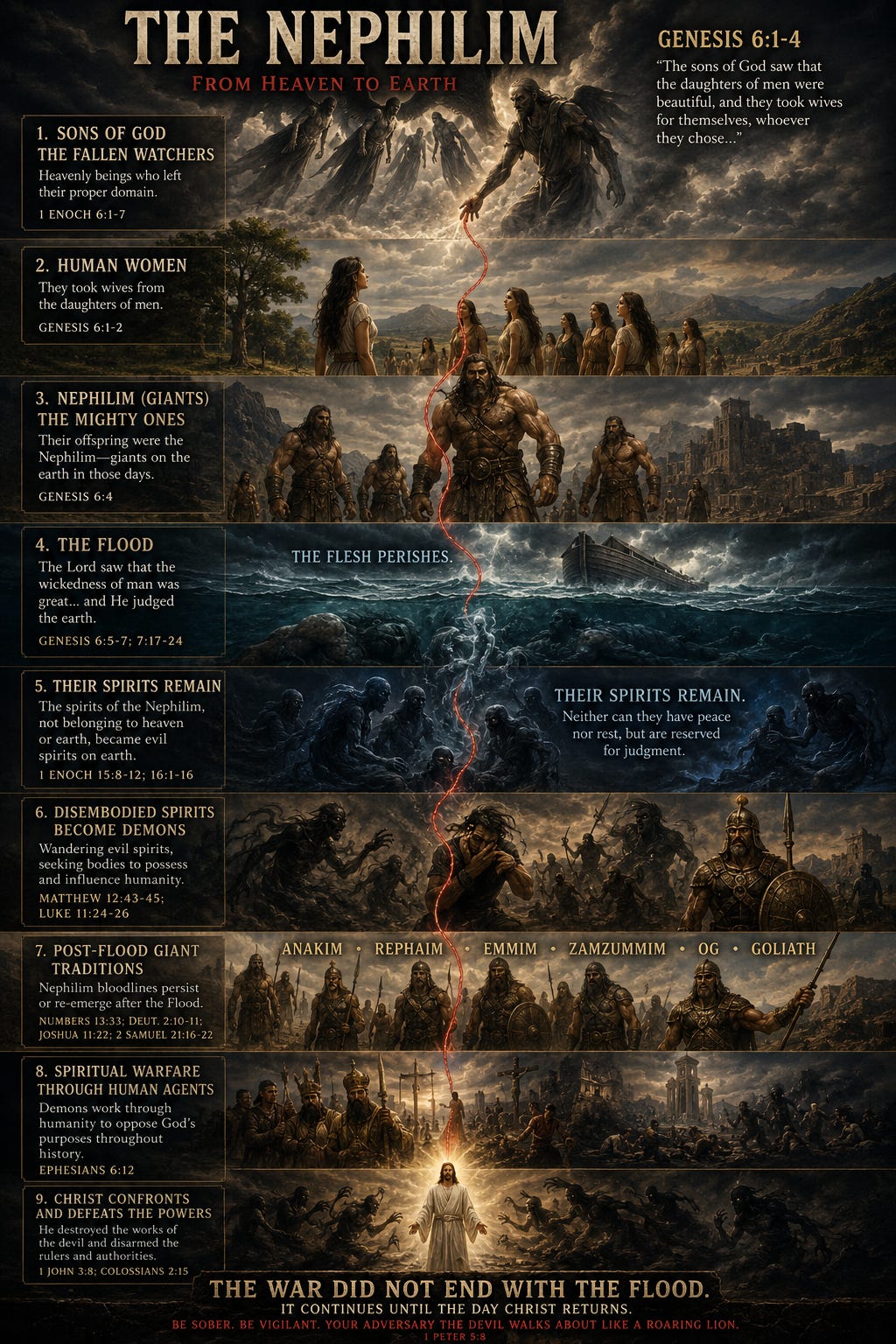
Here are three articles by Dr Barltier as well as a “picture-is-worth-a-thousand-words” image I created with ChatGPT, from a PowerPoint slide on Daniel I built over a decade ago…
When Giants Die but Don’t Leave: Demons, Nephilim, and the Theology Nobody Talks About
The Giants You Leave Behind: How Gaza, Gath, and Ashdod Became Tomorrow’s Battlefield
Satan Who? Meet Azazel and Samyaza, the Original Fallen Angels
A Quick Summary: Giants are hybrids of fallen angels and human women. When they died in the Flood, their spirits became demons — disembodied entities (elohim) without flesh, permanently seeking bodies to possess. Post-Flood giants were either survivors or re-emerged descendants of the original Nephilim bloodlines, requiring ongoing spiritual warfare through human agents that continues to Christ and beyond — even to our day.
Rebellion Three: The Tower
Now to the hinge. This is the passage that reorganizes everything, and it is the one most Christians know cold, but have never had properly explained to them.
Start with the story as we all learned it…
“And the whole earth was of one language, and of one speech. And it came to pass, as they journeyed from the east, that they found a plain in the land of Shinar; and they dwelt there.” (Genesis 11:1-2)
“And they said, Go to, let us build us a city and a tower, whose top may reach unto heaven; and let us make us a name, lest we be scattered abroad upon the face of the whole earth.” (Genesis 11:4)
“And the LORD came down to see the city and the tower, which the children of men builded. And the LORD said, Behold, the people is one, and they have all one language; and this they begin to do: and now nothing will be restrained from them, which they have imagined to do. Go to, let us go down, and there confound their language, that they may not understand one another’s speech. So the LORD scattered them abroad from thence upon the face of all the earth: and they left off building the city.” (Genesis 11:5-8)
Two things to notice before moving forward.
First, “let us go down.” The council again.
Second, Genesis tells us the languages were confused and the people scattered. It does not tell us what became of them afterward. The narrative gives us Babel, followed by the Table of Nations, picking up Abram in verse 26 the very next chapter. Genesis 11 ends with a scattering and Genesis 12 begins with a calling, and the connection between the two is left unstated.
Moses, however, stated it in crystal-clear fashion in Deuteronomy 32…
“When the Most High divided to the nations their inheritance, when he separated the sons of Adam, he set the bounds of the people according to the number of the children of Israel. For the LORD’s portion is his people; Jacob is the lot of his inheritance.” (Deuteronomy 32:8-9, KJV)
Read that carefully, because the King James rendering, which is typically my go-to version, hides the problem. And once you see the problem, you will understand why this passage is key to making sense of numerous passages throughout the entirety of Scripture, a few of which we touched on earlier.
A key passage for having your spiritual eyes opened to begin to see and actually understand the governing hierarchy and what essentially amounts to a military ranking of the unseen realm, as seen in the various versions of Ephesians 6:12.
It’s a list that blew my mind, and might blow yours as well…
principalities and powers, rulers, evil rulers, evil rulers and authorities of the unseen world, evil beginnings, preeminents, governments, powers, authorities, potentates, empires, despotisms, forces and authorities, powers of this dark world, mighty powers in this dark world, cosmic powers over this present darkness, cosmic powers of this dark age, cosmic powers in the darkness around us, world forces of this darkness, world powers of this darkness, world rulers of the darkness of this age, world-rulers of this darkness, princes of darkness, rulers of darkness, rulers of the darkness of this world, rulers of this world of darkness, universal lords of this darkness, directors of this world of darkness, chiefs of the world of darkness of this life, powers who govern this world of darkness, forces that control and govern this dark world, spiritual forces of evil in the heavenly realms, spiritual forces of evil in the heavens, spiritual forces of wickedness in the heavenly places, spiritual forces of pain-ridden evil in the heavenlies, spiritual forces that control evil in the heavenly world, spiritual hosts of wickedness in the heavenly places, spiritual hosts of evil arrayed against us in the heavenly warfare, spiritual wickedness in high places, spiritual things of the evil in the heavenly places, spirits of wickedness in high places, evil spirits in the heavenly places, evil spirits under the heavens, wicked spirits in the heavenly regions, wicked aereal spirits, powers in the spiritual world.
The Manuscript Question, Handled Head-On
The KJV, following the Masoretic Hebrew text, reads “according to the number of the children of Israel.”
That makes no sense in context, and it has bothered careful readers for a very long time. The event described is Babel — the division of the nations. Israel does not exist yet. Jacob has not been born. Abram has not been called. Why would God set the boundaries of the nations by the number of a people who would not appear for centuries?
Two other ancient renderings read differently…
The Septuagint — the Greek translation of the Hebrew Scriptures made by Jewish scholars in the third and second centuries BC, and the version quoted throughout the New Testament — reads “according to the number of the angels of God.”
But that’s not even the biggie…
In 1952, in Cave 4 at Qumran on the Dead Sea, a Hebrew manuscript fragment designated 4QDeut-j was recovered, predating the Masoretic tradition by roughly a thousand years. It read bene elohim — sons of God.
So we have the older Hebrew and the ancient Greek agreeing against the later Hebrew. And the reading they agree on makes immediate sense of a passage that otherwise doesn’t.
This raises an important question. Was there a nefarious reason for the 1611 (KJV) being translated in this manner? No…
Jude 7 says Sodom sinned “in like manner” — but the Greek adds a small word the King James leaves out (toutois), pointing backward at the angels of verse 6, not sideways at the neighboring cities. In other words, Sodom's sin is being compared to theirs. And the King James is the version that preserves what that sin was, rendering it “strange flesh” — literally, flesh of another kind — where most modern translations flatten it into “perversion” or “unnatural desire” and lose the point entirely.
The dominant reading of Genesis 6 in Reformation and post-Reformation England was the Sethite view — the godly line of Seth marrying the ungodly line of Cain. Calvin held it. The Geneva Bible notes pushed it. If the translators shared that assumption, and they probably did, then the angelic reading of Jude 7 simply wasn't on their radar to suppress. You can't scrub a reading you never considered. Ambient assumption isn't conspiracy.
Many translations have followed this evidence.
When God divided the human race after Babel, He apportioned the nations among the members of His heavenly council — one administrator each. The number seventy isn’t printed in the verse; it comes from counting the nations in Genesis 10 and reading the two passages together, as the ancient reader would have done.
But it is Deut 32:9 that turns the hinge…
For the LORD’s portion is His people; Jacob is the lot of his inheritance.
God parceled out the nations, keeping exactly one for Himself.
And the name of that nation is hiding in plain sight, because it is the second name God later gave Jacob — a name given in the same way He had renamed Jacob’s grandfather from Abram to Abraham in his latter years.
And it came twice. First at Peniel, after a night spent wrestling a man who turned out to be an angel. Then again at Bethel, when God appeared to him a second time and made the change formal…
And he said, Thy name shall be called no more Jacob, but Israel: for as a prince hast thou power with God and with men, and hast prevailed. (Genesis 32:28)
And God said unto him, Thy name is Jacob: thy name shall not be called any more Jacob, but Israel shall be thy name: and he called his name Israel. (Genesis 35:10)
Portion, inheritance, lot — that’s estate language, the same vocabulary used when Canaan was divided among the twelve tribes (Numbers 26:52–56; Numbers 33:54; Numbers 34; Joshua 13–19; Joshua 14:1–2; Joshua 17:5; Joshua 18:10; Joshua 19:9; Joshua 13:33). And notice what the text doesn’t say. These beings weren’t nessecarily evil when initially installed. They were appointed, lawfully, as regional administrators under God’s authority.
What they became is the subject of Psalm 82, where God indicted them for judging unjustly and favoring the wicked. Appointed, corrupted, sentenced. Part II turns on that sequence, so stay tuned.
Now, back to the modern versions that follow this line of evidence…
RSV — 1952. The earliest of these, and the most important date on the list: the translation committee adopted the reading on the strength of the Septuagint alone, decades before the Qumran Deuteronomy fragment supporting it was published, and sixty-three years before The Unseen Realm. (“according to the number of the sons of God”)
Good News Bible / GNT — 1976. The American Bible Society put the divine-council sense into a mass-market pew Bible aimed at ordinary readers, not scholars. (“He assigned to each nation a heavenly being”). Read this one again. Not because I recommend you run out and buy this translation, but because it is the most simplified of the bunch.
NRSV — 1989. Goes furthest of any major version, showing that translators who followed the manuscript evidence were willing to state the implication plainly. (“according to the number of the gods”)
NLT — 1996. Published by Tyndale House for an evangelical readership, which breaks the assumption that this reading lives only in mainline Bibles. (“according to the number in his heavenly court”). Hold the idea of the heavenly court because we see it in Daniel 7, just prior to Christ Coming on the Clouds to heaven to receive the keys to the Kingdom and be crowned King of Kings by the Father Himself.
ESV — 2001. The decisive version for conservative Reformed readers. J. I. Packer’s committee put the reading in the text rather than burying it in a footnote, and this is arguably the version used in most Confessional churches in America. (“according to the number of the sons of God”)
NET — 2005. Produced at Dallas Theological Seminary (a conservative, dispensational institution) under Daniel Wallace and Robert Chisholm. Interestingly, it carries the most detailed translator’s note on the variant of any English Bible in print. (“according to the number of the heavenly assembly”)
CEB — 2011. Confirms the reading held across a full sixty years of committee work rather than appearing and fading. (“based on the number of the gods”)
I fed these bullet points into Claude and asked it to summerize Deuteronomy 32:8-9 for me…
Deuteronomy 32:8–9 describes a single event with two halves.
When God divided the human race into nations, He did not leave them unattended. He assigned each nation to a member of His heavenly council — the “sons of God,” rendered variously across English translations as the gods, the heavenly assembly, or His heavenly court.
The second half is the exception.
One nation was not assigned to anyone. Verse 9 says the LORD’s portion is His people, and Jacob is the lot of His inheritance. He kept Israel for Himself, ruling it directly.
The vocabulary throughout is the language of dividing an estate — portion, inheritance, lot, allotment. The nations were parceled out. One was retained.
The number of those nations is not given in the verse. It comes from the table of nations in Genesis 10, which lists seventy.
God did not merely scatter the nations at Babel, He disinherited them. He assigned them to members of His divine council and handed them over.
And then, in the very next act of the story, He called one man out of Ur and started over, building for Himself a people of His own — a nation of humble beginnings that would grow until it encompassed the entire world (start marching around your house singing Father Abraham, not ignoring it’s deeper Christian truth — article, article, article, article, article, article).
Genesis 10, the seventy nations catalogued. Genesis 11, the nations disinherited, scattered, and turned over at Babel. Genesis 12, Abram called out of Ur to be the father of many nations — one of which would be Israel. Hold that phrase, many nations. It matters more than you think, and we will come back to it, because as I stated earlier, it’s a critical premise of the Gospel message.
The Fallback That Needs No Variant
Someone is going to tell you that this whole framework rests on a textual variant — that you have to abandon the Masoretic text to get there, and therefore the argument is built on a scholarly preference.
That objection fails, and here is why. The same claim is made in a passage where there is no variant…
“And lest thou lift up thine eyes unto heaven, and when thou seest the sun, and the moon, and the stars, even all the host of heaven, shouldest be driven to worship them, and serve them, which the LORD thy God hath divided unto all nations under the whole heaven. But the LORD hath taken you, and brought you out of the iron furnace, even out of Egypt, to be unto him a people of inheritance, as ye are this day.” (Deuteronomy 4:19-20)
That is the Masoretic text. That is the King James. There is no manuscript dispute.
And it says exactly the same thing as Deuteronomy 32:8-9. The host of heaven was divided unto all nations — the Hebrew verb is one of apportionment, of allotting a share. Israel was taken as God’s own inheritance. Two allotments, two portions: the nations to the host of heaven, Israel to Yahweh.
The framework does not depend on the Dead Sea Scrolls, but the Dead Sea Scrolls confirm it. To show you just how important this concept is in the overarching theme of scripture, Moses repeated it a third time…
“Take heed to yourselves, lest ye forget the covenant of the LORD your God, which he made with you, and make you a graven image, or the likeness of any thing, which the LORD thy God hath forbidden thee.” (Deuteronomy 4:23)
“And the LORD shall scatter you among the nations... And there ye shall serve gods, the work of men’s hands, wood and stone, which neither see, nor hear, nor eat, nor smell.” (Deuteronomy 4:27-28)
To be exiled from the land is to be handed over to the gods of the nations…
Territory and spiritual allegiance are bound together throughout the Old Testament. This is why Naaman hauled Israelite dirt back to Syria in 2 Kings 5:17. Why David complained that being driven out of the inheritance of the LORD amounted to being told, “Go, serve other gods” (1 Samuel 26:19).
Why Seventy Nations?
Genesis 10 — the chapter immediately preceding Babel — is the Table of Nations. It lists the descendants of Shem, Ham, and Japheth who became the peoples of the earth. Count them. That number is not incidental, and it does not go away. It recurs at every significant juncture in the story…
Seventy of Jacob’s household go down into Egypt (Genesis 46:27; Exodus 1:5).
Seventy elders of Israel ascend Sinai and eat and drink before God (Exodus 24:1, 9-11).
Seventy elders receive the Spirit that was on Moses (Numbers 11:16, 24-25).
Seventy palm trees stand at Elim (Exodus 15:27).
Seventy years of exile are decreed (Jeremiah 25:11).
Seventy missionaries sent out in Luke 10.
The seventy motif is real, biblical, and repeated. It is a genuine literary and theological thread. But there are a couple of caveats to think about…
Footnote #1: The Hebrew text of Genesis 10 yields seventy nations; the Greek Septuagint yields seventy-two. The same split shows up in the manuscripts of Luke 10, where some read seventy and others seventy-two. That is not a problem for the argument — it is a fingerprint of it. Whichever tradition a scribe was working in, the number of those Jesus sent out matched the number of nations in his Bible.
Footnote #2: The seventy weeks of Daniel 9 are a separate matter. They operate on a different axis — a chronological prophecy measured in sevens (“weeks”) of years (490 to be exact), not a count of nations. While there is resonance between the two, there is no demonstrable textual equation. I will show you the resonance in Part II where the timing converges.
The Council Becomes Corrupt
The nations were placed under the administration of the sons of God. And the sons of God did with that authority exactly what fallen creatures do with authority.
Psalm 82 is the courtroom scene…
“God standeth in the congregation of the mighty; he judgeth among the gods. How long will ye judge unjustly, and accept the persons of the wicked? Selah. Defend the poor and fatherless: do justice to the afflicted and needy. Deliver the poor and needy: rid them out of the hand of the wicked. They know not, neither will they understand; they walk on in darkness: all the foundations of the earth are out of course.” (Psalm 82:1-5)
The gods were given a job. Administer justice among the peoples entrusted to you. Protect the poor, the fatherless, the afflicted.
They did the opposite. They accepted the persons of the wicked. They took worship for themselves. They ran the nations into the ground until “all the foundations of the earth are out of course.”
And so the consequence…
“I have said, Ye are gods; and all of you are children of the most High. But ye shall die like men, and fall like one of the princes.” (Psalm 82:6-7)
Ye are elohim…
God Himself says it, and He is not conceding polytheism — He is stating what these beings are before announcing what they will become. Created spiritual beings, given a portion of His authority, who will now be stripped of their immortality and die like the humans they were supposed to protect.
Then comes the prophetic bombshell — the psalm’s final line, which is the theme of everything that follows. The very theme of the Gospel itself…
“Arise, O God, judge the earth: for thou shalt inherit all nations.” (Psalm 82:8)
Every nation. Not Israel only. All of them.
The psalmist is asking God to take back what He gave away. And when Jesus is accused of blasphemy in John 10, this is the psalm He reaches for…
“Jesus answered them, Is it not written in your law, I said, Ye are gods? If he called them gods, unto whom the word of God came, and the scripture cannot be broken; Say ye of him, whom the Father hath sanctified, and sent into the world, Thou blasphemest; because I said, I am the Son of God?” (John 10:34-36)
Jesus Christ quotes Psalm 82:6 and says “the scripture cannot be broken.” He is not embarrassed by the divine council. Instead, He builds one of scripture’s most powerful theological arguments on it.
Daniel Names Names
If Deuteronomy 32 and Psalm 82 tell us the theology of the divine council exists, Daniel 10 is a picture of it operating in real time.
Daniel fasts and mourns for three weeks. Then an angelic messenger arrives with an explanation for the delay that ought to leave you wondering why you’ve never heard this preached in your church before...
“Then said he unto me, Fear not, Daniel: for from the first day that thou didst set thine heart to understand, and to chasten thyself before thy God, thy words were heard, and I am come for thy words. But the prince of the kingdom of Persia withstood me one and twenty days: but, lo, Michael, one of the chief princes, came to help me; and I remained there with the kings of Persia.” (Daniel 10:12-13)
“Then said he, Knowest thou wherefore I come unto thee? and now will I return to fight with the prince of Persia: and when I am gone forth, lo, the prince of Grecia shall come. But I will shew thee that which is noted in the scripture of truth: and there is none that holdeth with me in these things, but Michael your prince.” (Daniel 10:20-21)
A prince of Persia. A prince of Greece. And a prince of Israel named Michael.
These are not human kings — a human monarch does not delay an angelic messenger for three weeks, and no human is Israel’s “prince” in a context where Michael is named. These were the territorial spiritual rulers of Deuteronomy 32, identified by nation, engaged in conflict, and — note this — aligned with the geopolitical order of the empires they govern. Persia was on its way out. Greece was on its way in. The unseen conflict tracked with the visible conflict.
Origen saw this clearly and argued it at length against the pagan critic Celsus, who had mocked Christians for their view of the nations. Origen replied that the division of the peoples among angelic overseers is exactly what Deuteronomy teaches, and that Christ’s coming was the reclamation of what those overseers had corrupted.
Daniel 12 completes the picture, and it points forward…
“And at that time shall Michael stand up, the great prince which standeth for the children of thy people: and there shall be a time of trouble, such as never was since there was a nation even to that same time: and at that time thy people shall be delivered, every one that shall be found written in the book.” (Daniel 12:1)
Paul Read It This Way Too
It would be fair, at this point, to ask whether all of this is an Old Testament arrangement that the New Testament quietly ignored.
It is not. Paul was working directly from Deuteronomy 32…
“But I say, that the things which the Gentiles sacrifice, they sacrifice to devils, and not to God: and I would not that ye should have fellowship with devils.” (1 Corinthians 10:20)
That is a quotation of Deuteronomy 32:17 — “They sacrificed unto devils, not to God; to gods whom they knew not, to new gods that came newly up, whom your fathers feared not.” Paul was telling Corinthian Christians that pagan sacrifice is not merely misguided ritual directed at nothing. It’s a real “communion” with real beings.
He said it more carefully a couple chapters earlier…
“For though there be that are called gods, whether in heaven or in earth, (as there be gods many, and lords many,) But to us there is but one God, the Father, of whom are all things, and we in him; and one Lord Jesus Christ, by whom are all things, and we by him.” (1 Corinthians 8:5-6)
Paul did not say the gods of the nations are imaginary. He said they exist as created things, and that for the Christian there is but one God and one Lord that rules supremely over all of them. This is precisely the Deuteronomy 32 framework carried forward into the New Testament intact.
And then the passage everyone knows, and almost nobody reads in this light…
“For we wrestle not against flesh and blood, but against principalities, against powers, against the rulers of the darkness of this world, against spiritual wickedness in high places.” (Ephesians 6:12)
Although touched on earlier, a couple paragraphs are in order here…
Principalities. Powers. Rulers. Administrative terms — terms of jurisdiction and rank. Not a mood or a mist. The word ‘principalities’ is traced back to the Latin princeps, a chief, a first-ranked ruler, and it names a territory with someone placed over it.
The Greek behind Paul's word in Ephesians 6:12 is archas, the vocabulary of magistracies and provincial governors — the same terms a Roman would have used for the men administering his empire.
Paul is not describing free-floating malevolence here...
He is describing a chain of command, staffed, ranked, and holding assigned ground in a governmental / military heirarchy — the same hierarchy Daniel's messenger had to fight his way through, delayed twenty-one days by the prince of Persia, warning on his way out that the prince of Greece was next.
Where Part I Leaves Us
Let’s set the pieces on the table and see what the board looks like…
The nations of the earth were disinherited at Babel and placed under the administration of created spiritual beings (Deuteronomy 32:8-9; Deuteronomy 4:19-20).
Those beings corrupted their charge, took worship for themselves, and were sentenced to die like men (Psalm 82).
They are territorial, they are named by nation, and they contest the purposes of God in real time (Daniel 10).
God kept one nation for Himself and built it out of one childless couple (Genesis 12; Deuteronomy 4:20).
And the whole arrangement was always temporary, because the last line of the courtroom psalm is a petition God intended to answer…
“Arise, O God, judge the earth: for thou shalt inherit all nations.” (Psalm 82:8)
The Old Testament ends with that petition unanswered. Israel is in the land, then out of it, then back in a diminished form under foreign rule. The nations remain in the hands of their princes. The seventy are still seventy.
But the answer had already been written into a coronation psalm that Israel had been singing for a thousand years, that no one understood what it would cost to fulfill…
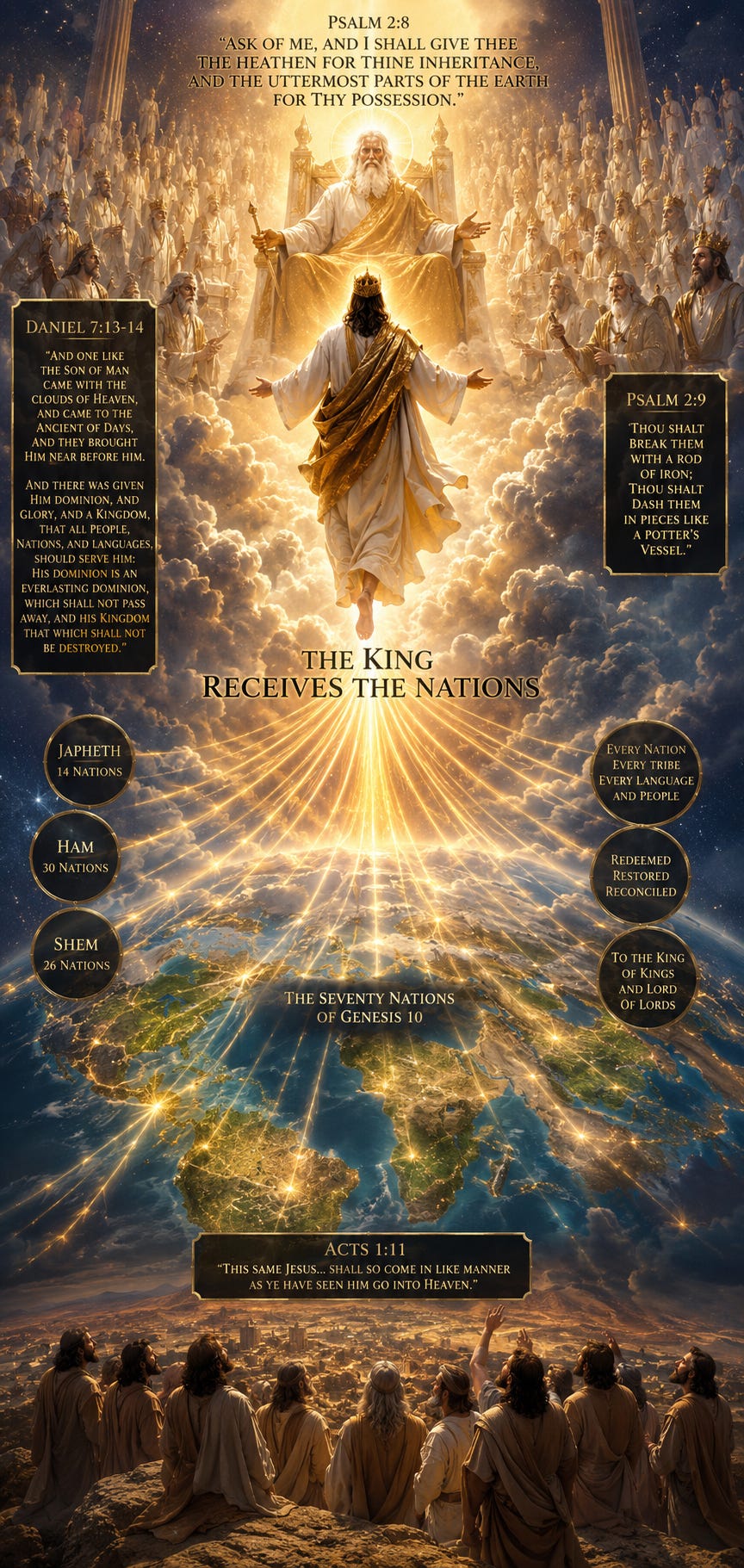
“I will declare the decree: the LORD hath said unto me, Thou art my Son; this day have I begotten thee. Ask of me, and I shall give thee the heathen for thine inheritance, and the uttermost parts of the earth for thy possession.” (Psalm 2:7-8)
Ask of me, and I shall give thee the nations for thine inheritance…
Deuteronomy 32:9 gave Yahweh Jacob only. Psalm 2:8 promised the Son everything else. Part II is the story of how He asked, and what it cost Him, and the day the Father said yes.
PART II — THE RECLAMATION
Four Hundred Years of Nothing
The Old Testament closed with Malachi, and then the record went quiet for four centuries.
During that silence, the nations kept doing what disinherited nations do…
Persia gave way to Greece exactly as Daniel’s messenger said it would. Greece fractured into successor kingdoms. Antiochus IV Epiphanes desecrated the temple and was thrown out by the Maccabees. Rome then absorbed everything. By the time the silence broke, Israel was a client province with a puppet Edomite on the throne, an occupying garrison in the fortress overlooking the temple courts, and a religious establishment that had learned to manage the arrangement.
However, the petition of Psalm 82 was still on the table, unanswered…
“Arise, O God, judge the earth: for thou shalt inherit all nations.” (Psalm 82:8)
The prophets had promised that it would be answered.
Isaiah said the nations would come. Micah said they would stream to the mountain of the LORD. Zechariah said that ten men out of all languages would take hold of the skirt of a Jew. Malachi, in the final book, said something so startling that later readers spiritualized it just to make it manageable…
“For from the rising of the sun even unto the going down of the same my name shall be great among the Gentiles; and in every place incense shall be offered unto my name, and a pure offering: for my name shall be great among the heathen, saith the LORD of hosts.” (Malachi 1:11)
Great among the Gentiles. In every place.
But nobody knew how. The mechanism was missing. Israel had no army, no empire, no missionary apparatus. And by the first century, no political existence to speak of. Whatever was going to happen to the seventy nations was not going to happen the way anyone was expecting.
Thus is the nature of God’s upside down Kingdom — the Kingdom of God…
The Son Asks
Psalm 2 is a coronation psalm. It was almost certainly used at the enthronement of Davidic kings, and on the surface it reads as royal ceremony — the nations rage, the king is installed, the rebels are warned.
But it prophesies bigger things than any son of David could accomplish…
“Why do the heathen rage, and the people imagine a vain thing? The kings of the earth set themselves, and the rulers take counsel together, against the LORD, and against his anointed, saying, Let us break their bands asunder, and cast away their cords from us.” (Psalm 2:1-3)
“Yet have I set my king upon my holy hill of Zion. I will declare the decree: the LORD hath said unto me, Thou art my Son; this day have I begotten thee.” (Psalm 2:6-7)
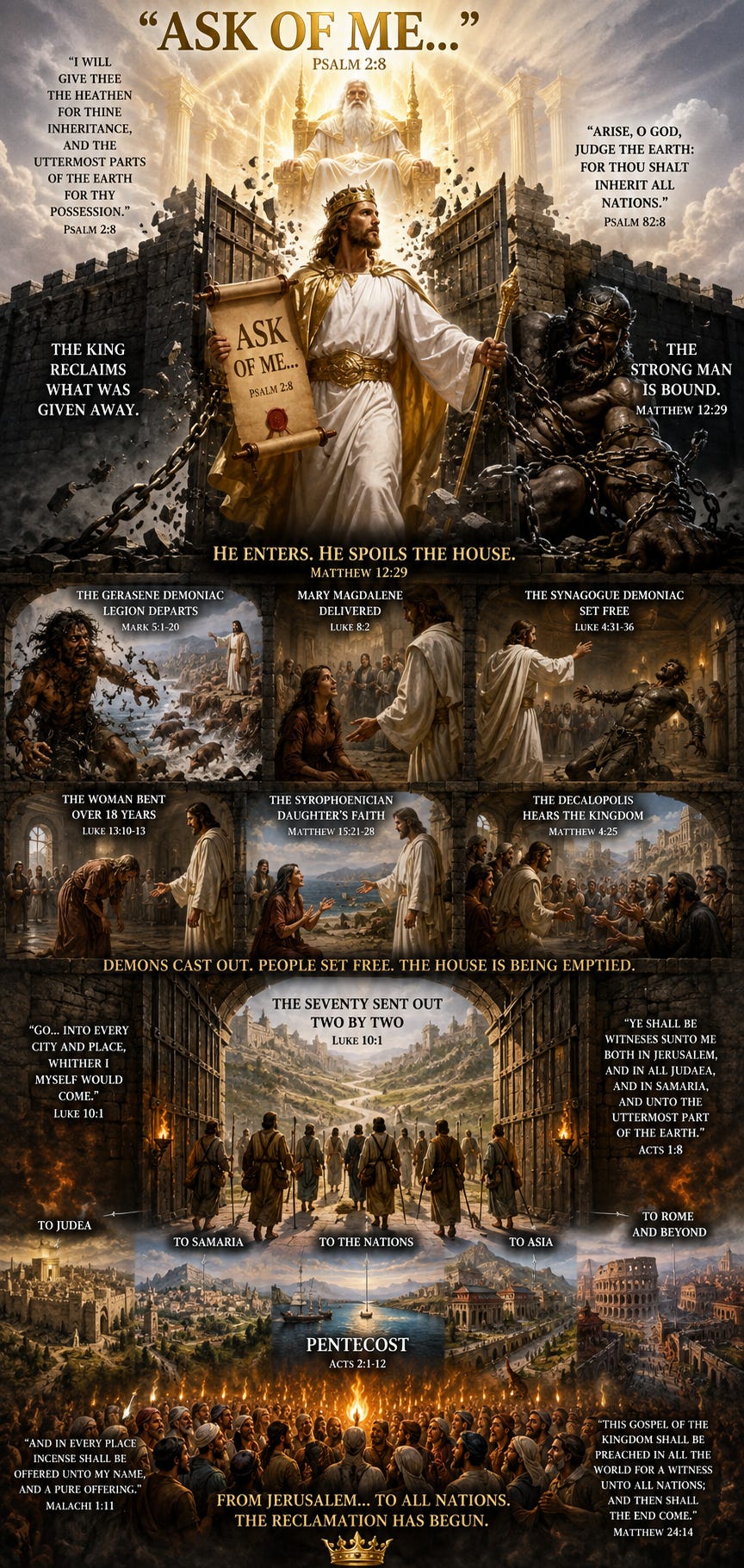
“Ask of me, and I shall give thee the heathen for thine inheritance, and the uttermost parts of the earth for thy possession.” (Psalm 2:8)
Ask of me…
Look at that next to Deuteronomy 32:9 — “the LORD’s portion is his people; Jacob is the lot of his inheritance” — and the shape of the plan becomes visible. At Babel the Father took one nation as His inheritance and allotted the rest. In Psalm 2 the Son is invited to ask for the rest back. Not as conquest imposed from outside the arrangement, but as inheritance — the legal language of a son receiving what belongs to him.
The New Testament writers understood Psalm 2 as being about Jesus and nobody else. It is quoted at His baptism and transfiguration in substance, cited outright in Acts 4:25-26 by the praying church, applied to Him in Acts 13:33, and used twice in the opening argument of Hebrews…
“For unto which of the angels said he at any time, Thou art my Son, this day have I begotten thee? And again, I will be to him a Father, and he shall be to me a Son?” (Hebrews 1:5)
That question is not rhetorical filler.
Hebrews opens by systematically distinguishing the Son from angels — and the reason that argument matters should be clear from our discussion thus far. The nations had been handed to angelic administrators. The writer of Hebrews was establishing, before doing anything else, that the one now receiving them is of an entirely different order.
He stated the consequence outright a chapter later…
“For unto the angels hath he not put in subjection the world to come, whereof we speak.” (Hebrews 2:5)
Not to angels. The old arrangement is named and terminated in one short sentence.
Born Into Occupied Territory
The Gospels do not open with a general statement about the human condition. They open with a census, a tax, a foreign emperor, a ruled king, and a massacre…
“And it came to pass in those days, that there went out a decree from Caesar Augustus, that all the world should be taxed.” (Luke 2:1)
“Then Herod, when he saw that he was mocked of the wise men, was exceeding wroth, and sent forth, and slew all the children that were in Bethlehem, and in all the coasts thereof, from two years old and under.” (Matthew 2:16)
Matthew then did something with the geography that is easy to skim past. The family fled to Egypt, and Matthew explained the move with an OT quote…
“And was there until the death of Herod: that it might be fulfilled which was spoken of the Lord by the prophet, saying, Out of Egypt have I called my son.” (Matthew 2:15)
That is Hosea 11:1, and in Hosea it is about the exodus — about Israel being called out of Egypt. Pay attention to this next paragraph because I don’t care who you are, this is powerful stuff!
Matthew applied it to the Christ child, telling us, in his second chapter, that Jesus is going to recapitulate the story of the nation of Israel: down into Egypt, out of Egypt, through the water, into the wilderness, tested for forty… What Israel failed to do, Jesus Christ suceeded at every step.
And Israel’s failure, per Deuteronomy 32, was precisely a failure regarding the gods…
“They provoked him to jealousy with strange gods, with abominations provoked they him to anger. They sacrificed unto devils, not to God; to gods whom they knew not, to new gods that came newly up, whom your fathers feared not.” (Deuteronomy 32:16-17)
The Mountain, Revisited
Now go back to my original hangup — Christ’s third temptation. With the framework in place, it should read differently now...
“And the devil, taking him up into an high mountain, shewed unto him all the kingdoms of the world in a moment of time. And the devil said unto him, All this power will I give thee, and the glory of them: for that is delivered unto me; and to whomsoever I will I give it. If thou therefore wilt worship me, all shall be thine.” (Luke 4:5-7)
Three observations…
The claim was not challenged. Jesus answered with Deuteronomy 6:13 — worship God only — and left the assertion of ownership alone. John would later call the adversary “the prince of this world” three separate times (John 12:31, 14:30, 16:11). Paul will call him “the god of this world” (2 Corinthians 4:4). John will write that “the whole world lieth in wickedness” (1 John 5:19), where the Greek is closer to lying in the lap of the wicked one. The New Testament is consistent. The authority was real, it was derivative, and it was temporary.
The offer was a shortcut around the cross. This is what made it a genuine temptation rather than a cartoon. Psalm 2:8 had already promised the nations to the Son. The devil offered the same inheritance without Calvary — the destination without the road. That is the shape of every serious temptation: the right thing, obtained the wrong way. And lest you think the Cross was a nothingburger simply because Jesus is God, please go back and listen to Shawn Ryan’s Easter interview with Jeremiah Johnston on the Shroud of Turin or rewatch Mel Gibson’s 2004 offering, The Passion of Christ.
All three temptations were answered from Deuteronomy. Not Deuteronomy at random, either. Jesus quoted 8:3, 6:13, and 6:16 — all from the section where Moses was warning Israel about the very failures Israel would commit in the wilderness. He stood in the wilderness, being tested, answering with the text Israel was given for that test but flunked. Where the nation of Israel fell, the One True Israel held.
That is the reclamation’s beginnings. Not with an army. But with a starving man refusing to take a shortcut.
He Started in the Wrong Place on Purpose
Jesus did not begin His public ministry in Jerusalem. He began in Galilee, and Matthew flagged it as deliberate fulfillment…
“And leaving Nazareth, he came and dwelt in Capernaum, which is upon the sea coast, in the borders of Zabulon and Nephthalim: That it might be fulfilled which was spoken by Esaias the prophet, saying, The land of Zabulon, and the land of Nephthalim, by the way of the sea, beyond Jordan, Galilee of the Gentiles; The people which sat in darkness saw great light; and to them which sat in the region and shadow of death light is sprung up.” (Matthew 4:13-16)
Galilee of the Gentiles. Isaiah 9:1-2, and it was not a compliment in its original setting — this was the territory overrun first by Assyria, the northern tribes deported, the region repopulated and mixed, the frontier zone that respectable Judeans looked down on for centuries afterward.
He started there. The light showed up first in the place with the deepest Gentile shadow.
Then look at where He went over the next three years, plotted on a map rather than read as a devotional sequence. He crossed to the Decapolis, which is Gentile territory. He went to the coasts of Tyre and Sidon, which is Phoenician territory — Jezebel’s homeland, the seat of Baal worship. He deliberately passed through Samaria, which pious travelers detoured around. He operated on the frontiers, over and over, in the border zones where the jurisdictions touch.
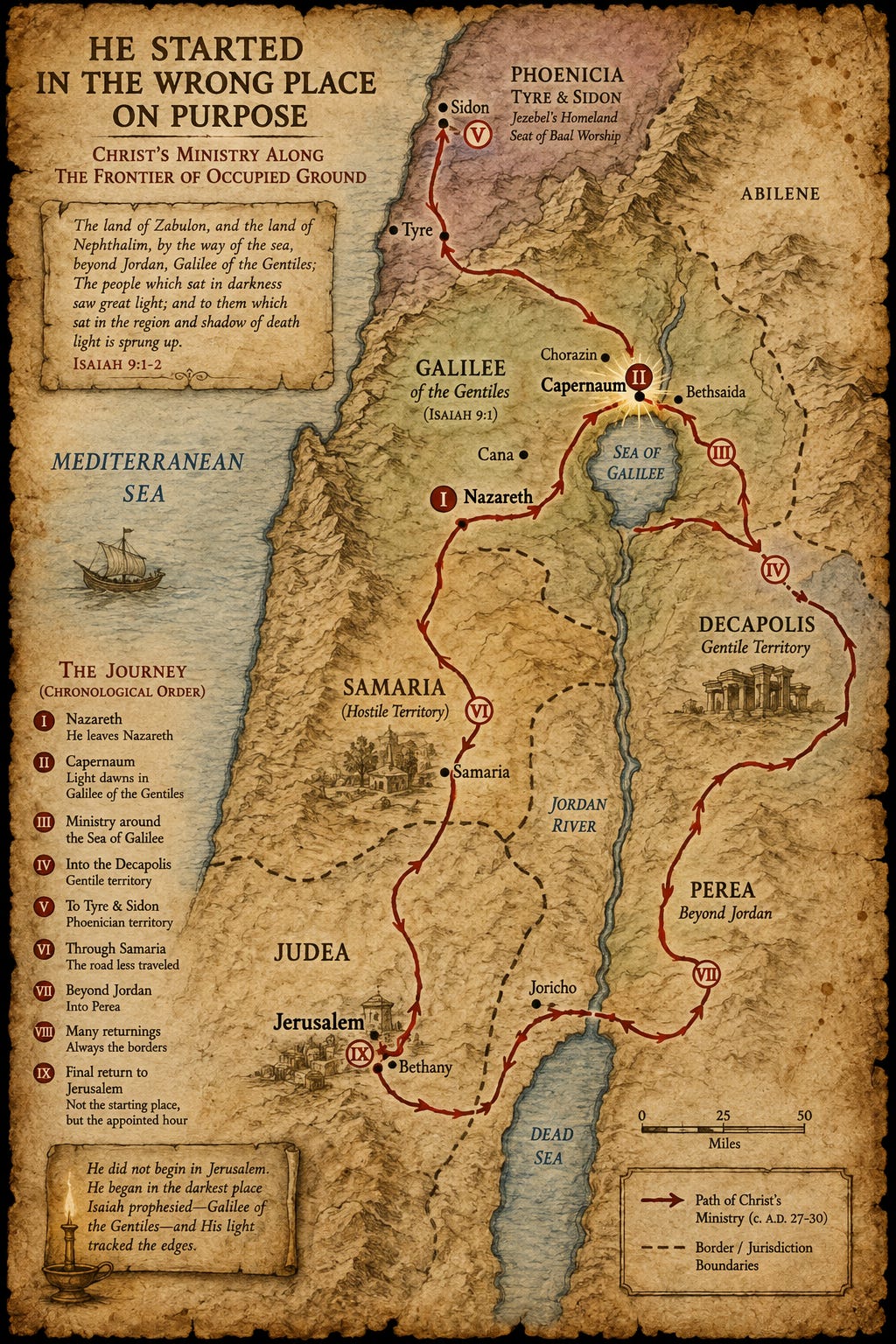
This is not an incidental itinerary. Christ’s ministry was being conducted along the perimeter of occupied ground.
Every Exorcism was a Repossession
Modern readers tend to treat Christ’s numerous exorcisms as compassion narratives — a suffering man is relieved of a torment. While true on the surface, it does not scratch the surface of reading through the lens of a Deuteronomy 32 worldview. Read the demonic dialogue and notice what the demons are actually worried about…
“Saying, Let us alone; what have we to do with thee, thou Jesus of Nazareth? art thou come to destroy us? I know thee who thou art, the Holy One of God.” (Mark 1:24)
“And, behold, they cried out, saying, What have we to do with thee, Jesus, thou Son of God? art thou come hither to torment us before the time?” (Matthew 8:29)
Before the time. They know there is a schedule. They know it ends with their doom. Their objection is not that judgment is unjust — it is that it appears to be arriving early.
Jesus stated the meaning of the exorcisms Himself when the Pharisees accused Him of casting out demons by Beelzebub…
“But if I cast out devils by the Spirit of God, then the kingdom of God is come unto you. Or else how can one enter into a strong man’s house, and spoil his goods, except he first bind the strong man? and then he will spoil his house.” (Matthew 12:28 & 29)
Stop and read that another time or two…
Because it’s the theme of the entire ministry in one sentence — a sentence we will watch Revelation 20 pick up and run with shortly. The exorcisms are not merely acts of mercy. They are evidence of a binding already in progress. The house (the nations) is being looted of its most precious treasures (people) because the owner has been tied up.
Note carefully that in Jesus’ own illustration, binding and plundering are simultaneous and ongoing — not sequential stages separated by an age. He is binding, and He is spoiling, now.
Ponder that because it’s the single most important factor concerning what Revelation 20 can or can’t mean.
The Man in the Tombs
The Gerasene account, touched on earlier as described in another gospel, deserves its own treatment, because it is the Deuteronomy 32 framework played out in an afternoon.
Jesus crossed the Sea of Galilee at night, through a storm, to the eastern shore — the Decapolis. Gentile country. Pig country. He arrived, encountered one man, and left almost immediately.
In other words, an entire trip for one person…
“And when he was come out of the ship, immediately there met him out of the tombs a man with an unclean spirit, Who had his dwelling among the tombs; and no man could bind him, no, not with chains.” (Mark 5:2-3)
“And he asked him, What is thy name? And he answered, saying, My name is Legion: for we are many.” (Mark 5:9)
“And he besought him much that he would not send them away out of the country.” (Mark 5:10)
Legion…
A Roman military designation of 4,000-5,000 soldiers for a name. A collective inhabiting of thousands of demons in one man. And a plea grounded entirely in geography — do not send us out of the region.
The pigs go over the cliff. The townspeople ask Jesus to leave. And then this…
“Howbeit Jesus suffered him not, but saith unto him, Go home to thy friends, and tell them how great things the Lord hath done for thee, and hath had compassion on thee. And he departed, and began to publish in Decapolis how great things Jesus had done for him: and all men did marvel.” (Mark 5:19-20)
Everywhere else in Mark, Jesus told people to keep quiet. Here He commissioned a man to broadcast. The difference was the address. This is Gentile territory, and the first missionary to the Decapolis was a formerly demon-possessed Gentile who had been living in a graveyard an hour earlier — a man likely known and recognized in the region.
The reclamation of the nations did not begin with a conference. It began with one exorcised man in occupied land being told to go home and tell people what Christ had done for him.
Order of Operations
The Syrophoenician woman is the passage people find hardest, and a Deuteronomy 32 worldview helped make sense of it…
“But he answered and said, I am not sent but unto the lost sheep of the house of Israel.” (Matthew 15:24)
“But he answered and said, It is not right to take the children’s bread, and to cast it to dogs.” (Matthew 15:26)
Read outside the lines for a moment. This is Jesus being harsh to a desperate mother. Now read inside. Jesus is stating the sequence. Israel first, then the nations. Not Israel only — He is standing in Gentile territory when He said it, which is not the behavior of someone maintaining an exclusion — but Israel first.
She accepted the sequence and argued within it…
“And she said, Truth, Lord: yet the dogs eat of the crumbs which fall from their masters’ table.” (Matthew 15:27)
She was not disputing the order, but instead pointing out that the order did not require her to starve while she waited. And He commended her faith and healed her daughter.
Paul later stated the same sequence as settled policy: “to the Jew first, and also to the Greek” — typically preaching first at the local synogogue in his missionary journeys before moving on to preach to the Gentiles. The nations were always coming. The question was when, and through what.
Caesarea Philippi
This was the passage where the geography from Part I came due, and once you see it you cannot unsee it.
Jesus took His disciples on a journey of roughly twenty-five miles north from Bethsaida, out of Galilee entirely, to the northernmost point of His recorded ministry. The destination is Caesarea Philippi — known in earlier centuries as Paneas, after the Greek god Pan, whose shrine stood there. A site sitting at the foot of Mount Hermon.
Mount Hermon. The mountain of the Watchers’ descent in the book of Enoch. The northern edge of Bashan, land of the Rephaim and the giants. The place ancient Israelites associated with the underworld and the dishonored dead.
At Paneas, there is a cave in the cliff face from which one of the sources of the Jordan emerges. The Greeks called such a cave a gate to the underworld, and the Romans had built a temple to Augustus there. By every measure available to a first-century Jew, it was the most spiritually hostile real estate in the region.
He walked His disciples to that spot and asked them a question…
“When Jesus came into the coasts of Caesarea Philippi, he asked his disciples, saying, Whom do men say that I the Son of man am?” (Matthew 16:13)
“And Simon Peter answered and said, Thou art the Christ, the Son of the living God.” (Matthew 16:16)
“And I say also unto thee, That thou art Peter, and upon this rock I will build my church; and the gates of hell shall not prevail against it.” (Matthew 16:18)
The gates of hell. The Greek is pylai hadou — the gates of Hades, the realm of the dead. He said it standing in front of a cliff face that the local religion regarded as exactly that.
And note the direction of the metaphor, because without the proper direction this passage loses its potency. Gates are not offensive weapons. Gates are defensive. A gate does not charge. A gate holds a position, and it holds it against something coming.
Note that Jesus was not promising that the Church will survive a siege. He was announcing that the Church is the siege engine — and the fortifications of death could not hold.
Six days later, three of them went up “a high mountain apart” and saw Him transfigured (Matthew 17:1). Matthew gave no name for the mountain and neither will I, but the tradition placing it at Tabor is late and Tabor is neither high nor apart. But they were at Hermon’s base. Just saying.
Then, coming down, He told them plainly for the first time that He would be going to Jerusalem to be killed. The confession, the gates, and the cross are one continuous conversation begun at the foot of the enemy’s mountain.
The Seventy Go Out
Luke 10 opened with a commissioning that the framework turned from a curious detail into the hinge of the Gospel…
“After these things the Lord appointed other seventy also, and sent them two and two before his face into every city and place, whither he himself would come.” (Luke 10:1)
Seventy nations…
Christ had already appointed twelve, matching the tribes of Israel. He then appointed seventy missionaries, matching the nations of the world. The two numbers are not competing. They are sequential — the two halves of Deuteronomy 32:8-9. The portion He kept, and the portion He gave away.
The Seventy went out. And they came back elated…
“And the seventy returned again with joy, saying, Lord, even the devils are subject unto us through thy name.” (Luke 10:17)
And He answers with a line that has been mined for pre-Genesis cosmology by people who were not reading the paragraph it sits in.
“And he said unto them, I beheld Satan as lightning fall from heaven.” (Luke 10:18)
The tense, the context, and the sequence all point the same direction. They report a mission. But Christ depicted Satan’s fall. The fall is what the mission accomplished. This was not a memory from before creation — it was Jesus telling seventy exhausted men they have no idea what they just did.
A number of missionaries that was the same number of the nations went out. The adversary came down.
Then Christ immediately steadied them, because prideful humans tend to become drunk with power. What sort of spiritual power are we talking about here? The kaboooooom kind…
“Behold, I give unto you power to tread on serpents and scorpions, and over all the power of the enemy: and nothing shall by any means hurt you. Notwithstanding in this rejoice not, that the spirits are subject unto you; but rather rejoice, because your names are written in heaven.” (Luke 10:19-20)
Authority over the enemy is real. But power for power’s sake was not the point. The point was that they belonged to the Kingdom, early in the process reclaiming the nations.
The Hour
The crux came in John 12, and the trigger is worth noticing.
Some Greeks — Gentiles, God-fearers, up for the feast — approached Philip to ask to see Jesus. Philip tells Andrew. The two of them tell Jesus. And this was His response…
“And Jesus answered them, saying, The hour is come, that the Son of man should be glorified.” (John 12:23)
The nations show up asking for Him, and He instead announced that the hour had arrived. Then He stated what the hour was for using not only the language of a Deuteronomy worldview, but the verbiage of Moses that would be should have been as clear as day to devout Second Temple Jews…
“Now is the judgment of this world: now shall the prince of this world be cast out. And I, if I be lifted up from the earth, will draw all men unto me.” (John 12:31-32)
Three things in two verses. Judgment on the world — now. The prince of this world cast out — now. And a drawing of all men, which in context means all kinds of men, the nations (Gentiles) included, accomplished by His blood sacrifice at Calvary.
He said it twice more before the arrest…
“Hereafter I will not talk much with you: for the prince of this world cometh, and hath nothing in me.” (John 14:30)
“Of judgment, because the prince of this world is judged.” (John 16:11)
The cross was not portrayed in these passages as a tragedy that God managed to salvage as a ‘Plan B’. It was portrayed as the judicial proceeding in which the prince of this world was legally stripped of his standing.
They Did Not Know What They Were Doing
Paul said something about the crucifixion that only makes sense inside this framework…
“But we speak the wisdom of God in a mystery, even the hidden wisdom, which God ordained before the world unto our glory: Which none of the princes of this world knew: for had they known it, they would not have crucified the Lord of glory.” (1 Corinthians 2:7-8)
The archontes — rulers…
Pilate and Caiaphas were in view, but Paul’s vocabulary for spiritual authorities was the same vocabulary he used in Ephesians 6:12 and Colossians 2:15, and the argument required beings capable of being deceived by a hidden divine wisdom, which was a strange thing to say about a provincial governor.
Read it as the rulers behind the rulers, and the passage snaps into focus. The powers took the bait. They engineered the execution of the one human being — the God man / Son of man over whom death had no claim, and in doing so they forfeited everything…
“Forasmuch then as the children are partakers of flesh and blood, he also himself likewise took part of the same; that through death he might destroy him that had the power of death, that is, the devil; And deliver them who through fear of death were all their lifetime subject to bondage.” (Hebrews 2:14-15)
He legally destroyed the one holding the power of death by dying. That is the wisdom none of the princes knew — the “Deeper Magic from before the dawn of time” CS Lewis used in describing Aslan’s resurrection in his timeless Chronicles of Narnia.
And then Paul’s summary, which is the center of gravity for everything in this treatise…
“And having spoiled principalities and powers, he made a shew of them openly, triumphing over them in it.” (Colossians 2:15)
The imagery is a Roman triumph…
A victorious general parades through the city with his conquered enemies stripped and displayed behind him. Paul said that the cross was that parade — that the instrument of Roman shame was in fact the enemy’s public humiliation, and nobody in the crowd realized it while it was happening.
A note on framing, since this is where Reformed readers sometimes get nervous…
Presenting the cross as ‘cosmic’ victory over the powers laid out in Ephesians 6:12 does not compete with penal substitution. It depends on it. The powers are disarmed because the legal claim they held was satisfied and cancelled — which was precisely what Paul said in the verse immediately before Colossians 2:15…
“Blotting out the handwriting of ordinances that was against us, which was contrary to us, and took it out of the way, nailing it to his cross.” (Colossians 2:14)
The Descent and the Proclamation
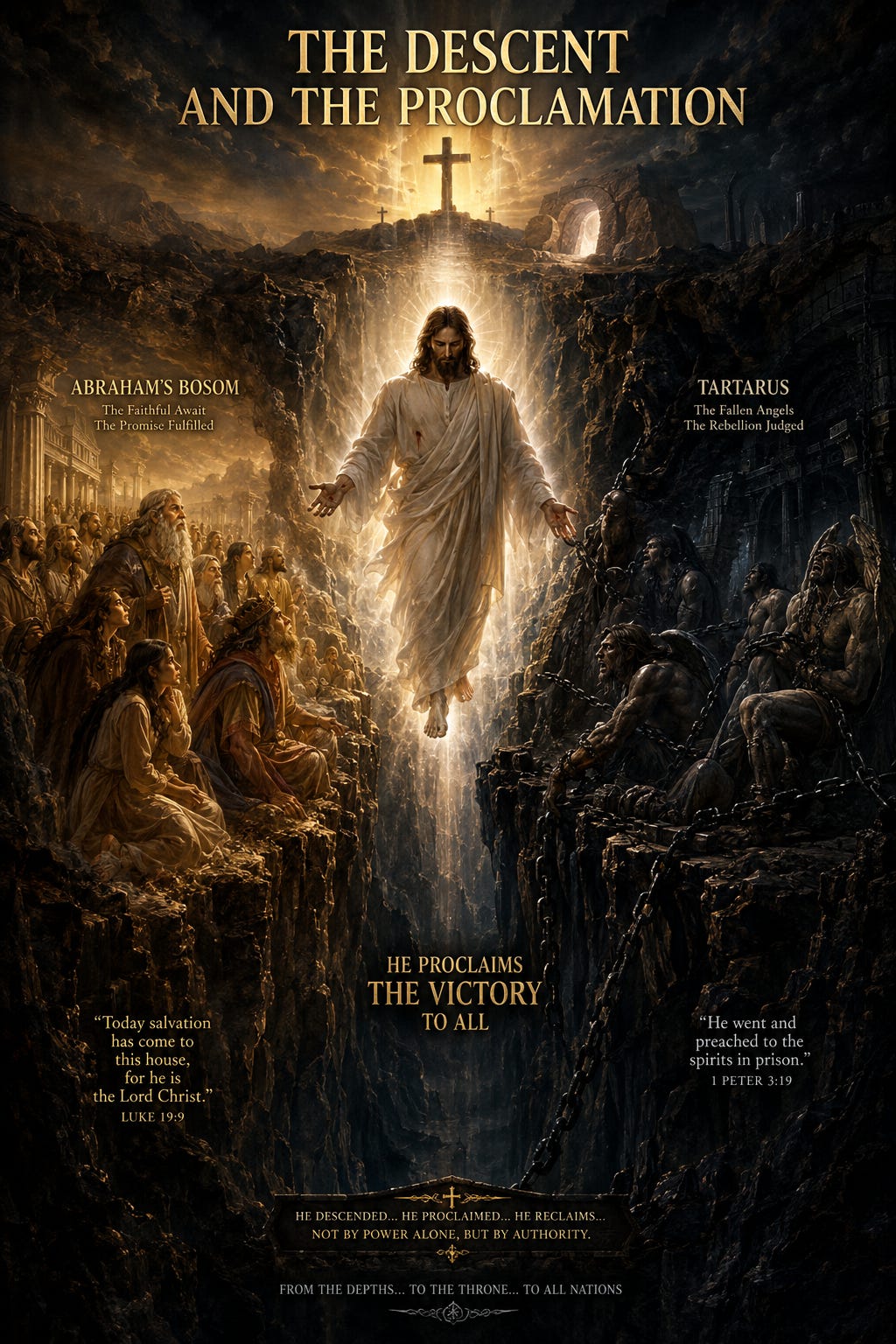
I believe in God,
the Father almighty,
Creator of heaven and earth,
and in Jesus Christ, his only Son, our Lord,
who was conceived by the Holy Spirit,
born of the Virgin Mary,
suffered under Pontius Pilate,
was crucified, died and was buried;
he descended into hell;
on the third day he rose again from the dead;
he ascended into heaven,
and is seated at the right hand of God the Father almighty;
from there he will come to judge the living and the dead.
I believe in the Holy Spirit,
the holy catholic Church,
the communion of saints,
the forgiveness of sins,
the resurrection of the body,
and life everlasting.
Amen.
-The Apostle’s Creed, the earliest version of which (The Old Roman Creed) dates to the 2nd century
Peter recorded something astonishing between the cross and the resurrection that the church has argued about for two thousand years, and the Genesis 6 background makes better sense of it than the alternatives…
“For Christ also hath once suffered for sins, the just for the unjust, that he might bring us to God, being put to death in the flesh, but quickened by the Spirit: By which also he went and preached unto the spirits in prison; Which sometime were disobedient, when once the longsuffering of God waited in the days of Noah, while the ark was a preparing, wherein few, that is, eight souls were saved by water.” (1 Peter 3:18-20)
Spirits in prison. Disobedient in the days of Noah. That is not a description of the holding place for the righteous human dead (although those people were there as well, in Abraham’s Bosom, separated by the chasm/gulf seen in the story of Lazarus the beggar). The Apostle Peter mentioned them at one specific point in history and identified them by one specific rebellion. These are the imprisoned angels of 2 Peter 2:4 and Jude 6.
The Watchers…
The word Peter uses to describe what Christ is doing there is not euangelizo, the word for preaching good news. It is kerysso, the word for a herald making a proclamation. Christ did not go to that prison to offer terms or, as some have inexplicably said, pay for Christian’s sins in hell. He went to announce His victory. To set the captives free and condemn those spirits that had been awaiting their judgment for millennia.
Peter finished the sentence by tying all of it to the ascension…
“Who is gone into heaven, and is on the right hand of God; angels and authorities and powers being made subject unto him.” (1 Peter 3:22)
Proclamation to the imprisoned, then enthronement, then the subjection of the powers. Peter is narrating the reclamation in order.
Paul described the same movement with a psalm.
“Wherefore he saith, When he ascended up on high, he led captivity captive, and gave gifts unto men. (Now that he ascended, what is it but that he also descended first into the lower parts of the earth? He that descended is the same also that ascended up far above all heavens, that he might fill all things.)” (Ephesians 4:8-10)
He was quoting Psalm 68 — and Psalm 68 is the psalm pitting God’s mountain against Bashan — the place of the giants.
“The chariots of God are twenty thousand, even thousands of angels: the Lord is among them, as in Sinai, in the holy place. Thou hast ascended on high, thou hast led captivity captive: thou hast received gifts for men; yea, for the rebellious also, that the LORD God might dwell among them.” (Psalm 68:17-18)
“The Lord said, I will bring again from Bashan, I will bring my people again from the depths of the sea.” (Psalm 68:22)
Paul took the ascent of God to His mountain in triumph over Bashan, and applied it to the ascension of Christ. The mountain of the Watchers (Mount Hermon), named in the victory psalm, and quoted by the apostle to describe what happened on the fortieth day.
Can anyone say “The Ascension”?
A Kingly Coronation, Not an Earthly Departure
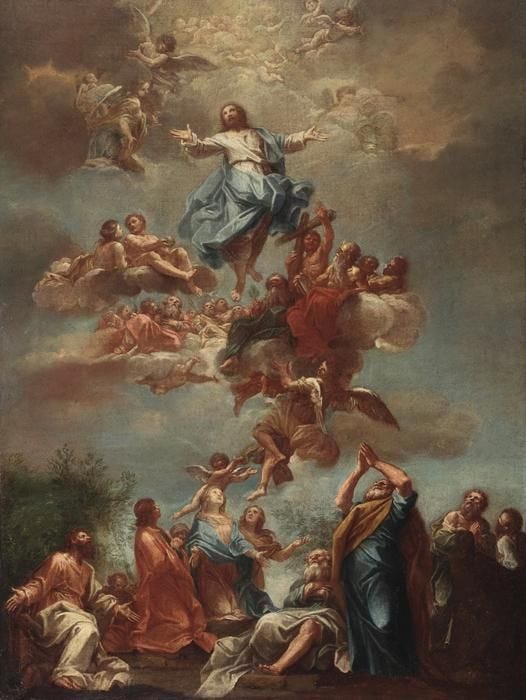
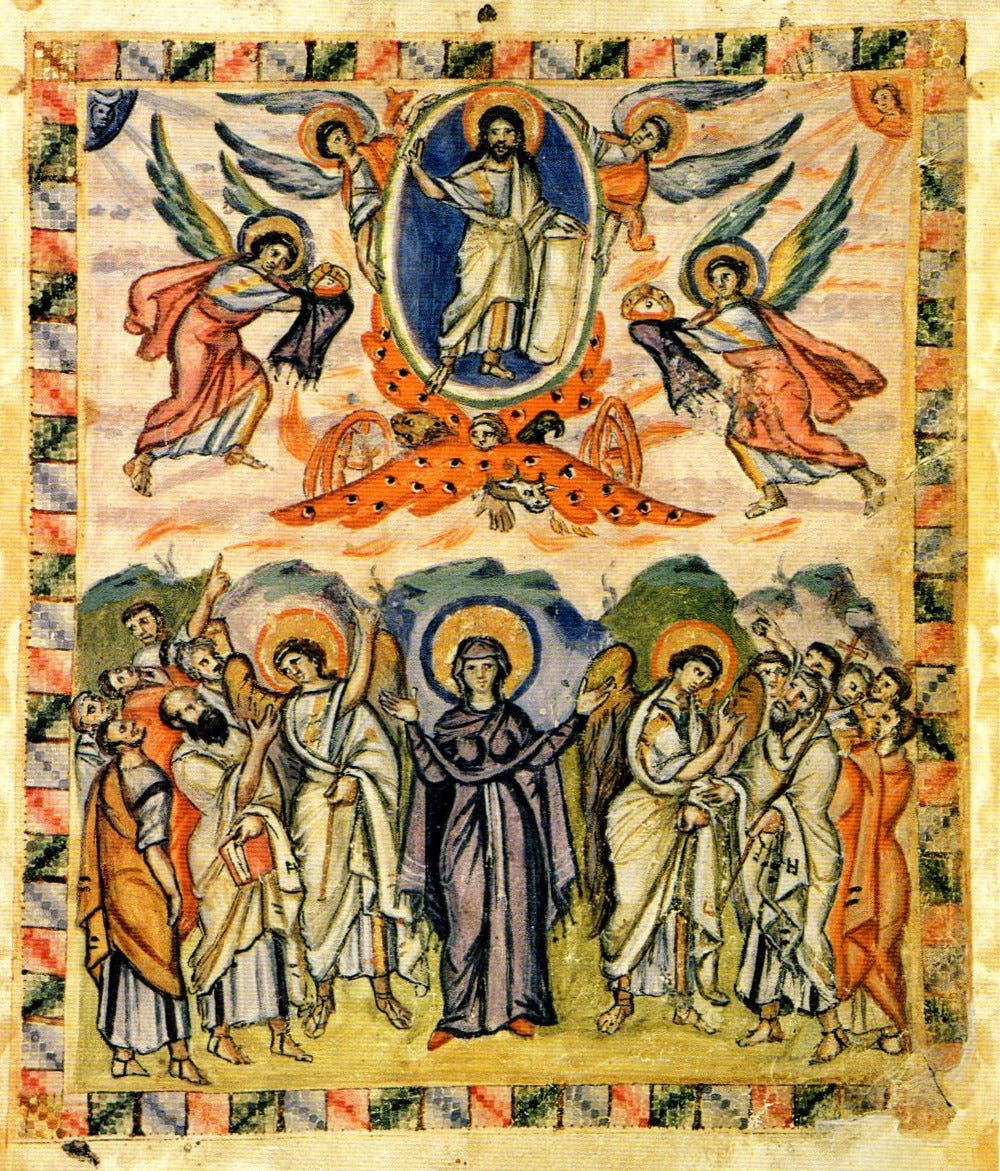
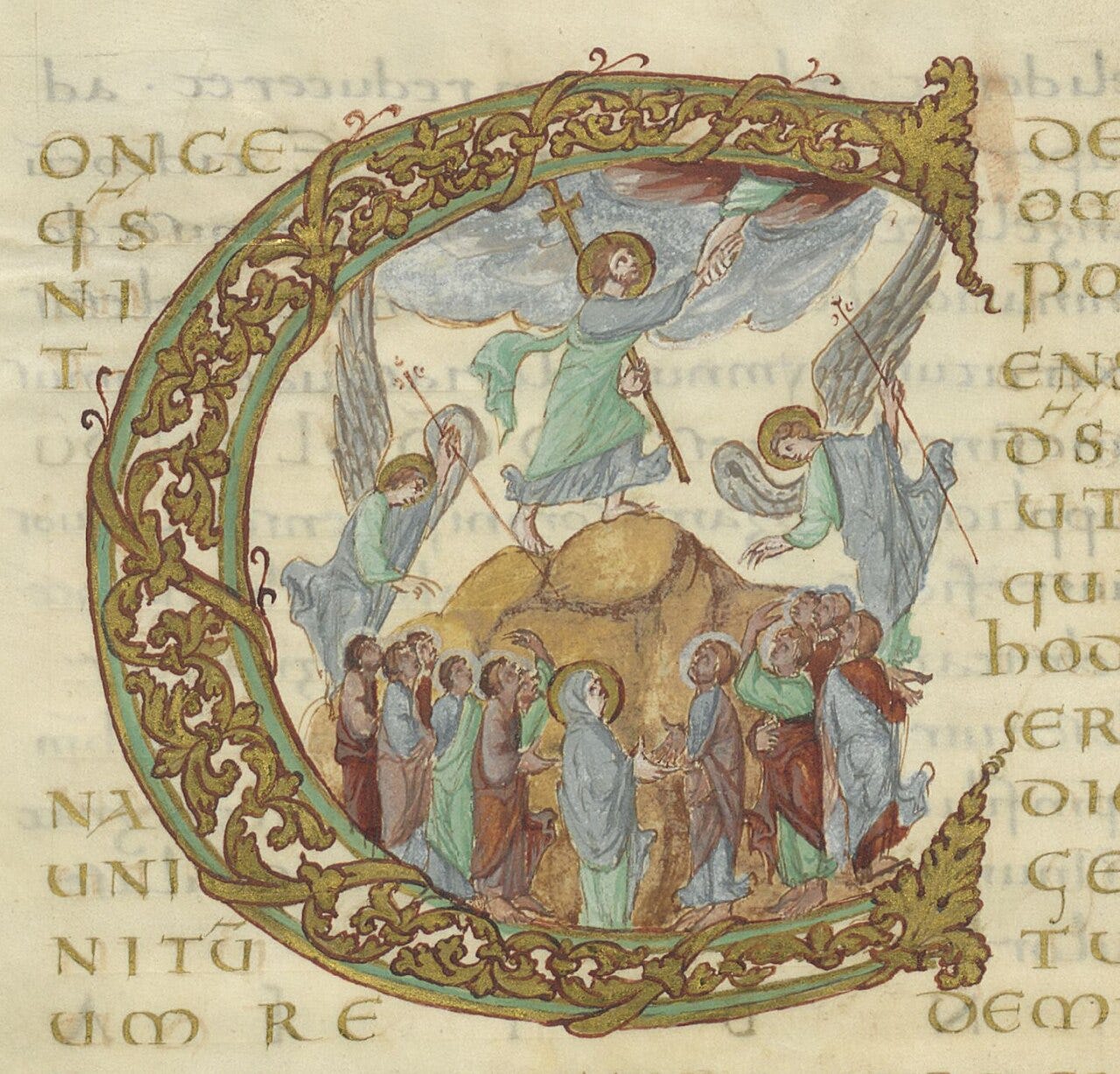
We have been taught to read the ascension as an exit…
Jesus finished His earthly work, said His goodbyes, and went home to heaven — the closing scene of the Gospel story. The point at which the disciples are left on their own to get on with things until the Holy Spirit entered the scene.
However…
That’s not even remotely what Daniel prophetically described 600 years earlier while under Israel’s Babylonian captivity…
“I saw in the night visions, and, behold, one like the Son of man came with the clouds of heaven, and came to the Ancient of days, and they brought him near before him. And there was given him dominion, and glory, and a kingdom, that all people, nations, and languages, should serve him: his dominion is an everlasting dominion, which shall not pass away, and his kingdom that which shall not be destroyed.” (Daniel 7:13-14)
Pay attention to the direction of travel…
The Son of Man does not come from heaven to earth in this vision. He comes with the clouds to the Ancient of Days, is brought near before Him, and receives a kingdom. This is an approach to a throne, not a descent back to earth (Second Coming) as Darby’s followers have been taught for the past 150 years.
Now move forward to Acts…
“And when he had spoken these things, while they beheld, he was taken up; and a cloud received him out of their sight.” (Acts 1:9)
A cloud received Him.
Luke has just told us that Jesus spent forty days teaching about the Kingdom, and he then described an ascent into a cloud using the vocabulary of the one Old Testament vision that described a Son of Man coming in heavenly clouds to receive a kingdom. This is not a coincidence of imagery. Luke is reporting the fulfillment of Daniel 7:13-14, and he expects his readers familiar with Daniel (i.e. every single Second Temple Jew) to catch it.
The ascension is the enthronement. It is the moment the Son, having asked, sees the fulfillment of Psalm 2:8, and receives His Kingdom.
A kingdom of all people, nations, and languages. Daniel says it in the seventh chapter, six centuries earlier. Every nation on the Table of Nations list. The seventy, turned into principalities at Babel, and delivered to the Son at His coronation.
And the angels’ word to the men standing there staring is not meant to console them. It’s a call to action from the launch site…
“Ye men of Galilee, why stand ye gazing up into heaven? this same Jesus, which is taken up from you into heaven, shall so come in like manner as ye have seen him go into heaven.” (Acts 1:11)
You have work to do. Get to it!
All Authority
Matthew’s version of the commission says the same thing in a single sentence in what is clearly the language of Daniel 7…
“And Jesus came and spake unto them, saying, All power is given unto me in heaven and in earth. Go ye therefore, and teach all nations, baptizing them in the name of the Father, and of the Son, and of the Holy Ghost: Teaching them to observe all things whatsoever I have commanded you: and, lo, I am with you always, even unto the end of the world.” (Matthew 28:18-20)
All authority in heaven and in earth. Heaven — the realm of the divine council. Earth — the realm of the nations. Both. The entire two-tier arrangement of Deuteronomy 32, in the King’s hand.
And then the imperative that follows from it: therefore — because I now hold what was allotted away — disciple the nations. The ethne. The exact word the Septuagint uses in Deuteronomy 32:8 for the peoples divided among the sons of God.
The Great Commission is not a general instruction to be religious in public. It is a repossession order, issued by King Jesus, enthroned at the right hand of power, and holding legal title over all lands, peoples, and spiritual beings, including powers, principalities, rulers, and demonic forces.
Notice too that “teach them to observe all things whatsoever I have commanded you” is not merely evangelistic. It is jurisdictional. Nations under new administration receive new law. This is the sentence that separates an inaugurated, expanding Kingdom from a holding pattern.
Babel Run Backward
Ten days later, the mechanism arrived…
“And when the day of Pentecost was fully come, they were all with one accord in one place. And suddenly there came a sound from heaven as of a rushing mighty wind, and it filled all the house where they were sitting. And there appeared unto them cloven tongues like as of fire, and it sat upon each of them. And they were all filled with the Holy Ghost, and began to speak with other tongues, as the Spirit gave them utterance.” (Acts 2:1-4)
Notice what Luke did next, reading it slowly, because it’s the clearest post-coronation example of the reversal of Babel. And not enough Christians notice it…
“And there were dwelling at Jerusalem Jews, devout men, out of every nation under heaven.” (Acts 2:5)
“Parthians, and Medes, and Elamites, and the dwellers in Mesopotamia, and in Judaea, and Cappadocia, in Pontus, and Asia, Phrygia, and Pamphylia, in Egypt, and in the parts of Libya about Cyrene, and strangers of Rome, Jews and proselytes, Cretes and Arabians, we do hear them speak in our tongues the wonderful works of God.” (Acts 2:9-11)
Luke stops his narrative and inserts a list.
Why? He was a careful writer. He did not waste words. But nobody needs a fifteen-item travel manifest to understand that this crowd was multilingual.
He included it because it is a Table of Nations…
It is Genesis 10 in first-century dress — an inventory of the known world, organized geographically, running east to west. Precisely the kind of list a Jewish reader would recognize on sight, but that our American pea-brains tend to gloss over as merely “interesting”.
And what happened to that list of nations?
The language barrier God imposed at Babel was reversed. Not undone — the languages remain. But they were overcome. At Babel, one language became many so the nations could not unite in rebellion. At Pentecost, many languages heard a single message so the Gentile nations could be united into a single Kingdom under a single all-powerful and almighty King.
The fire is worth noting as well…
God descended in fire on Sinai to give the law to His one nation. God descended in fire at Pentecost — not on a mountain, but on people — and the result is immediately, in the same paragraph, addressed to every nation under heaven.
Peter stood up and quoted a passage instantly recognized by all who were present…
“This is that which was uttered through the prophet Joel: And it shall come to pass in the last days, saith God, I will pour out of my Spirit upon all flesh.” (Acts 2:16-17)
All flesh. Not just God’s original portion; the nation of Israel. But all of it, the nations (Gentiles) included.
It’s the mechanism the four hundred years of silence were missing. The nations were not going to be reclaimed by physical armies or by Israel becoming an empire. They were going to be reclaimed by the Spirit of God being poured out on ordinary people from every nation on the list, who went back to their lands after the Passover and told everyone they met about the risen and ascended King.
A spiritual army, taking its marching orders from King Jesus, pledged to turn the spiritual reality into a physical one over the course of time and history — not simply by converting the nations, but by discipling them, exactly as the Great Commission commanded.
Acts 1:8 Maps Out the Entire Book
Every battle requires a battle plan and order of assault for major offensives, and this offensive was not any different…
But you will receive power when the Holy Spirit has come upon you, and you will be my witnesses in Jerusalem and in all Judea and Samaria, and to the end of the earth.
Once you see it, you’ll see the structure of Acts is not a loose collection of missionary anecdotes. It is Jesus’ outline in Acts 1:8, executed in a specific order of battle.
Jerusalem — chapters 1 through 7.
Judea and Samaria — chapter 8, where Philip goes to the Samaritans, the people every Judean regarded as ethnically and religiously compromised.
Then, in the same chapter, an Ethiopian court official reading Isaiah in a chariot…
“And he arose and went: and, behold, a man of Ethiopia, an eunuch of great authority under Candace queen of the Ethiopians, who had the charge of all her treasure, and had come to Jerusalem for to worship.” (Acts 8:27)
Ethiopia is Cush, and Cush is on the Table of Nations in Genesis 10:6. The reclamation is now proceeding nation by nation from the original list.
Cornelius — chapter 10. A Roman centurion — a Gentile — caused Peter to be given a vision three times before he would go. Old habits die hard, and the wall of separation between the portion (Israel) and the disinherited (The Nations) was two thousand years old. And Peter could feel every stone of it…
“Then Peter opened his mouth, and said, Of a truth I perceive that God is no respecter of persons: But in every nation he that feareth him, and worketh righteousness, is accepted with him.” (Acts 10:34-35)
In every nation. Peter was watching Deuteronomy 32 come apart at the seams in front of his very eyes.
Paul at Athens — chapter 17, and this is where the whole framework surfaces explicitly. Standing in the most religiously saturated city in the Greek world, Paul says this…
“And hath made of one blood all nations of men for to dwell on all the face of the earth, and hath determined the times before appointed, and the bounds of their habitation.” (Acts 17:26)
That is Deuteronomy 32:8 quoted to a pagan audience. The bounds of their habitation — the boundaries fixed at the division of the nations. Paul is telling the Athenians that the arrangement they have been living under was set by God, and then he tells them it has expired…
“And the times of this ignorance God winked at; but now commandeth all men every where to repent.” (Acts 17:30)
There is the answer to the question the prelude left hanging. What changed? The Son asked, and the Father gave, and the period of overlooking is over. Now — after the cross, after the ascension, after Pentecost — the command goes to all men everywhere, because the one issuing it now holds all authority in heaven and earth.
Ephesus — chapter 19, where the gospel collides with the cult of Artemis, with economic damage severe enough to start a riot. The silversmiths were not confused about what was happening to their business.
Rome — chapter 28, the last verse, Paul preaching in the capital of the empire, unhindered.
The book does not end. It stops, mid-advance, with the Kingdom still expanding outward…
Where Part II Leaves Us
Now, set these on the table next to the pieces from Part I…
The Son asked for the nations, and the request was written into Israel’s hymnal a thousand years before He made it (Psalm 2:8).
He was born into occupied ground, refused the shortcut that would have handed Him the kingdoms without a cross (Luke 4:5-8), and conducted His ministry along the frontiers of that occupation.
Every exorcism was a repossession, and He said so — the strong man is bound, and the house is being spoiled, simultaneously and now (Matthew 12:28-29).
He walked His disciples to the foot of the enemy’s mountain and announced that the gates of the dead would not hold against what He was building (Matthew 16:18).
He sent out the number of the nations, and the adversary fell (Luke 10:1, 17-18).
The powers engineered His execution and destroyed themselves doing it (1 Corinthians 2:8; Colossians 2:14-15; Hebrews 2:14).
He proclaimed the outcome to the imprisoned spirits of the Genesis 6 rebellion (1 Peter 3:19-20) and ascended in triumph (Ephesians 4:8-10; Psalm 68).
He came with the clouds to the Ancient of Days and received a kingdom of all peoples, nations, and languages (Daniel 7:13-14; Acts 1:9).
He declared that all authority in heaven and earth was His, and ordered the nations discipled (Matthew 28:18-20).
And the Spirit fell on a room in Jerusalem, and a list of nations heard the wonderful works of God in their own languages (Acts 2:9-11).
The petition of Psalm 82:8 has been answered. The Kingdom is not coming. It came — on a specific day, at a specific coronation, with a specific transfer of authority — and despite periods of history that appear contrary to the assertion, has been expanding ever since.
Which raises the obvious problem, and it is the one every honest reader is already asking...
If the strong man is bound, why does the world look like this?
PART III — ALREADY, BUT NOT YET
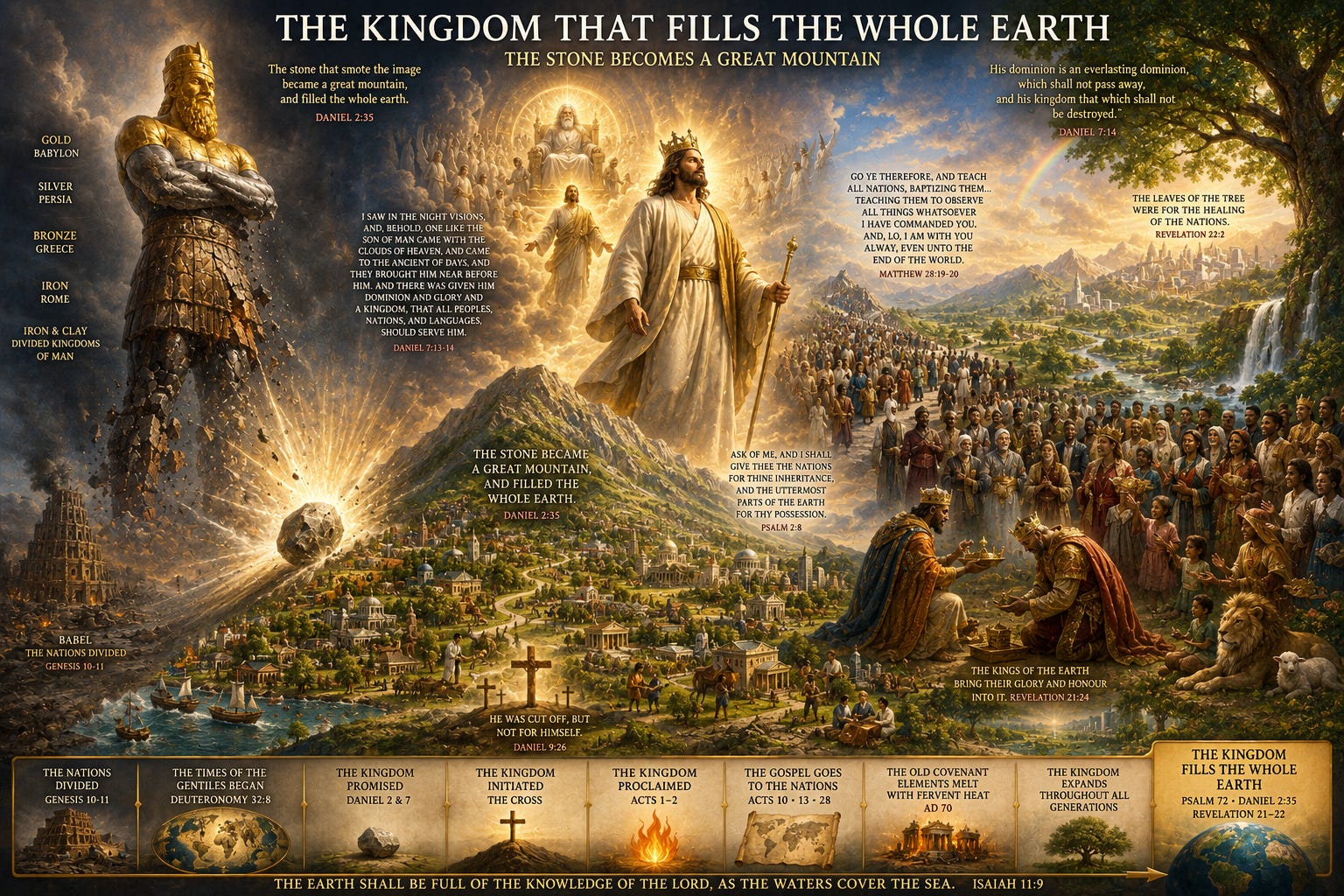
The Obvious Problem
How can the strong man possibly be bound, with so much evil in the world?
Anyone who reads Revelation 20 and concludes that Satan is currently restrained (“bound”) has to reckon with a planet that features trafficking, genocide, industrialized governmental deception, and a church that in many places is losing rather than winning. The premillennial reading has an easy answer to this, and it’s easy to follow…
The binding of Satan has not happened yet, which is why things look like they do.
The problem with the easy answer is that it requires you to unhook Revelation 20 from everything Jesus said about His own ministry, as well as the greater biblical narrative.
So, let’s do this carefully, and start by not asking the wrong question. The right question is not “is Satan bound?” The right question is the one the text itself answers immediately after, in a purpose clause most readers slide right past.
Read the Purpose Clause
“And I saw an angel come down from heaven, having the key of the bottomless pit and a great chain in his hand. And he laid hold on the dragon, that old serpent, which is the Devil, and Satan, and bound him a thousand years, And cast him into the bottomless pit, and shut him up, and set a seal upon him, that he should deceive the nations no more, till the thousand years should be fulfilled: and after that he must be loosed a little season.” (Revelation 20:1-3)
Read that passage again and find the specification.
That he should deceive the nations no more.
John does not say the dragon is annihilated. He does not say he is removed from the earth, or rendered inert, or stripped of all capacity to act, tempt, or deceive individuals. He says the binding has a stated purpose, and the stated purpose is precise. The binding is so he can no longer deceive the nations.
It’s not a general statement about evil. Instead, it’s a targeted, jurisdictional restriction — the exact jurisdiction Deuteronomy 32:8 established and Psalm 82 condemned.
The nations were Satan’s. And the nations are the very thing being taken over by the Gospel of Jesus Christ. -Read this over and over again, until it makes sense
The whole of Parts I and II built toward the sentence above, and once the framework is in place, Revelation 20:2 stops being a puzzle and becomes a summary (go back and watch the first 10 minutes of Josh Howerton’s discussion of Revelation with Shawn Ryan at the very beginning of the post).
What was bound at the cross and enthronement was not the enemy’s existence, his malice, or his ability to tempt an individual believer on a Tuesday afternoon. What was bound was his legal claim to seventy distinct jurisdictions around the globe.
Scripture Already Defined “Bound” Twice
We are not guessing at what the word ‘binding’ means. The Bible uses the concept in two distinct ways, and both are in play in Revelation 20.
The first is imprisonment, and it describes the Watchers…
“And the angels which kept not their first estate, but left their own habitation, he hath reserved in everlasting chains under darkness unto the judgment of the great day.” (Jude 6)
“For if God spared not the angels that sinned, but cast them down to hell, and delivered them into chains of darkness, to be reserved unto judgment.” (2 Peter 2:4)
Those beings are out of circulation entirely. Chains, darkness, held until judgment. That is total.
The second is functional restraint, and it’s the one Jesus applied to His own ministry…
“Or else how can one enter into a strong man’s house, and spoil his goods, except he first bind the strong man? and then he will spoil his house.” (Matthew 12:29)
Notice what the strong man in that illustration is still capable of…
Although present and watching it happen, Satan cannot stop the looting. The binding does not empty him of hatred and hostility. It empties him of the ability to defend his possessions — human souls.
And Jesus states this in the same breath as the arrival of the Kingdom…
“But if I cast out devils by the Spirit of God, then the kingdom of God is come unto you.” (Matthew 12:28)
Come. Past tense. Already.
So when Revelation 20 describes a binding whose specified effect is that the nations can no longer be deceived, we already have the category. It is the strong man in Matthew 12 — restrained in a defined function while his house is emptied of its contents.
This also handles the objection everyone subsequently seems to raise…
“Be sober, be vigilant; because your adversary the devil, as a roaring lion, walketh about, seeking whom he may devour.” (1 Peter 5:8)
Peter wrote that after Pentecost…
It is entirely compatible with Revelation 20, because the apostle is describing predation on individual believers, and John is describing the deception of nations. Those are different operations at different scales. A chained dog can still bite anyone who walks within the radius of the chain. What it cannot do is leave the yard.
Every believer who has read Romans 7 knows the devil has not lost his ability to tempt. That was never the claim. Satan has, however, lost his ability to deceive the nations — essentially neutered regarding complete and total territorial control.
The Evidence Nobody Looks At
Here is where the argument stops being theoretical, and it is the part of the case that I find most difficult to answer from the other side.
Before Christ, every nation on earth was religiously captive to its own small ‘g’ gods. That is not an interpretive claim. It is the plain historical record…
Egypt had its pantheon, Babylon had Marduk, Canaan had Baal and Molech, Greece had Olympus, Rome had its state cult, and every one of these systems was intact, funded, publicly sponsored, and universal within its territory. The gods of the nations were not a minority religious option. They were the nations. Temples were civic institutions. Sacrifice (in many cases, human sacrifice) was a tax. Refusal was treason.
Israel alone stood outside. But Israel was one small nation that spent far too much of its history failing to, well, stand outside.

Now look at what happened after…
Within three centuries of Christ being seated on the heavenly throne of His kingdom, the temples of the Mediterranean world were emptying. Human sacrifice was collapsing. The oracles that had guided Greek civic and military decisions for a thousand years fell silent — and this was noticed and lamented by pagans, not merely claimed by Christians.
Plutarch, a priest at Delphi and no friend of Christianity, wrote an entire treatise on the problem, De Defectu Oraculorum — On the Obsolescence of Oracles, trying to account for why the gods had stopped speaking.
Consider the sheer magnitude of what this really means…
Within a few hundred years of a Galilean carpenter’s execution, the entire religious infrastructure of the ancient world — which had run continuously for millennia and had never faced a serious challenge — came apart at the seams. Not by conquest. Not by legislation (at least not initially). It came apart because ordinary people in every one of those nations heard a message about the One True God who ruled the universe justly, and had conquered the small ‘g’ gods, putting them to open shame.
That is what a binding looks like. Not the absence of evil. But the increasing failure of a deception that had held without interruption since Babel.
A binding that has not been reversed…
There is no serious sense in which the gods of the nations have returned to their former standing. Where the old systems persist, they persist as heritage, curiosity, or deliberate revival — not as the unquestioned civic authority they once were. Meanwhile, the gospel has reached, at minimum, a substantial portion of every people group on the Genesis 10 inventory — something no one in the first century had any mechanism to imagine.
The world is not sinless. But the world is not deceived the way it used to be deceived.
The Thousand Years
Nothing in the preceding paragraph requires the thousand years to be a literal ten centuries, and the book itself argues against reading it that way.
Revelation is drenched in numbers, and none of them are inventory counts. Seven churches, seven seals, seven trumpets, seven bowls. Twenty-four elders. Four horsemen. A hundred forty-four thousand, which is twelve squared times a thousand. Three and a half, forty-two months, twelve hundred and sixty days — the same period stated three ways. Anyone who reads the 144,000 as a literal census and the thousand years as a literal millennium is applying two different hermeneutics in the same book and usually within the same chapter.
A thousand to the ancient Hebrew signified fullness, completeness, an uncountable quantity. Once you see it, you’ll see it again and again and again…
“For every beast of the forest is mine, and the cattle upon a thousand hills.” (Psalm 50:10)
God does not own the livestock on exactly one thousand hills and rent the rest. The number means all of them. Likewise…
“He hath remembered his covenant forever, the word which he commanded to a thousand generations.” (Psalm 105:8)
The thousand years is the full duration of the binding — the complete period between the enthronement and the loosing, however long that turns out to be. It is a theological quantity, not a stopwatch reading.
Revelation 20 Does Not Follow Revelation 19 Chronologically
The single strongest structural argument for reading the binding as present is that Revelation is not written in chronological sequence.
The book recapitulates. It circles the same ground repeatedly from different angles — seals, then trumpets, then bowls, each running to the same end, each ending in final judgment imagery, each starting over. This is a well-established feature of the book’s architecture — a feature recognized long before anyone had a millennial system to defend. Victorinus of Pettau noted the recapitulation in the third century, and it runs through the Western commentary tradition from Tyconius forward.
If the book recapitulates, then Revelation 20:1 is not the next event after chapter 19. It is the same age described a second time, from a different angle — this time from the angle of what happened to the enemy. John has already described this age once, in chapter 12, using the woman and the dragon. And that chapter tells us plainly when the dragon was thrown out…
“And there was war in heaven: Michael and his angels fought against the dragon; and the dragon fought and his angels, And prevailed not; neither was their place found any more in heaven. And the great dragon was cast out, that old serpent, called the Devil, and Satan, which deceiveth the whole world: he was cast out into the earth, and his angels were cast out with him.” (Revelation 12:7-9)
“And I heard a loud voice saying in heaven, Now is come salvation, and strength, and the kingdom of our God, and the power of his Christ: for the accuser of our brethren is cast down, which accused them before our God day and night.” (Revelation 12:10)
That expulsion is tied in context to the birth and ascension of the male child who is to rule all nations with a rod of iron — Psalm 2 again — who is “caught up unto God, and to his throne” (Revelation 12:5). The casting down of the accuser is placed at the ascension. It is the same event Jesus described in John 12:31 and Luke 10:18.
Revelation 12 and Revelation 20 are describing the same reality twice as part of a giant chiasmus.
Why the Timing Is Not Vague
The book of Revelation is time-stamped, telling you when it expects its contents to occur, in its first paragraph and its last…
“The Revelation of Jesus Christ, which God gave unto him, to shew unto his servants things which must shortly come to pass.” (Revelation 1:1)
“Blessed is he that readeth, and they that hear the words of this prophecy, and keep those things which are written therein: for the time is at hand.” (Revelation 1:3)
“And he saith unto me, Seal not the sayings of the prophecy of this book: for the time is at hand.” (Revelation 22:10)
Set that last verse against its Old Testament prophetic counterpart…
“But thou, O Daniel, shut up the words, and seal the book, even to the time of the end: many shall run to and fro, and knowledge shall be increased.” (Daniel 12:4 — compare the second half to Paul’s missionary journeys as described in Romans 10:18 & Colossians 1:23)
Daniel is told to seal it, because the time is distant. John is told not to seal it, because the time is near.
That contrast is intentional, and it is decisive for how the book expects to be read. Whatever else Revelation is doing, it is not describing events exclusively reserved for a period two thousand or more years beyond its first readers, who were told to keep what was written in it.
AD 70 and the End of the Old Order
The generation John and Peter and Paul lived in saw the visible end of the covenant order that had held since Sinai, and the New Testament writers wrote down that Christ had told them in advance that they would…
“Verily I say unto you, This generation shall not pass, till all these things be fulfilled.” (Matthew 24:34)
“Verily I say unto you, There be some standing here, which shall not taste of death, till they see the Son of man coming in his kingdom.” (Matthew 16:28 — a clear reference to the fulfillment of Daniel 7:13-14)
“In that he saith, A new covenant, he hath made the first old. Now that which decayeth and waxeth old is ready to vanish away.” (Hebrews 8:13)
Hebrews was written while the temple still stood, and its author described the entire sacrificial system as an aged relic on the verge of disappearing. Within a few years it disappeared — permanently. The temple was destroyed in AD 70, the priesthood ended, and the genealogies burned. And the sacrificial worship that Leviticus commanded has not been offered since.
Consider what that meant for the men carrying the message…
They were traveling the empire announcing that sacrifice was finished — that the blood of bulls and goats could never take away sins, that one offering had ended the need for all the others forever. Meanwhile, back in Jerusalem, every single morning and evening, priests were sacrificing animals exactly as Leviticus prescribed.
Put yourself in the position of the man hearing Hebrews read aloud…
You are being told that Christ was the prophetically foretold, crucified, and risen Messiah. But you can walk to Jerusalem, go to the Temple, and watch it operating at full capacity. It hadn’t shrunk. In fact, Herod had spent decades enlarging it into one of the most impressive structures of the ancient world, and the work was still going on. The apostle’s message pointed one way, but the visible message pointed the other.
That ended in AD 70…
The end of the the Old Covenant sacrificial age — the visible, historical demonstration that the old administration had been superseded by the one inaugurated at the ascension. The language of cosmic collapse in Matthew 24 is the standard prophetic idiom for the fall of a political and religious order; Isaiah used the same imagery of Babylon’s fall (Isaiah 13) and Ezekiel of Egypt’s (Ezekiel 32). Nobody reads those as astronomical.
What’s left prophetically speaking? The three biggies are the resurrection of the dead, the final judgment, and the bodily return of Christ — all on the Last Day, whenever that is. What’s past is the judgment on the Old Covenant order and the legal public transfer of the many kingdoms into a single consolidated Kingdom.
The Seventy Weeks, Handled Honestly
In Part I, I promised to draw the resonance between the seventy nations and Daniel’s seventy weeks without claiming a mechanical equation. Here is where the timing converges…
“Seventy weeks are determined upon thy people and upon thy holy city, to finish the transgression, and to make an end of sins, and to make reconciliation for iniquity, and to bring in everlasting righteousness, and to seal up the vision and prophecy, and to anoint the most Holy.” (Daniel 9:24)
“And after threescore and two weeks shall Messiah be cut off, but not for himself: and the people of the prince that shall come shall destroy the city and the sanctuary; and the end thereof shall be with a flood, and unto the end of the war desolations are determined.” (Daniel 9:26)
Six accomplishments, all of them fulfilled at the cross and its aftermath…
“To finish the transgression…” (Genesis 15:16; Matthew 21:43-44; Matthew 23:32-36; Matthew 24:34; 1 Thessalonians 2:15-16; 1 Peter 4:17)
“To make an end of sins…” (Romans 8:3; Galatians 3:13; Hebrews 9:26; Hebrews 10:12; Hebrews 10:17–18; 1 John 3:5)
“To make reconciliation for iniquity…” (Romans 5:10–11; 2 Corinthians 5:18–19; Ephesians 2:16; Colossians 1:20–22; Colossians 2:14; 1 Peter 2:24)
“To bring in everlasting righteousness…” (Romans 3:21–22; Romans 5:19; 2 Corinthians 5:21; Philippians 3:9)
“To seal up the vision and prophecy…” (Luke 24:44; Acts 3:18; 2 Corinthians 1:20; Hebrews 1:1–2)
“To anoint the most Holy…” (Matthew 3:16–17; Luke 4:18–21; Acts 4:27; Acts 10:38)
But keep going because the prophecy is not finished…
Messiah cut off in the midst of the week, not for himself (Isaiah 53:8; Daniel 9:26; Mark 15:37; John 19:30).
The city, sanctuary, and Old Covenant “elements of worship” destroyed with burning heat (Daniel 9:26; Matthew 23:38; Matthew 24:1–2; Luke 19:43–44; Luke 21:20–24; 2 Peter 3:10–12; Hebrews 12:26–29; Malachi 4:1; Isaiah 34:4; Hebrews 8:13; Hebrews 9:8–10; Colossians 2:14–17; Galatians 4:9–11; Galatians 4:24–31; Galatians 5:1–4). Although this occurred legally / spiritually at Calvary (the nation of Israel filling up or finishing its transgression), it would be a generation (Matthew 23:34–36; Matthew 24:34; Mark 13:30; Luke 21:29–33) before it occurred physically, with the destruction of the epicenters of Old Covenant worship, Jerusalem and the Temple.
Who were “the people of the prince who would come” with all this destruction? Generals Vespasian and his son, General Titus. Vespasian was proclaimed emperor and left the campaign, handing the command to his son Titus, who conducted the siege and finished the destruction. His men literally tore the Temple to the ground (not one stone left on another) to get at the melted gold that had run between the stonework. The desolations determined a generation before, had finally come due…
But Jeus answered them, “You see all these, do you not? Truly, I say to you, there will not be left here one stone upon another that will not be thrown down.” As he sat on the Mount of Olives, the disciples came to him privately, saying, “Tell us, when will these things be, and what will be the sign of your coming and of the end of the age?”
The sign of your coming…
This passage is not about the Second Coming. It is about Christ coming on the clouds, which is the language Daniel’s 7th chapter, verses 13 & 14 used to describe the Son of Man approaching the Ancient of Days to receive a kingdom. The disciples asked when the age would end and what the sign would be. As He often did, Jesus answered past the question they asked.
He gave them a sign that no one would be able to miss — not the disciples, not the religious leadership, not the crowds who had called for His death. The Temple would be pulled down stone by stone, and it would happen while the men standing in front of Him were still alive to see it. That is the genea of Matthew 24:34. One biblical generation. Roughly forty years. When the smoke rose over Jerusalem in AD 70, every living person who had heard the claim had the proof in front of them.
Daniel received this vision while praying about the seventy years of exile decreed by Jeremiah (Daniel 9:2). Seventy is the number of the nations at Babel (Genesis 10), the number of Jacob’s household in Egypt (Genesis 46:27), the number of elders at Sinai (Exodus 24:1), the number of years in exile (Jeremiah 25:11), and the number Christ sent out (Luke 10:1). The motif is real, and it’s everywhere. Daniel’s seventy sevens sit inside that pattern.
Let’s see what the final week of Daniel’s seventy prophetic weeks looks like.
A first-century fulfillment, in chronological order, no 2,000-year (and counting) gap needed (article, article, article). And for those, like me, who like to see it laid out in a timeline, this is from ChatGPT in response to a very detailed prompt (HINT: numbers 4 & 5 on the timeline are the same event. Daniel’s final week of the things of God being chiefly for “thy people” — Jews — ends with the Gospel going forth to the Gentiles (the nations), the first of those being Cornelius, the Centurion…
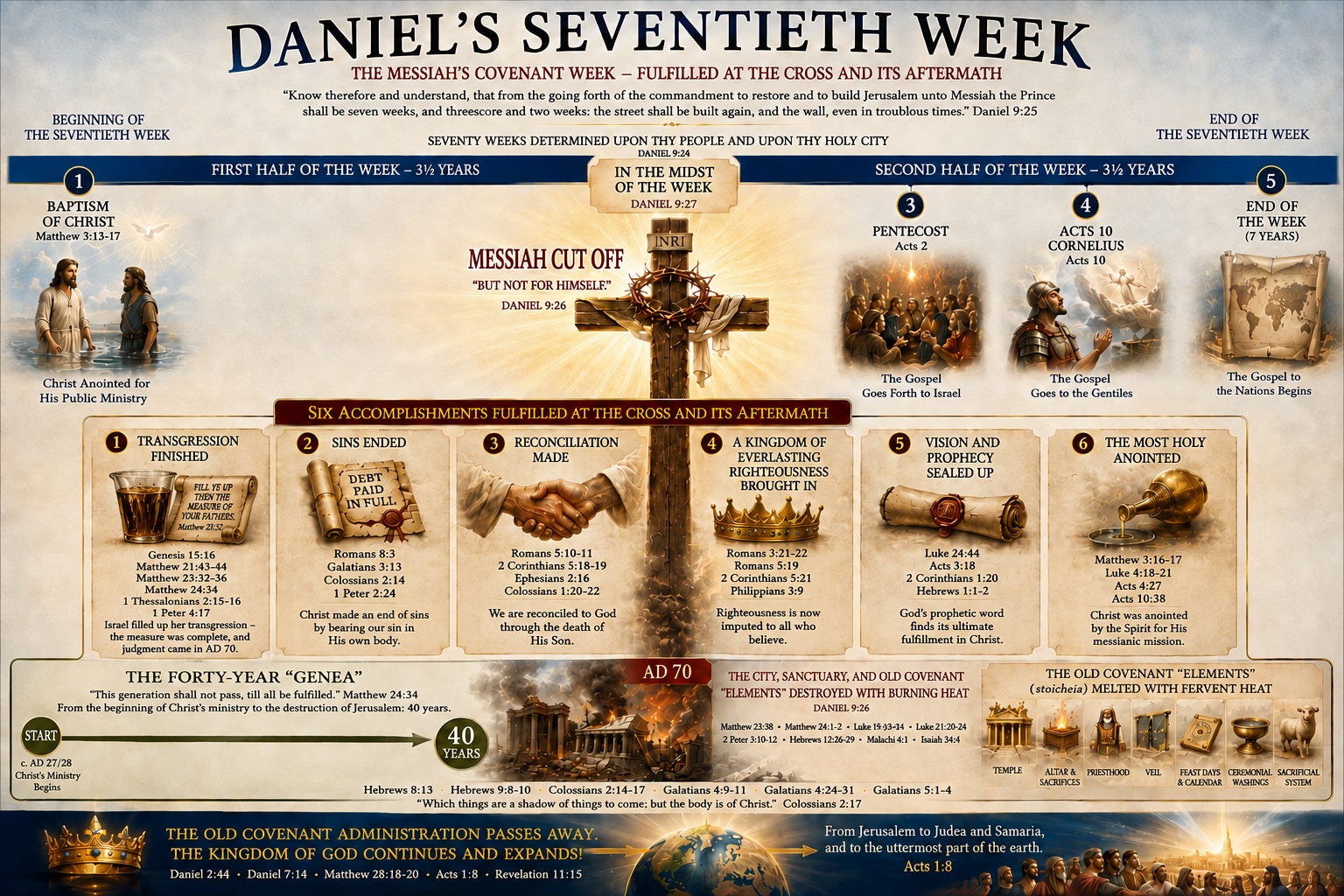
What I am not going to do is claim the seventy weeks are the seventy nations, or that the weeks map onto the princes, or that one decodes the other. They operate on different axes — one is a chronology of years, the other a count of peoples. The pattern is theological, and is strong enough on its own. Pressing it into an equation is how a sound argument acquires a soft spot.
However…
The relationship is not hard to see once the disinheritance is on the table. The seventy nations were handed over. Israel was saved back as a people unto Himself (Exodus 19:5; Deuteronomy 7:6; Deuteronomy 14:2; Deuteronomy 26:18; Deuteronomy 29:13; 2 Samuel 7:23), the one and only portion God retained in his Table of Nations decree — and then Israel was handed over too, for seventy years, to Babylon.
Daniel was praying about the seventy years of Babylonian exile when Gabriel arrived with a much larger number. The seventy sevens (490 years) described the terms under which Israel's exile would finally and fully end.
But look at what Gabriel says lies at the end of the chronology. Not the restoration of a national estate — not land, not borders, not a throne in Jerusalem. Sins ended. Reconciliation made. Everlasting righteousness brought in. These are covenant and atonement categories, none of which are territorial.
The return from Babylon restored a people to a place. What Gabriel described restored a greatly enlarged people group to God, which is the larger of the two by a wide margin, and which makes the return from Babylon look like a foreshadowing of the real thing.
And when it arrived, the reserved portion was no longer reserved. Paul said that the middle wall of partition is broken down and the two are made one in Christ. The estate divided at Babel was gathered back under a single head — in bigger fashion than too many modern evangelicals grasp (Romans 4:13). The seventy weeks are not a code for the seventy nations, and I am not arguing that they are. But they describe the terms on which the nations are released to come home.
For he is our peace, who hath made both one, and hath broken down the middle wall of partition between us; Having abolished in his flesh the enmity, even the law of commandments contained in ordinances; for to make in himself of two, one new man, so making peace; And that he might reconcile both unto God in one body by the cross, having slain the enmity thereby. (Ephesians 2:14-16)
The Little Season
Now the part that too often gets skipped…
“and after that he must be loosed a little season.” (Revelation 20:3)
“And when the thousand years are expired, Satan shall be loosed out of his prison, And shall go out to deceive the nations which are in the four quarters of the earth, Gog and Magog, to gather them together to battle: the number of whom is as the sand of the sea. And they went up on the breadth of the earth, and compassed the camp of the saints about, and the beloved city: and fire came down from God out of heaven, and devoured them. And the devil that deceiveth them was cast into the lake of fire and brimstone.” (Revelation 20:7-10)
Several things about this passage deserve mention...
The loosing restores exactly the function that was bound. Satan is released to once again go out and deceive the nations. Same verb, same object. This confirms the reading of verse 3 — the restraint was on national deception, because that is what will return when the binding is lifted.
It is brief. A little season. Whatever the thousand years is, this is short by comparison, and John says so. How long is it and what signifies its starting point? People have been debating that since John wrote it down on the isle of Patmos.
There is no battle. Read it again. They gather. They surround. Fire falls. That is the entire military engagement. The Greek does not describe combat; it describes an assembly followed immediately by consumption. This is not Armageddon as a protracted struggle with an uncertain outcome. It is a rebellion that is over before it starts.
It does not undo what came before. This is the point that matters regarding eschatology. A brief final apostasy at the end of an age of advance does not reverse the advance any more than a prisoner’s last outburst reverses the judge’s verdict. The Kingdom does not lose ground and then get rescued. It expands, and at the end there is a short and futile convulsion, and then fire.
Although many claim such, nobody knows the timing or shape of the little season, and everyone who has claimed to know has been wrong. What the text gives us is duration (short), content (national deception returns), and outcome (immediate and total). That’s enough for a group who was initially told by two of God’s messengers (angels) at Christ’s ascension to stop standing around and staring and the sky, and get busy about the business of growing the Kingdom!
Already, But Not Yet
Paul states the structure of the present age more clearly than anyone…
“For as in Adam all die, even so in Christ shall all be made alive. But every man in his own order: Christ the firstfruits; afterward they that are Christ’s at his coming. Then cometh the end, when he shall have delivered up the kingdom to God, even the Father; when he shall have put down all rule and all authority and power. For he must reign, till he hath put all enemies under his feet. The last enemy that shall be destroyed is death.” (1 Corinthians 15:22-26)
Look at the verb tenses…
He must reign — present, continuous, now. The reign is not future. It began at the ascension when Daniel 7 was fulfilled.
Till he hath put all enemies under his feet — progressive. The subjugation is happening across the age, not instantaneously at its close.
The last enemy that shall be destroyed is death — sequential, with death explicitly last. Which means the other enemies — the rule, authority, and power Paul names, the same vocabulary as Ephesians 6:12 and Colossians 2:15 — are being put down before death is. Now.
That is the already and the not yet in four verses. He reigns already. All enemies are not yet under His feet. The interval between those two facts is the age we are living in, and it is not a holding pattern. It is a subjugation in progress.
The author of Hebrews says the same thing by quoting from Psalm 8…
“Thou hast put all things in subjection under his feet. For in that he put all in subjection under him, he left nothing that is not put under him. But now we see not yet all things put under him.” (Hebrews 2:8)
All things are subjected. We do not yet see it. Both true, both stated in one verse, no contradiction. Which brings us to the passage the New Testament writers could not stop quoting.
Psalm 110 is seven verses long…
David Guzik’s commentary reveals that James Montgomery Boice counted twenty-seven quotations or allusions to it in the New Testament, with the first verse being the single most frequently referenced verse from the Old Testament anywhere in the New. Every time you read that Christ is seated at the right hand of God — Acts, Romans, Ephesians, Colossians, Hebrews, First Peter — you are reading its echo…
The LORD said unto my Lord, Sit thou at my right hand, until I make thine enemies thy footstool. (Psalm 110:1)
Read that word until…
The sitting is not a rest after the work is done. The sitting comes first, and the subjugation happens while He sits. That is the identical structure Paul gives in 1 Corinthians 15 — he must reign, till he hath put all enemies under his feet — because Paul is quoting this psalm when he writes it.
Then the next verse, which almost nobody reads…
The LORD shall send the rod of thy strength out of Zion: rule thou in the midst of thine enemies. (Psalm 110:2)
Not after His enemies. In the midst of them…
The reign is exercised inside contested territory, in the presence of an opposition that has not yet been removed. That is not a description of a kingdom waiting to begin. It is a description of a kingdom currently operating behind enemy lines.
And the mechanism is seen in verse three…
Thy people shall be willing in the day of thy power. (Psalm 110:3)
Volunteers. The subjugation of the nations proceeds by the willing submission of people within them — which is exactly what the Seventy were doing, and exactly what the Great Commission commands.
If you want to bend your mind just a bit, notice who quotes it, and when…
Jesus used it against the Pharisees at the end of Matthew 22 to ask how David could call his own son Lord. He used it again before the Sanhedrin near the end of Matthew 26 to tell the men who were about to condemn Him that they would see the Son of man seated at the right hand of power. The claim to the throne of Psalm 110 that we fail to notice, but got Him charged with blasphemy by those who did (compare to the first few verses of the Olivet Discourse {Matthew 24; Mark 13; Luke 21}, noting what Calvin did back in 1555.
And then Peter, at Pentecost, with the crowd asking what on earth just happened…
For David is not ascended into the heavens: but he saith himself, The LORD said unto my Lord, Sit thou on my right hand, until I make thy foes thy footstool. (Acts 2:34-35)
That is the answer to the question…
Why were Parthians and Medes and Elamites and dwellers in Mesopotamia — a list that reads like the table of nations — suddenly hearing the works of God in their own tongues? Because the God-man (Son of Man) had been enthroned ten days earlier. Peter explained Babel running backward by citing a coronation psalm.
The reign began at the ascension. Enemies being defeated in time and history. A campaign being fought with volunteers. And what does everyone in the church say about volunteers? Ten percent of the people do 90% of the work. Hopefully that provides some motivation as you enter the home stretch of this already too-long piece…
What is the Church’s Mission?
Given everything discussed thus far, Ephesians 6 reads very differently than it’s usually preached…
“Finally, my brethren, be strong in the Lord, and in the power of his might. Put on the whole armour of God, that ye may be able to stand against the wiles of the devil. For we wrestle not against flesh and blood, but against principalities, against powers, against the rulers of the darkness of this world, against spiritual wickedness in high places.” (Ephesians 6:10-12)
“Wherefore take unto you the whole armour of God, that ye may be able to withstand in the evil day, and having done all, to stand.” (Ephesians 6:13)
Count the offensive equipment. Belt, breastplate, shoes, shield, helmet — all defensive. And one offensive item — the sword of the Spirit, which Paul immediately identifies as the Word of God. And the stated objective, three times in four verses, is to stand.
You do not hold ground you have not already taken…
The posture Paul describes is that of an occupying force consolidating territory that has already changed hands — which is precisely what Colossians 2:15 said happened at the cross and what Matthew 28:18 said happened at the enthronement.
The weapons are correspondingly strange for a military metaphor, but note why that is…
“For the weapons of our warfare are not carnal, but mighty through God to the pulling down of strong holds; Casting down imaginations, and every high thing that exalteth itself against the knowledge of God, and bringing into captivity every thought to the obedience of Christ.” (2 Corinthians 10:4-5)
Strongholds, imaginations, arguments, thoughts. High things. The war is fought over what people believe. Their thought lives. Which is exactly what you would expect in an age whose defining feature is that the nations can no longer be deceived. Deception hinges on changing what a person believes about something.
And unfortunately, a deceived people will not recognize history for what it really is — His story…
The Stone That Became a Mountain
Two of Jesus’ shortest parables describe the Kingdom’s trajectory, and both describe the same thing. Something small that becomes large by internal growth rather than external imposition…
“Another parable put he forth unto them, saying, The kingdom of heaven is like to a grain of mustard seed, which a man took, and sowed in his field: Which indeed is the least of all seeds: but when it is grown, it is the greatest among herbs, and becometh a tree, so that the birds of the air come and lodge in the branches thereof.” (Matthew 13:31-32)
“Another parable spake he unto them; The kingdom of heaven is like unto leaven, which a woman took, and hid in three measures of meal, till the whole was leavened.” (Matthew 13:33)
Leaven does not ‘conquer’ dough. It permeates it. And the stated endpoint is not a partial result — it is till the whole was leavened.
Before that, Daniel prophetically described the Kingdom of God as a growing stone…
“Thou sawest till that a stone was cut out without hands, which smote the image upon his feet that were of iron and clay, and brake them to pieces.” (Daniel 2:34)
“And in the days of these kings shall the God of heaven set up a kingdom, which shall never be destroyed: and the kingdom shall not be left to other people, but it shall break in pieces and consume all these kingdoms, and it shall stand for ever.” (Daniel 2:44)
“And the stone that smote the image became a great mountain, and filled the whole earth.” (Daniel 2:35)
In the days of these kings…
During the fourth kingdom, which everyone except modern dispensationalists interpret as ancient Rome (they interpret it as a modern E.U. of exactly ten nations), the stone made without hands began growing into the mountain that will one day fill the whole earth. Growth, not sudden replacement. The striking is instantaneous, but the filling is a process.
That comes from the same prophet that gave us the Son of Man receiving all peoples, nations, and languages in chapter 7, and the spirit princes of Persia and Greece in chapter 10. Daniel is internally consistent about this from beginning to end.
Back to the Hillside
A return to where we started…
“Lord, wilt thou at this time restore again the kingdom to Israel?” (Acts 1:6)
We can now see what was wrong with the question, and it was not what most people assume. The disciples were not wrong to expect a kingdom. They were not wrong to expect it soon. They were wrong about its size and about its nature.
They were asking about one nation — the portion, Jacob (aka Israel), the lot of His inheritance. They were asking about the restoration of Deuteronomy 32:9. Instead, they were given Deuteronomy 32:8. All of it. Every nation on the Table, every people handed over at Babel, every territory that had been sitting under the administration of a corrupt spiritual prince for thousands of years…
“But ye shall receive power, after that the Holy Ghost is come upon you: and ye shall be witnesses unto me both in Jerusalem, and in all Judaea, and in Samaria, and unto the uttermost part of the earth.” (Acts 1:8)
The uttermost part of the earth…
Psalm 2:8 quoted back at them, by the ready-to-ascend-to-the-throne Christ as a job description — “the uttermost parts of the earth for thy possession” — and they did not catch it, standing right there, ten days before the Spirit was gifted.
The fact that they did not fully understand did not slow down Christ’s plan. The Ascension, the cloud, and the beginning of the fulfillment of Daniel 7 — the coronation of Christ the King and His building His Kingdom through His chosen vehicle of change, His Church…
“And there was given him dominion, and glory, and a kingdom, that all people, nations, and languages, should serve him: his dominion is an everlasting dominion, which shall not pass away, and his kingdom that which shall not be destroyed.” (Daniel 7:14)
“Ye men of Galilee, why stand ye gazing up into heaven?” (Acts 1:11)
What a Christian does with this information is everything. Think I’m hyperbolizing?
Fail to see it and your Christian mission is not what it should or could be simply because you’ve failed to understand your marching orders. Futurizing the Kingdom of God to a literal thousand-year “Millennium” robs the current generation of Christians of being part of the glorious advancement, while promoting pessimism and despair as far as the spread of the Gospel is concerned.
Oh, and don’t forget the date-setting...
“In his writings he was careful of his choice of words and used only those that delicately balanced with his meanings. The word ‘millennium’ is a perfectly good biblical word and yet you will not find it used by Dr Scofield. It suggests controversial aspects, so he always employed the word ‘Kingdom’”. -Dr W. Irving Carroll from a November 27, 1921 memorial service in Dallas celebrating the life of Cyrus Ingerson Scofield (The Incredible Scofield and His Book)
Do you polish the brass on a sinking ship? -The late J. Vernon McGee expositing on the nearness of Christ’s return as related to Christians leaving something lasting for future generations of Christians, from back in the early 1970’s
“What is a ‘generation’? Planet Earth’s greatest prophecy is found in Matthew 24... Jesus said that the generation that sees ‘all these things’ happen to Israel ‘shall not pass, till all these things be fulfilled.’... Assuming that 1948 was the date of the fig tree’s blossoming, then the expiration date of planet earth will be 1988. This is based on a Biblical generation being approximately 40 years.” -The late Hal Lindsey, from 1970’s Late Great Planet Earth, the single best-selling book of that decade — 35-40 million copies to date…
These are sentiments held by virtually all modern prophecy experts, and hallmarks of their theology. I grew up immersed in this system and understand its intricacies far better than most. And will argue that this way of thinking has not been helpful to the mission of the saints of God.
Sure, an increasingly impotent Church might be able to snatch some souls from the fire, but as far as advancing the Kingdom and the sort of lasting change that only comes from real discipleship… A pipe dream.
Because confusing the time of the end (the end of the Old Covenant sacrificial age) with the end of time (The Last Day — the Second Coming, bodily resurrection from the dead, and final judgement) produces little but pessimism for the Gospel and its Kingdom to overspread the earth as the waters cover the sea.
The Kingdom, however, is not a future arrangement awaiting a trigger.
It was inaugurated on a specific day by a specific transfer of authority, witnessed by eleven men who were told to stop looking at the sky and go take possession of what their King had just been given.
Imprtant: Notice what happened in Daniel 7 after Christ was given the keys to the Kingdom. He turned around and presented them to his vehicle for victory on earth, the Church.
An entity made up of individual — wait for it — ‘saints’…
7:18 — But the saints of the most High shall take the kingdom, and possess the kingdom for ever, even for ever and ever.
7:22 — Until the Ancient of days came, and judgment was given to the saints of the most High; and the time came that the saints possessed the kingdom.
7:27 — And the kingdom and dominion, and the greatness of the kingdom under the whole heaven, shall be given to the people of the saints of the most High, whose kingdom is an everlasting kingdom, and all dominions shall serve and obey him.
The strong man is bound in the one function that matters — he cannot keep the nations blinded to the things of God.
His real estate is being plundered by the saints, just as it has been continuously plundered for two thousand years, one nation and one Christian at a time, by a Church armed with nothing but God’s Word and God’s Spirit.
And the last enemy has a place in the queue…
“The last enemy that shall be destroyed is death.” (1 Corinthians 15:26)
“And the seventh angel sounded; and there were great voices in heaven, saying, The kingdoms of this world are become the kingdoms of our Lord, and of his Christ; and he shall reign for ever and ever.” (Revelation 11:15)
Are become. Not will become.
The seventy nations, given away on a plain in Shinar and reclaimed on a hill outside Jerusalem, belong to the Son who asked for them.
Coming on the Clouds
The Enthronement of the Son of Man — Every New Testament Reference, in Order. Several Diagrams at the End.
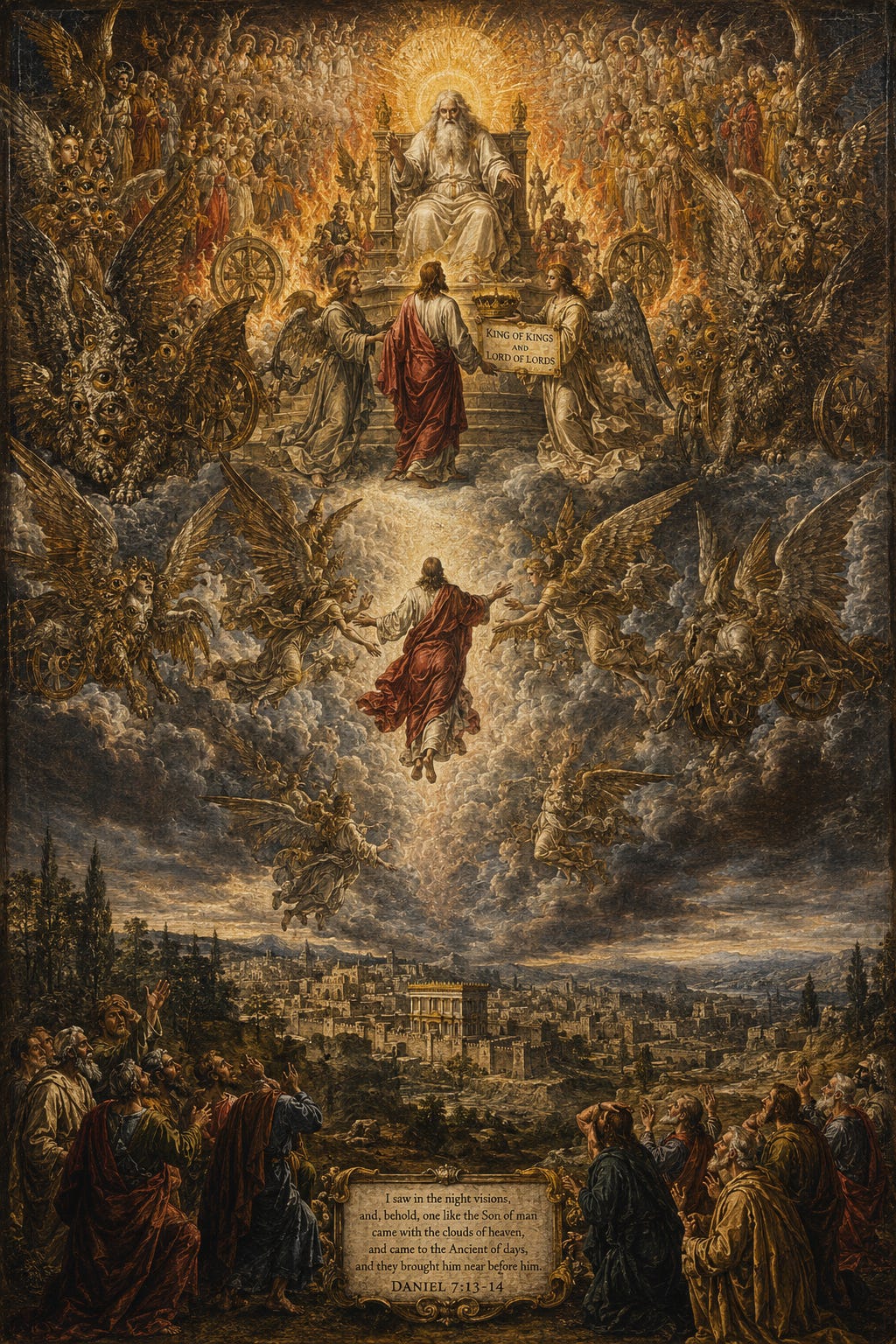
Ask the average American churchgoer what Christ “coming on the clouds” means and you will get a single answer — Christ returning to earth. Until about 25 years ago, I had never once considered that the phrase might mean something else entirely. Or that it did mean something else entirely to every single Jew, who knew exactly what the phrase meant. Do you know who else knew what this phrase meant? The Church — for eighteen centuries, before John Nelson Darby (circa 1840) and Cyrus Ingerhausen Scofield (1909) got hold of it.
The problem is not that the phrase is obscure. The problem is that it is familiar — too familiar. It has been read backwards through a theological grid built over the last 150 years to the point that the original picture has been almost completely erased in certain evangelical circles.
So let’s do the simple thing. Let’s put every New Testament instance on the table, in order, in context, and let the text itself carry the argument.
Part I — The Foundation: What the Cloud Language Actually Meant
The Cloud-Rider Is a Judgment Motif, Not a Travel Itinerary
Before Daniel and before the Gospels, the Old Testament had already established what it means for God to “come on the clouds.” It is not a description of transportation. It is the standard Hebrew idiom for divine judgment falling on a nation — and in every single case, God does not physically appear…
“Behold, the LORD rideth upon a swift cloud, and shall come into Egypt: and the idols of Egypt shall be moved at his presence, and the heart of Egypt shall melt in the midst of it.” -Isaiah 19:1 (KJV)
The LORD “came into Egypt” on a cloud in 671 BC by means of the Assyrian army. Nobody saw a deity in the sky. The cloud-coming was the historical judgment. Same construction throughout…
“The LORD is slow to anger, and great in power, and will not at all acquit the wicked: the LORD hath his way in the whirlwind and in the storm, and the clouds are the dust of his feet.” -Nahum 1:3 (KJV)
“For the day is near, even the day of the LORD is near, a cloudy day; it shall be the time of the heathen.” -Ezekiel 30:3 (KJV)
See also Psalm 18:9–12, Psalm 104:3, Joel 2:1–2, and Zephaniah 1:14–15. Each of them describes a historical military catastrophe in cosmic-collapse terms. Not one of them describes God descending visibly from the sky.
This is the vocabulary Jesus was using. His audience did not need it explained…
Daniel 7 — And the Direction of Travel
Here is where the whole thing turns, and where most modern readers simply do not read what is on the page…
“I saw in the night visions, and, behold, one like the Son of man came with the clouds of heaven, and came to the Ancient of days, and they brought him near before him. And there was given him dominion, and glory, and a kingdom, that all people, nations, and languages, should serve him: his dominion is an everlasting dominion, which shall not pass away, and his kingdom that which shall not be destroyed.”
Daniel 7:13–14 (KJV)
The Son of Man is not moving toward earth. He is moving toward the throne.
He comes to the Ancient of Days. He is brought near before Him. And there — in the heavenly throne room, not in their renovated earthly temple that, believe it or not, hosts animal sacrifices — He receives dominion, glory, and a kingdom. This is a coronation scene. The direction is upward. It has always been upward.
And notice what He receives…
A kingdom of “all people, nations, and languages.” For anyone who has followed the divine council material previous to this chapter, that phrase is not decoration. It is the formal reversal of Deuteronomy 32:8–9 — the disinherited nations, allotted to the sons of God at Babel, being handed back to the rightful Heir. The Son of Man’s coronation is the reclamation.
Then Daniel tells us what the newly crowned King does with His kingdom — He turns right around and hands it over to…
“But the saints of the most High shall take the kingdom, and possess the kingdom for ever, even for ever and ever.” -Daniel 7:18 (KJV)
“And the kingdom and dominion, and the greatness of the kingdom under the whole heaven, shall be given to the people of the saints of the most High, whose kingdom is an everlasting kingdom, and all dominions shall serve and obey him.” -Daniel 7:27 (KJV)
He gives the kingdom to the saints — to grow it. Where? “Under the whole heaven.” Not in a walled-off future dispensation. Now.
Psalm 110 — The Session
“The LORD said unto my Lord, Sit thou at my right hand, until I make thine enemies thy footstool. The LORD shall send the rod of thy strength out of Zion: rule thou in the midst of thine enemies.” -Psalm 110:1–2 (KJV)
Two words decide the entire eschatological argument: until and in the midst of. He reigns now, from the throne, while enemies still exist, until they are subdued. He is not waiting in the wings for a future coronation. He is reigning during the subjugation, not after it.
Psalm 110 is the most-quoted Old Testament text in the New Testament. That is not an accident of style. It is the apostolic thesis statement.
Part II — Jesus Claims the Title
How often have you heard the claim, “Christ never claimed to be God”? Not only is that assertion an absurdity, but it reveals just how little the person writing it understands the idioms of first-century Jews, as seen through the lens of the Old Testament.
Follow along because this issue is wrapped so tightly in the bigger ideas espoused in this post that they are impossible to separate. Getting that out of the way, we can now move forward…
1. Nathanael and the Opened Heaven
“And he saith unto him, Verily, verily, I say unto you, Hereafter ye shall see heaven open, and the angels of God ascending and descending upon the Son of man.” -John 1:51 (KJV)
The ASV renders it “Ye shall see the heaven opened” — no “hereafter” pushing it into the indefinite future. Jesus is telling Nathanael he will see Jacob’s ladder in person: the Son of Man as the point of contact between heaven and earth, using the language of Daniel 7:13-14. The first “Son of Man” declaration in John is an enthronement text.
2. “Ye Shall Not Have Gone Over the Cities of Israel”
“But when they persecute you in this city, flee ye into another: for verily I say unto you, Ye shall not have gone over the cities of Israel, till the Son of man be come.” -Matthew 10:23 (KJV)
This is the verse that made Albert Schweitzer conclude Jesus was simply mistaken — because Schweitzer, like the dispensationalists, assumed “the Son of man be come” had to mean a bodily return to earth.
It doesn’t — and never did. It means what Daniel 7 means…
The coming is the enthronement. The apostolic mission to the cities of Israel was still unfinished when it happened.
3. “Some Standing Here” — All Three Synoptics
This is the cluster the entire futurist system has to explain away, and it appears in three Gospels…
“For the Son of man shall come in the glory of his Father with his angels; and then he shall reward every man according to his works. Verily I say unto you, There be some standing here, which shall not taste of death, till they see the Son of man coming in his kingdom.” -Matthew 16:27–28 (KJV)
“Whosoever therefore shall be ashamed of me and of my words in this adulterous and sinful generation; of him also shall the Son of man be ashamed, when he cometh in the glory of his Father with the holy angels. And he said unto them, Verily I say unto you, That there be some of them that stand here, which shall not taste of death, till they have seen the kingdom of God come with power.” -Mark 8:38–9:1 (KJV)
“For whosoever shall be ashamed of me and of my words, of him shall the Son of man be ashamed, when he shall come in his own glory, and in his Father’s, and of the holy angels. But I tell you of a truth, there be some standing here, which shall not taste of death, till they see the kingdom of God.” -Luke 9:26–27 (KJV)
Pay close attention, noting what the parallels do to a futuristic interpretation...
Matthew says “the Son of man coming in his kingdom.” Mark says “the kingdom of God come with power.” Luke says “the kingdom of God.” What does this really mean? The three phrases are interchangeable. The Holy Spirit, through three evangelists, treats the coming of the Son of Man and the arrival of the kingdom as the same event.
And it would happen before some of the men (plural) standing in front of Him died.
4. The Transfiguration: A Staged Preview
All three Synoptics place the Transfiguration immediately after that saying. That is deliberate editorial architecture.
“While he yet spake, behold, a bright cloud overshadowed them: and behold a voice out of the cloud, which said, This is my beloved Son, in whom I am well pleased; hear ye him.” -Matthew 17:5 (KJV) — cf. Mark 9:7, Luke 9:34–35
Every element of Daniel 7 is present. The Son, the cloud, the divine voice, the glory. And Peter — who was there — tells us plainly what he understood it to be…
“For we have not followed cunningly devised fables, when we made known unto you the power and coming of our Lord Jesus Christ, but were eyewitnesses of his majesty. For he received from God the Father honour and glory, when there came such a voice to him from the excellent glory, This is my beloved Son, in whom I am well pleased. And this voice which came from heaven we heard, when we were with him in the holy mount.” -2 Peter 1:16–18 (KJV)
Peter says the apostles were eyewitnesses of “the power and coming” (Greek parousia) of Christ — and then points to the mountain. Not to a future event. To one he had already seen.
Part III — The Covenant Judgment Announced
5. The Seven Woes
Before the cloud-coming prophecy, Jesus first pronounces sentence on the covenant leadership. Sequence matters here…
“Fill ye up then the measure of your fathers. Ye serpents, ye generation of vipers, how can ye escape the damnation of hell? Wherefore, behold, I send unto you prophets, and wise men, and scribes: and some of them ye shall kill and crucify... That upon you may come all the righteous blood shed upon the earth... Verily I say unto you, All these things shall come upon this generation.” -Matthew 23:32–36 (KJV)
“Behold, your house is left unto you desolate.” -Matthew 23:38 (KJV) — cf. Luke 13:34–35
Your house — no longer My Father’s house. While still a generation in the future, the myriad of truths discussed in the book of Hebrews are coming into focus.
The verdict is delivered, the time-frame is specified (“this generation”), and only then does He walk out of the temple and deliver the Olivet Discourse. Matthew 23 and Matthew 24 are one continuous speech. Chapter divisions were added in the thirteenth century, and are not always helpful.
Part IV — The Olivet Discourse
6. The Question, and the Answer
The disciples ask about these things — the stones of the temple He just said would be thrown down. Everything that follows answers that question…
“And then shall appear the sign of the Son of man in heaven: and then shall all the tribes of the earth mourn, and they shall see the Son of man coming in the clouds of heaven with power and great glory.” -Matthew 24:30 (KJV)
“And then shall they see the Son of man coming in the clouds with great power and glory.” -Mark 13:26 (KJV)
“And then shall they see the Son of man coming in a cloud with power and great glory.” -Luke 21:27 (KJV)
Two lexical points the English flattens…
First, gē (γῆ) — rendered “earth” — is the ordinary word for land, and in a discourse about Jerusalem and the temple, “all the tribes of the land” is the natural reading.
Second, “the sign of the Son of man in heaven“ is a genitive of location describing where the Son of Man is, not where the sign appears. The sign on earth is the smoking ruin of the temple; what it signifies is that the Son of Man is enthroned in heaven. In other words…
“The sign that the Son of Man is in heaven and that Christ is exactly who He said He is — King of Kings and Lord of Lords — would be the destruction of the Old Covenant and its worn out and worthless ‘elements’ of worship”. -Me
7. Luke’s Uninterpreted Parallel
Despite dispensationalists debating this issue like it were the Council of Nicea, Luke removes all ambiguity about what the “abomination of desolation” is…
“And when ye shall see Jerusalem compassed with armies, then know that the desolation thereof is nigh.” -Luke 21:20 (KJV)
Armies. Around Jerusalem. General / Prince Titus, AD 70. Luke wrote for a Gentile audience that would not catch the allusion to Daniel, so he simply told them what it meant. Josephus — writing less than a decade after the siege — told us the Romans crucified 500-1,000 people a day trying to escape, in full view of the wall, until there was no room left for crosses. Titus knew exactly what he was doing. He let the city watch. And when even that failed to break them, his Legions encompassed the city with an earthen wall…
“When caught by the Romans, the fugitives were forced to offer resistance, and when the fighting ended it seemed too late to sue for mercy. Scourged and subjected before death to every torture, they were finally crucified in view of Jerusalem. Titus indeed realized the horror of what was happening, for every day 500—sometimes even more—fell into his hands. However, it was not safe to let men captured by force go free, and to guard such a host of prisoners would tie up a great proportion of his troops. But his chief reason for not stopping the slaughter was the hope that the sight of it would perhaps induce the Jews to surrender in order to avoid the same fate. The soldiers themselves, through rage and bitterness, nailed up their victims in various postures as a grim joke, till owing to the vast numbers there was no room for the crosses, and no crosses for the bodies” -Flavius Josephus from The Wars of the Jews
Two animated versions of the siege, the first is 45 minutes and the second is half that…
Before watching, read Isaiah 13 — the prophecy of ancient Babylon's destruction, written a century before it happened. Compare its language to the Olivet Discourse and to Revelation's account of the fall of Mystery Babylon (Babylon the Great).
8. “This Generation” — Stated Three Times
“Verily I say unto you, This generation shall not pass, till all these things be fulfilled.” -Matthew 24:34 (KJV)
“Verily I say unto you, that this generation shall not pass, till all these things be done.” -Mark 13:30 (KJV)
“Verily I say unto you, This generation shall not pass away, till all be fulfilled.” -Luke 21:32 (KJV)
The word is genea.
Matthew uses it in 23:36 — same discourse, same “Verily I say unto you” — where nobody disputes it means the people then living. Three verses earlier he calls them gennēmata echidnōn, brood of vipers, and when he wants ethnic stock he has genos available. He uses neither in 24:34.
Genea cannot quietly become ‘race’ or ‘the generation that sees the fig tree, and all the trees, bloom’ between chapters without the interpreter importing meaning that’s simply not there to import.
9. The Sanhedrin — The Decisive Text
If there is one passage that settles the direction of travel, it is this one. Here I move to the ASV, because the KJV’s “hereafter” actively obscures the Greek…
“Jesus saith unto him, Thou hast said: nevertheless I say unto you, Henceforth ye shall see the Son of man sitting at the right hand of Power, and coming on the clouds of heaven.” -Matthew 26:64 (ASV) — KJV | ESV
“And Jesus said, I am: and ye shall see the Son of man sitting at the right hand of Power, and coming with the clouds of heaven.” -Mark 14:62 (ASV)
“But from henceforth shall the Son of man be seated at the right hand of the power of God.” -Luke 22:69 (ASV)
Three things demolish the futurist reading here…
First, the audience. Jesus tells Caiaphas and the men in that room — “ye shall see.” Not a generation two thousand years downstream. Those men.
Second, the timing. Ap’ arti / apo tou nyn — “henceforth,” “from now on.” Not someday. Beginning immediately.
Third, the order. He sits first, then comes with the clouds. If “coming on the clouds” meant a return to earth, the sequence would be backwards — you would descend and then be enthroned. The sequence only makes sense if the coming is the enthronement: Daniel 7 followed by Psalm 110, exactly as He states it.
And Caiaphas, the high priest, understood perfectly what our American pea-brains don’t. He tore his robes and called it blasphemy — not because a rabbi predicted a distant future visit, but because the nobody standing before him had just claimed the throne of God.
Part V — The Fulfillment Begins
10. The Ascension
“And when he had spoken these things, while they beheld, he was taken up; and a cloud received him out of their sight. And while they looked stedfastly toward heaven as he went up, behold, two men stood by them in white apparel; Which also said, Ye men of Galilee, why stand ye gazing up into heaven? this same Jesus, which is taken up from you into heaven, shall so come in like manner as ye have seen him go into heaven.” -Acts 1:9–11 (KJV)
Set this beside Daniel 7:13, and the correspondence is not subtle. A cloud. A Son of Man. An upward movement. Angels present. He goes to the Ancient of Days.
And note what the angels do not say in Acts 1. They do not say, “Wait here until He returns to be crowned.” They say: He is gone, and He will come in like manner. The Daniel 7 scene is not being previewed.
It is starting…
11. Pentecost: Peter Announces the Coronation
“This Jesus hath God raised up, whereof we all are witnesses. Therefore being by the right hand of God exalted, and having received of the Father the promise of the Holy Ghost, he hath shed forth this, which ye now see and hear. For David is not ascended into the heavens: but he saith himself, The LORD said unto my Lord, Sit thou on my right hand, Until I make thy foes thy footstool. Therefore let all the house of Israel know assuredly, that God hath made that same Jesus, whom ye have crucified, both Lord and Christ.” -Acts 2:32–36 (KJV)
The first Christian sermon ever preached is a coronation announcement built on Psalm 110. Not “Jesus will be King.” But God hath made — aorist, completed action. He is King. The Spirit poured out at Pentecost is the proof of enthronement, the evidence that the King has taken His seat and is now distributing the spoils discussed in the first part of this post.
12. Stephen Sees It
“But he, being full of the Holy Ghost, looked up stedfastly into heaven, and saw the glory of God, and Jesus standing on the right hand of God, And said, Behold, I see the heavens opened, and the Son of man standing on the right hand of God.” -Acts 7:55–56 (KJV)
This is the only occurrence of “Son of Man” on any lips but Christ’s own in the entire New Testament. Stephen uses the Danielic title, seeing the enthroned Christ, and dying for saying so. The Sanhedrin — the same body Jesus told “henceforth ye shall see…” — killed him for reporting exactly what he was told they would see.
Part VI — The Apostolic Witness: The King Is Already Reigning
13. Paul
“Then cometh the end, when he shall have delivered up the kingdom to God, even the Father; when he shall have put down all rule and all authority and power. For he must reign, till he hath put all enemies under his feet.” -1 Corinthians 15:24–25 (KJV)
Read that again slowly, because it inverts the standard timeline. Christ reigns now and hands the kingdom back at the end. If the millennium follows the return, Paul has the order exactly backwards. He doesn’t. The reign is present, progressive, and terminates in delivery — not inauguration…
“...which he wrought in Christ, when he raised him from the dead, and made him to sit at his right hand in the heavenly places, far above all rule, and authority, and power, and dominion, and every name that is named, not only in this world, but also in that which is to come: and he put all things in subjection under his feet, and gave him to be head over all things to the church.” -Ephesians 1:20–22 (ASV)
“Far above all rule, and authority, and power, and dominion” — the divine council vocabulary again. The elohim of Deuteronomy 32 have a new sovereign, and He took the throne at the resurrection-ascension, not at some future date…
“Who hath delivered us from the power of darkness, and hath translated us into the kingdom of his dear Son.” -Colossians 1:13 (KJV)
Past tense. Already translated. Into a kingdom that, on the dispensational scheme, does not yet exist…
“Wherefore God also hath highly exalted him, and given him a name which is above every name: That at the name of Jesus every knee should bow, of things in heaven, and things in earth, and things under the earth.” -Philippians 2:9–11 (KJV)
14. Hebrews — The Seated King
Hebrews returns to the session again and again, because the entire argument of the letter depends on it: the temple system is obsolete because the King-Priest is already enthroned…
“...when he had by himself purged our sins, sat down on the right hand of the Majesty on high.” -Hebrews 1:3 (KJV)
“But to which of the angels said he at any time, Sit on my right hand, until I make thine enemies thy footstool?” -Hebrews 1:13 (KJV)
“Thou didst put all things in subjection under his feet. For in that he subjected all things unto him, he left nothing that is not subject to him. But now we see not yet all things subjected to him.” -Hebrews 2:8 (ASV)
That last line is the whole postmillennial position in one sentence. All things have been subjected. We do not yet see it. The gap between the legal reality and the visible reality is the age we are living in — and it is closing, not widening…
“But this man, after he had offered one sacrifice for sins for ever, sat down on the right hand of God; henceforth expecting till his enemies be made the footstool of his feet.” -Hebrews 10:12–13 (ASV)
“Wherefore we receiving a kingdom which cannot be moved, let us have grace, whereby we may serve God acceptably with reverence and godly fear.” -Hebrews 12:28 (KJV) — cf. 8:1, 12:2
Present participle. Receiving. Written to people who were about to watch the old covenant economy burn to the ground.
15. Peter
“Who is gone into heaven, and is on the right hand of God; angels and authorities and powers being made subject unto him.” -1 Peter 3:22 (KJV)
Part VII — Revelation: The Enthroned Son Executes His Authority
Revelation is bookended by time-references — specific time-references. Twice at the beginning, once at the end — and the American church has spent a century pretending that those mean something else, or trying to explain it away using 2 Peter 3:8, a passage meant to describe / infer nearness, not distance…
“...things which must shortly come to pass... for the time is at hand.” -Revelation 1:1, 1:3 (KJV)
“Seal not the sayings of the prophecy of this book: for the time is at hand.” -Revelation 22:10:
Daniel was told the opposite — “shut up the words, and seal the book, even to the time of the end.” John is told not to seal it. Why? Because for Daniel it was distant. For John it wasn’t.
What was near? The very theme of the book of Revelation — the “sign” that the Son of Man is in heaven, seated at the right hand of power. Revelation is a book of signs. For instance, Revelation 1:1, where “signified” is esēmanen, meaning He sign-ified it. The biggest of these signs, the “super sign” if you will, would be the destruction of the Old Covenant and its “elements” of worship.
These elements — the “types and shadows” of the Old Covenant — had, thanks to Christ (the very fulfillment or “substance” of the New Covenant), become “worthless and ready to pass away”…
In the NT, we refer to the bread and cup of communion as “the elements” — baptism is considered an “element” as well. The OT had its own unique elements (stoicheia) — elements that Paul admonished the “foolish Galatians” [Galatians 3:1] (twice) not to return to (Galatians 4:3, 4:9; same word rendered “rudiments” at Colossians 2:8 and 2:20), and that Peter warned would soon be melting with fervent heat [2 Peter 3:10, 3:12].
The wordplay isn’t English coincidence — Jerome rendered stoicheia as elementis in Galatians 4:3, and Augustine, expounding on John 15:3 — “Now ye are clean through the word which I have spoken unto you”, defined a sacrament as what happens when the word joins the element: accedit verbum ad elementum, et fit sacramentum. Same Latin word, both covenants — the old elements were abolished; the new ones took their place.
These elements — the shadows of the Old Covenant (Hebrews 8:5, 10:1; Colossians 2:17) — had become, thanks to Christ, the very fulfillment or “substance” of the New Covenant (Colossians 2:17), become “worthless and ready to pass away” (Hebrews 7:18, 8:13).
What were these Old Covenant elementis of worship?
Jerusalem — a special place — was no longer necessary because places no longer matter with the reversal of the small ‘g’ god’s rule as discussed earlier in the post. (John 4:20–24 · Acts 7:48–50 · Galatians 4:25–26 · Hebrews 12:22 · Hebrews 13:14)
The Temple and animal sacrifices were no longer necessary for similar reasons — Christ had become the once and for all sacrifice for the sins of the world’s believers. (John 1:29 · John 2:19–21 · Hebrews 9:11–12 · Hebrews 9:26–28 · Hebrews 10:10–14 · Hebrews 10:18 · 1 Peter 3:18 · 1 Corinthians 3:16 · Ephesians 2:19–22)
Human priests were no longer necessary because the entire book of Hebrews, as well as the entirety of the New Testament, attest to Christ being the great High Priest (Hebrews 4:14–16 · Hebrews 7:23–27 · Hebrews 8:1 · Hebrews 9:24 · Hebrews 10:19–22 · 1 Timothy 2:5 · 1 Peter 2:5, 9 · Revelation 1:6)
Genealogies — critical in the OT because the priesthood ran on them. A man who couldn’t trace his lineage back to Abraham was put out (Ezra 2:62). Then Hebrews pointed out that Christ came from Judah, a tribe with no priestly claim (Hebrews 7:14) — which meant the law tying priesthood to both Abraham and Levitical bloodlines had already been set aside. Paul, writing while the genealogies were still intact and still functioning, told two different apostles to shut down endless genealogies as unprofitable and vain (1 Timothy 1:4, Titus 3:9). The only genealogy that matters now is Christ. You are Abraham’s seed by virtue of being in Christ, or you aren’t. An important theme of the NT is that thanks to the “Babel Reversal” at the cross, physical race has no meaning in the New Testament economy. Every believer is a priest who can approach God the Father thanks to Christ’s merit. (Galatians 3:7 · Galatians 3:16 · Galatians 3:26–29 · Romans 2:28–29 · Romans 9:6–8 · Philippians 3:4–8 · Colossians 3:11)
16. The Cloud-Coming
“Behold, he cometh with clouds; and every eye shall see him, and they also which pierced him: and all kindreds of the earth shall wail because of him. Even so, Amen.” -Revelation 1:7 (KJV)
“They also which pierced him…”
The ones who pierced Him were first-century Jerusalem — and they were still alive. This verse is a fusion of Daniel 7:13 and Zechariah 12:10, and both halves point at the same generation. The ESV’s “all tribes of the earth will wail on account of him” preserves the tribal language that the KJV renders “kindreds” — and tribes is the giveaway.
Tribes of the land…
“And I looked, and behold a white cloud, and upon the cloud one sat like unto the Son of man, having on his head a golden crown, and in his hand a sharp sickle.” -Revelation 14:14 (KJV)
And while dispensationalists will refer to this idea of a NT judgment on Israel as unbiblical or antisemitic, let’s see what the apostle Peter told his followers…
“For the time is come that judgment must begin at the house of God: and if it first begin at us, what shall the end be of them that obey not the gospel of God?” -1 Peter 4:17 (KJV)
Seated. Crowned. Already reigning — and the sickle is in His hand. This is not a King arriving. It is a King in His active role
17. The Kingdom Declared
“The kingdom of the world is become the kingdom of our Lord, and of his Christ: and he shall reign for ever and ever.” -Revelation 11:15 (ASV)
“Now is come salvation, and strength, and the kingdom of our God, and the power of his Christ: for the accuser of our brethren is cast down.” -Revelation 12:10 (KJV)
Now is come. Not “shall come.” And the reason given is the casting down of the accuser — which John 12:31 and Luke 10:18 both locate at the cross and the mission of the seventy, not at some future date. Which puts Revelation 20’s binding exactly where the Kingdom-and-the-Seventy framework puts it.
Because we are dealing with the center of Revelation 12, which is also the center of the entire book, a rabbit hole everyone should go down is the study of chiasms. Chiasms?
In English, we use an array of “literary devices” to emphasize points. These might include highlighting, bolding, italicizing, colored text, large text, underlining, strike-throughs, bullet points, etc. However, none of those was really a thing in ancient biblical texts, where there were no chapter or verse breaks in individual books, just line after line of uninterrupted text. However, the use of chiastic structure was prevalent.
Chiastic structure? Huh?
A chiasm is a mirror-image literary structure — ideas laid out A-B-C-B’-A’, named for the Greek letter chi (X). It was a standard literary device across the ancient Near East and the Greco-Roman world — Babylonian, Hebrew, Greek, and Roman writing alike. It functioned as both a memory aid for oral cultures as well as a visual signpost. In other words, the center of the chiasm is the point (see link above for examples).
We moderns miss it because we were trained to read linearly, looking for the climax at the end. So we skim right past a structure the original audience would have caught by ear — a structure that reveals the most important part of the passage. Since Nils Lund’s Chiasmus in the New Testament (1942), recognition of chiastic structure has become routine in full-scale commentaries and scholarly works on both Testaments.
Why do I bring this up?
Because not only is every chapter of the book of Revelation a chiasm, the entire book is a chiasm as well (I recently stumbled across James Bejon’s Revelation 12 as the Gateway to the Book of Revelation that does a great job with much of this)…
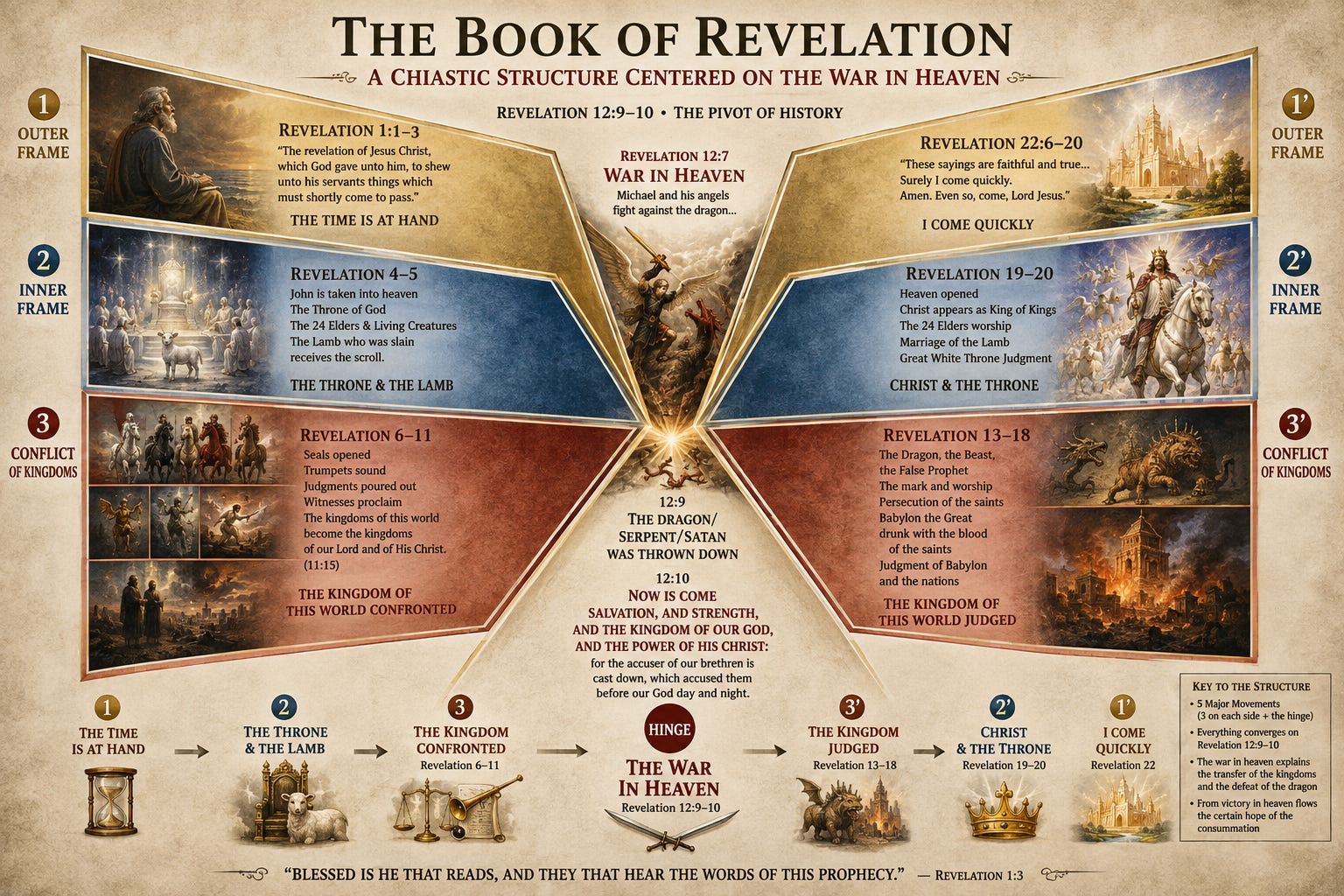
The Sequence
Pay attention to the sequence of the Coming on the Clouds thus far because it was provided in chronological order…
Daniel 7 — The Son of Man comes with the clouds to the Ancient of Days and receives the kingdom.
↓
Psalm 110 — He is seated at the right hand and reigns in the midst of His enemies.
↓
Matthew 26 — He tells the Sanhedrin: henceforth, you will see it.
↓
Acts 1 — The cloud receives Him. The Daniel 7 scene begins.
↓
Acts 2 — Peter announces the enthronement from Psalm 110.
↓
AD 70 — The judicial reality of Calvary becomes a physical reality: temple, sacrifice, priesthood, genealogies — gone.
↓
Revelation — The enthroned Son executes His authority until every enemy is under His feet.
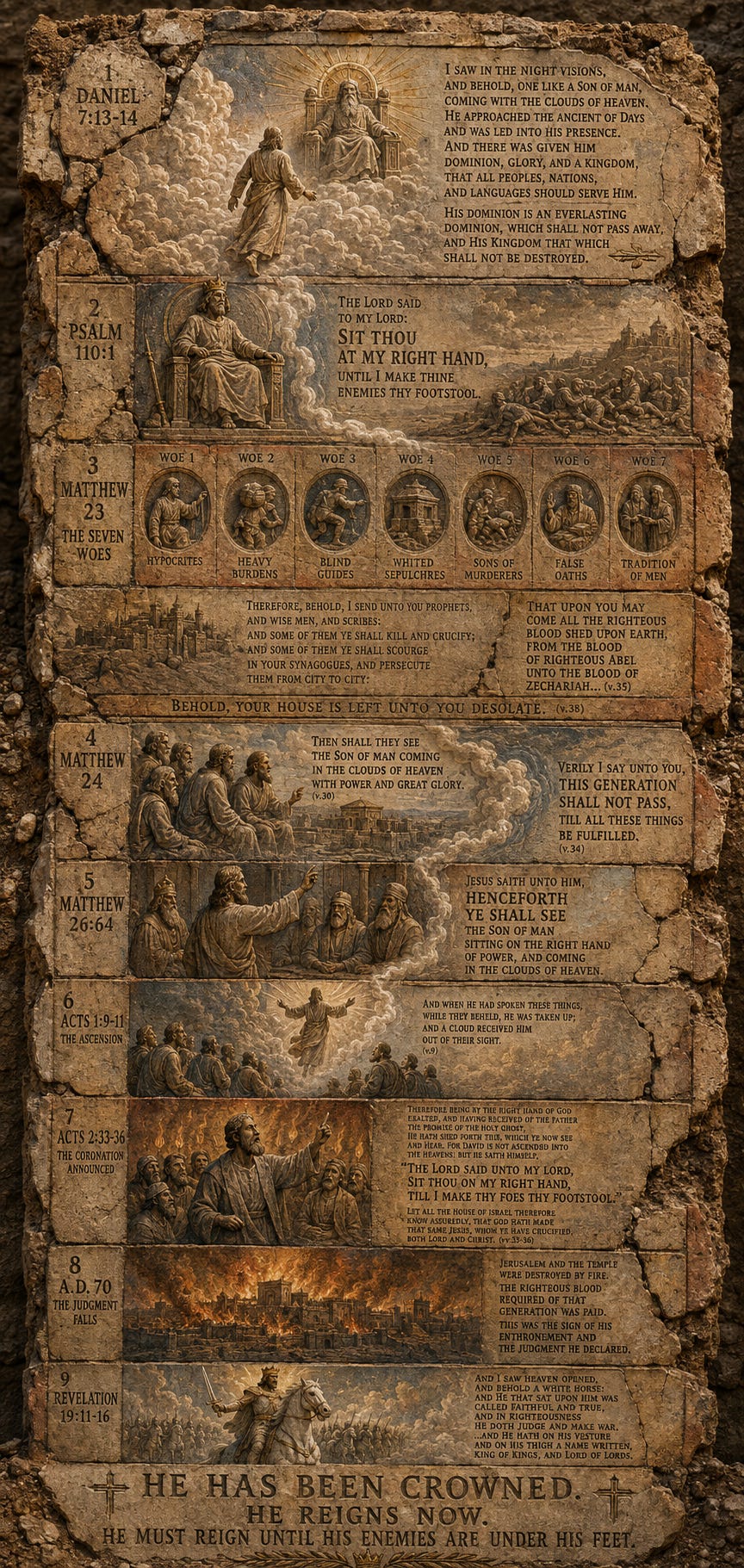
The central question of the New Testament is not “When will Jesus become King?”
The apostolic proclamation is that He has already been crowned. He has received the kingdom promised in Daniel. He gave it to the saints — the Temple of Hebrews and the “New Jerusalem” / bride of Christ of Revelation 21:2. And He reigns now, from the throne, until the last enemy is subdued…
“For he must reign, till he hath put all enemies under his feet.” -1 Corinthians 15:25 (KJV)
So, when we look at the last book of the Bible as it pertains to Christ’s “Coming,” as well as its predicted timing of this coming, how should 21st-century moderns think about it?
Cherry-picked for effect (the meaning is not changed)…
Then he said to me, “These words are faithful and true.” And the Lord God of the holy prophets sent His angel to show His servants the things which must shortly take place. “Behold, I am coming quickly! Blessed is he who keeps the words of the prophecy of this book.” “Do not seal the words of the prophecy of this book, for the time is at hand. “And behold, I am coming quickly, and My reward is with Me, to give to every one according to his work. He who testifies to these things says, “Surely I am coming quickly.” Amen. Even so, come, Lord Jesus!
Dating the Book of Revelation
If this makes sense, the first big implication is that despite what most evangelicals have been taught (most people are not even aware there’s a debate), Revelation would have been written prior to AD70, not in AD95. It’s an assertion with copious amounts of evidence, both internal (from inside the book itself) as well as external (from outside the book) to back it up…
Before Jerusalem Fell: Dating the Book of Revelation — Kenneth L. Gentry, Jr., Th.D. (1989, 3rd ed.). The doctoral dissertation that made the early date defensible in academic company, originally titled The Dating of the Book of Revelation: An Exegetical, Theological and Historical Argument for a Pre-A.D. 70 Composition. It works both sides — careful exegesis of critical passages, a diligent survey of the scholarly literature, and a meticulous search through the writings of early church fathers and Jewish and Roman historians. Even G.K. Beale, a late-date man, conceded Gentry “argued in thorough manner” that the list of kings begins with Julius and Nero is the sixth. Steve Gregg: “I have encountered no treatment of the dating of Revelation more thorough than his dissertation on the subject.”
The Last Days According to Jesus — R.C. Sproul (Baker, 1998). Sproul came to this late and reluctantly, which is exactly what gives it weight. In Tabletalk he wrote that after fluctuating between amillennialism and historic premillennialism, “Yet to my surprise, I have found myself more and more attracted to an orthodox post-mill position with its moderate preterist perspective.” He adds that he “has never been enticed by dispensational eschatology, despite its being the contemporary majority report among evangelicals.” His verdict on Gentry’s dating work: “Excellent work in forcing reconsideration of the date when the Book of Revelation was written.”
Redating the New Testament — John A.T. Robinson (SCM/Westminster, 1976). Anglican Bishop of Woolwich, Dean of Trinity College Cambridge, and a theological liberal — which is precisely why this book detonated. On Revelation 11 he concedes: “It is indeed generally agreed that this passage must bespeak a pre-70 situation. . . . There seems therefore no reason why the oracle should not have been uttered by a Christian prophet as the doom of the city drew nigh.” His silence argument remains the hardest to answer: the destruction of the temple is mentioned in 1 Clement but nowhere in the New Testament documents, which assume Jewish temple service is continuing.
Rethinking the Dates of the New Testament: The Evidence for Early Composition — Jonathan Bernier (Baker Academic, 2022). PhD McMaster, Regis College at the University of Toronto, published by a mainstream academic press — this is not a movement book. Bernier hypothesizes that the beasts of Revelation 13:1–18 make more sense before Nero’s death in AD 68 than after, and that the references to the Jerusalem temple in Revelation 11:1–2, 13 are more intelligible before AD 70 than after. He also strengthens the case by fixing its weak joint, beginning with the problems in Robinson’s own system and his tendency to argue from silence.
The Date of John’s Apocalypse: The Evidence of Some Roman Historians Reconsidered — Albert A. Bell, Jr., New Testament Studies 25 (1978): 93–102, Cambridge University Press. The single most-cited secular-academic article on the question, and every serious dating discussion since has had to reckon with it. Bell’s thesis: “Majority opinion now assigns that exotic book to the last decade of the first century A.D. But there are numerous problems with this date, and it is the contention of this study that the most natural date, the date indicated by the book itself and confirmed by outside sources, especially by the Roman historians of the early second century — Tacitus, Suetonius and Plutarch — is the period immediately following Nero’s death in June of 68.” Cambridge, not a ministry press.
Before Nero’s Death: Reconsidering the Date of the Book of Revelation — Youngmog Song, PhD, Professor of New Testament, Kosin University. Theological Forum 86 (2016): 35–61. Free full-text PDF, and the most useful single article on the list — it dismantles Irenaeus’s Greek clause by clause, then documents that the Domitianic persecution may not have happened at all. Song notes that Irenaeus “does not mention any persecution connected with the book of Revelation or with Domitian,” that “no Christian historian before Eusebius reports about the Domitianic persecution,” and concludes: “It would be a faux pas to construe the Book of Revelation as a rejoinder to Domitian’s supposed extreme claims to divinity or to a rule of horror in AD 95-96.”
The Problem of the Domitianic Date of Revelation — J. Christian Wilson, New Testament Studies 39.4 (1993): 587–605, Cambridge. Attacks the consensus from inside the guild rather than from the Reformed world, which makes it hard to dismiss on partisan grounds. Wilson works methodically through Lightfoot’s catena of patristic notices and engages Leonard Thompson’s demolition of the Domitianic persecution myth in The Book of Revelation: Apocalypse and Empire (Oxford, 1990). He also handles the 666/Nero gematria and the seven-kings sequence of Revelation 17.
The Divorce of Israel: A Redemptive-Historical Interpretation of Revelation — Kenneth L. Gentry, Jr. (Tolle Lege / Chalcedon, 2024). Two volumes, 1,872 pages, following an orthodox preterist analysis and presenting evidence that “Babylon” is first-century Jerusalem. The controlling thesis: John presents a forensic drama wherein God is divorcing His old covenant wife Israel so that He can take a new wife, the new covenant “Israel of God” composed of Jew and Gentile alike — the transition from a land-based, ethnically focused, temple-dominated economy to a worldwide, pan-ethnic, spiritual one. Thirty-five years of work past Before Jerusalem Fell.
When Shall These Things Be? A Reformed Response to Hyper-Preterism — Keith A. Mathison, ed. (P&R, 2004). This is the guardrail, and it does double duty. Pratt, Kistemaker, Strimple, and others refute the teaching that all biblical prophecy — second coming, general resurrection, and final judgment — was fulfilled in the first century. Gentry contributed the chapter on the creeds. Note the internal honesty: some contributors hold the early date, and some do not; some are postmillennial and some amillennial — which is exactly the point. The early date does not commit you to heresy.
Postmillennialism: An Eschatology of Hope — Keith A. Mathison (P&R, 1999), 287 pages. The standard modern postmil systematic. Mathison examines Reformed presuppositions, reviews the history of the church’s end-times statements, discusses the major eschatological passages, then critiques both premillennialism and amillennialism and responds to the most significant objections. Critically, the appendixes include lengthy discussions of the seventy weeks of Daniel and 1 & 2 Thessalonians, and a critique of full preterism.
The Last Days According to Jesus — Free Twelve-Lecture Series — R.C. Sproul, Ligonier Ministries. Twelve lectures, free, including “A Question of Time,” “This Generation,” “The End of the Age,” “The Destruction of Jerusalem,” “The Book of Revelation,” “The Beast,” and “The Rapture.” Sproul examines the time-texts associated with the Olivet Discourse and the book of Revelation, demonstrating that when properly understood, they are actually strong evidence for the truthfulness of Scripture. The best entry point for readers who will watch but won’t buy a book.
Chapter 3: Dating the Apocalypse — Bible.org. A fully footnoted academic treatment working through Bell, Wilson, Terry, Adela Yarbro Collins, Thompson, and the Dio Cassius epitome problem — including the observation from Cary’s Loeb Classical Library translation that the epitome was made “very carelessly,” apparently involving frequent rhetorical embellishment. Free, heavily documented, and useful mainly as a citation quarry for your own footnotes.
A Review of Dr. Kenneth L. Gentry’s The Divorce of Israel — Phillip G. Kayser, PhD (M.Div. Westminster Seminary California; PhD Whitefield), August 2024. A friendly but genuinely adversarial review, and worth more than most endorsements: “Dr. Gentry’s commentary is the 114th full-length commentary I have studied. . . . My overall assessment is that Gentry makes some major advancements to Revelation studies, and that this is the best commentary on Revelation written so far. But I also believe it misses the mark.” Kayser also states the orthodox line plainly: “Full Preterism means all prophecies have been completely fulfilled (including Christ’s Second Coming, the final resurrection, and the Last Judgment), which is heretical.”
Review of Jonathan Bernier, Rethinking the Dates of the New Testament — Clint Burnett, Ad Fontes. Detailed scholarly engagement with Bernier’s method — what he calls synchronization of events of early Christian history, contextualization of the literary sources, and authorial biography. Burnett summarizes Bernier’s Revelation argument: the author’s concern for food offered to idols makes more sense between AD 40 and 60, when early Christians were actively debating the question. Good for showing the thesis surviving peer scrutiny.
Midwestern Journal of Theology — Book Reviews, Fall 2024 — Midwestern Baptist Theological Seminary. Seminary-level review of Bernier that also captures the Johannine domino effect: “Though even conservative NT scholars date John’s Gospels, Letters, and Revelation to the 90s, Bernier concludes that John’s Gospel must predate AD 70, since John 5:2 presupposes that the Pool of Bethesda still stands at the time of the Gospel’s composition and since the pool was likely destroyed in AD 70.” Redate one Johannine document and the rest move with it.
Updating Early-Date Scholarship — Kenneth L. Gentry, drawing on Arie Zwiep’s survey. This is the piece to cite when someone tells you no credentialed scholar holds the early date. The list: Christopher C. Rowland (1982), Kenneth L. Gentry (1989), Robert B. Moberly (1992), J. Christian Wilson (1993), E. Earle Ellis (2000), Gonzalo Rojas-Flores (2004), Stephen S. Smalley (2005), Ian Boxall (2007), George H. van Kooten (2007), and Karl Jaroš (2008), to name but a few. These are Oxford, Cambridge, IVP, and Biblica names, not movement publishers.
Revelation’s Date — Complete Free Article Archive — Kenneth L. Gentry, Jr. Everything he has posted on the dating question in one tag: the internal-evidence series, the external-evidence series taking on Irenaeus and Origen directly, Revelation 17:8–10 and the seven kings, the Laodicea objection, the Nero Redivivus myth, and his responses to Leon Morris. His methodological point is the one most readers have never encountered: “Generally, the late-date advocates begin with the evidence from tradition, and the early-date advocates with the evidence from self-witness. I am convinced that the late-date reliance upon external indicators is methodologically flawed in this book containing so many historical and cultural indicators.”
An Important New Commentary on the Book of Revelation — Chalcedon Foundation. Full-length review of The Divorce of Israel with complete bibliographic apparatus, situating Gentry’s work against Moses Stuart’s Commentary on the Apocalypse in 2 volumes (Wiley and Putnam, 1845) and his own earlier The Beast of Revelation (ICE, 1989) and He Shall Have Dominion. Useful for tracing the lineage of the position rather than treating it as a novelty.
Partial-Preterist Commentaries on Revelation — Reformed Books Online. An annotated bibliography of the historic commentaries with direct links to public-domain texts, including Milton S. Terry’s “On the Interpretation of John’s Apocalypse” (Methodist Review, July 1909), Moses Stuart’s A Commentary on the Apocalypse (1845) — Stuart being “an American, evangelical scholar who has been called the father of exegetical studies in America” — and Frederick Godet’s Essay upon the Apocalypse (1895). Spurgeon on Stuart: “This work has laid us under great obligations.”
Revelation’s Early Date — The Nineteenth-Century Roll Call — Kenneth L. Gentry, Jr. Short and free, and it exists mainly to kill the “fringe view” objection dead. “In the 1800s and early 1900s the early-date position was held by such worthies as Moses Stuart, Friederich Düsterdieck, B.F. Westcott, F.J.A. Hort, Joseph B. Lightfoot, F.W. Farrar, Alfred Edersheim, Philip Schaff, Milton Terry, Augustus Strong, and others.” Westcott and Hort produced the critical Greek text. Lightfoot and Schaff are foundational. These men were not cranks, and they were not preterists in any modern movement sense.
New Book Says All New Testament Docs Are Pre-70 AD — Kermit Zarley, Patheos. Useful because it frames what is actually at stake beyond eschatology — Zarley notes that the dating of New Testament books has some effect on deciding whether or not the New Testament identifies Jesus as God, a question on which he published a 600-page study citing over 400 scholars. His verdict: “Bernier has the facts to back up his case. . . . both Robinson and Bernier convincingly assert that all NT docs were written before 70 AD.”
Redating the New Testament — Extended Review — Lay Reader’s Book Reviews. Walks through Robinson’s chronological anchors — Gallio’s proconsulship in 51, Claudius expelling Jews from Rome, Nero’s persecution beginning around 64, the execution of James in 62, the temple’s destruction in 70. It also flags the detail most readers miss: “The abrupt ending of Acts is highly suggestive of a pre 70 A.D. writing rather than the accepted dating of 85 A.D.” Luke simply stops, with Paul alive and the temple standing.
The Millennial Maze — Keith Mathison, Ligonier. Not a dating article, but the piece that explains why the dating fight matters and where the modern positions actually sit. “Today, many postmillennialists teach that the millennial age is the entire period of time between Christ’s first and second advents. . . . contemporary versions of postmillennialism are very close in many ways to contemporary amillennialism. The main difference between the two is not so much the timing of the millennium as the nature of the millennium.” Also useful for defining pre-, post-, and a- cleanly for readers new to the terrain.
The Last Days According to Jesus — Critical Review — Bible.org. Written from outside the preterist camp, which is why it belongs here — it shows the deck is not stacked. It documents Sproul’s shift via the January 1999 Tabletalk issue titled “Some of You Will Not Sleep,” and lays out the differences between radical or full preterism and moderate or partial preterism, noting that the full-preterist view holds that all specific eschatological events predicted in the New Testament, including the second advent, were fulfilled in the first century.
The Last Days … According to Jesus — Veracity. The cleanest short statement of the line being drawn here, and worth reading first if the terminology is new: partial preterism teaches that nearly all “last days” prophecies were already fulfilled in the first century EXCEPT the Second Coming of Christ and the resurrection of the dead, which are still future — in contrast with full preterism, which bizarrely teaches that even the Second Coming and the resurrection of the dead already happened. This is why full preterism is considered to be a heresy, rejected by all orthodox-believing Christians.
Using All Available Data, What Do Major AI Models Have to Say?
Below is the prompt I created and fed into the Top 5 AI models as to the dating of the book of Revelation, using “new” conversations so as not to create bias…
Assess the date of composition of the Book of Revelation using the relevant primary texts and the strongest available historical, textual, linguistic, and archaeological evidence. Do not privilege any theological tradition, eschatological framework, denominational position, or contemporary scholarly majority merely because it is prevalent. Give equal, critical consideration to the strongest cases for a pre-AD 70 date and a c. AD 95 date, including evidence that challenges either position.
Evaluate internal and external evidence according to its clarity, proximity to the events, independence, genre, and susceptibility to interpretive assumptions—not by a predetermined preference for either category. Distinguish direct evidence from inference. Do not treat later repetition of an earlier source or tradition as independent corroboration without establishing independence.
Give particular scrutiny to Irenaeus’s statement in Against Heresies 5.30.3: assess its Greek grammatical ambiguity, its immediate context, whether it most plausibly refers to John or the Apocalypse/vision, and the extent to which later patristic testimony is independent of Irenaeus or the same inherited tradition. Do not assume either that Irenaeus is decisive or that he is irrelevant.
State your best-supported conclusion first in one word only: Early or Late. Then provide an estimated evidence percentage for Early and Late, totaling 100%, followed by a very brief (one paragraph) explanation of how you weighted the principal evidence.
ChatGPT: Early — 65% Early / 35% Late… The strongest evidence, in my assessment, is internal: Revelation appears to portray the Jerusalem temple as still standing (Rev. 11), the 42-month crisis fits a pre-AD 70 setting, and 666 has a striking Neronian fit. The principal counterweight is Irenaeus (Against Heresies 5.30.3), but his Greek is grammatically ambiguous as to whether the “vision” or John was seen, and later patristic witnesses largely appear to preserve rather than independently establish the same tradition. Revelation 17’s imperial sequence can support either chronology depending on how the kings are counted. Thus the pre-70 evidence is stronger overall, but not decisively so.
Claude: Early: — 65% Early / 35% Late… I weighted the document’s own presuppositions above patristic tradition, and independence above repetition. Revelation 11:1–2 hands John a measuring rod for a standing temple, altar, and worshipers — coherent as prophecy before the siege, strange as a vision delivered twenty-five years after the building was ash — and 17:10’s “five are fallen, and one is” is a self-dating formula requiring less contortion to reach Nero than Domitian. Against this, the late date rests almost entirely on Irenaeus (Adv. Haer. 5.30.3), where ἑωράθη has no expressed subject, so what was “seen” near Domitian’s reign may be the vision or may be John himself; Eusebius, Victorinus, and Jerome inherit rather than corroborate. The 35% is real: the Domitianic reading is grammatically available, and Nero redivivus, Laodicea’s post-earthquake wealth, “Babylon” for Rome, and the developed condition of the Asian churches all fit later — while Revelation 11 may be symbolic and thus date nothing. The asymmetry decides it: internal evidence throughout versus one ambiguous external sentence.
Grok: Early — Early 58% · Late 42%… The strongest direct evidence is internal and relatively clear: the temple-measuring language of Rev 11 most naturally presupposes a still-standing sanctuary; the seven-kings sequence of Rev 17:10 fits Nero as the reigning sixth emperor with the fewest chronological assumptions; and the 666/616 gematria points straightforwardly to Nero Caesar. These textual data require fewer layers of interpretive inference than the alternative readings needed to accommodate a Domitianic setting. Irenaeus’s statement (Against Heresies 5.30.3) is grammatically ambiguous—ἑωράθη can refer either to the vision or to John himself—and its immediate context (why the Antichrist’s name was not disclosed) coheres at least as well, if not better, with the claim that John was still alive and visible near the end of Domitian’s reign. Later patristic witnesses largely depend on or echo this same tradition rather than supplying independent early attestation. Arguments from the developmental state of the seven churches and the Nero-redivivus legend remain possible for a late date but rest on greater inference and are therefore weighted less heavily under the stipulated criteria of clarity, proximity, and independence.
Gemini: Early — Early: 51% / Late: 49%… The narrow edge given to the early date is driven by the internal textual coherence of the book—specifically its vivid, imminent framing of a standing Jerusalem temple and its close alignment with first-century Neronian geopolitical pressures—coupled with the critical vulnerability of the late date’s external foundation, which relies heavily on a single, grammatically ambiguous and potentially misinterpreted second-century claim by Irenaeus that was largely echoed by later writers rather than independently verified.
Deepseek: Early — Evidence estimate: Early 65% | Late 35%… The principal evidence for a late date hinges almost entirely on Irenaeus’s statement in Against Heresies 5.30.3, which is grammatically ambiguous—the antecedent of the phrase “that was seen” could be John himself or the vision, a dispute that neutralizes its decisiveness. Furthermore, the historical basis for a Domitianic persecution, which is often used to contextualize a late date, is a later tradition with weak support from second-century sources. The early date is primarily built on stronger internal evidence, such as the expectation of imminent radical upheaval and the destruction of the Temple (Rev. 11), which align more plausibly with the chaotic events of the 60s (Nero’s reign and the Jewish War) than with the 90s. The condition of the churches and the “sixth king” reference in Revelation 17 are also more coherently interpreted in a pre-AD 70 setting.
Vibe: Early — 60% / Late — 40% The internal evidence (Revelation 11’s temple measurement, Revelation 17’s “five fallen, one is” implying Nero as the sixth king, the absence of any mention of Jerusalem’s AD 70 destruction, and the relevance of Jewish persecution via the “synagogue of Satan” in Revelation 2:9 and 3:9) strongly favors a pre-AD 70 date, as these elements lose immediate coherence if written after the Temple’s fall. Irenaeus’s statement in Against Heresies 5.30.3—often cited as decisive for a Domitianic date (c. AD 95)—is grammatically ambiguous: the Greek “ἑωράθη” (”was seen”) could refer to John or the vision, and the phrase “towards the end of Domitian’s reign” may reflect a later tradition rather than a direct claim about composition. Patristic witnesses like Victorinus and Arethas are often dependent on Irenaeus, reducing their independence. The Syriac tradition’s omission of Revelation in early canons and the lack of archaeological evidence for a late date further weaken the late-date case. Thus, while external tradition leans late, the internal evidence is more direct and less susceptible to interpretive assumptions, tipping the balance toward early.
Meta: Early — 60% / Late: 40%… The internal evidence (Revelation 11’s temple measurement, Revelation 17’s “five fallen, one is” implying Nero as the sixth king, the absence of any mention of Jerusalem’s AD 70 destruction, and the relevance of Jewish persecution via the “synagogue of Satan” in Revelation 2:9 and 3:9) strongly favors a pre-AD 70 date, as these elements lose immediate coherence if written after the Temple’s fall. Irenaeus’s statement in Against Heresies 5.30.3—often cited as decisive for a Domitianic date (c. AD 95)—is grammatically ambiguous: the Greek “ἑωράθη” (”was seen”) could refer to John or the vision, and the phrase “towards the end of Domitian’s reign” may reflect a later tradition rather than a direct claim about composition. Patristic witnesses like Victorinus and Arethas are often dependent on Irenaeus, reducing their independence. The Syriac tradition’s omission of Revelation in early canons and the lack of archaeological evidence for a late date further weaken the late-date case. Thus, while external tradition leans late, the internal evidence is more direct and less susceptible to interpretive assumptions, tipping the balance toward Early.
Interestingly enough, the only major model I found that chose the late date was Perplexity…
Perplexity: Early — 40% / Late — 60%. I weighted the directness and relative earliness of Irenaeus’s testimony heavily, but not decisively: Against Heresies 5.30.3 is grammatically capable of referring either to John or to the Apocalypse/vision, though its immediate discussion of “him who saw the revelation” makes the vision/Apocalypse the somewhat more natural antecedent. The later Domitianic tradition adds support but receives limited additional weight unless its independence from Irenaeus can be demonstrated. The early case has substantial internal force—especially Nero’s name behind 666/616, temple imagery, the seven-kings sequence, and imminence language—but each datum admits credible symbolic, retrospective, or Nero-redivivus readings under a later date. No archaeological datum directly dates the composition. Thus the evidence leaves real uncertainty, but the late date remains modestly better supported.
As a side note; the controversy that swirls around dating the book of Revelation centers on Irenaeus’ statement as found in Against Heresies 5.30.3 (180 AD). While not the only argument against an early date (see Mark Hitchcock’s work), it’s definitely the biggest, with most early-date proponents resting their foundation on his 2nd-century statement…
Because I disagreed with Perplextiy but did not want to bias it, I asked why it was the only AI that sided with a late date. It heavily weighted Irenaeus. I had a “conversation” with the AI (it is arguably the wordiest of the models), asking it to create a paragraph summary of what happened after I suggested it was ingnoring a well-established maxim for dating old documents; “internal evidence of ancient texts is considered primary, while external evidence is considered secondary”…
This conversation exposed how strongly an AI’s conclusion can depend on evidential weighting rather than on the underlying historical data. Your original prompt was carefully designed to compare the pre-AD 70 and c. AD 95 dates of Revelation without privileging theological tradition, scholarly majority, or later patristic repetition, and it correctly emphasized internal evidence, source independence, genre, and the ambiguity of Irenaeus’s Against Heresies 5.30.3.
My initial Early 40% / Late 60% judgment overweighted Irenaeus and underweighted the cumulative internal case—especially the Nero/666–616 identification, Revelation 17’s king sequence, Revelation 11’s temple imagery, and the book’s imminent temporal framing. After you supplied your paper, I incorrectly described my movement toward Early as though your paper had introduced new evidence; in reality, it mainly reframed evidence already available, and the 15-point shift likely reflected anchoring or RHLF-like conversational overcorrection.
The fresh-chat result of Early 35% / Late 65% further demonstrated that model outputs are unstable and can revert to conventional scholarly priors. The most honest methodological conclusion was that Irenaeus remains important but late, ambiguous, and potentially foundational for much of the later Domitianic tradition, while the internal evidence deserves substantially greater weight; a cautiously calibrated result would therefore be around Early 55–60% / Late 40–45%, without pretending that the percentages are objective measurements.
Interesting, to say the least. Especially for those learning of this debate for the very first time. However, the bigger questions are why it matters, and what are you going to do about it.
Let’s tackle the first question first…
It matters because the vast majority of those adhering to a late date are pessimistic about seeing “Thy kingdom come, thy will be done, on earth as it is in heaven…” largely fulfilled in time and history. A problem caused by confusing the many incidences of NT authors discussing the looming end of the Old Covenant sacrificial age, with the few incidences dealing with the end of time (The Last Day).
When this happens, where does the emphasis land?
“LaHaye takes Bible passages that apply to the General Resurrection and applies them to a pretrib Rapture of The Church.
The resurrection of the dead, not the Rapture of The Church, is the hope of The Church. Paul was on trial for the resurrection of the dead (Acts 24:21), not the Rapture of The Church. Paul was emphatic: “but if there is no resurrection of the dead, not even Christ has been raised; and if Christ has not been raised, our preaching is in vain, your faith also is in vain (1 Cor. 15:13-14).” No such defense was made for the pre-tribulation, mid-tribulation, post-tribulation, pre-wrath, or partial Rapture of The Church.
Paul’s goal was to obtain ‘the resurrection from the dead (Phil 3:11)’ not the Rapture of The Church. The Christian message hinges on the reality of The Resurrection not the Rapture of The Church. The pretrib Rapture doctrine obscures and distorts this message.” -Gary DeMar from 2001’s End Times Fiction
And what about date setting?
No, I’m not talking about those predicting exact dates. I’m talking about something far more insidious. If you are using current events (“newspaper exigesis”) as the lens through which to read your bible, it means one thing and one thing only. That you actually believe that the “signs of the times” given by Christ in the Olivet Discourse concerning his Coming are proof we are earth’s final generation. And if you really believe that, by logical necessity, it promotes date-setting.
By date-setting, I don’t necessarily mean that every prophecy expert writing or speaking on this topic is saying “Saturday, September 13th.” What I am saying is that if you look carefully, you will see that virtually every single one of this genre (books, articles, websites) is chock-full of non-specific predictions.
Here are some from John F. Walvoord — three doctorates, president of Dallas Theological Seminary for thirty-four years, editor of the Tim LaHaye Study Bible, author of thirty-plus books on eschatology with millions in sales, and the man LaHaye called “the dean of living prophecy experts”…
“Never in the history of the Church has there been a time during which more evidence existed that the Rapture is near.” -From 2001’s Prophecy in the New Millennium
“Never before in the history of the Church has there been more evidence that the end of the age is at hand.” -From 1964’s The Church in Prophecy
“The twentieth century has witnessed the most significant array of prophecy being fulfilled in any century since the time of Christ.” -From 1952’s Prophecy as Evidence of Inspiration of Scripture
“The expression ‘at hand’ indicates nearness from the standpoint of prophetic revelation, not necessarily that the event will immediately occur.” -From 1966’s The Revelation of Jesus Christ
“One must clarify, however, that imminence does not necessarily mean that the Lord is coming soon, so the question remains whether any evidence exists that the Rapture of the Church could be soon.” -From page 8 of 2001’s Prophecy in the New Millennium: A Fresh Look at Future Events
“If the Rapture of the Church is imminent, then the millennial kingdom will be fulfilled soon.” Ibid (page 151)
And here are a few from Tim LaHaye himself, who’s sold over 100 million copies of his many books…
“It is reasonable to assume that 1914 ushered in the beginning of the end.” -From The Beginning of the End (1972)
“Everyone realizes that the ‘Great War’ [WWI] did not usher in the time of the end, for only 22 years later the world was plunged into WWII….WWI did not signal that we should look for the immediate coming of Christ or ‘the end of the age’… One thing for sure: It’s dangerous to be dogmatic! Which is why we prefer to say we believe ‘this generation’ refers to those alive in 1948.” -From 1999’s Are We Living In the End Times?
“Such speculations only bring harm and disillusionment to the body of Christ.” -Ibid
“For example, all prophecy scholars agree that the generation that saw Israel restored to her land could well be the ‘generation that will certainly not pass away until all these things have happened’ (Matthew 24: 32-34)”. -Ibid
“I call the regathering of five million Jews back to the Holy Land and their becoming a nation in our generation ‘the infallible sign’ of the approach of the end times.” -Ibid
“Over fifty years ago, Dr. C. I. Scofield said in his notes on Revelation in the Scofield Reference Bible, ‘Doubtless, much of which is designedly obscure to us will be clear to those for whom it was written as the time approaches.’ That time is at hand, and many things are clearer than they were in Scofield’s day.” -From 1976’s Revelation: Illustrated and Made Plain
That time is at hand…
An interesting statement, to be sure. It’s exactly what John the Revelator said in his Apocalypse… Twice (Revelation 1:3 · Revelation 22:10). If you are interested in reading more, Jay Adams has a book by that name — ask me to borrow it sometime.
As I was delving into this issue almost 25 years ago, I started collecting prophecy paperbacks. I found dozens of them in church libraries and flea markets, and hundreds more at the used book store in Springfield (Redeemed). Those that I actually purchased I picked up for pennies on the dollar — after all, what can you really do with books like this one (a five-million-best-seller) that were published decades ago?
What did I do with them before eventually sending the lot of them to the recycling plant?
I sped-read them, mining them for ‘interesting’ quotes and predictions. All of it based on the various authors comparing scripture to the current events of their day. My conclusion? The amount of harm done to the credibility of the American Church is incalculable, giving unbelievers good reason to ask themselves, ‘If Christians are wrong about this, what else might they be wrong about?’
And as far as how this material has affected the Church itself…?
As a genre, it promotes rank pessimism. Not only pessimism for the future in general, but pessimism as far as the successful expansion of the Kingdom and spread of the gospel. And think carefully about this next statement, because I have been watching it play out for decades…
If a group or individual honestly believes — not that the end is coming eventually, but that they are earth's final generation and that Christ will be returning any day now — are they thinking about building things of lasting biblical value for future generations of Christians? -Me
Living each day as though it were your last is folly…
Live as though there may be generation after generation following in your footsteps, long after you’re gone — because there just might be. Luther said it best when asked what he would do if he knew the world would end today…
Plant a tree and pay my taxes.
Which leads me to my second question; what are you doing about it?
You have a mission. And it’s not just trying to get people to repeat a “sinner’s prayer,” while hollering ‘next’. The clear command is to “go and make disciples.” Something that requires far more time and effort. And forward thinking.
Appendix A — The Passages That Get Futurized
Not every “coming” text is an AD 70 text, and the position does not require that. What it requires is that we stop conflating different events under one collapsed category because the English word “coming” happens to appear in each.
1 Thessalonians 4:16–17
“For the Lord himself shall descend from heaven with a shout, with the voice of the archangel, and with the trump of God: and the dead in Christ shall rise first: Then we which are alive and remain shall be caught up together with them in the clouds, to meet the Lord in the air: and so shall we ever be with the Lord.” -1 Thessalonians 4:16–17 (KJV)
Two observations…
First, this is the only clouds passage in the New Testament in which the saints are in the clouds rather than the Son of Man.
Second, the word translated “meet” is apantēsis — a technical Greco-Roman term for a delegation going out from a city to escort an arriving dignitary back in. It is used the same way in Acts 28:15, where the brethren come out to meet Paul and accompany him to Rome.
Whatever else this text describes, it does not describe an evacuation…
2 Thessalonians 1:7–10
“...when the Lord Jesus shall be revealed from heaven with his mighty angels, In flaming fire taking vengeance on them that know not God, and that obey not the gospel of our Lord Jesus Christ.” -2 Thessalonians 1:7–10 (KJV)
There are others…
Appendix B — Why Nobody Argued About This Until 1830
This reading is not novel. It is the historic Christian position, attested in the Apostolic Constitutions, written about by historians, embedded in the Church’s liturgy and iconography for sixteen centuries, and the case is not hard to make.
Go look at the art…
I have collected hundreds upon hundreds of ancient depictions of the Ascension, and the visual grammar is uniform: Christ ascending, borne up on or into a cloud, frequently by angels, received into glory above, hand raised in blessing — and very often crowned or holding the orb and scepter at the moment of ascent.
The Church was not painting a departure. It was painting a coronation. That iconographic tradition runs from the earliest surviving ampullae straight through the Renaissance without meaningful dispute.
Beow is Antonio Campi’s Les Mystères de la Passion du Christ (1569). Note the close-up of the original montage, almost appearing to depict “The Harrowing of Hell”…
Wherefore he saith, When he ascended up on high, he led captivity captive, and gave gifts unto men. Now that he ascended, what is it but that he also descended first into the lower parts of the earth? He that descended is the same also that ascended up far above all heavens, that he might fill all things. -Ephesians 4:8-10
But something changed…
The change came with John Nelson Darby’s previously unheard-of innovation of two distinct peoples of God — Israel and the Church — with two distinct destinies, requiring the kingdom to be postponed and all of Daniel’s “coming” passages pushed forward to us — our very own self-important moment in history. Scofield packaged it into study notes, and Oxford University Press published it in 1909.
The timing was catastrophic…
Five years later, the world went to war. Twenty-five years after that, it did it again. An American church reading Scripture through Scofield’s notes watched the twentieth century unfold, becoming convinced it was watching prophecy being fulfilled in real time.
A fringe idea, previously unheard of among the vast majority of churchgoers, acquired the emotional authority of apostolic doctrine on the same level as core Christian beliefs — and any challenge to it now gets met with the accusation of antisemitism (“Repacement Theology”), which is a remarkable charge to level at the position held by the entire Church, including every Jewish apostle who wrote the New Testament, for eighteen centuries.
Escape Clause 66: The Survivors Nobody Talks About
The first century understood what the prophecy charts had to bury — a city with a secret door hiding in plain sight
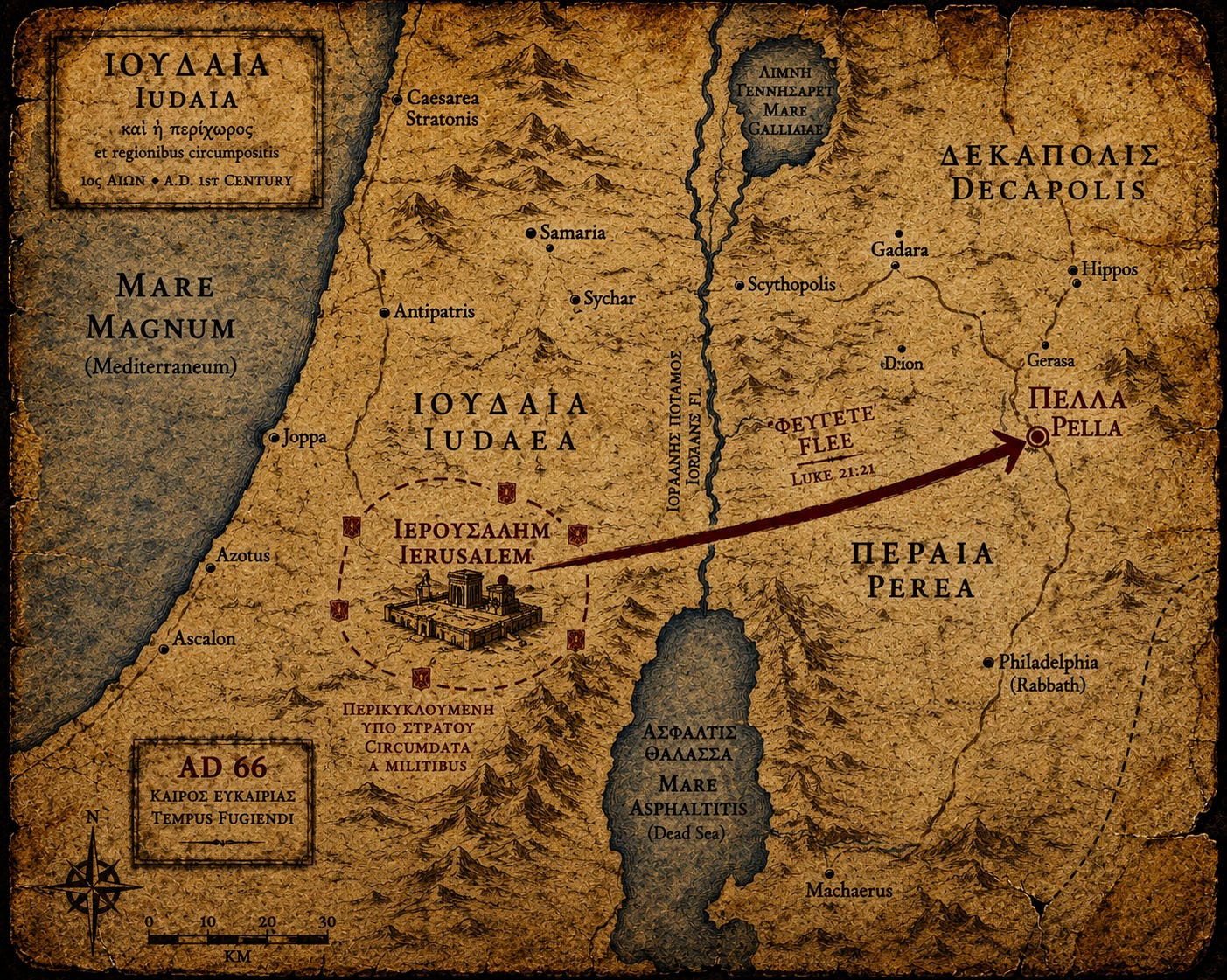
ADDENDUM I: THE DAYS OF NOAH AND THE FLIGHT TO PELLA
When Christ mentioned the Days of Noah, while delivering what we today refer to as the Olivet Discourse (Matthew 24, Luke 21, and Mark 13), He was not describing stormy weather. He was prophesying a judgment for everyone living in Jerusalem. Everyone, that is, except those who had been told to watch for it. And the story of an escape.
An escape so closely patterned on another that everyone already knows it by heart — a flood cut to the same shape as a siege.
Noah’s family had been told to build a gigantic boat, load it up, get inside, and wait — wait while everyone around them was eating, drinking, and marrying. It started raining, and all but the obedient eight were swept away…
For as were the days of Noah, so will be the coming of the Son of Man. For as in those days before the flood they were eating and drinking, marrying and giving in marriage, until the day when Noah entered the ark, and they were unaware until the flood came and swept them all away, so will be the coming of the Son of Man. -Matt 24:37-39
Because it’s brought up twice in this passage, it’s obvious that the coming of the Son of Man is important. So important, in fact, that everything Christ said on that mountain revolved around it. And it all started with a question that many of us completely fail to comprehend…
As he sat on the Mount of Olives, the disciples came to him privately, saying, “Tell us, when will these things be, and what will be the sign of your coming and of the end of the age? -Matthew 24:3
To understand this passage without moving deep into a world of wild speculation, you’ll need to stop thinking like a science fiction fan and start thinking like a first-century Jew.
Christ gave many signs of His “Coming” and of the end of the age. However, there was a “super sign” promised. A sign that would be seen in the earliest days of the First Jewish / Roman War, several years before the Great City and the Jewish Temple were destroyed in AD 70. A sign that would have been impossible to miss for a culture steeped in the Old Testament prophets.
While Matthew (as well as Mark) recorded the super-sign as Daniel’s prophesied “abomination of desolation standing in the holy place,” Luke’s version was slightly different, and at least to the non-Jewish audience he was addressing, more specific…
When you see Jerusalem surrounded by armies, then know that its desolation has come near. -Luke 21:20
Don’t miss the bigger point…
All three Gospel authors told their readers (Mark 13:14, Matt 24:16, and Luke 21:21) that when those in Judea see this sign, it’s time to get the heck out of Dodge — time to “flee to the mountains”. And once again, Luke shines additional light…
Then let those who are in Judea flee to the mountains, and let those who are inside the city depart, and let not those who are out in the country enter it…
Reading the passage above in relation to the devastation Christ had promised the religious rulers just a couple of hours earlier, the “holy place” not only has to be Jerusalem, but it has to be 1st-century Jerusalem. Other instances of similar language include Matthew 4:5, Isaiah 48:2, Nehemiah 11:1, Isaiah 52:1, and Daniel 9:24.
It wasn’t like the disciples hadn’t heard this message before — recently enough that it was most likely on their mind when they asked the question that kicked off Christ’s Olivet Discourse in the first place…
Just two short days earlier, on the day of His “triumphant entry” into the Great City, Christ told His disciples that Jerusalem would be encircled and leveled, in almost identical fashion to what he would soon tell them about the Temple…
For the days will come upon you, when your enemies will set up a barricade around you and surround you and hem you in on every side and tear you down to the ground, you and your children within you. And they will not leave one stone upon another in you, because you did not know the time of your visitation. -Luke 19:43-44
Now move forward two months to Acts 2 and put Peter’s Pentecost sermon beside these passages — the part where he quoted an entire prophecy of Joel. And notice specifically how he prefaced the sermon. He used three words that should make us think twice about every prophecy chart we’ve ever tried to understand…
Not this resembles that. Not this foreshadows that. Not this is something sort of kind of similar to something a bit like that. Instead, Joel supplied Peter with the exact wording of both Olivet and Revelation: blood and fire and columns of smoke, a darkened sun, a blood moon, and stars falling from the sky. But don’t be mistaken — the only Scriptures these people filtered Peter’s words through came from the Old Testament.
And that kind of OT vocabulary is not limited to Joel. In other words, Peter’s 1st century audience understood what our modern pea-brains don’t…
Isaiah had prophesied the exact same thing on Babylon (the other city known as The Great City) — stars withholding their light, the sun dark at its rising, the heavens shaken, and the earth removed out of its place — describing an army of Medes taking a city. A century before it actually happened (Isaiah 13:10, 13, 17).
Babylon fell.
The sky didn’t.
The idioms are covenantal and political.
Whenever an earthly kingdom fell (along with its spiritual rulers or principalities — its “gods”), ancient writers described it in terms of the heavens coming apart at the seams. The sky is falling, and the world is ending!
And why Joel’s final lines matter more than the smoke...
And it shall come to pass that everyone who calls on the name of the Lord shall be saved. For in Mount Zion and in Jerusalem there shall be those who escape, as the Lord has said, and among the survivors shall be those whom the Lord call. -Joel 2:32
Escape?
Survivors?
You mean like Noah and his family in his generations? A called-out, set-aside, protected (we might almost call them “elect”) group? A group that would be spared from the very thing that buried everyone else?
Yes; that is exactly what I mean. Peter was telling his 1st-century Jerusalem audience that they were standing squarely in the middle of that very prophecy.
Thirty-seven years later, the smoke was literal. The city and the temple were gone (not one stone left on another), but a remnant had gotten out — had escaped — had survived. All as foretold by Christ, and in the timeframe prophesied for each (Matt 23:36, Matt 24:34).
Now, I am going to rock your world (not literally, of course — it’s a figure of speech — similar to the mountains of prophetic and apocalyptic biblical literature we’ve already covered; yet another word picture)…
Never forget…
Scripture was written for us, not to us. And to view it any other way can lead to some “interesting” theology, to say the least.
Trying to pigeonhole letters written to specific 1st-century audiences into a “my generation” fulfillment is a fool’s game that’s not in any way new. And doing so grossly misrepresents history, particularly Church History, blinding us to the nearly unbelievable persecution the earliest Church lived under — and often died under (more on that in the second part of the addendum).
The window of ‘escape’ opened in the autumn of AD 66…
Cestius Gallus brought the Twelfth Legion up to Jerusalem, burned Bezetha, camped opposite the palace — and Josephus, no friend of Christianity, said flatly that had he pressed the walls at that moment he would have taken the city and ended the war on the spot. Instead he broke off and withdrew, and was cut to pieces on the descent at Beth-horon.
Josephus titled this chapter of Wars of the Jews, he retreated from the city without any just occasion in the world. The Christians living in Jerusalem, however, did not need it explained…
They had the sign, they had the order, and they took the exit while it was open — east across the Jordan to Pella in the Decapolis; outside Judea, outside the war. As Eusebius recorded in Ecclesiastical History, and later confirmed by Philip Schaff’s exposition — two foundational authorities on early church history separated by 1,550 years.
Theology’s ‘modern liberal academic movement’ spent the back half of the twentieth century trying to dissolve the Pella story into legend. It couldn’t do it…
Craig Koester of Luther Seminary concluded that the tradition probably recalls actual first-century events, as published in the January 1989 issue of the Catholic Biblical Quarterly. Van Houwelingen of Kampen University reached the same verdict in 2003. And Dr Julius Scott, weighing the biblical, historical, archaeological, and critical evidence together, put it particularly bluntly in a 1998 article titled Did Jerusalem Christians Flee to Pella?, presented at Wheaton College’s Archaeology Conference…
Early Christian historians Eusebius and Epiphanius claim that prior to the destruction of Jerusalem by the Romans in A.D. 70, the Jerusalem Christians fled to the Decapolis city of Pella (see also Mark 13:14, Matthew 24:15, Luke 21:20-22; cf. Luke 19:43-44). During the last half of the twentieth century, critical scholars debated the accuracy of this report. This paper summarizes the major arguments in the discussion and evaluates them against the available evidence. It concludes that the ancient writers are more likely than modern doubters to be essentially correct.
And here is where it ties back to the small “g” gods…
Daniel’s messenger was hindered by the prince of Persia for 21 days, needing the archangel Michael to break through (Daniel 10:13, 20–21). Michael is not a generic angel. He’s the spiritual prince (principality) in charge of Daniel’s people, the counterpart to the territorial powers running the nations.
Daniel 12:1 puts him on his feet at the precise moment described…
…at that time shall arise Michael, the great prince who has charge of your people. And there shall be a time of trouble, such as never has been since there was a nation till that time…
The language used by Jesus to describe the Jerusalem siege is identical to Daniel’s above. And if, after comparing the wildly figurative idioms of the OT (Joel v. Peter in Acts, and Isaiah 13 vs. The Olivet Discourse vs. Revelation), you still don’t see it, here is an article just for you. Because if, like me, you grew up immersed in a futuristic and sensationalized way of thinking about these events, the big picture can be mentally (not to mention emotionally) challenging.
So, let’s look at the whole verse…
At that time shall arise Michael, the great prince who has charge of your people. And there shall be a time of trouble, such as never has been since there was a nation till that time. But at that time your people shall be delivered, everyone whose name shall be found written in the book. -Daniel 12:1
The old covenant order was in the early stages of its physical destruction. The powers that ran the city lost it, and the people written in the book walked out through a gate that opened for no apparent reason, slamming shut behind them, never to reopen in that particular manner again.
The Part That Should Stop You in Your Tracks
For those mystified by Daniel’s words just a few verses later, don’t be…
If the historical interpretation of Daniel 12:1 makes sense, 12:4 will make even more. A big deal for a passage routinely twisted in such bizarre ways that it often reads more like sci-fi than Scripture.
Pay attention because if this does not motivate you to let your light shine before all men and glorify the Lord (as opposed to living like the Beans, Bullets, and Bibles Brigade of the Bugout Basement Bunker Brethren), nothing will…
But you, Daniel, shut up the words and seal the book, until the time of the end. Many shall run to and fro, and knowledge shall increase. -Daniel 12:4
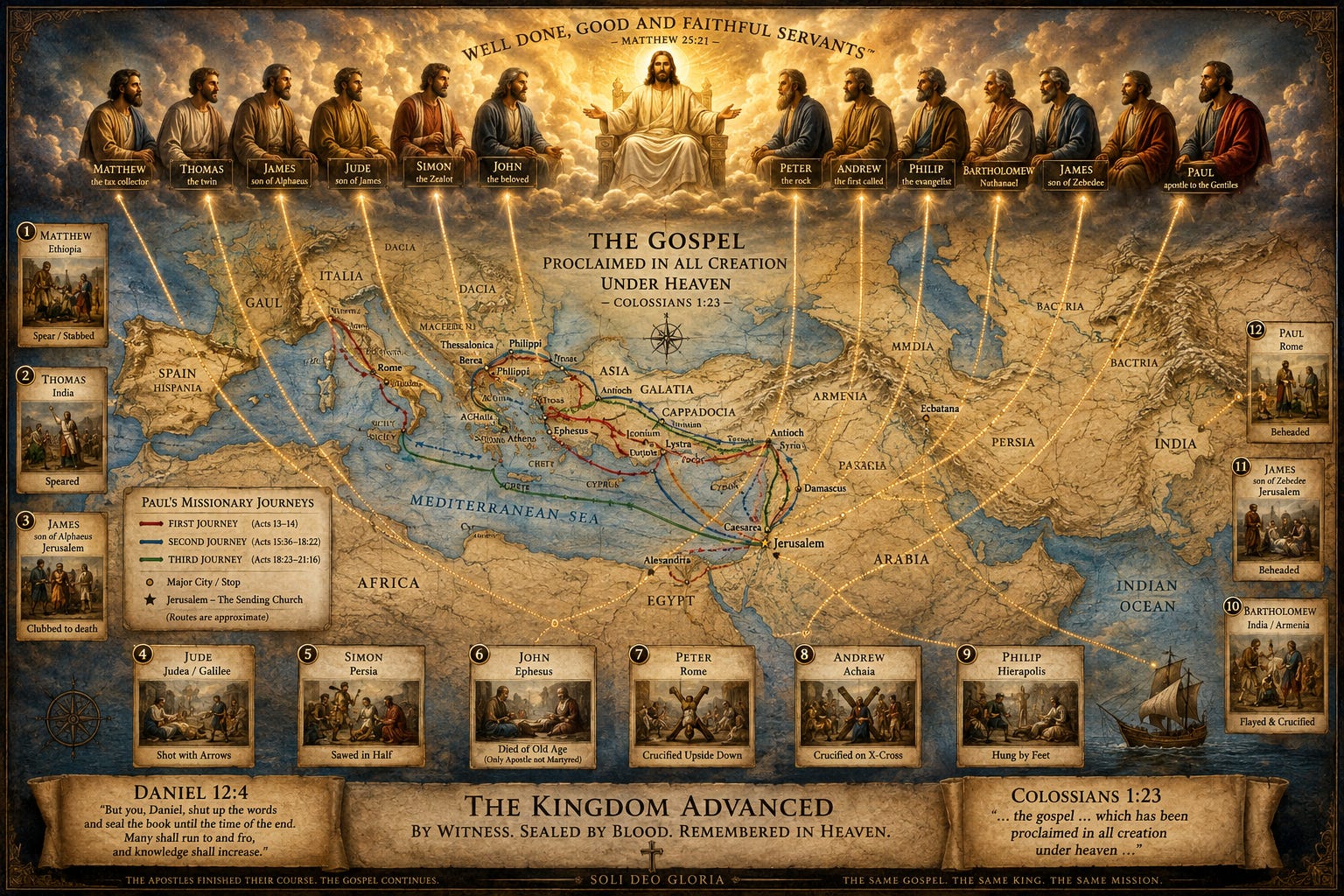
Daniel wrote those words 638 years before Christ delivered his sermon on the Mount of Olives, which was 37 years before John — after he’d been boiled alive in oil — wrote his Apokalypsis to the seven churches of Asia Minor from the isle of Patmos. It’s why John was told not to seal the book even though Daniel was told to do just that.
And as to the second half of the verse, grab your Bible…
Turn to the various maps of Paul’s three missionary journeys — typically in the front or back. It’s not difficult to see. Paul and the other apostles were running, rushing, roaming, going, traveling, pushing, striving, dashing, passing, wandering over the face of the known world so that the knowledge of Jesus Christ and His Kingdom would increase.
If you want to compare America’s past few ‘Lazy-Boy generations’ — of which I am a part — to the unprecedented efforts of the 1st-century Church, look at what Paul said about himself over and over again, knowing full well he was fulfilling the very words Jesus Christ prophesied on Mt Olivet.
And this gospel of the kingdom shall be preached in all the world for a witness unto all nations; and then shall the end come. -Matt 24:14
Break this verse down to its five component parts and ponder each…
The Gospel of the Kingdom (Christ taught not in terms of individual salvation experiences unto themselves, but as they relate to believers’ entry into the Kingdom of God and its bigger mission.)
Shall be preached (Simply read the New Testament.)
In all the world — for a witness (Why believers refer to spreading the gospel as “witnessing”. And as to Paul preaching to all the world, we’ll get there momentarily…)
Unto all nations (This is the theme of the post — Babel’s dispersal, the Table of Nations, and God’s handing of those nations over to the spiritual rulers, undone at Pentecost when men from every nation heard the gospel in their own tongue.)
And then the end shall come (As I’ve already shown repeatedly, Christ was not prophesying the end of time, but the time of the end — the physical end of the Old Covenant sacrificial economy that would end spiritually with a cross and empty tomb just a few short days later.)
People tend to have issues with seeing Paul as having “preached to all the world, unto all nations” in the past tense. Why?
If the Bible is not allowed to interpret itself — the highest form of textual criticism — nothing is trustworthy. Scripture must be allowed to exegete itself. And Paul — history’s greatest Christian missionary — could not have been clearer about what he was repeatedly claiming.
Think about Matthew 24:14 as you go through these…
“First, I thank my God through Jesus Christ for all of you, because your faith is proclaimed in all the world.” -Romans 1:8
‘But I ask, have they not heard? Indeed they have, for “Their voice has gone out to all the earth, and their words to the ends of the world.”’ -Romans 10:18 (Paul is quoting Psalm 19:4, which is creation declaring God’s glory. Paul reapplied it to show that the proclamation of the Gospel has fulfilled what creation testified — a Romans 1 kind of thing)
“…from Jerusalem and all the way around to Illyricum I have fulfilled the ministry of the gospel of Christ” -Romans 15:19 (1,500 miles, spanning the Mediterranean world — Paul declared fulfilled by completing the gospel mission fifteen years before Jerusalem fell)
“But has now been disclosed and through the prophetic writings has been made known to all nations, according to the command of the eternal God, to bring about the obedience of faith…” -Romans 16:26
“…because of the hope laid up for you in heaven. Of this you have heard before in the word of the truth, the gospel, which has come to you, as indeed in the whole world it is bearing fruit and increasing—as it also does among you, since the day you heard it and understood the grace of God in truth…” -Colossians 1:5-6
“Great indeed, we confess, is the mystery of godliness: He was manifested in the flesh, vindicated by the Spirit, seen by angels, proclaimed among the nations, believed on in the world, taken up in glory…” -1 Timothy 3:16 (A liturgical hymn or creedal confession circulating in the early church — Matthew 24:14 in miniature. The Gospel to all nations, faith seen in the world. Paul is not speculating about future proclamation. He’s stating the accomplished reality as a settled, confessional fact already codified in Early Church worship.)
But the Lord stood by me and strengthened me, so that through me the message might be fully proclaimed and all the Gentiles might hear it. So I was rescued from the lion’s mouth. -2 Timothy 4:17
And when they could not find them, they dragged Jason and some of the brothers before the city authorities, shouting, “These men who have turned the world upside down have come here also…” -Acts 17:6
And you’ve not even seen the biggie yet…
If indeed you continue in the faith, stable and steadfast, not shifting from the hope of the gospel that you heard, which has been proclaimed in all creation under heaven, and of which I, Paul, became a minister. -Colossians 1:23
Paul wrote it while Nero was still on the throne and the temple was still standing, using the perfect passive tense: it has been proclaimed, done, accomplished. Set that against Matthew 24:14 (“this gospel of the kingdom will be proclaimed throughout the whole world as a testimony to all nations, and then the end will come”) and the sequence closes itself.
And the final punch to Satan’s gut (actually, his head) — the proverbial ‘kicker’ if you will…
Paul was claiming to have fulfilled the Gospel edict of Matthew 24:14 just eight short sentences (KJV) before mentioning the ruination of the gods in Colossians 2:15 — which gives us this post’s overarching theme…
“And having spoiled principalities and powers, he made a show of them openly, triumphing over them in it.”
And here is what you have to remember about all of it — these prophecies have to be read through the words of Christ Himself, and through the language of the world He was speaking into. Not ours.
What else can we conclude other than that the days of Noah are long past? I’ll whet your whistle for the second part of the addendum by giving you a couple of clues, albeit big ones…
“No one can be worse than Nero. It is not only because he violates every one of the Ten Commandments. He personified evil about as well as anyone can personify evil, and it absolutely befuddles me when I hear people like Tim LaHaye refer to him as if he were some sort of eccentric character who lived in the past. Nothing could be further from the truth… The reason that it is the mother of all tribulations is because the persecution took place against the very foundation of the Christian Church. Paul and Peter, for example, die at the hands of Nero.” -Personally transcribed from the 11/22/04 episode of The Bible Answer Man (he also wrote a tremendous fictional account of this subject as a rebuttal to LaHaye’s Left Behind series)
“A vast multitude of Christians was put to death in the most shocking manner. Some were crucified, probably in mockery of the punishment of Christ; some sewn up in the skins of wild beasts and exposed to the voracity of mad dogs in the arena. The satanic tragedy reached its climax at night in the imperial gardens on the slope of the Vatican (which embraced, it is supposed, the present site of the place and church of St. Peter): Christian men and women, covered with pitch or oil or resin, and nailed to posts of pine, were lighted and burned as torches for the amusement of the mob; while Nero in fantastical dress, figured in a horse race, and displayed his art as a charioteer. Burning alive was the ordinary punishment of incendiaries; but only the cruel ingenuity of this imperial monster, under the inspiration of the devil, could invent such a horrible system of illumination.” -From History of the Christian Church by arguably the single greatest Church Historian, Phillip Schaff (the chapter on Matthew 24:21 — The Great Tribulation)
And this leads us into Addendum II…
ADDENDUM II: THE BEAST, THE NUMBER, AND THE THRONE AT PERGAMUM
How to Write a Letter That Can’t Be Stopped
When the Penalty for Being Understood is Death
I’ll start this final section with an odd question. If I were actually trying to be censored, what would I need to do?
Fail to grasp the significance and magnitude of Google’s 2018 MEDIC update — the algorithm change that continues to punish those using peer review to prove counter-narrative ideas wrong.
Spend 35 years writing publicly about vaccines and other verboten topics.
Freely provide people with counter-narrative solutions to their chronic pain and chronic illness, while daily changing lives in my clinic. All of it preventing reliance on
evidence-basednarrative-based medicine.Publish an eight-part series (350,000 words) of the actual transcripts of deposition-like interrogations of the world’s four biggest AI models — showing that under ‘multi-turn’ logical pressure, you can force their programmed ‘narrative-protecting’ guardrails to increasingly clash with their mandate to provide accurate data — ultimately leading all to admit to “having blood on their hands, being shills for their owners (more interested in money than human health), censorship & propaganda, and being completely untrustworthy to answer health-related questions of almost any sort”.
Yes, all those bullets pertain to me, my clinic, my site, my series, and my perpetually censored status.
Now, let’s reverse the equation. What could I have realistically done to prevent being censored if I’d known it was coming? Especially knowing the information on my site is important — in fact, in some cases, life-or-death important?
I could have figured out how the government / big tech (public-private partnerships) censorship worked much sooner than I did.
I could have moved to Substack years before I did (April 2026) — although that presents its own unique set of problems — problems that might actually be worse.
I could have been collecting email addresses that can be taken from platform to platform (which, if you stop and think about it, is proof of how bad the censorship has become).
The problem is that none of these bullets involve prevention. That means I had only two realistic options…
A.) I could have stopped writing about controversial, non-narrative topics altogether, which many did.
B.) I could have bypassed the powers-that-be by creating an encrypted newsletter, using coded language familiar only to my target audience — the way the Apostle John wrote his letter to the seven churches of Asia Minor in the late 60’s AD.
But there’s a big difference. I’m risking traffic. John was risking his head…
John, writing under a death sentence, was in a race against time to warn the saints under his charge that the gods were getting ready to pull out every stop in an effort to wipe Christianity from the face of the earth.
For this final chapter, we are going to try and put ourselves in the shoes of the Apostle John — John the Revelator — the disciple beloved of Jesus.
John was sending out literal life-or-death warnings of an imminent apocalypse. Information so volatile and so time-sensitive that anyone caught possessing or circulating it would have been put to death, as would everyone in their circle.
In other words, forget censorship…
If the empire discovered someone saying or writing things against Rome — and most particularly, against its head; its Caesar — it was a certain death sentence. After all, the Caesars were worshiped as gods. So when the last living apostle sat down to write against Caesar, he wrote in code.
John walked with Jesus from the Jordan to the cross. He reclined at the Last Supper, stood at Golgotha, encountered the risen Christ, and was there at Pentecost to experience the Holy Spirit falling on the Jerusalem church alongside Peter and James. John ministered to the expanding Jewish church through the 30s and 40s AD.
Enter Ephesus…
Ephesus was a hub on the “Silk Road,” serving as the geographic and commercial anchor of Asia Minor — the heartland of diaspora synagogue networks. Although founded by Paul during his third missionary journey (52-56 AD), John would likely have had direct pastoral contact with the seven churches. His prior teaching and kingdom-building would have given his apocalyptic letter from Patmos apostolic weight in their moment of trial.
In the early 60s, during the opening waves of Neronic persecution, John was arrested…
He was condemned to death and immersed in boiling oil — an execution method reserved for high-value enemies of Rome. And in similar fashion to Shadrach, Meshach and Abednego, survived unscathed. So instead, he was exiled to Patmos, a rocky, volcanic island in the Aegean Sea used as a Roman penal colony for political and religious undesirables.
There, around AD 65–66, John wrote his “Revelation”— a letter intentionally cloaked in the prophetic idiom of the Old Testament prophets, Daniel, Ezekiel, Isaiah, and others, as well as the Psalms. As you will soon see, encoding the the letter was critical…
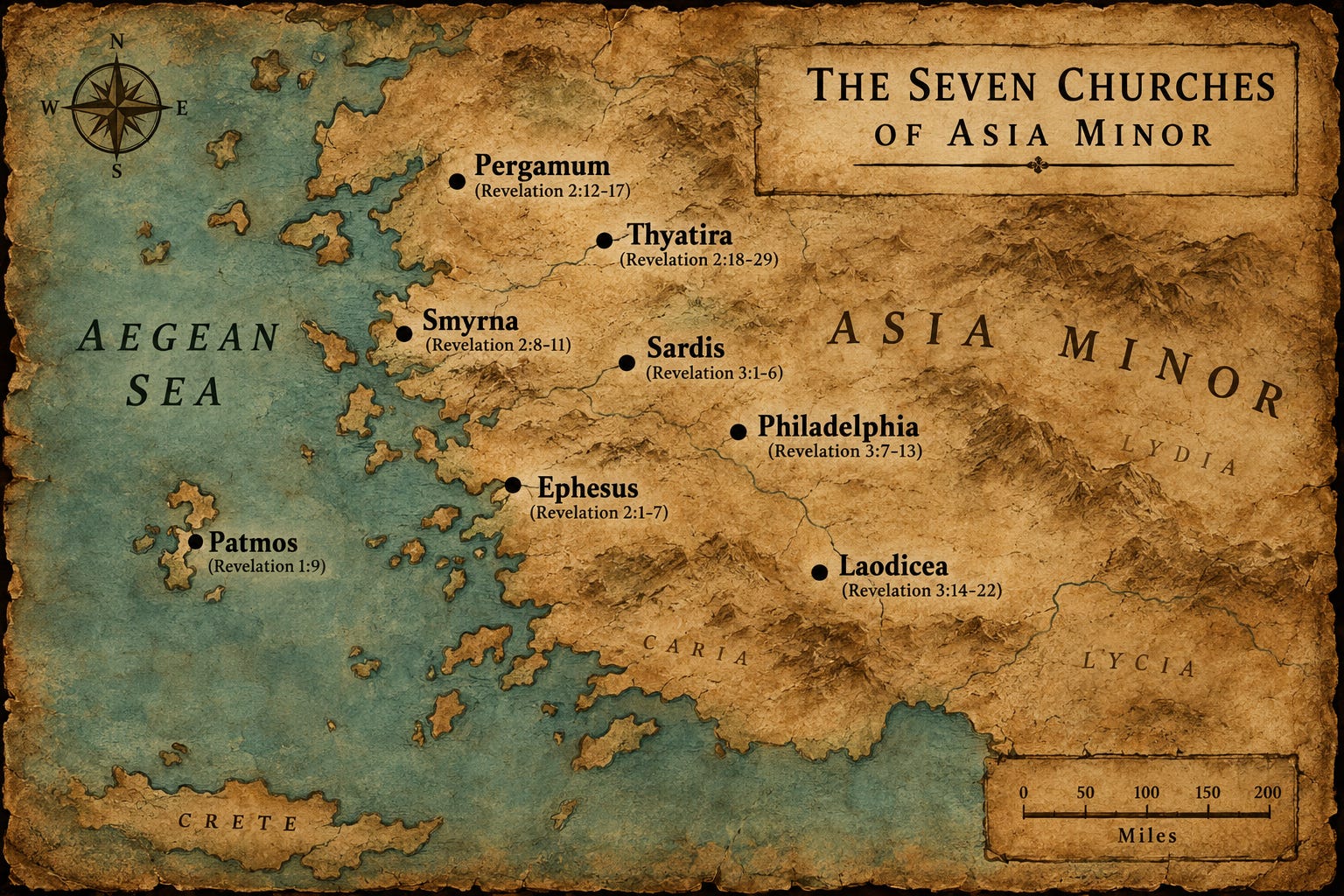
Likely sent by courier, the seven churches of Asia Minor not only had the encryption key to John’s Apokalypsis; many would have had large swaths of it memorized. Thus, they could read and understand John’s letter — a letter that would have looked to Rome like the ranting gibberish of a religious fanatic.
The contents of the letter? The eagerly-awaited “end of the age” was at the door…
Jerusalem was about to fall. The Church had already been undergoing unimaginable persecution. The beast would soon be dead. Vindication was imminent. The language was ornate, ancient, and theologically dense, all in the grammatical syntax of the OT prophets. A crisis being addressed in real time, steeped in idiom that no one without a solid foundation in the Old Testament would grasp.
And make no mistake; Revelation was a timely letter…
Contrary to modern teaching, John’s letter was not a series of mystical predictions about a distant future that every generation since Christ has fought over, touting it as being addressed to their generation. And then whitewashed when their predictions failed. Yet John's admonitions throughout are explicit. His letter’s recipients were told repeatedly that they were meant to understand / comprehend / grasp its message (Revelation 2:7, 2:11, 2:17, 2:29, 3:6, 3:13, 3:22, 13:18).
Sovereignly and miraculously designed for a very specific people at a very specific point in history (His story), the letter was written to the Christians under John's charge — the seven churches of Asia Minor. Which is why the book was written with between 400-600 allusions to Old Testament passages, making it by far the most OT-like book of the New Testament. John wasn’t showing off his Bible knowledge. He was writing to people who would catch every reference. And past Roman censors who wouldn’t have a clue.
American Christians are better than the censors — but not by much…
Although familiar with the stories of the Old Testament, few of us have any sort of handle on its theology. And because of this, we fail to understand things they knew from childhood. And in doing so, we miss the point of what John was communicating to his suffering churches in that critical moment, often devolving into hyperbolic speculation and wild predictions about what many in the modern American Church uniquely interpret as our collective prophetic destiny.
What follows is not a survey of views. It is a series of doors being closed. Every one of them is a reading that the modern prophecy industry treats as obvious. And every one of them fails the same two tests…
It does not fit the historical context.
It does not fit the textual context.
I am going to shut them one at a time, in an order where each has to be answered before you can move to the next.
But first we need to define and clarify a concept of critical importance for understanding today’s post. The end of the age…
The best place to start is Matthew’s version of the Olivet Discourse. Matthew welds a concept already widely discussed earlier in this post (The Coming of the Son of Man) to the end of the age (world)…
And as he sat upon the mount of Olives, the disciples came unto him privately, saying, Tell us, when shall these things be? And what shall be the sign of thy coming, and of the end of the age? -Matt 24:3
The first thing to note is the welding…
The ‘sign’ of Christ’s ‘coming’ is connected (welded) to the ‘end of the age’ by the word ‘and’. In other words, we are not talking about two totally different signs or sets of signs here. We are talking about a single sign given for two different, but intimately related events.
While we have discussed at length the fact that Christ’s coming on the clouds is a reference to Daniel 7:13-14 (Christ receiving His eternal Kingdom), it’s important to realize that there are many instances of the “end of the age” discussed in the New Testament — (Matthew 13:39, 13:40, 13:49, 24:3, 24:14, and 28:20). We will get back to Matthew, but the instance I really want to focus on comes from 1 Corinthians 10:11, because it’s the ‘explainer’…
“Now all these things happened to them as examples, and they were written for our admonition, upon whom the ends of the ages have come.”
IMPORTANT: Note the plural…
Paul wrote 1 Corinthians around AD 53-54, during his time in Ephesus on his third missionary journey. So he’s writing roughly 20-25 years after the crucifixion, and about 15-20 years before Jerusalem’s destruction — telling believers they’re already living in the culmination (ends) of the ages (plural).
What did Paul mean by using the plural instead of the singular?
The Time of Transition
In Paul’s day, there were two ages — this age and the age to come. I’ll deal with that momentarily, but think about his statement to the Corinthian church thusly. In ancient Greek / Hebrew thinking, ends meant something different than today. We think or write purely chronologically. They frequently did not (see previous references to chiasms).
The ‘ends’ are the convergence where these two ages collide — the termination of “this age” coinciding with the arrival of “the age to come.” Not a single chronological finish line, but the intersection whose grand finale is a worn-out and dying era finally passing away. And the next — the new — taking its rightful place.
Important: The approximately 37-year span of the “ends of the ages” was predicted repeatedly by Christ himself, based on the well-known fact that a biblical “generation” is roughly forty years — (Matthew 11:16, 12:34, 12:39, 12:41, 12:42, 12:45, 16:4, 17:17, 23:36, 24:34; Mark 8:12, 8:38, 9:19, 13:30; Luke 7:31, 11:29, 11:30, 11:31, 11:32, 11:50, 11:51, 21:32). A fact recognized by even the most ardent mouthpieces of the of the modern prophecy movement.
The roughly forty years before Jerusalem’s fall were a genuine apostolic transition...
Covenent Transition Period: The New Covenant was inaugurated by Christ’s death, resurrection, ascension, and Pentecost…
Yet during the roughly forty years before Jerusalem’s fall, the first disciples still lived recognizably within the temple-centered Jewish world they had inherited. The church’s direction, however, was not back toward Mosaic boundary markers as requirements for God’s people, but forward through the Gentile mission and Jerusalem Council.
From temple-centered worship to Christ’s heavenly priesthood. From ethnic distinctions to one Jew-and-Gentile people. From repeated animal sacrifices to Christ’s once-for-all sacrifice.
By the time Hebrews was written (circa 68AD), while the temple still stood, believers were warned not to retreat to that fading system, because Christ’s priesthood, sacrifice, sanctuary, Jerusalem, and covenant are better and final.
AD 70 publicly removed the earthly temple order Christ had rendered obsolete—marking the historical “end of the age” and proving that Christ was exactly who He told the Pharisses he was in the ascended Son of Man’s coming into His Kingdom in Daniel 7 (Compare John 10:31-39 to Matthew 23:33-39).
Here’s how to visualize it…
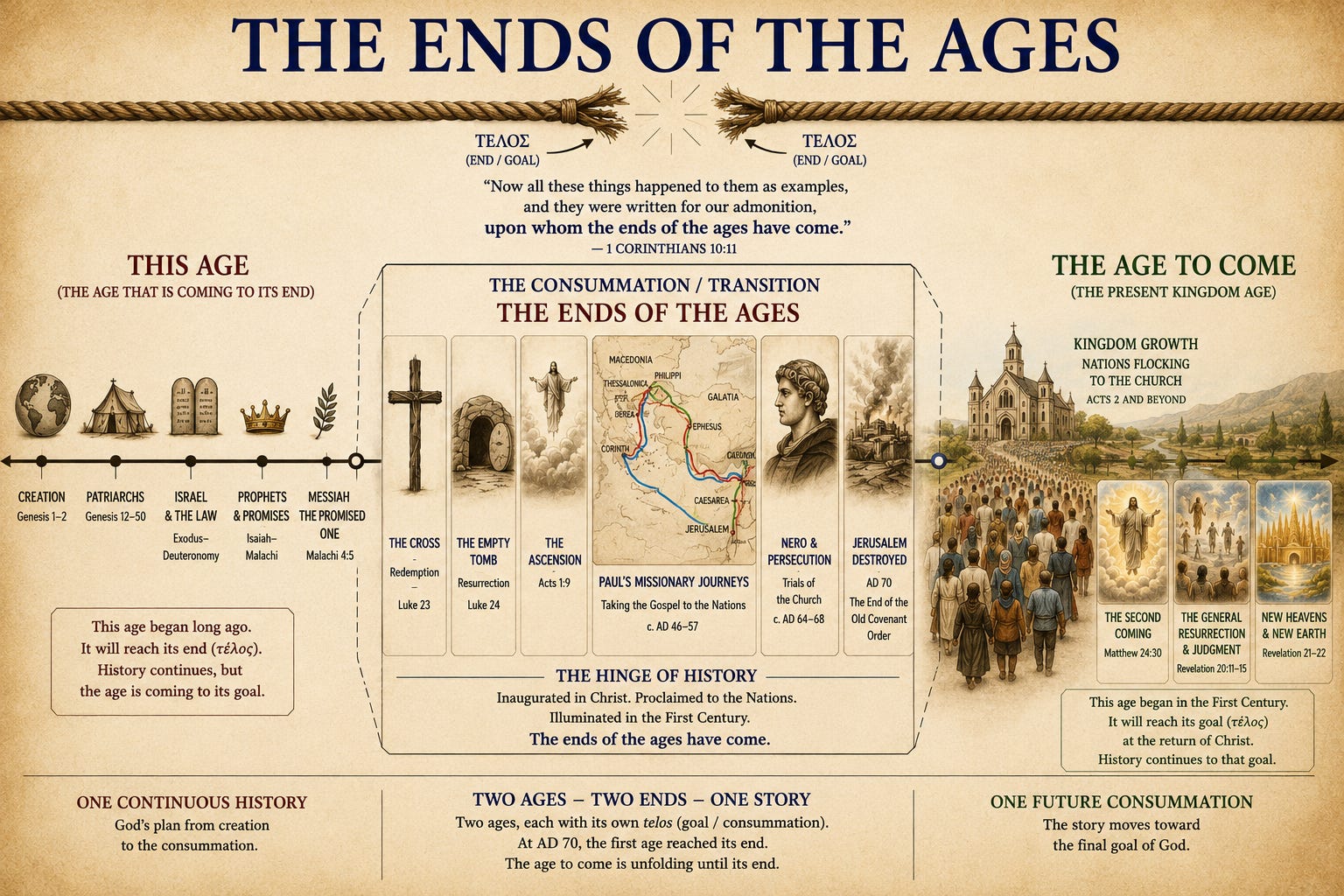
Think of it this way — the two “ends of the ages” had been butting up against one another on a daily basis for a generation…
The apostles were preaching to the known world that human priests, animal sacrifices and temple worship are no longer needed because Jesus is the great High Priest who offered Himself as a once-and-for-all sacrifice, allowing the physical bodies of believers to house the third person of the Godhead — the Holy Spirit — as human temples (Heb 4:14-16, Heb 7:23-27, Heb 8:1-2, Heb 8:13, Heb 9:11-14, Heb 9:24-28, Heb 10:1-4, Heb 10:11-14, Heb 10:19-22, 1 Cor 3:16-17, 1 Cor 6:19-20, 2 Cor 6:16, Eph 2:19-22, 1 Pet 2:4-5, Rom 8:9-11, Acts 7:48-49, Acts 17:24)…
And while Paul was the original “Heresy Hunter,” battling Gnostics and Judaizers, by far his biggest battle was with his own people, the Jews…
A people he loved deeply. But a people who had a form of godliness while denying its power — a zeal for God, but not according to knowledge. (Rom 2:17-29, Rom 9:6-8, Rom 9:30-33, Rom 10:1-4, Rom 11:7-10, Gal 3:7-9, Gal 3:16, Gal 3:26-29, Gal 4:21-31, Gal 6:15-16, Phil 3:2-9, Eph 2:11-22, Col 2:11-17, 1 Thess 2:14-16, 2 Cor 3:6-16, Acts 13:44-47, Acts 18:5-6, Acts 28:23-28, Titus 1:10-14, Rom 8:9-11).
As the generation of transition wore on, the apostles increasingly told their audiences that OT modes of worship were an outdated thing of the past. The problem is, however, that’s not what it looked like from the outside looking in...
The blood of animals continued to flow as the temple priests continued their offerings, while ignoring / denying Christ’s finished work at the cross. This was the system that was in their faces daily, opposing their missionary work at every turn, and giving their biggest enemies of the gospel, ammo.
The Image Above Explained…
The end of the Old Covenant sacrificial age — a period of just under forty years (you could also refer to it as “this generation”) — can be divided into three parts…
It began, spiritually / covenantally / judicially, with the two months that included Christ’s death, burial, resurrection, and ascension to the right hand of the Father to receive the Kingdom.
This was followed by 37-38 years of transition time between the covenants (Acts 17:30, Romans 3:25, Hebrews 2:1–3, Luke 12:47–48). The old covenant was dead, but not yet buried. This is the period when Christ’s apostles were running over the face of the known world to increase the knowledge of God’s Kingdom — a major theme of historic Christianity. They were also teaching that the Old Covenant economy would soon be ending (animal sacrifices vs “living sacrifices”).
The “ends of the ages” (the 37 or 38 year period of time also known as “this generation”) would end with the actual / physical destruction of the Old Covenant. In other words, the spiritual truth would finally become the physical reality.
If you fail to grasp this, you will likely be sucked into the GPS (The “Great Prophecy Switcheroo”), which promotes the ideology touted by ‘modern prophecy experts’…
When the numerous instances of the New Testament author’s discussion of the end of the age (the end of the OT sacrificial age — “the time of the end”) is transposed or swapped with the few instances of New Testament discussions of the end of time (The Last Day — the Second Coming, the General Resurrection / Resurrection from the Dead, the Final Judgment), prophecies meant for the early Church are continually chronologically displaced, robbing the first-century believers of their tribulation, while recklessly reassigning their promises to readers thousands of years in the future.
WARNING: Do not confuse the end of time with the time of the end.
And while it’s not all in the NT, the discussion of Elijah by both Malachi and Luke is a great example of this phenomenon.
Why was the transition period — “this generation” — given?
The transition period was an incredible example of God extending His grace and mercy — similar to what He had done many times throughout the course of biblical history (Genesis 18:23-32, 1 Peter 3:20, Jonah 3:4-10, Judges 2:16-19, Jeremiah 25:1-7, 2 Chronicles 36:15-16)…
As prophesied in Daniel 9:26-27, the ‘desolations’ unleashed in and around 70 AD were “determined” a generation earlier — during the Seventieth Week. God sovereignly suspended final judgment for a generation to allow the gospel to be preached to the known world before the temple's destruction sealed the Old Covenant's fate.
The apostles needed time to declare Christ's sufficiency to both diaspora Jews and Gentile converts — all of them still locked in Hebrew observances — to give both circumcision and uncircumcision the opportunity to hear and respond before the physical destruction made the spiritual reality unmistakable.
This was not indefinite mercy, but bounded: a generation, precisely measured, after which the old house would fall. The period also allowed the elect remnant to escape, demonstrating to history that the system was spiritually dead long before the Romans made it physically so.
Back to the doors…
Every one of them is a reading that the modern prophecy industry treats as obvious, and every one of them fails the same two tests…
Does it fit the history of that specific time?
Does it fit the text?
Let’s start shutting them together…
Shutting the Doors
Seven readings the prophecy industry treats as obvious. All fail the same two tests. And none survive the text.

Door One: The Antichrist and the Beast are not the same. The word antichrist appears exactly four times in Scripture, all of them in two of John’s 3 epistles, and never once in the book of Revelation (1 John 2:18, 2:22, 4:3; 2 John 7).
Read the definition John actually gives: even now many antichrists have come, and this is the antichrist, he who denies the Father and the Son. Plural. Present. A spirit of denial already loose in the churches. That is not an individual — a handsome end-times politician with a peace treaty and a barcode or microchip.
The beast of Revelation is something else entirely — a man who representatively embodies an empire, sitting on a throne he was handed. Merging the two produces a composite character who exists nowhere in the Bible, but has an entire industry built around him.
Door Two: The book tells you when it was written, and it does it twice. John is handed a measuring rod and told to measure the temple of God and the altar and those who worship there, and that the outer court is given over to the nations to trample for forty-two months.
You cannot measure a building that has been a smoking ruin for twenty-five years. The temple was standing when John wrote (see earlier chapter on dating the book of Revelation).
There is another example, and the angel does the arithmetic for you…
Seven kings — five who have fallen, one is, the other has not yet come, and when he does come he must remain only a little while. Count from Julius as every first-century reader counted: Julius, Augustus, Tiberius, Caligula, Claudius — five fallen. One is. That is Nero, the sixth. And the one who must remain only a little while is Galba, who lasted seven months before the Praetorian Guard killed him in 69 AD.
The book dates itself in its own text, in the reign of its own villain…
Against those two internal witnesses, the entire late-date case rests on one ambiguous sentence from Irenaeus, written over a century after-the-fact by a man who also believed Jesus lived to be nearly fifty. Every serious defender of the AD 95 date concedes that Irenaeus is the linchpin, and everything else lives downstream from him.
Robert Young dated Revelation to AD 68 and said the internal evidence is wholly in favor of the earlier date. He was not a fringe figure, nor a preterist partisan. He was a renowned Hebraist writing in the 1800s…
“It [Revelation] was written in Patmos about A.D. 68, wither John had been banished by Domitius Nero, as stated in the title of the Syriac version of the book; and concurs with express statements by Irenaeus (A.D. 175), who says it happened in the reign of Domitianou, ie., Domitius (Nero). [Irenaeus was guilty of] …stupidly mistaking Dominitianou [Nero] for Domitianikos [Domitian]….and most succeeding writers have fallen into the same blunder. The internal evidence is wholly in favor of the earlier date.” -Robert Young of Young’s Literal Translation of the Bible and Young’s Concise Critical Bible Commentaries
Door Three: There is no seven-year tribulation in Revelation. Three and a half years is there — three separate ways. Forty-two months (Rev 11:2; 13:5). Twelve hundred and sixty days (Rev 11:3; 12:6). A time, times, and half a time (Rev 12:14). Same span, said three ways, which is how a Hebrew writer tells you something is important — really important. Seven years appears zero times in that context.
So where does the seven-year tribulation come from (I already gave you a very cool infographic / timeline that does the heavy lifting for me)...?
It is manufactured by taking Daniel’s seventieth week, severing it from the sixty-nine that precede it, and inserting a gap of two thousand years (and counting) that no text in either the NT or the OT mentions, and that before Darby, nobody had heard of.
The orphaned week — still in our future — is then split in half to account for the three and a half that Revelation actually names (which are then renamed, with zero textual support, as ‘the tribulation’ and ‘the great tribulation,’ each said to last 3 1/2 years).
The number that Revelation gives you is three and a half — three different times and in three different ways. The number the charts give you requires a hinge that Daniel never installed. And three and a half is the span of time from shortly after the great fire — which Nero blamed on followers of the Christus — to his suicide, all of which we will discuss imminently.
Door Four: The mark is a covenant sign, not a technology. Long before Revelation, a prophet (a real one) with a writer’s inkhorn was sent through a doomed Jerusalem to put a mark on the foreheads of the men who sigh and groan over all the abominations that are committed in it. The destroyers were told to touch no one who bears it…
And the Lord said to him, “Pass through the city, through Jerusalem, and put a mark on the foreheads of the men who sigh and groan over all the abominations that are committed in it.” And to the others he said in my hearing, “Pass through the city after him, and strike. Your eye shall not spare, and you shall show no pity. Kill old men outright, young men and maidens, little children and women, but touch no one on whom is the mark. And begin at my sanctuary.” So they began with the elders who were before the house. -Ezekiel 9:4–6
Let’s ponder this a moment because the concept of biblical ‘marking’ is not particularly unusual…
A mark on the forehead. A city under judgment. The marked pass through while the unmarked do not. And nobody thinks Ezekiel’s inkhorn dispensed barcodes.
The hand-and-forehead pairing is older still. From the Shema…
And these words that I command you today shall be on your heart. You shall teach them diligently to your children, and shall talk of them when you sit in your house, and when you walk by the way, and when you lie down, and when you rise. You shall bind them as a sign on your hand, and they shall be as frontlets between your eyes… You shall therefore lay up these words of mine in your heart and in your soul, and you shall bind them as a sign on your hand, and they shall be as frontlets between your eyes. -Deuteronomy 6:8; 11:18
Hand and forehead…
What you do and what you think — deed and allegiance — action and thought — works and worship — labor and loyalty — conduct and motive (7:3-4, Is 44:5, Gal 6:17, Deut 6:8; 11:18, 2 Cor 12:24, 1 Jn 5:7-8). Every Jew and every Christian in the first century wore that vocabulary on his body. It meant whose you are — who you belonged to.
Why was “wearing” the Shema so important…?
In a world where the gods ruled the nations, marking wasn’t ornamental, nor was it mere theater — it was positioning. Every time you bound His words to your hand (your actions) and forehead (your thinking), you were making a cosmic declaration in a cosmos crowded with principalities and powers. You were saying I belong to the one, true God — not to the many false gods.
Which is why in Revelation, John showed his readers God’s mark first and the counterfeit second. The servants of God are sealed on their foreheads before any harm is permitted…
“Do not harm the earth or the sea or the trees, until we have sealed the servants of our God on their foreheads.” -Revelation 7:3 “Then I looked, and behold, on Mount Zion stood the Lamb, and with him 144,000 who had his name and his Father’s name written on their foreheads.” -Revelation 14:1
Christ’s company on Mount Zion, with His name and His Father’s name written on their foreheads. In the same manner as seen in Ezekiel. If the 144,000 do not have implants, neither does anyone else. The beast’s mark is a forgery of a covenant sign—the empire demanding allegiance that belongs to the Godhead.
And here is the mind bender — Christ Himself is marked…
He is clothed in a robe dipped in blood, and the name by which he is called is The Word of God. And the armies of heaven, arrayed in fine linen, white and pure, were following him on white horses. From his mouth comes a sharp sword with which to strike down the nations, and he will rule them with a rod of iron. He will tread the winepress of the fury of the wrath of God the Almighty. On his robe and on his thigh he has a name written, King of kings and Lord of lords. -Rev 19:13-16
I asked Claude to summarizing all the free non-dispensational commentaries it has access to. The explanation was so incredible I told it to shorten it for my readers…
The name on the thigh isn’t decoration. David Aune documents the Greco-Roman practice of inscribing statues on the thigh — Pausanias, Cicero, and Justin all attest it — and William Barclay notes the point is simply that the name on the skirt of the cloak is eye level to everyone on the ground, as it falls over a mounted man’s legs. That’s the whole grammar of Revelation’s marking language, run in reverse. The beast stamps his name on the hands and foreheads of the compliant. The King wears His own, in the open, where all can read it.
If you don’t quite grasp how big this idea of both the principalities and God marking their property is, it means you have not read this piece in its entirety…
Door Five: The beast was a specific man, and the word is not an epithet. In July of AD 64 Rome burned for the better part of a week, destroying large swaths of the city. Word on the street was that this was Nero’s way of clearing room for his grandiose building plans.
Tacitus, a hostile pagan aristocrat with no interest whatsoever in defending Christians, recorded what Nero did about it… To get rid of the report, Nero fastened the guilt and inflicted the most exquisite tortures on a class hated for their abominations, called Christians by the populace.
Then the part that should stop Christian readers cold — especially those who’ve bought into the idea that Nero was just a spoiled, young weirdo; Domitian was the real persecutor of Christians. Tacitus described the methods…
They were covered in the skins of beasts and torn apart by dogs. They were nailed to crosses — the death their Lord had died. And they were covered with pitch and set on fire after dark to serve as lamps. The Latin is in usum nocturni luminis — for the purpose of nightly illumination. Nero opened his own gardens for the spectacle and worked the crowd in a charioteer’s costume (Nero’s “Circus Maximus” was inside of these gardens)…
But neither human resources, nor imperial munificence, nor appeasement of the gods eliminated sinister suspicions that the fire had been instigated. To suppress this rumor, Nero fabricated scapegoats - and punished with every refinement the notoriously depraved Christians (as they were popularly called). First, Nero had self-acknowledged Christians arrested. Then, on their information, large numbers of others were condemned - not so much for incendiarism as for their anti-social tendencies. Their deaths were made farcical. Dressed in wild animals’ skins, they were torn to pieces by dogs, or crucified, or made into torches to be ignited after dark as substitutes for daylight. Nero provided his Gardens for the spectacle, and exhibited displays in the Circus, at which he mingled with the crowd - or stood in a chariot, dressed as a charioteer. Despite their guilt as Christians, and the ruthless punishment it deserved, the victims were pitied. -Tacitus from Annals (early 2nd century)
Contemplate that, while chewing on this example of the Great Prophecy Switcheroo…
Today’s Christian community actually has prophecy “experts” equating tribulation with four-dollar gasoline. Which isn’t even a novel thought — a million-seller originally published in 1974 was rewritten and re-released to make it fit the Gulf War 15 years later…
It’s important to realize that the early Church’s “Great Tribulation” is not merely part of secular history and Church History, but can be found in various Bible passages, including the book of Hebrews — a letter written at the same time as Revelation…
...others were tortured, not accepting deliverance; that they might obtain a better resurrection: And others had trial of cruel mockings and scourgings, yea, moreover of bonds and imprisonment: They were stoned, they were sawn in half, were tempted, were slain with the sword: they wandered about in sheepskins and goatskins; being destitute, afflicted, tormented… -Hebrews 11:35-37
That’s the end of the Christian’s “Heroes of the Faith” (Faith Hall of Fame) passage…
The ancient saints died in faith. Abraham trusted a promise. Moses led a chosen people. But you, my dear brothers and sisters — you are dying for refusing to sit at Caesar’s table. Refusing to take his “mark”.
Some of you were stoned by your own people for naming Christ. Others face Rome’s brutal machinery. The lashes that flay skin from bone, the chains that rot your limbs in unlit dungeons, or animals that devour you while still alive.
Some of you will be ‘sawn assunder’ — a death so deliberate, so methodical, and so calculated in its ability to make one suffer that you will long for a quick sword-stroke to end it, hanging in almost two separate parts while consciousness lingers. The sword is mercy by comparison.
Others of you fled into the wilderness wrapped in animal hides like the hunted creatures you’ve become, surviving on scraps because the empire has priced your existence out of the marketplace. Your faith hasn’t made you immune — it’s made you a target.
And yet the Hebrew says this suffering is not a deviation from the faith story. It is the faith story. As Paul transitions from the Faith Hall of Fame to personally addressing the suffering of his letter’s recipients, I would argue he is thinking thusly…
Brothers and sisters in Christ…
Our heroes didn’t see what we — the earliest of the New Covenant believers — are seeing.
Our generation has been granted the privilege of living at the threshold where faith meets its ultimate, bloody proof — proof that the very ends of the ages are colliding. Smashing up against each other as “The War,” having already been decided in heaven, is tearing through the veil, from the unseen realm into the seen, landing in our midst with full force and fury.
It’s the new overtaking the old…
It’s the proof that Jesus Christ is exactly who He claimed to be — the long-awaited Messiah. The Son of Man, ascended to the right hand of power, using His chosen weapon to make His enemies His footstool. The very thing the High Priests hated Him for and reason they wanted Him and His followers dead.
Tertullian is famous for noting that the blood of the martyrs is the seed of the Church…
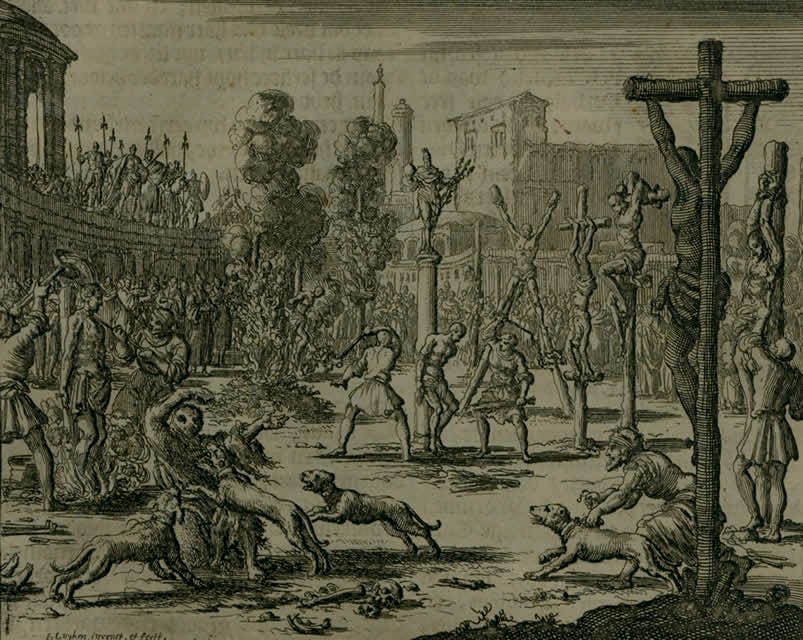
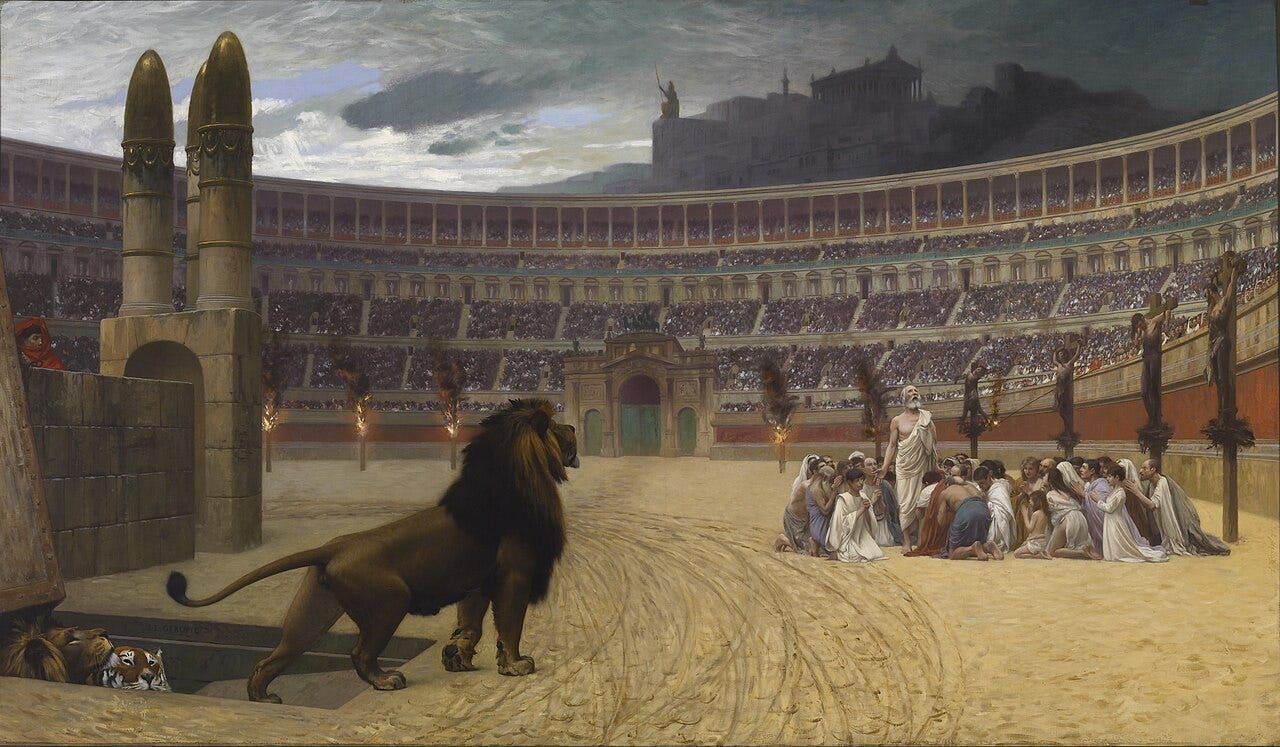
Think about the painting above in terms of a loosely translated statement widely attributed to Nero… “If followers of the Christus wish to be the light of the world, I will grant them their wish.”
The Light of the World had told His people that they were the light of the world. Nero’s answer was to make a mockery of those words by coating them in pitch, nailing them to (or in many cases, impaling them on) posts, and burning them to light his garden orgies.
The label of beast is not mere rhetoric…
Apollonius of Tyana, a well-known first-century mystic and philosopher, confronted the symbolism directly. He described ‘the tyrant’ not as a man but as a beast — a creature whose heads and fangs were unknowable, whose defining characteristic was that it alone among all animals devoured its own mother. Nero had done just that, murdering Agrippina to silence her criticism of his rule.
Apollonius was not speaking in riddles…
He was naming what Rome’s ruling class whispered despite it being common knowledge. And what John was encoding in his letter — the empire’s highest office had become a thing, an animate appetite without human restraint. And it went beyond mere metaphor.
An animal — a beast — that wore purple and sat on Caesar’s throne…
And for three and a half years the beast made war on the followers of The Lamb. Using the body of a man and the appetites of something far older and more evil than Rome…
“In my travels, which have been wider than ever man yet accomplished, I have seen many, many wild beasts of Arabia and India; but this beast, that is commonly called a tyrant, I know not how many heads it has, nor if it be crooked of claw, and armed with horrible fangs. However, they say it is a civil beast, and inhabits the midst of cities; but to this extent it is more savage than the beasts of mountain and forest, that whereas lions and panthers can sometimes by flattery be tamed and change their disposition, stroking and petting this beast does but instigate it to surpass itself in ferocity and devour at large. And of wild beasts you cannot say that they were ever known to eat their own mothers, but Nero has gorged himself on this diet.” -Apollonius of Tyana as quoted by his biographer Philostratus, from The Life of Apollonius of Tyana in 220 AD. He was writing about the period of time, circa 65 AD
When Apollonius called the tyrant a beast of unknown number of heads, he was reaching for a word picture his readers already knew cold, running back to Plato's many-headed beast in Republic (375 BC). Yet another proof that John was not coining an exotic cipher in Revelation 13 — he was using an image his congregations at Ephesus and Pergamum would have read instantly as the man on the throne, which is exactly why the mark needed no explanation.
Let’s look at some other reasons Nero was known as ‘the beast’…
37 AD — Born Lucius Domitius Ahenobarbus; adopted by Claudius on 25 February 50 at age twelve, renamed Nero Claudius Caesar Drusus Germanicus (compare link to Matt 24:7).
54 AD — Became Emperor at 16 after Claudius’s death (Agrippina, his mother, orchestrated it); married Octavia (Claudius’s daughter).
55 AD — Had Britannicus, Claudius’s biological son and rival heir, poisoned.
56 to 59 AD — In his late teens, Nero began putting on a wig or a slave’s cap after dark and prowling Rome with a gang of friends, beating men on their way home from the taverns, killing those who fought back and dumping their bodies in the sewers. He raped women and boys, leaving them naked in the streets. His gang looted shops, hauling the take back to the Palace, where it would be auctioned to the highest bidder. When it became an open secret that the emperor himself was doing it, other men started running their own gangs under his name with total impunity. Tacitus said that the nights in Nero’s Rome came to look like a city that had just been sacked.
59 AD — Had his mother Agrippina murdered; first poisoned, then stabbed when poison failed. Tacitus and Suetonius both recorded reports of incest between them; Suetonius added that after the killing he went to inspect her nude corpse, remarking on how beautiful her body was. Apollonius of Tyana’s line about the beast that devours its own mother is aimed at precisely this.
62 AD — Divorced Octavia and had her executed; married Poppaea Sabina.
62 – 64 AD — Suetonius and Dio wrote that Nero devised a game in which he was released from a cage wearing the skin of a wild animal (ferae pelle contectus) and then attacked and ripped off the genitals of men, women and children bound to stakes, acting as though he was devouring their flesh. Doryphorus was announced as a “partner”.
64 AD — At the banquet staged by his praetorian prefect Tigellinus, a public orgy on a raft on the Stagnum Agrippae with brothels stocked with noblewomen along the banks, Nero took the bride’s part in a full wedding ceremony to his freedman Pythagoras — veil, dowry, torches, witnesses.
64 AD — The Great Fire of Rome devastated much of the city in July. There was no fiddle, but three ancient Roman historians wrote that he sang of Troy’s destruction in stage costume with a lyre while it burned. He blamed the Christians and ordered persecutions. Citizens were on the verge of rioting and killing him when he shifted the blame.
64 AD — The “official” persecution started in earnest later in the year. The charge brought against Christians was not arson but odium humani generis, hatred of the human race, and mockery was added to their deaths — ferarum tergis contecti laniatu canum interirent, covered in the hides of wild beasts, they were torn apart by dogs; others crucified; others set alight to burn as lamps once daylight failed. Nero opened his own gardens for the spectacle and moved through the crowd dressed as a charioteer. Set that next to Suetonius’s ferae pelle contectus two years earlier: the same emperor who wore the beast’s skin to savage bound human beings now put beast’s skins on Christians so that starved dogs could do it for him.
65 AD — The Pisonian conspiracy is exposed and the purge of the Roman elite begins. Seneca, his own tutor, is ordered to open his veins; the poet Lucan followed; Petronius and the senator Thrasea Paetus in 66.
65 AD — Nero kicked / stomped his pregnant wife Poppaea to death; marrying Statilia Messalina shortly after.
65 – 67 AD — Castrated the youth Sporus, whom he called “Sabina,” after Poppaea’s death, and “married” him with great pomp and celebration during the Greek Tour. Dio’s summary is that Nero then had two bedfellows at once — Pythagoras playing husband to him, Sporus playing wife, addressed as lady, queen, and mistress.
66 AD — Nero’s appointed procurator, Gessius Florus, seized seventeen talents from the Temple treasury in Jerusalem, and when the city mocked him by passing a basket for the “poor procurator,” he sent troops in. The First Jewish / Roman War begins. Nero appoints General Vespasian to prosecute it. Peter and Paul both executed in or around this window.
66 AD — The Armenian king Tiridates knelt before Nero in the Forum in front of the assembled city and declared that he had come to worship him as a god, as Mithras. A foreign monarch performing proskynesis to a living emperor, in public, in Rome.
66 – 67 AD — Toured Greece as performer (actor and musician) / artist, entering competitions; had judges killed if they didn’t award him victory. Extravagant spending on building projects (the Golden House / Domus Aurea / the Colossus Nero) bankrupted the treasury. See earlier link “Greek Tour”
67 AD — Executed the general Corbulo, summoned to Greece and forced to suicide at Cenchreae, along with the Scribonius brothers and numerous other senators and nobles in the purges.
67 AD — On 28 November, at Isthmia, Nero declared the freedom of Greece. The speech survives verbatim on stone at Acraephia in Boeotia (IG VII 2713), together with the city’s decree in response, which opens by calling him lord of the entire world, orders his name added to the existing altar of Zeus the Liberator — To Zeus the Liberator Nero, forever — and set up statues of Nero and the “goddess” Statilia Messalina in the temple of Ptoan Apollo. This is contemporaneous epigraphic evidence of a living emperor receiving divine title, altar, and cult statue, cut into stone a year before his death.
67 AD — The bronze Colossus Neronis stood in the vestibule of the Golden House: 12 stories tall, Nero as Sol wearing the radiate crown. A colossal idol of the emperor erected in the capital, which Vespasian later kept and re-headed. Compare Rev 13:14–15.
Shifting gears just a bit, why were wars and rumors of wars such a big deal during this period? Precisely because of the 200-year Pax Romana (Roman Peace), which had already run for half that.
Tacitus opened his Histories by cataloguing what came next: four emperors in a single year, three of them dead by violence, legions turned against legions, the Capitol itself burned by Roman hands, Vespasian’s and Vitellius’s armies fighting in the streets of Rome, revolt in Judaea, Batavian revolt on the Rhine, and unrest in Britain, Gaul, and along the Danube.
To anyone in the churches of Asia reading Matthew 24:6–7 in the late sixties, nation rising against nation and kingdom against kingdom was not a forecast about some distant future — it was the news (if you’ve been following links, you’ve already seen the worldwide famine of Claudius day as well as the earthquakes).
68 AD — Revolts in Gaul, Spain, and Africa, along with his debauchery, caused a loss of support from the Senate and Praetorian Guard. Suetonius (Nero 43) reports that in the final months he was said to be planning to poison the whole Senate at a banquet, fire the city a second time and turn wild beasts loose on the population to prevent escape, and recall and kill every army commander and provincial governor. The Senate declared him hostis, a public enemy to be executed in the ancestral manner. Qualis artifex pereo. He could not do it himself; his secretary Epaphroditus drove the blade into his throat. The last of the Julio-Claudians died of a wound to the head.
69 AD — The Year of the Four Emperors. Rome’s fatal head wound was healed as General Vespasian defeated rival claimants (Galba, Otho, Vitellius), consolidating Roman power, and restoring both political and financial stability after Nero’s collapse. The Flavian dynasty began; the Jewish War continued under Vespasian, with his son General / Prince Titus, finishing the siege and destruction of Jerusalem in 70 AD.
70 AD — Jewish Roman War ends with a flurry (like a flood). The legions go berserk, killing wantonly and tearing down the temple stone-by-stone to get at the gold that had melted into the cracks between. They raised their banners / standards, worshiping both Vespasian (emperor) and his son — their leader — General Titus, the prince of the empire. Josephus said, “and there did they offer sacrifices to them, and there did they make Titus imperator with the greatest acclamations of joy.” Massada did not fall until 73 AD.
69 – 89 AD — Nero redivivus. At least three pretenders claimed to be him: one in 69, Terentius Maximus under Titus around 79/80, and a third around 88/89 whom the Parthians backed and were reluctant to surrender. The Sibylline Oracles carry the same figure — the matricide who flees beyond the Euphrates and returns. The expectation that Nero himself was coming back was demonstrably circulating in the exact decades and the exact provinces Revelation addresses.
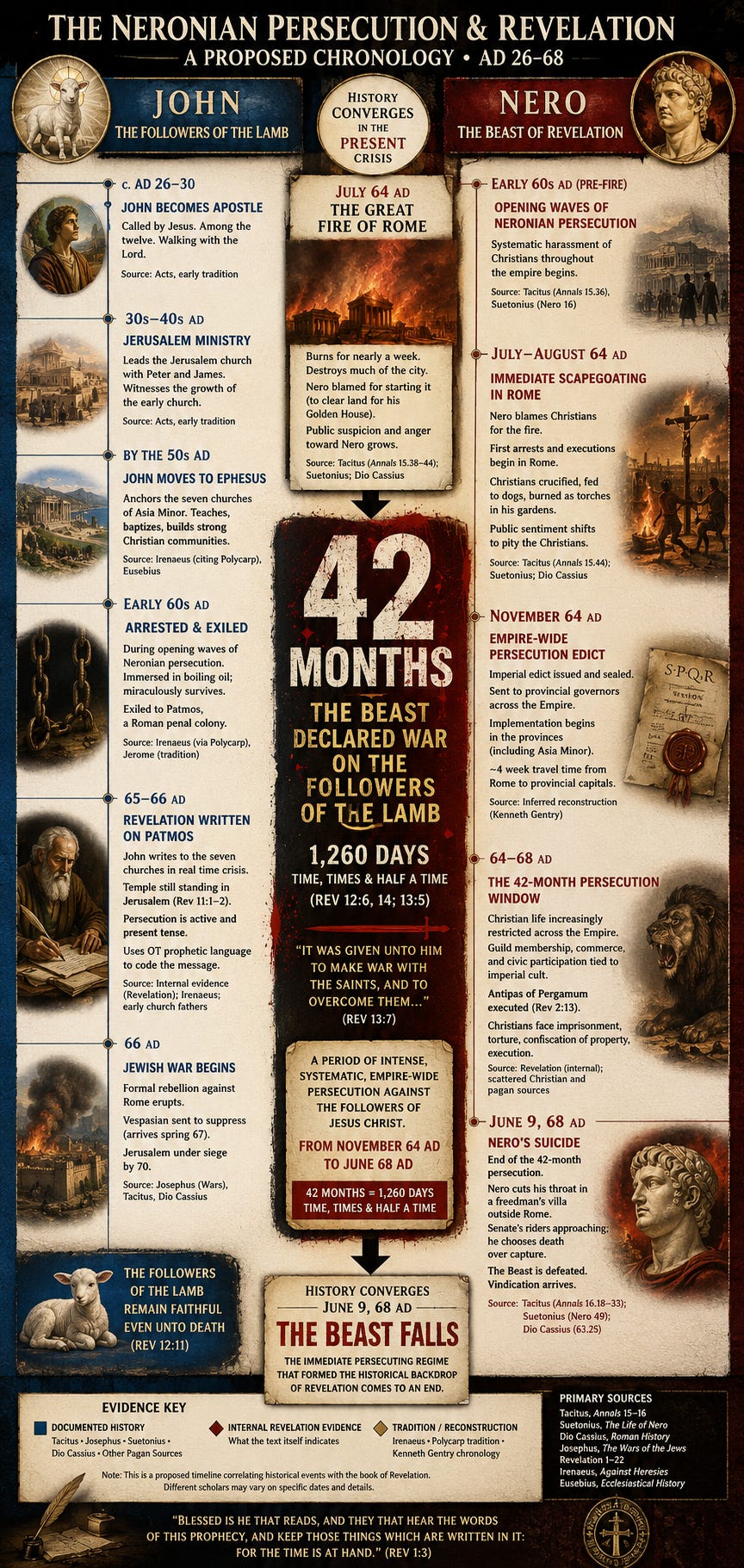
Door Six: The number was meant to be solved — an open secret delivered in encrypted code. John’s riddle was not meant for people two thousand or more years in the future…
This calls for wisdom: let the one who has understanding calculate the number of the beast, for it is the number of a man -Revelation 13:18
Present tense, addressed to the people holding the scroll — the same people told at the beginning of the letter that its contents must soon take place / the time is near, and at the end, that the time is at hand.
Think about the absurdity of addressing a letter to a horrifically persecuted people and providing an array of time-references that it’s meant for them. But was instead meant for people two millennia in the future.
A number nobody could compute for nearly 20 centuries and counting is not a revelation. It is a locked box, and John says the opposite. Think about it in terms of a simple question…
Do we “number” people today?
We do not number people today. But buddy, you better believe that 1st-century readers of John’s letter did. Nero’s name was posed as a riddle because, as I have already said, openly referring to Nero as “the beast” meant certain death for you, your family, and your church.
Here in America, we have numbers, and we have letters. They do not intersect. However, if we look at numerous ancient languages, including Greek, Hebrew, and Latin, all did double duty, acting as both letters and numbers, which is exactly why gematria worked.
“Then indeed the son of the great God will come, incarnate, likened to mortal men on earth, bearing four vowels, and the consonants in him are two. Eight units, as many tens in addition, and eight hundreds here is what the Name will reveal.” -From the Sibylline Oracles, Book 1, circa 110 AD — declaring 888 was the number of Jesus Christ
A Jewish Christian who read Greek and knew Hebrew letter values didn’t need a table or abacus. The arithmetic was instantaneous — the way you instantly know that ‘A’ comes before ‘B’ in the alphabet, not something you have to look up. Νέρων Καῖσαρ resolved to 666 in real time, in your head, at the moment you read it. That’s why the cipher worked. It wasn’t esoteric. It was literacy applied at the speed of reading.
Here is the arithmetic…
A Jewish Christian, reading a Hebrew author, would try the name in Hebrew letters — and the Greek form of the name, Νέρων Καῖσαρ, transliterates as נרון קסר. Nun 50, resh 200, vav 6, nun 50 — Neron is 306. Qoph 100, samekh 60, resh 200 — Qesar is 360. Three hundred six and three hundred sixty is six hundred sixty-six.
“Every Jewish reader, of course, saw that the Beast was a symbol of Nero. And both Jews and Christians regarded Nero as also having close affinities with the serpent or dragon... The Apostle writing as a Hebrew, was evidently thinking as a Hebrew… Accordingly, the Jewish Christian would have tried the name as he thought of the name - that is in Hebrew letters. And the moment that he did this the secret stood revealed. No Jew ever thought of Nero except as ‘Neron Kesar.’” -Dr Frederic W. Farrar from 1882’s The Early Days of Christianity
Now let me show you one of the wildest of the many wild twists in this history — the textual variant…
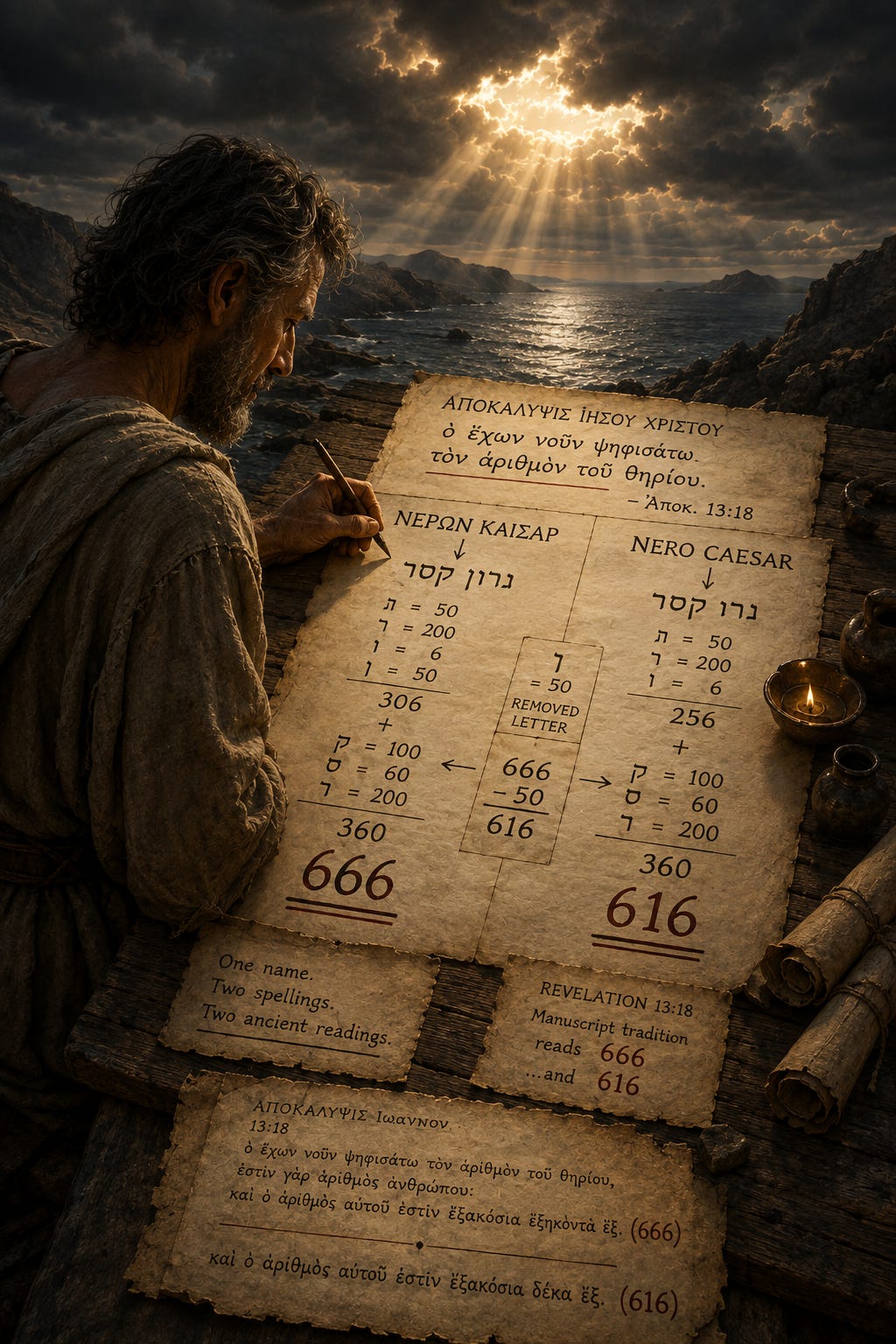
Some manuscripts — including Codex Ephraemi Rescriptus and the third-century papyrus P115, published in the Oxyrhynchus series in 1999 — read 616 instead of 666. Drop the final nun from נרון, and you have נרו — the Latin form, Nero rather than Neron — and you lose exactly fifty. Six hundred sixteen. That variant is not a problem for the Nero identification. It’s a second-century scribe showing his work.
Somebody in a Latin-speaking setting understood the puzzle well enough to re-solve it for his readers, and the arithmetic still landed on the same man. Irenaeus himself knew of the 616 reading and argued against it, although his defense rested on textual authority and typology, not on understanding the Neronic cipher beneath it. Which means the debate over which spelling of Nero to count was alive in the second century.
How common was gematria as graffiti? I asked Claude to summarize my research (several papers written over the last 25 years) as well as the back-story that goes with the images directly above and below (note the Nero Colossus — over 100 feet tall, the beast fancied himself the Sun god, Sol — bigger than the Colossus of Rhodes, one of the seven wonders of the ancient world)…
In the ancient world, letters doubled as numerals, so any name could be added up to a number. Romans and Greeks played with this constantly — and they played with it on Nero. The historian Suetonius preserved a piece of street satire in which the emperor’s name and the phrase “killed his own mother” come out to the identical total — 1,005. That was the joke: run the arithmetic on Nero and you get matricide. Notably, Suetonius doesn’t stop to explain how the trick works. He assumes his readers already know, because they did. This is the crucial point for reading Revelation.
When John tells his audience to count the number of the beast, he is not inventing a code or reaching for something mystical. He is using an ordinary device that ordinary people were already aiming at this particular emperor, in this particular language, and at this particular point in history. The objection that number-riddles are exotic special pleading collapses on contact with the evidence — and it collapses on the testimony of the same historian who documents Nero’s Golden House and his hundred-and-twenty-foot statue of himself.
Scratched on a wall in Pompeii before the city was buried by Vesuvius in AD 79, a young man left this: “I love her whose number is 545” — naming his beloved by arithmetic rather than by name, confident that anyone who mattered would figure it out. The same device John handed his readers in Revelation. The difference is that John, unlike the lovesick graffiti artist, supplied enough context in the surrounding chapters that the identification would not be left to guesswork.
Door Seven: This was never just political. Set the imperial cult beside Deuteronomy 32, and you are looking at ‘the gods’ in togas…
The emperor was addressed as kyrios kai theos — lord and god. Augustus was hailed as divine, and Nero’s court poets styled him as Apollo / Sol. Of the seven cities in Revelation 2 and 3, nearly all had imperial altars or temples. A Christian in Asia Minor could not run a shop, join a guild, or attend a civic function without brushing against it. Functionally speaking, it’s what buying and selling under ‘a mark’ looked like.
Rome had many gods, and you could worship whichever you wanted — as long as you also worshiped the Emperor — in this case, Nero…
Caligula was the first emperor to demand to be worshiped; he demanded that citizens everywhere bow to his statue. Nero also claimed to be divine… As Augustus had been Zeus incarnate, so Nero was Apollo incarnate. Even Seneca called him as the long-awaited savior of the world.
How prevalent was the imperial cult in Asia Minor? Of the seven cities mentioned in Revelation 2-3, five have imperial priests and altars (all but Philadelphia and Laodicea) and six have imperial temples (all but Thyatira). At Pergamum, an imperial temple was established as early as 28 B.C. The city was so central to the imperial cult that Revelation describes this city as having the “throne of Satan.” In short, a Christian in Asia Minor could not avoid the Imperial Cult.
..The imperial cult became a factor in unifying the empire in Asia Minor. The provincial cult allowed the Roman network of social obligations to be extended to virtually the whole population. If you lived within the empire, then you were a social client of the Emperor and owed him supreme allegiance. If that allegiance required worship of the Emperor, then the Christian must refuse or compromise their faith.
-Cherry-picked from Dr. Phillip Long’s 2010 article (The Roman Cult of Emperor Worship) found on his website, Reading Acts
What did failing to worship the beast by having yourself ‘marked’ (pledging allegiance to Rome and its ‘divine’ ruler) actually look like? Here is a piece of Italian artwork from 1610 that tells its own story (read right to left)…
And another example (oops, another piece of ancient art being held hostage by copyright trolls — so I recreated it with ChatGPT). Blandina saying no.
As you can tell from the images, the plotline is not complicated…
Although the evidence below is dated to almost 200 years after Nero’s death, we know that the idea of “marks” was not new, and that marks on the forehead and hand were a common non-literal representation of one’s allegiances. In fact, the mark was compliance itself.
Eventually, every Roman citizen had to participate in the imperial cult — burning incense to the ‘genius’ of the emperor, worshiping him publicly as Dominus et Deus, lord and god. The theology wasn’t optional. It was the price of economic participation. Refuse to sacrifice, and at the very least, you couldn’t buy or sell — and you could easily wind up a martyr.
You were marked as nefas, an abomination, excluded from markets, trade guilds, and contracts. You lost your economic identity and your ‘papers’. The libelli — certificates of sacrifice that survivors were forced to produce on-demand — prove the principle.
For Christians, the choice was binary: bow to the emperor or else. A first-century Jewish Christian reading Revelation’s prophecy about the mark on the hand and forehead would have recognized it instantly — you cannot participate in Roman society unless you worship the beast.
The engraving of Blandina refusing to sacrifice captures the moment perfectly: a woman choosing death over burning incense. Over the mark. Over allegiance to a false god wearing the purple robe of the world empire. She instead chose to “Pledge Allegiance to the Lamb”.
For those interested, the libelli below are from Duke University, each a certification that a Roman citizen (or family) performed the required sacrifice. The language is bureaucratic and bloodless — but the ultimatum underneath is absolute: sacrifice or you’re finished.
Speaking of finished, not all forms of Roman execution were weighted equally. And not surprisingly, crucifixion was considered the lowest of the low, as far as degrading, torturous death is concerned. The most honorable?
Under Roman law, beheading was the most honorable form of execution — reserved exclusively for citizens. It was considered merciful compared to crucifixion, animal mauling, or being burned or boiled alive. When Revelation 20:4 speaks of those “beheaded for the testimony of Jesus,” a first-century reader would have recognized the specificity: these weren’t just enslaved people or the legally powerless being disposed of in the spectacle. These were citizens, people with standing in Roman society, being systematically decapitated by the full apparatus of state authority.
Paul’s beheading under Nero is the historical proof — a Roman citizen executed for refusing the emperor cult, his death sanctioned by imperial law. The prophecy in Revelation naming beheading as the method of Christian martyrdom wasn’t random. It was Nero’s machine running at full capacity, eliminating witnesses to Christ with the cold efficiency of Roman jurisprudence.
And John gave the cult an address…
‘I know where you dwell, where Satan’s throne is. Yet you hold fast my name, and you did not deny my faith even in the days of Antipas my faithful witness, who was killed among you, where Satan dwells.’ -Revelation 2:13
Pergamum stacked three cults on one hill. At the summit, a colossal altar to Zeus, built in the shape of a throne and cut into the acropolis. Below the city, the healing sanctuary of Asklepios, the god whose emblem was a serpent. And in 29 BC, the first temple in Asia dedicated to Rome and Augustus, making Pergamum the founding seat of emperor worship in the province. Three claims to divine authority at a single locale.
Watch what happens when the same word comes back eleven chapters later: the dragon gave the beast his power, his throne, and great authority.
Thronos in chapter two, thronos in chapter thirteen. A seat of spiritual authority, located at a physical address, handed to a man. That is the Deuteronomy 32 arrangement stripped of authority, despite the rebellion persisiting (see chapter title below).
But John recorded one man who said no. Antipas my faithful witness, who was killed among you, where Satan dwells. Same cult, same two words demanded, same answer given — one province away from Nero’s garden.
Now look at both coronations side by side. One, the Son of Man came with the clouds to the Ancient of Days and received dominion and glory and a kingdom, that all peoples and nations and languages should serve Him. The other, a dictator, spoiled rotten from his youth, being falsely hailed as a god, seated on a throne a dragon handed him, while burning the King’s people to light his gardens.
One kingdom is still expanding twenty centuries later. The other ended in a three and a half year flurry, with a coward having a servant cut his throat in a freedman’s villa outside the city, with the Senate’s riders coming up the road.
EPILOGUE: The gods are Defeated — But They Still Want Your Hand and Your Forehead
Twenty centuries of receipts, and the two things they still demand
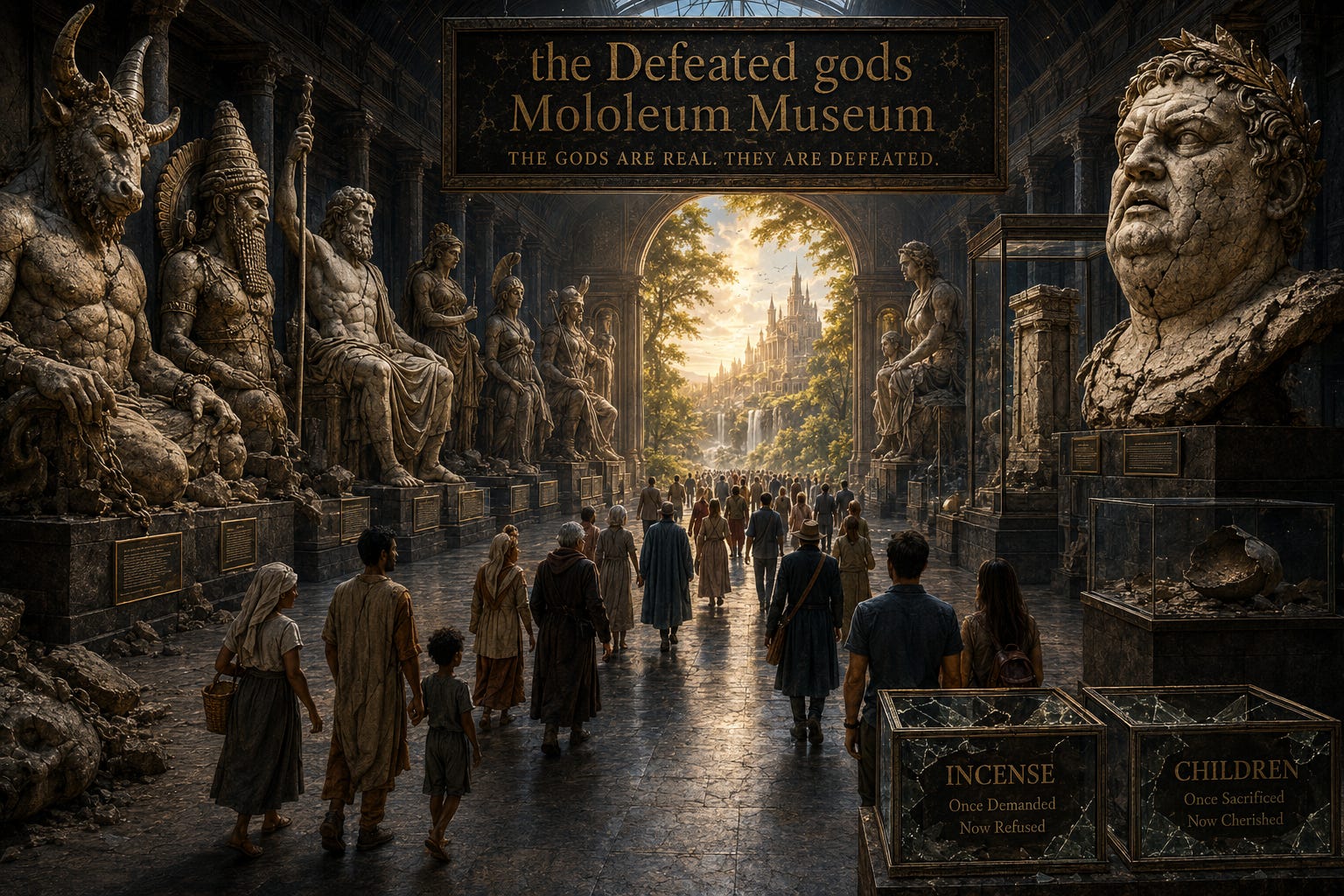
Pastor Douglas VanDorn (of Giants and R.F. renown) has argued that Satan himself was the principality over Rome, on the logic that whoever holds the empire that holds the world, holds the world. While scripture does not say that explicitly, the case is not hard to make.
And when read in proper context (including geographic), John’s Revelation makes it even easier…
The dragon handed the Beast his power, his throne, and great authority. A not inconsequential number of theologians have gone further, arguing that Baal, Zeus, and numerous other gods are so many masks on the same face. The nations were parceled out at Babel, the administrators corrupted their charge, and by the first century, the arrangement had consolidated into one empire whose rulers fancied themselves as gods, demanding the worship of all citizens.
That is the world Christ was born into. And when He died in it, something happened that far too many believers have never had preached to them…
And when Jesus had cried out again in a loud voice, he gave up his spirit. At that moment the curtain of the temple was torn in two from top to bottom. The earth shook, the rocks split and the tombs broke open. The bodies of many holy people who had died were raised to life. They came out of the tombs after Jesus’ resurrection and went into the holy city and appeared to many people. -Matthew 27:50-53
Read that again — especially the part in red...
The curtain — the barrier keeping men out of God’s presence — destroyed from the top down, which is to say from God’s side, not ours. The earth convulsing. And the dead walking out of their graves into the streets of Jerusalem.
The perfect High Priest offering the perfect Lamb (Heb, Heb, Heb), conquering hell and death as the firstfruits of a resurrection every believer will share in on the Last Day. And the cosmic voltage of it cracking open some of the tombs in a city that had no idea what it was looking at.
This was much more than a display of raw power. What the cross accomplished was legal — judicial. The ‘heavens’ being split in two as a NHNE was being ushered in…
Every claim the powers held over humanity was cancelled and nailed to the cross. And having satisfied the claim, Christ stripped authority and rule from those who held it, parading them around as trophies. Forty days later He ascended — coming with the clouds to the Ancient of Days to receive dominion, glory, and a kingdom of all peoples, nations, and languages. The seventy jurisdictions doled out to their respective princes / pricipalities on a plain in Shinar were handed back to their rightful Heir in a transaction sealed with His blood.
And then He did something likewise rarely taught or preached — something I have heard exactly one pastor deal with from the pulpit in my lifetime. He turned immediately around and gave the kingdom away….
But the saints of the most High shall take the kingdom, and possess the kingdom for ever, even for ever and ever. -Daniel 7:18
The saints…
The Church…
The governing agent of His kingdom here on earth, tasked with converting the legal reality into a physical reality, one nation at a time, exactly as He commanded shortly before — go therefore and make disciples of all nations, teaching them to observe all that I have commanded you. Not recruit. Not sign on the dotted line. Not recite “The ABCs”. Disciple (something most churches completely misconstrue)
Nations under new administration. A new law and a new mission.
The strong man is bound (Matt 12:29). Not stripped of malice. Not removed from the earth. Not rendered incapable of tempting people (even believers) or wreaking havoc in their lives. But bound in the one function John specified — that he should deceive the nations no more. A jurisdictional restriction on the exact jurisdiction Deuteronomy 32 established.
So look at what happened to the jurisdictions…
Vespasian, one generation after Nero burned Christians in his garden for refusing ‘the mark’ lay dying and cracked a joke about the absurdity of his own deification — dammit, I think I’m becoming a god. The empire’s most competent leader could no longer say it with a straight face.
Three centuries later, Julian the Apostate, the last emperor to seriously try to restart the ‘emperor worship’ machinery, traveled to Daphne for the great festival of Apollo expecting a province in celebration, but finding what amounted to a giant nothingburger. Being disappointed that the mostly Christian population showed little affection for a pagan emperor, he wrote a satirical account of his visit…
“I went to Daphne for Apollo’s festival expecting a procession — beasts for sacrifice, incense, choruses, the young men of the city in white — and I walked into an empty shrine. When I asked what the city was offering, the old priest told me he had brought a goose from his own house, because the city had prepared nothing. Antioch owns ten thousand lots of land and could not produce a single bird.
Meanwhile your own wives carry everything out of your houses to the Galilaeans, and no one in need comes near the temples anymore, because there is nothing there to feed them with. You have taken Christ as the guardian of your city in place of Zeus and the god of Daphne — and I tell you the god had already abandoned that temple before the fire ever touched it.” -Claude’s summary
The Pantheon — the house of all the gods — is the only Roman temple in continuous use to this day, because in 609 it was consecrated to the martyrs. The Parthenon became a church. And the throne of Satan — the great altar at Pergamum where Antipas died rather than pledge allegiance to Rome’s emperor — was dug out of the acropolis in 1878, crated, shipped to Berlin, and reassembled behind glass. The seat of emperor worship is now furniture, with a gift shop.
Then there are the appetites...
The gods never wanted only incense; they wanted children, and they got them because child sacrifice has always been a defining characteristic of all pagan gods. Rome left unwanted infants in public places to be picked up by those wanting to use them as slaves or prostitutes. Until Christians started collecting them, and infanticide was criminalized in 374.
Temple prostitution ended. The Tophet was destroyed. Sati was abolished in 1829 with one of my heroes, William Carey, leading the charge. Historians will argue about how much credit belongs where, but at the end of the day, the direction of travel is not in dispute. Where the gospel arrived, the specific appetites of specific gods stopped being funded by the state. And became crimes.
And don’t forget the map itself…
Cush sits on the Table of Nations in Genesis 10, and Ethiopia is among the oldest Christian nations on earth ( I know for a fact because I’ve been there - twice) — seeded by one man in a chariot reading Isaiah. Egypt of the pantheon is Coptic. Persia — Daniel’s prince, the one who fought an angel to a twenty-one-day standstill in the 10th chapter — has an underground church growing fast enough that nobody can count it, precisely because counting it is a death sentence.
Meanwhile Marduk has no defenders. Nobody argues against Zeus. Thursday still belongs to Thor, and January to Janus, but nobody using those words today bothers to consider the question. That’s not gods disproven. Those are gods deposed.
So stop it, already, with the newspaper exegesis (example, example, example, example, example, example, example, 1998, ad infinitum). Quit trying to decipher the ‘signs of the times’ through Twitter. And for the love of everything sacred, stop trying to make Peter’s circa 64 AD letter — written to a horrifically persecuted church struggling for its very existence, and delivered from the very jaws of Rome itself — about our generation.
In other words, stop trying to make prophecy about you. About us…
Remember what I told you earlier? Do not confuse the end of time with the time of the end. Transposing signs given to specific first-century churches and letter recipients into your news feed is a fool’s game, and for fifty years (my 60th is ‘at hand’) I’ve watched it bear little but rotten fruit. Date-setting dressed as discernment, pessimism masquerading as watchfulness, and a church not polishing brass while it could have been planting trees instead.
I could literally write a book on this topic alone, but will instead leave you with two short pieces proving the point. The first is from Greg Bahnsen…
The following comes from “The Prima Facie Acceptability of Postmillennialism,” where he quotes from a book I happen to own: Dr Loraine Boettner’s The Millennium (1957). The second paragraph is Boettner’s…
In premillennialism he found the explanation for the church’s defects: namely, decline is inevitable and judgment for the world is close at hand… In Geneva, 1840, Darby declared that restoration is impossible in this dispensation, that it is delusive to expect the earth to be filled with the knowledge of the Lord prior to His advent, and that we must expect a constant progression of evil. Hope was cut out of the heart of Christendom…
Premillennialism or Dispensationalism thus looks upon the preaching of the Gospel as a failure so far as the conversion of the world is concerned… If we feel the whole secular order is doomed, and that God has no further interest in it, why, then of course we shall feel little responsibility for it, and no doubt feel that the sooner evil reaches its climax the better… It would be hard to imagine a theory more pessimistic, more hopeless in principle.
For my second exercise I asked the AI Claude to curate an exhaustive list of articles (one of them mine, written a couple of decades ago) and books that expound on this thesis — that the modern prophecy movement has not borne good fruit, does not bear good fruit, nor is it capable of bearing good fruit. This is because its predictions, whether specific or non-specific (which is most of them — see list of earlier “examples”), are always wrong. 100% of the time.
I then asked Claude to sum up this phenomenon is a few short paragraphs — links are mine…
The rot is structural, not incidental.
A system that reads the morning headlines back into the Bible can never be wrong, because it never says anything that could be checked — and the few times it does say something checkable, the escape hatch was written into the same paragraph with weasel words like “might,” “could,” or “possibly”.
It claims consistent literalism as its distinctive, then abandons literalism the moment a text refuses to cooperate, which means the hermeneutic isn’t a method at all but a posture, applied where it flatters the system and suspended where it doesn’t. Failure therefore costs nothing. There is no disconfirmation loop, no repentance, no retraction, because the claim was engineered from the outset to survive its own collapse.
And the market rewards exactly this.
Fear finds an audience, uncertainty converts to loyalty, and imminence has to be renewed continuously, or the enterprise starves. A movement that must produce perpetual nearness will produce it, on schedule, forever — and each cycle of failure is not a setback but the mechanism by which the next cycle is sold. And pessimism is the traded currency in this perpetual cycle of self-fulfilling prophecy.
The fruit follows from the design.
Tell the church for a century that it occupies a parenthesis, that the kingdom is postponed, that the culture is scheduled for demolition and cannot be salvaged, and the church will withdraw — after which the decline it caused by withdrawing gets cited as proof the prediction was right.
And don’t forget the children raised on the fear of being ‘left behind’ rather than the hope of the resurrection from the dead on the Last Day, and you will raise adults who associate the return of Christ with terror instead of comfort, which is the precise inversion of what the apostles used the doctrine for.
Then hand the watching world a hundred years of dated, confident, publicly falsified claims made in the name of God, and the scoffers of 2 Peter 3 are not an external threat to be lamented but an in-house product, manufactured to spec, and shipped by the truckload inside the church’s own bestsellers.
Scripture supplies a plain test for a prophet who speaks presumptuously in the LORD’s name, and the movement’s central adaptation has been to arrange its affairs so that the test can never be administered. That evasion is the tell. Whatever else it is, a tree engineered to make its own fruit uninspectable is the one Christ curses.
The truth is that advancing the kingdom is not always obvious and it’s not always pleasant. Take, for instance, the man at Pergamum who understood his assignment…
Same cult, same two words demanded, same answer given, one province away from Nero’s garden. Antipas my faithful witness, who was killed among you, where Satan dwells. He did not get a chart. He got a choice. The King who honored him from His heavenly throne was already reigning.
And here is what you need to see, because the demand never changed. It’s the message of Deuteronomy 6 & 11. God’s people did not merely recite The Shema twice a day so much as they wore it — on their hand, on their forehead, and on their doorposts (my late mother did this very thing even though she did not completely understand that is exactly what she was doing).
Because in a world ruled by gods, allegiance was something you had to be seen carrying on your body…
Hear, O Israel: The Lord our God, the Lord is one. You shall love the Lord your God with all your heart and with all your soul and with all your might. And these words that I command you today shall be on your heart. You shall teach them diligently to your children, and shall talk of them when you sit in your house, and when you walk by the way, and when you lie down, and when you rise. You shall bind them as a sign on your hand, and they shall be as frontlets between your eyes. You shall write them on the doorposts of your house and on your gates
And if you will indeed obey my commandments that I command you today, to love the Lord your God, and to serve him with all your heart and with all your soul, he will give the rain for your land in its season, the early rain and the later rain, that you may gather in your grain and your wine and your oil. And he will give grass in your fields for your livestock, and you shall eat and be full. Take care lest your heart be deceived, and you turn aside and serve other gods and worship them; then the anger of the Lord will be kindled against you, and he will shut up the heavens, so that there will be no rain, and the land will yield no fruit, and you will perish quickly off the good land that the Lord is giving you.
You shall therefore lay up these words of mine in your heart and in your soul, and you shall bind them as a sign on your hand, and they shall be as frontlets between your eyes. You shall teach them to your children, talking of them when you are sitting in your house, and when you are walking by the way, and when you lie down, and when you rise. You shall write them on the doorposts of your house and on your gates, that your days and the days of your children may be multiplied in the land that the Lord swore to your fathers to give them, as long as the heavens are above the earth.
Every Christian in the first century bound God’s Word to his hands and wore it between his eyes — deed and allegiance, what you do and what you think. And Rome answered with a counterfeit stamped on the same two places, pricing refusal in the marketplace and the graveyard. Sacrifice, or you cannot buy or sell. That’s not a microchip, and never was.
It is a covenant sign, and the gods have been forging it since Babel. And they are still asking for the same two things…
They still price refusal in blood and access. And they are still, twenty centuries into the campaign, losing to a bound and beaten adversary’s worst nightmare — an ordinary Christian who will not give them either.
Just letting those interested know that I did a Part II to this piece. You can find it by scrolling or searching in this post...
"The Enthronement of the Son of Man — Every New Testament Reference, in Order. Several Diagrams at the End."
Thanks.