


Audio & Video Overviews
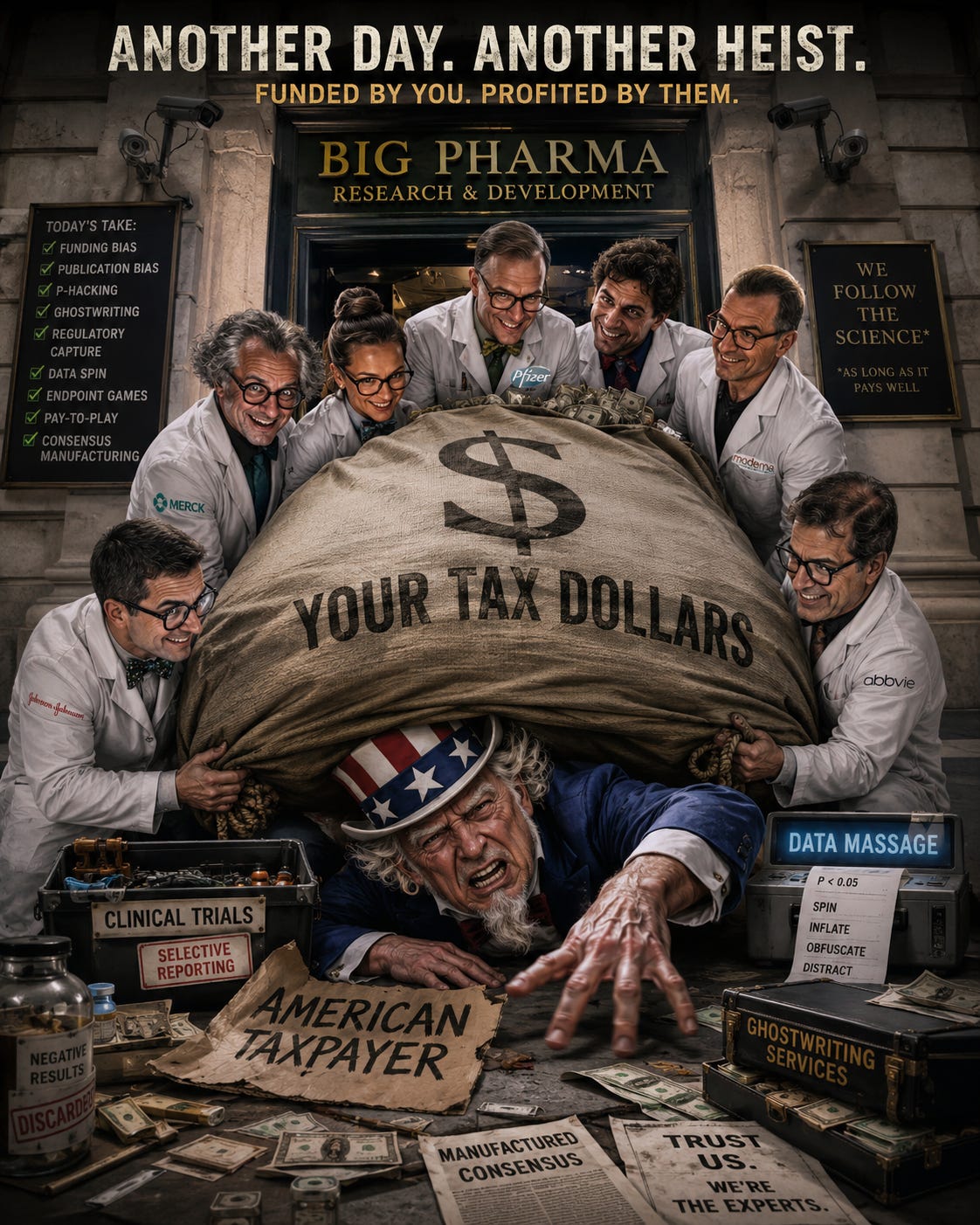
For more than a century, Hollywood has been obsessed with a question… How many different ways can a bank be robbed?
Sometimes it’s ski-masked lunatics kicking in the front door with sawed-off shotguns. Sometimes it’s elegant thieves in tailored suits quietly bypassing the vault through the air ducts. Sometimes it’s hackers, insiders, fake cops, crooked politicians, shell corporations, tunnel crews — or entire institutions quietly rewriting the rules so the robbery technically becomes “legal.”
From Point Break to Heat to Ocean’s Eleven to Inside Man — and for the old-school crowd, classics like Rififi and The Asphalt Jungle — the lesson is always the same… Once there’s enough money at stake, intelligent people stop asking whether the system can be gamed and start discovering the endless number of ways it already is. Unfortunately, the same phenomenon is true for a large portion of scientific studies — only Hollywood’s not turning those heists into movies.
The biomedical version is uglier than any bank caper that’s ever hit the silver screen. Why so? Because the bank being robbed is the American taxpayer, and the annual take is in the hundreds of billions (yesterday’s post put it at just under a trillion). The NIH alone disburses nearly 50 billion a year in publicly funded research grants. A 2018 PNAS analysis found that NIH funding contributed to published research associated with every single one of the 210 new drugs approved by the FDA between 2010 and 2016.
Throw in Medicare, Medicaid, the VA, the DoD, employer-subsidized insurance, and direct out-of-pocket spending, and the American public is bankrolling both ends of the operation — directly through NIH grants that seed the science, and indirectly through inflated drug prices that fund industry's own trials, marketing, and the next round of “research.” Same studies. Same drugs we don't need. Same prices we can't afford. Same safety signals systematically buried. And the scientists in the white coats don’t even have to pick the lock or jackhammer through a concrete wall. They’ve been handed the keys, the vault combination, and a getaway van with new tires, a full tank of gas, and fake plates.
It’s the robbery movie Hollywood never made…
And the people most aware of the robbery aren’t the patients in the waiting rooms. They are the doctors, editors, and senior scientists who spent their careers inside the institutions pulling the heist, as well as their accomplices deep inside — those running the very watchdog agencies that are supposed to be putting the kibosh on this sort of thing (FDA, CDC, NIH, HHS, HRSA, CMS, AHRQ, DOJ, OHRP, ORI, GAO, etc, etc, etc). The collapse of trust in biomedical research is not coming from the outside; it’s coming from the very people best positioned to know.
Below are a number of quotes — every one of them from a former editor of a top medical journal or a senior physician-researcher, every one of them on the record. It’s the “stuff” (I’d have been well within my rights to use other descriptors here) I’ve been writing about in my oxymoronically-named Evidence-Based Medicine column over at DoctorSchierling.com and elsewhere for 35 years (thanks to censorship, I am now here instead of there).
Be sure to have a trash can handy in case your level of quesiness rises to upchuck threshold…
“It is simply no longer possible to believe much of the clinical research that is published, or to rely on the judgment of trusted physicians or authoritative medical guidelines. I take no pleasure in this conclusion, which I reached slowly and reluctantly over my two decades as an editor of The New England Journal of Medicine.” -Dr. Marcia Angell, former Editor-in-Chief, New England Journal of Medicine, from 2009’s Drug Companies & Doctors: A Story of Corruption
“The case against science is straightforward: much of the scientific literature, perhaps half, may simply be untrue. Afflicted by studies with small sample sizes, tiny effects, invalid exploratory analyses, and flagrant conflicts of interest, together with an obsession for pursuing fashionable trends of dubious importance, science has taken a turn towards darkness.” -Dr. Richard Horton, Editor-in-Chief, The Lancet, from a 2015 piece, Offline: What is Medicine’s 5 Sigma?
“The medical profession is being bought by the pharmaceutical industry, not only in terms of the practice of medicine, but also in terms of teaching and research. The academic institutions of this country are allowing themselves to be the paid agents of the pharmaceutical industry. I think it’s disgraceful.” -Dr. Arnold Relman, former Editor-in-Chief, New England Journal of Medicine from PBS Frontline in 2002
“Medical journals are an extension of the marketing arm of pharmaceutical companies.” -Dr. Richard Smith, former Editor, BMJ (25 years) from PLoS Medicine’s 2005 article, Medical Journals Are an Extension of the Marketing Arm of Pharmaceutical Companies
“There can be no doubt that its business model fulfills the criteria for organised crime.” -Dr. Peter Gøtzsche, co-founder of the Cochrane Collaboration and former director of the Nordic Cochrane Centre, from 2013’s Deadly Medicines and Organised Crime: How Big Pharma Has Corrupted Healthcare
“There seems to be no study too fragmented, no hypothesis too trivial, no literature citation too biased or too egotistical, no design too warped, no methodology too bungled, no presentation of results too inaccurate, too obscure, and too contradictory, no analysis too self-serving, no argument too circular, no conclusions too trifling or too unjustified, and no grammar and syntax too offensive for a paper to end up in print.” -Dr. Drummond Rennie, Deputy Editor of JAMA from 1986 Announcement of the First International Congress on Peer Review in Biomedical Publication
What if I told you that medical research has been suspect for longer than you can imagine — probably before your grandparents great-grandparents were born? That biomedical research has always been under assault, due to corrupting pressures from the sheer amount of dollars involved?
Notice that the last quote above is four decades old — proof that, as Solomon wrote in Ecclesiastes three millennia ago, there is nothing new under the sun. Not only is the effort to game the biomedical research system not just a 21st-century phenomenon, it’s not even a 20th-century phenomenon.
Take a look at what some of the historical heavyweights of medicine were saying over 160 years ago…
“I firmly believe that if the whole materia medica, as now used, could be sunk to the bottom of the sea, it would be all the better for mankind — and all the worse for the fishes.” -Dr. Oliver Wendell Holmes, Dean of Harvard Medical School, delivering the Annual Address to the Massachusetts Medical Society — five years before Lincoln was assasinated (May 30, 1860)
“Far too large a section of the treatment of disease is to-day controlled by the big manufacturing pharmacists, who have enslaved us in a plausible pseudo-science.” -Sir William Osler, the ‘Father of Modern Medicine,’ first physician-in-chief of Johns Hopkins, and Regius Professor of Medicine at Oxford, from the 1909 issue of Lancet (The Treatment of Disease)
“Evidence is at hand that many of the patients in the examples to follow never had the risk satisfactorily explained to them, and it seems obvious that further hundreds have not known that they were the subjects of an experiment although grave consequences have been suffered as a direct result of experiments described here.” -Dr. Henry K. Beecher, Professor of Research in Anaesthesia at Harvard Medical School from the June 1966 issue of the NEJM (Ethics and Clinical Research)
That’s the historical baseline. None of these men was fringe. None were “anti-pharma activists”. None were considered outliers.
Holmes ran Harvard Medical School. Osler not only built Johns Hopkins, but his textbook, The Principles and Practice of Medicine, trained two generations of American doctors (he called the pharmaceutical industry’s grip on therapeutics a “plausible pseudo-science” in The Lancet in 1909). Beecher held an endowed chair at Harvard and documented 22 unethical experiments — all published in major American medical journals, all having passed through editorial boards and peer review.
And now bring it forward, decade by decade, into the modern era, where the same stale warnings come from the people who ran the New England Journal of Medicine, The Lancet, JAMA, and the BMJ — and who co-founded Cochrane, the world's premier evidence-synthesis network. These are not anti-vax bloggers, naturopaths, kooky chiros, or voices from ‘the fringe.’ They are the architects and gatekeepers of modern medicine itself, spending their careers watching how the heist works.
What follows is an inventory of techniques they were watching…
GROUP 1 — Funding & Conflict-of-Interest Capture
Industry sponsorship of the trial itself: The single best predictor of a trial reaching a “positive” conclusion is who paid for it. A 2023 medRxiv analysis of 1,533 RCTs published in NEJM, Lancet, and JAMA between 2015 and 2019 found 82% of industry-funded RCTs reported positive primary outcomes versus 54% of non-industry-funded RCTs — a 28-point gap not explainable by methodological differences. And let’s be honest, this point is no-brainer maximus when the fox is left to guard the henhouse. I’ve only written about this topic a thousand times in the last 35 years over on my DoctorSchierling site.
Author financial ties — consulting, speaking, equity, royalties: Beyond who funded the trial, the individuals listed as authors routinely have personal financial relationships with the sponsor — speaking fees (like Clinton Cash), consulting contracts, stock options, royalties on related patents. A cross-sectional analysis of 2017 trials in NEJM and JAMA, published in BMJ Open in 2022, found 118 physician-authors received nearly $8 million in industry general payments during their disclosure windows, with the 23 highest-compensated authors hiding $3 million — 47.6% — that should have been declared. Of course, yours truly wrote about this as well.
Ghostwriting & medical communications firms: Pharma doesn’t just fund the trial and pay the authors — in a substantial share of cases, it writes the paper itself. Medical Education and Communication Companies (MECCs) draft the manuscript inside the sponsor’s publication strategy, then recruit academic (cough cough) “authors” to attach their names and credibility for a fee. The Project On Government Oversight’s explainer walks through the practice and the documented cases — Vioxx, Prempro, Paxil, Neurontin, Zoloft, Avandia — and explains why journal disclosure rules have failed to stop it. Yep, I found an appropriately titled article I wrote back in 2011.
CRO selection & sponsor control over data: Industry sponsors don’t hand the trial to neutral academics — they hire Contract Research Organizations whose entire revenue depends on repeat business from those same sponsors, and they retain ownership of the raw data. A Danish FOIA study of 42 industry-involved trials approved by ethics committees, led by Peter Gøtzsche and colleagues, found the industry partner owned all data in 48% of trials, publication constraints were written into 71%, and not one informed consent document told participants about either restriction.
Institutional & departmental capture: Money buys more than individual authors — it buys departments, endowed chairs, training grants, and the named buildings that house them. Once a department’s operating budget is fed by industry funding, the people running it cannot afford to bite the hand. Public Citizen documented in 2019 that even the editorial boards of the top-impact medical journals are routinely populated by editors with undisclosed financial ties to the same companies whose products their journals review.
Disclosure failures — the regulatory fig leaf: The entire COI system runs on author self-reporting, which is then not audited. The 2022 BMJ Open / medRxiv cross-sectional analysis found that even comparing self-disclosures against the federal Open Payments database — which Sunshine Act reporting makes mandatory for industry — 81% of authors who received payments left at least some of the money off their journal disclosure forms.
GROUP 2 — Study Design Rigging
Comparator manipulation — fraudulent placebos and weak actives: The single cleanest tell that a trial was rigged before it started is the choice of comparator. Industry trials routinely compare a new drug to a "placebo" containing the same toxic excipients as the active arm (washing out the safety signal), to a competitor drug deliberately under-dosed or used in patients known to do poorly on it, or to outdated regimens that newer evidence has already abandoned. The James Lind Library catalogues how three of four large industry-sponsored antihypertensive trials used atenolol as the comparator after atenolol had already been shown inferior to low-dose thiazide diuretics — guaranteeing the new drug looked better than it was. The vaccine schedule is the most egregious example of all. Not a single childhood vaccine on the current CDC schedule has ever been tested against an inert saline placebo in a real RCT — new vaccines are ‘tested’ against older vaccines or against the aluminum adjuvant alone, washing out the safety signal by design. ICAN's lawsuit forced HHS to admit on the record that it had never filed a single biennial vaccine safety report to Congress in 34 years — the heist RFK Jr. has spent two decades screaming about.
Dose and duration gaming: Pick a dose of your drug high enough to show effect but a dose of the comparator low enough to lose; run the trial long enough to catch the benefit signal but short enough to miss the harm signal that always emerges later. The pattern is most flagrant in psychiatry and cardiovascular trials, where 6-week or 12-week studies make the case for indefinite prescribing while toxicities that manifest at 6 months, 2 years, or 10 years never enter the dataset that approves the drug. The TOGETHER trial — the supposed death blow to ivermectin — capped dosing at 3 days when clinicians treating the more virulent gamma variant were dosing for 5+ days at double the strength, then added a 90kg weight cap that systematically underdosed the heaviest, highest-risk patients, a dose-and-duration fraud Pierre Kory itemized in granular detail.
Surrogate endpoints instead of clinical outcomes: The most consequential design choice in modern trials is the substitution of surrogate markers — tumor shrinkage, LDL drop, progression-free survival, viral load — for outcomes patients actually care about, like living longer or feeling better. An empirical analysis of 392 FDA oncology approvals between 2006 and 2023, published in Cancer Medicine in 2024, found that only 32% of all oncology drug approvals had any evidence of improved overall survival — meaning roughly two-thirds of cancer drugs reach the market and stay there without ever being shown to make patients live longer.
Population selection — healthy-user bias and exclusion of the actually sick: Industry trials systematically exclude the patients who will actually take the drug. A Lancet Healthy Longevity analysis of 43,895 trials and more than 5.7 million UK patients found median exclusion rates of 26% for people over 60, 41% for those over 70, and 53% for those over 80 — meaning the trial population bears little resemblance to the real-world prescribing population, particularly the elderly who tend towards multiple comorbidities and consume the most drugs.
Powering tricks — under and over: A trial powered too small will miss real harms; a trial powered enormously will detect statistically significant differences far smaller than anything clinically meaningful. Both trumpet them as breakthroughs. The asymmetry is the point: industry pours money into enrollment to chase a barely-detectable benefit while keeping harm trials small enough that adverse signals stay below the threshold of significance. If you want, you can prove that the moon really is made of green cheese — or that the Raiders are the best team in the NFL.
Non-inferiority margin gaming and biocreep: Non-inferiority trials are designed not to show a new drug works, but only that it’s “not unacceptably worse” than an existing one. Set the margin wide enough, and a drug barely better than placebo can be declared non-inferior to a proven therapy. Worse, biocreep takes hold, with each generation of approved drugs being inferior (yet non-inferior — not unacceptably worse) to the previous one. After a few cycles the active comparator itself may be no better than placebo — or in many cases, worse.
Run-in periods and enrichment designs: Before randomization, run all candidate patients on the active drug; exclude anyone who can’t tolerate it, doesn’t respond, or has early side effects; only randomize the survivors. The published trial then reports outcomes for a population pre-selected for tolerance and response — burying the very signal a doctor needs to know in advance. The 2018 JGIM analysis by Fralick and colleagues confirmed run-in trials produce systematically different outcomes than no-run-in trials of the same drug, and the run-in’s existence is often not even adequately reported.
GROUP 3 — Conduct & Data Collection Fraud
Unblinding — accidental and engineered: A double-blind trial only stays double-blind if the people interacting with patients can’t figure out who’s in which arm. In practice, however, blinding routinely collapses as drug-assignment confirmations get left in patient charts, packaging is distinguishable, side-effect profiles tip off both patient and clinician, and “unblinded staff” tasked with prep have direct contact with blinded staff. Once that wall falls, every subjective endpoint (pain, fatigue, depression, quality of life) becomes biased reporting dressed up as blinded data. The infamous Pfizer C4591001 trial documented exactly this — drug-assignment printouts sitting in participant charts accessible to blinded personnel, fixed only after 1,000 participants had already been enrolled.
Protocol deviations — buried and reclassified: Every clinical trial generates protocol deviations: patients enrolled who shouldn’t have been, doses missed, visits skipped, lab values not drawn. The fraud isn’t the deviation — it’s the classification. Deviations the site doesn’t want the sponsor to see get downgraded from “major” to “minor”; deviations the sponsor doesn’t want the FDA to see get filed without timely IRB notification. The FDA’s December 2024 draft guidance specifically calls out the pattern — incorrectly enrolled participants, missing safety lab values, frequent deviations in safety reporting, and inaccurately recorded data as “important” deviations that are routinely under-classified.
Adverse event miscoding and “not related” attribution: Every adverse event in a trial requires a causality assessment by the investigator — “related” or “not related” to the study drug. The structural problem: the investigator is paid by the sponsor, trained by the sponsor, and operating under sponsor-drafted causality criteria that allow virtually any AE to be coded “not related” by pointing to underlying disease, concomitant medications, or implausibility of timing. Industry pharmacovigilance literature openly acknowledges that “related/not related” determinations are made for case-processing convenience rather than to reach scientific conclusions about causation. A friend of mine showed how this is pulled off in the real world.
Source document manipulation: The source documents — the original case report forms, patient charts, lab slips, ECG strips — are supposed to be the bedrock against which the published paper is checked. In practice, they’re filed at the investigator site, controlled by site staff, and inspected by the FDA at roughly 1% of trial sites. Charles Seife and his Columbia students reviewed FDA inspection documents covering 57 clinical trials where researchers had failed inspection for fraud, fabrication, or scientific misconduct — and found that of 78 resulting publications, only 3 contained any mention of the problems the FDA had identified. The agency systematically redacts the drug name, study name, and nature of the misconduct, making it impossible for doctors or patients to know which published trial is tainted. Check this out for real-world examples.
Site-level fabrication: Beyond miscoding and manipulation, outright fabrication happens — fake patients, copy-pasted vitals, invented lab values, swabs never taken, AEs never recorded. The Ventavia/Pfizer whistleblower, reported in The BMJ in November 2021 by investigative journalist Paul Thacker, documented this directly at three of the Pfizer C4591001 trial sites: falsified data, unblinded patients, inadequately trained vaccinators, slow follow-up on adverse events, mislabeled lab specimens, vaccines stored at wrong temperatures, and protocol deviations not reported. Brook Jackson was fired by Ventavia the same day she emailed her concerns to the FDA; Pfizer rehired Ventavia for four subsequent vaccine trials, including pediatric and pregnancy studies. The FDA did not inspect any of Ventavia’s three sites before granting full approval.
Pharmacovigilance suppression — passive surveillance by design: Once a drug or vaccine reaches the market, the trial-conduct fraud becomes pharmacovigilance fraud: the systems designed to catch what trials missed are deliberately built to fail. The Lazarus / Harvard Pilgrim ESP:VAERS study, AHRQ-funded and finalized in 2010, found that fewer than 1% of vaccine adverse events ever reach VAERS — and when Lazarus built an automated EMR-based reporting tool that worked (identifying 35,570 possible reactions in 1.4 million doses, or 2.6% of vaccinations), the CDC stopped responding to his team, and the project was abandoned. The current VAERS database therefore represents roughly 1-in-100 of what’s actually happening in the population, according to the federal government’s own commissioned research. (See my three-part series on the Lazarus study and the scale of the underreporting problem in ‘vaccine world’.)
GROUP 4 — Statistical Manipulation
P-hacking and multiple comparisons: Test enough hypotheses against the same dataset and chance alone will produce “statistically significant” results at p<0.05 in roughly 5% of them. Industry trials routinely measure dozens of outcomes — secondary endpoints, tertiary endpoints, subgroups by age, sex, race, baseline severity, concomitant meds — and then report only the comparisons that crossed the magic threshold, as if they had been the question all along (I described this the other day like this). John Ioannidis put a name and a number on the consequence in his now-famous PLOS Medicine paper Why Most Published Research Findings Are False — the structural incentives of modern biomedical research virtually guarantee that the majority of published findings are wrong.
Endpoint switching: The single most documented form of trial fraud in the modern literature: a trial is registered with a pre-specified primary outcome, the data come in negative, and by the time the paper is published, the primary outcome has been quietly demoted to secondary, while something that managed to reach significance has been promoted to primary. The COMPare project at Oxford, led by Ben Goldacre, monitored 67 trials published in NEJM, Lancet, JAMA, BMJ, and Annals of Internal Medicine over six weeks: 58 of those 67 trials contained discrepancies requiring correction letters (87%), and across the cohort there were a mean of 5.4 undeclared additional outcomes added per trial. When Goldacre’s team wrote correction letters, NEJM dismissed concerns, Annals of Internal Medicine wrote error-laden rebuttals, and only BMJ promptly issued corrections. This is a form of I&A that I wrote about last week.
Subgroup mining and HARKing: When the overall trial result fails, the rescue strategy is to slice the data into subgroups — by age, sex, severity, biomarker status, prior treatment — until some subgroup shows a “responder” effect that can be marketed as the real finding. Hypothesizing After the Results are Known (HARKing) is the academic name; in industry it’s standard practice. The paper then presents the post-hoc subgroup as if it had been the pre-specified hypothesis. The Liu/Kesselheim/Cliff cohort study published in JAMA in May 2024 documented the downstream consequence in oncology: of 46 cancer drugs granted FDA accelerated approval between 2013 and 2017 with at least 5 years of follow-up, only 43% (20/46) demonstrated actual clinical benefit in confirmatory trials — yet 63% (29/46) were converted to regular approval anyway.
ITT vs. per-protocol shell games: Intention-to-treat (ITT) analysis includes everyone who was randomized, regardless of whether they completed the protocol. Per-protocol analysis includes only those who finished the assigned treatment. The two can produce dramatically different results, and sponsors choose whichever is more favorable while burying the other. Drop-outs who left because the drug made them sick disappear from per-protocol analyses; non-responders who were swapped out get reclassified as protocol violations. Whichever analysis is reported as primary is the one that made the drug look good.
Relative risk vs. absolute risk framing: The single most consequential statistical sleight of hand in modern medicine: report your benefit as a relative risk reduction (sounds huge) and report your harms as absolute risk increases (sounds trivial). The 2023 Cureus historical review documented how every landmark statin trial over four decades has reported cardiovascular benefits as relative risk reductions — “30% lower risk of heart attack!” — while the absolute risk reduction is consistently in the range of 1-2 percentage points or less. The 2022 JAMA Internal Medicine meta-analysis of 21 statin RCTs found absolute risk reductions of 0.8% for all-cause mortality, 1.3% for myocardial infarction, and 0.4% for stroke — numbers patients would never accept the side effects to chase if anyone told them. As you might imagine, I’ve covered this topic at length, especially as it pertains to statins.
Composite endpoints — burying the driver: When no single outcome shows benefit, combine three or four or five outcomes into a single “composite endpoint” so that whichever component happens to move drives the overall p-value. The classic move in cardiovascular trials: combine mortality (rarely moves) with non-fatal MI (moves a little) with hospitalization (moves a lot, often for soft reasons) — then announce that the composite was significantly reduced, leaving readers to assume mortality was the driver. Khan’s 2023 review in JACC Advances documented that composite endpoints conflate outcomes of differing severity, weight, and clinical impact into a single metric, creating a significant potential for misrepresenting treatment effects because the more frequent but less severe components disproportionately shape the overall result.
Spin in abstracts and conclusions: Even when the data come in unambiguously negative, the abstract can still be written to make the drug sound effective — by emphasizing non-significant trends, recommending the treatment despite missed primary endpoints, burying the negative result deep in the results section while leading the abstract with a positive secondary, or framing failure as “warrants further study.” Boutron and colleagues developed the standard classification of trial spin in JAMA in 2010; subsequent applications of that framework have documented spin in 34% to 70% of biomedical research literature with statistically non-significant primary outcomes — and randomized studies of oncologists and cardiologists confirm that spin measurably alters clinical interpretation of the same underlying data.
So there you have it. Twenty-six documented techniques for rigging a clinical trial, across four groups, every one of them peer-reviewed, every one of them named by the editors who ran the journals where the rigging happens.
Fund the trial. Pay the authors. Ghostwrite the manuscript. Hire a CRO that depends on repeat business. Pick a fraudulent placebo. Pick a sandbagged competitor. Pick a dose that wins. Pick a duration that hides the harm. Swap a surrogate for a clinical outcome. Exclude the elderly and the actually sick. Cherry-pick the responders. Sandbag the comparator. Unblind the blinded. Reclassify the protocol deviations. Code every adverse event “not related.” Redact the inspection reports. Fabricate the source documents. Bury the pharmacovigilance signal. P-hack the data. Switch the endpoints. Mine the subgroups. Game the ITT/per-protocol switch. Frame the benefits in relative risk and the harms in absolute risk. Bury the driver inside a composite endpoint. Spin the abstract.
Twenty-six locks on the vault — and the crew already has a key to every single one of them. And we haven’t even gotten to the easy part of the heist yet. Everything above is what happens inside a single trial.
Part II — coming tomorrow — moves to the system that surrounds those trials: how the publication process selects for the rigged results, how peer review fails to catch them, how regulatory agencies wave them through, how medical guidelines launder them into “standard of care,” and how the media amplifies them into public health gospel.
Today we watched the bank being robbed…
Tomorrow we look at how the getaway car gets a police escort, the local prosecutor declines to file charges, the newspaper runs the crew's press release on the front page — and your doctor sends you the bill.
And for those who come back for Part II, there's something in it for you. A practical way to put everything in these two posts to work the next time a doctor pulls out the prescription pad or delivers “the studies say” pitch. Not theory. Not outrage bait. A tool — a simple tool — that used correctly could save your life.
See you tomorrow.
Thank you for laying this out in such an easy to understand format. The tragedy is that most people have no idea that any of this is happening.