



For my children and grandchildren…
In Part I, I built a fence. On one side, I put everything solid — Richet’s Nobel Prize, the route problem, the Japanese gelatin admission, the billing codes, and my own Amish patient base, covered in ticks, completely unvaccinated, and, at least as far as I can ascertain, free of alpha-gal — with a single imported exception I’ll come back to shortly. On the other side, I put my suspicions about a declassed clandestine program, telling you where the record stopped, and my hunches began.
Today, there will be no discussion of Fort Detrick, Plum Island, or other biolabs / bioweapon labs. There’s no need for that when answering a question that several readers asked via the comment section. Before I had finished my morning coffee…
If it’s really the shots that cause alpha-gal, then why is the tick needed at all?
I’m going to answer this by asking and answering three very specific questions from the tick research community’s own filing cabinet — CDC-funded papers and the industry-disclosed authors. From the scientists who are certain the Lone Star tick is the primary cause.
I’m going to let people far smarter than me answer these questions using their own studies…
Question One: Why Is a Tick Needed At All?
But the condition has no historical precedent. It appears in the literature at a specific moment in the late 1980s, in multiple countries simultaneously, at a time when gelatin-containing vaccines were being introduced into childhood immunization schedules worldwide. Japanese researchers documented, confirmed through intervention, and published the direct causal relationship between gelatin-containing DTaP vaccines and alpha-gal sensitization in children who had never been exposed to ticks. That evidence is in the peer-reviewed record. It has been there since 1996. -From Dr Travis Johnson’s June 2 piece in Medium (The Allergy That Shouldn’t Exist: Vaccines, Gelatin, and the Strange Origins of Alpha-Gal Syndrome)
To answer question one, it isn’t — at least not as the origin. Vaccines alone can do it — the tick isn’t required for the mechanism. But historically, before the schedule ballooned, cases clustered in tick country. And the scientific literature already told you why.
Go pull the 2021 paper from Frontiers in Cellular and Infection Microbiology that tick researchers themselves titled “Tick Saliva and the Alpha-Gal Syndrome: Finding a Needle in a Haystack”. Read that title again. A needle in a haystack. They picked the metaphor, but pointed it at the park instead of at the vial.
Let’s watch what the tick actually does and why the needle in the haystack might be apropos, but maybe not in the way the authors intended…
Another 2021 study, this one on a tick enzyme, describes the alpha-gal sugar as being — their word, not mine — “injected into humans from the lone-star tick bite”. Injected. Not eaten. Not digested. Injected — straight through the skin, past the gut and its digestive processes, and into areas where food is not supposed to be. And as I stated in Part I, this is extremely similar to the phenomenon I have referred to for over two decades as “The Leakies”. Example: (Systemic Leaky Barrier Syndrome (SLBS): A Systems-Level Framework for Chronic Disease).
Earlier studies localized the sugar to the secretory vesicles of the tick’s salivary glands — meaning it’s built to be squirted into a bite. In other words, it’s not wrong to think of ticks as syringes with eight legs — light enough to cross your skin without tripping pressure receptors, and armed with saliva loaded with painkillers, anti-inflammatories, and anticoagulants that let them latch and drink for days without ever setting off the itch that would make you look down and flick them off.
What these devilish little creatures are loading into you is galactose-alpha-1,3-galactose — alpha-gal for short; the “ose” tells you it’s a sugar, like glucose or sucrose — a bit of mammalian sweetness squirted straight under your skin. And here's the kicker nobody thus far has answered…
When it comes to the animals the tick commonly feeds on — deer, cattle, dogs, rodents, goats, hogs, etc — alpha-gal is “endogenous”. In other words, they build it, they carry it, and their immune systems recognize it as native (“self”) so that it’s not attacked as an invader. So the best answer for why it's in the saliva at all isn't that it works some mechanical trick like the anticoagulants and painkillers do — it's camouflage. Dress your spit in the host's own sugar, and it reads as ‘self,’ letting the tick guzzle until 100X normal size, all under the immune radar. Which means the sugar is doing exactly its job on a deer.
To see this in action, let’s look at a study that was done at my alma mater (Kansas State University) and funded in part by the DoD (specifically, the U.S. Department of Defense Tick-Borne Disease Research Program) — and published in what I would argue is an “interesting” journal considering the topic. Reading between the lines is helpful, especially after noting that one of the program's stated research priorities is “immune evasion, host tolerance, or pathogen-host immunosuppression.”
Translated out of grant-speak, that's the government cutting checks to study how ticks are able to slip mammalian sugar past a host's immune system — undetected — which is the exact camouflage mechanism this paper documents. The military didn't stumble onto molecular mimicry by accident. They funded it, named it in the priority list, and then acted surprised when the same trick that hides a tick from a deer can “unexpectedly” send a human to the ER with anaphylaxis.
Your tax dollars at work…
Decoration of the tick salivary proteins with the host-specific glycan aGal would be an efficient way of evading the host immune system in the case of parasitization of non-primate mammals (i.e., goat, sheep, horse, mouse, pig, and deer)... although it may unexpectedly function as an allergy sensitizer in humans lacking aGal. -From a 2020 study published in the journal, Vaccines
The irony here (besides the words may and unexpectedly) is that the coating that hides the tick from a whitetail’s immune response lights it up like a Roman candle in humans. The tick isn't hunting you specifically. We know that because it's wearing its ‘non-primate mammalian’ camo. But if one of these ticks happens to bite you, injecting you with a dose of enzymes, you're the only animal on its menu whose immune system might view alpha-gal as the enemy.
Now go read the men who named the syndrome — Platts-Mills and Commins — in their own paper, The Alpha-gal Story: Lessons Learned From Connecting the Dots. Because buried in their own findings is something intriguing — a finding that goes against their working hypothesis. This is not a direct quote, but I wanted it highlighted because it’s important concerning routes of moving alpha-gal into the body. Read it until you grasp what it’s saying. It will help you understand why the digestive tract is considered not simply part of the immune system, but arguably the largest part…
A tick bite (“injection” of alpha-gal) can induce high-titer food-specific IgE in adulthood, whereas eating alpha-gal does not elicit that response. It’s the route that decides the outcome — tolerance by mouth, sensitization by needle.
What is the difference, immunologically, between a tick injecting alpha-gal into your dermis and a syringe injecting alpha-gal into your deltoid? There isn’t one — both bypass the gut and meet the immune system in the wrong compartment. What separates them, however, is dose, inflammation, and age, and that’s exactly where the syringe and the tick part ways. The tick is doing its thing outdoors, hopefully rarely, in microgram doses.
However…
“The Schedule” does it on purpose, via a strict calendar, dozens of times, starting in infancy, with gelatin that carries the same sugar — and it does it in a deliberately inflammatory context.
In the killed and subunit shots, that context is adjuvants (often in various forms of aluminum), included to make the immune system treat whatever is delivered alongside as a threat worth remembering — the “boost” that forces the body to ‘recall’ which antigen to attack years, or even decades, later. In the live shots — MMR, varicella, zoster — no aluminum is used, because a replicating virus is itself a powerful immune activator. Either way, the mammalian sugar arrives with the alarm already ringing
And aluminum is just the adjuvant everyone knows by name…
Industry has spent decades engineering newer ones — saponins like QS-21, squalene emulsions like AS03, synthetic danger-signals like the CpG in Heplisav-B — every one built to hit harder than aluminum, because a stronger ‘kick’ is the entire commercial point. Their own literature says the quiet part out loud, “raw QS-21 causes hemolysis, inflammation, and outright tissue necrosis,” and Nature concedes crude saponin is “unsuitable for human use due to its toxicity”.
A rabbit hole for another day, but one I was writing about 15 years ago…
Ask the Europeans who watched an AS03-adjuvanted flu shot trigger a wave tsunami of childhood narcolepsy. All you really need to understand is that adjuvants trend toward more provocation, not less, every dose landing where the gut is less likely to tolerate it. And if you really want to hit the adjuvant rabbit hole, read yesterday’s article by Unbekoming, Negative Synergies: Where Injected Metals Meet Modern Life, which delves into a host of issues critical for this post, including the effects Glyphosate has on aluminum.
Every one of those doses lands where the gut can't reach it, intentionally creating inflammatory response, and helping fuel something I mentioned earlier — The Leakies (the subject of Part III).
And here’s the tell nobody wants to let go of — the tick brings its own party favors (as long as we refer to endogenous adjuvants as ‘party favors’)…
A CDC-funded study showed one effect of Lone Star bites on the immune system. The bites steered the animals' immunity toward Th2 and drove alpha-gal sensitization — the allergic, IgE-making arm. That's the tick's saliva acting as its own adjuvant… In other words, it doesn't just deliver the sugar; it inflames the surrounding tissue, telling the immune system to treat what just arrived as a threat.
That’s not a bug feeding; that’s an adjuvanted injection…
Nature (the tick), doing in miniature, a weaker, and hopefully no more than occasional version of what the adjuvanted schedule does deliberately and repeatedly… It injects mammalian protein, while screaming at the immune system to treat the very same protein as an enemy.
Ticks and vaccines, however, are not the only needles…
Before Lone Star bites were being linked to steak dinners, the pharmaceutical industry had already run this experiment at scale — injecting mammalian protein into people and documenting, in its own literature and its own body count, exactly what happens when alpha-gal reaches the immune system, after bypassing the gut.
As you’ve already seen, the route is one of three major factors in sensitization (the others are age of first exposure, and repeated exposure). Eat the sugar, and the gut tolerates it; inject it, and the body is taught to attack. Here are the two receipts pharma left behind.
The Cetuximab Precedent: When the cancer drug cetuximab — a chimeric antibody grown in a mouse cell line that carries the alpha-gal sugar — killed people with anaphylaxis on the first infusion, it settled the route question in a hospital, under observation, and with a body count. These patients had eaten beef their whole lives without incident. Then the same sugar hit their bloodstream through an IV line instead of a fork, and their immune systems tried to kill it, in some cases killing them in the process. The alpha-gal IgE was already loaded — most reactors carried it before the drug ever touched them, clustered right in the tick-endemic Southeast — and it didn't matter one bit while that sugar was going through the digestive tract. However, it mattered the instant it went in through a needle. That's the entire argument in one drug… The epitope is identical, the people are identical. It’s the route of intake separating Tuesday's burger from serious or even deadly reactions. Eat it, and the gut waves it through. Inject it, and the body detonates. Read about it in the New England Journal of Medicine.
The Gelatin Route. Mammalian material runs all through vaccine manufacturing, but the alpha-gal that reacts rides in on gelatin — a mammalian protein added to some vaccines as a stabilizer, which means it gets injected straight past the gut. Bovine and porcine gelatin carry the alpha-gal epitope, and AGS patients’ serum exposed to gelatin-containing vaccines (MMR, MMRV, varicella, zoster) has its alpha-gal IgE stripped out and its basophils fired, while gelatin-free formulations do nothing. One controlled analysis found the signal tracked with gelatin content, not calf serum — which sharpens the point rather than softening it. See the vaccine / alpha-gal binding data in the Journal of Allergy and Immunology in Practice.
Now the obvious question…
If vaccinations are really the primary sensitizer, why were the individuals reacting hardest to cetuximab clustered in the tick-endemic Southeast instead of spread evenly across a nation that’s blanketly vaccinated coast to coast?
Because the alpha-gal a body absorbs through a needle is the sum of two injectors — tick and syringe — and for that cohort, one of those terms was near zero. Platts-Mills’ own group found the pre-existing IgE ran 20.8% in Tennessee, 6.1% in northern California, and 0.6% in Boston — a Southeast gradient that looks like a tick map.
But let’s not overlook the obvious…
Those were adults in 2008, most born in an era when the childhood schedule was a fraction of today’s, and the gelatin-heavy products that carry the epitope didn’t yet exist in pediatric use. For instance, MMR wasn’t licensed until 1971, varicella not until 1995 — the CDC’s own Pink Book noting, in passing, that the varicella vaccine “contains gelatin.” Strip the vaccine “excipients” away (another list), and the tick route becomes more dominant for two distinct reasons. Less gelatin and one we will deal with momentarily, less “adjuvanted” inflammatory response.
Now run the schedule forward from the 1950s…
As vaccines were added to the modern lineup, the injected load of gelatin would have climbed. And gelatin is the operative word… When researchers fired alpha-gal patients’ serum at these vaccines, the gelatin-containing MMR, varicella, and zoster lit up their basophils while the gelatin-free MMR did nothing.
That basophil study only proves the vaccine can set off an allergy someone already has — not that the shot created it. Japan showed the rest by accident: with two DTaP versions in use, only the gelatin one produced new sensitizations, and pulling the gelatin stopped them. The antibodies these kids made reacted across mammal species — the alpha-gal signature, years before it had a name. Cetuximab showed the route in; Japan showed where it started.
So…
As the amount of ‘pharmed’ gelatin rises, the tick’s share of sensitization falls, though tick exposure never changed. So the correlation should be tightest in the oldest cohorts and loosen in the younger ones — not because the bug changed, but because a second injector grew up in the same ZIP code.
The tick model can’t predict that; a tick is a tick in 1955 and 2025. Mine predicts a correlation that decays as the schedule climbs. That tight Southeast clustering in mid-century adults isn’t the anomaly I have to explain away — it’s what I would expect from a low-schedule generation. Cetuximab proved the route, not the origin.
And it points to a test…
As the ‘modern-schedule’ generation ages, cases should surface in people the tick can't account for — not just outside the old Southeast map, but in the tick-naïve with heavy injection histories. That last part matters because the Lone Star is expanding its own range (see the Bonus section), so “new territory” is something the tick model predicts too. The clean test isn't new geography — it's new exposure. Range expansion can move the bug into a county. It can't bite someone who's never had a tick on them.
Moving forward…
A 2023 paper (High Levels of Alpha-gal with Large Variation in the Salivary Glands of Lone Star Ticks Fed on Human Blood) measuring alpha-gal in tick salivary glands concedes, in print, that only a subset of bitten people ever develops the syndrome — pointing to “unidentified variables” in the sensitization event. A 2024 study in Frontiers in Immunology admits that the salivary sugar may not be doing as much of the tick model’s heavy lifting as the biomedical community lays claim to…
The precise mechanism by which tick bites sensitize humans and contribute to the development of AGS is not fully understood. It is hypothesized that tick saliva, which contains α-gal antigens and salivary components, may trigger a host immune response and skew the immune system toward a TH2 response, resulting in the production of IgE antibodies that target α-gal. In fact, repeated tick bites have been observed to enhance the existing specific IgE antibody response.
However, the relationship between glycosylated proteins containing α-gal in tick saliva and the process of α-gal sensitization or AGS induction in hosts requires further investigation, as these salivary factors may not be the sole determinant… the specific conditions under which ticks or other exposures trigger sIgE antibody production against α-gal, resulting in AGS, remain unclear.
They’ve left a hole in their own theory and labeled it unknown. I’m just pointing out that the gap looks suspiciously like an emptied syringe.
Because the route of intake is the whole enchilada, the tick doesn’t rival the injection thesis — the tick is the injection thesis, the proof of concept. The shots and IVs are just the ‘industrialised version’. In many ways, the tick is a decoy that tells the truth about the mechanism while lying about the source. Point at the pasture, and nobody looks at the vial — even though the two are doing something similar.
And only one of them is forced on babies…
Parents to Pediatrician: Does my newborn really need the Hep B vaccine that was created specifically for prostitutes, IV drug users, and promiscuous homosexual men?
Pediatrician: Of course they do, dadgum it — who’s the expert here? Hey, isn’t that a Bigfoot running through the parking lot…?
Question Two: Then Why the Tick At All (Geography, Deer, Serology)?
Why? Because the tick is real — a point I have been making all along.
I’m not going to tell you the insect is a fairy tale because the serology says otherwise. My goal here is to simply follow the evidence. And if you’ve followed my column-within-my-blog (Evidence-Based Medicine), you already know that ‘evidence’ and the way it’s collected and interpreted are tricky at best — in far too many cases intentionally tricky — with industry frequently picking “The Winners™” during a study’s planning stages. Following this trail can be tricky because, as you’ll soon see, there are other factors at play.
For starters, tick bites do raise alpha-gal IgE…
Platts-Mills’ group documented twenty-fold-or-greater jumps in alpha-gal IgE in subjects after tick bites. The Cleveland Clinic’s own review notes that repeated bites sustain or increase those IgE levels and that the titers of most patients who avoid ticks fall. Good. That’s not an argument against me — read it again. It says a repeated injection of alpha-gal drives up the antibody, and removing the injections lets it fall. That’s the mechanism, spelled out in a dosing curve.
The tick is a weaker, less frequent, self-limiting version of the exact exposure I’m indicting via the vaccine route — except that it’s an exposure that would not typically start in infancy. If a few bites can move IgE twentyfold, what does a lifetime schedule of gelatin-bearing injections do — and why would you expect it to fall if the injections never stop?
Here's the part that resolves the apparent paradox, and it comes down to answering three questions — how much, how inflamed, and how young?
A little alpha-gal, delivered quietly under the skin over a lifetime — the way a few tick bites do it — and the body often shrugs it off. The same sugar delivered in bulk, with an adjuvant or live virus screaming at the immune system to pay attention, in the first months of life before the body has finished deciding what counts as food, doesn't teach tolerance. It teaches attack. The Amish get the first version. The schedule delivers the second.
So the tick correlation is real, and it points the same direction I do. Which leaves the geography...
Yes, alpha-gal maps onto geographic areas swarming with the Lone Star ticks. Yes, it maps onto the deer boom — Platts-Mills makes a lot of the white-tailed deer exploding since 1950, noting that deer were essentially extinct in Missouri in 1950 and are now so common they’ve become a nuisance. Fine.
But you cannot explain a disease with a variable that two populations share equally, but only one of them gets. Tick country and needle country are the same country. The Ozarks are wall-to-wall deer, wall-to-wall Lone Star ticks, and wall-to-wall vaccinated — except for the group sitting smack dab in the middle of it that took vaccinations out of the equation.
My Amish live inside that deer boom…
They walk the same pastures, work the same livestock, and pull the same ticks off the same skin as everybody else in this area. Only there are more of them. And not just more of them but waaaaay more of them because they’re outdoors from dawn to dark. Without repellent.
By the deer-and-tick theory, they should be the disease’s epicenter. Instead, they’re the null result. Maximum tick, maximum deer, zero vaccinations, no alpha-gal. Geography isn’t the cause. Geography is an alibi the ‘forced vaccination community’ at large is hiding behind because ticks and the heavily vaccinated live side by side in so much of the country.
And then yesterday the natural experiment handed me the other half of itself…
Since Part I dropped almost a month ago, every time I treat my Amish patients, I’ve been asking them about alpha-gal (“Does anyone in your community have allergies to meat?”). And every time the answer has been the same — until yesterday. One of the men mentioned his wife. I know her. He said that she carries the allergy — tested, confirmed, alpha-gal IgE, the real thing — and she is, as far as I have been able to ascertain, the only case in their particular community.
Guess what else makes her the only one…
She grew up in Minnesota and received “some shots” as an infant. Her husband told me she’s probably the only person in the entire community who falls into this category. Sit with that, because it’s the null result running in reverse.
Everything the tick people would reach for to explain away my Amish — some protective diet, some genetic quirk, some mystery exposure, consuming specialized herbal tinctures, duct-taping their pant legs closed — is held flat by the community itself.
She walks the same pastures, pulls the same ticks off the same skin, eats at the same table, and shares as tight a gene pool as any population in America. Every confounder is nailed down by the setting. The one axis she differs on — the only one I can see — is the vaccinations. The tick model predicts she should be indistinguishable from the other women in her community. She isn’t. And the single variable that separates her is the exact variable I’ve been indicting since Part I.
It’s one woman. I’m not going to dress it up as a statistic, because its power was never in the number — it’s in the control. You could not design a cleaner case-control if you tried…
And that’s just it — as far as I can tell, no one has tried. The community built it by accident, and I just happened to walk into it on a Wednesday. Maximum tick exposure, zero vaccination exposure, zero meat allergy — except for the one person who received some shots, who is also the one person with the disease. They told you to watch the woods. The woods are full of my patients. And the only one with alpha gal brought her sensitization with her from Minnesota.
The tick people know their bug isn’t enough, and say so when they think no one’s connecting it to anything…
Question Three: Why Doesn’t Everyone Vaccinated Get It — and How Would You Ever Prove This?
This is the most difficult to answer, although you see it in action every day of your life... When “Infection X” is making the rounds (insert infection-of-choice here_______________ common cold, RSV, COVID, flu / flu-like, EBV, CMV, Lyme, strep, etc, etc, etc), why do some get it and some don’t?
In other words, why not everyone? (We are going to deep-dive this topic for the series finale.)
Immune sensitization isn’t a coin toss. It’s dose-related to a specific substance. But even “dose” and “substance” are not the biggest factors — the biggest factor, once the other two criteria are met, is age of exposure. Need proof?
Look at the Japanese study of almost 400 healthy children — the same country that pulled gelatin out of its vaccines. When they measured vaccine-specific IgE by age, the pattern was brutal and clean: IgE rose in the infants and toddlers, went flat in the school-age kids, and actually fell in the teenagers. The same shot, but with an opposite immunological outcome. What was the deciding factor? How old the child was when they were vaccinated.
Let me spell it out for you… The younger the child and the larger the dose(s), the more likely they are to develop sensitivity rather than tolerance. Japan is a big piece of the puzzle because it ran the experiment in both directions…
When they moved gelatin-containing DTaP earlier in the schedule, anaphylaxis reports to later vaccines climbed. Then manufacturers pulled the gelatin — and the establishment admitted, in peer review, that infants were no longer being sensitized by DTaP because it no longer contains gelatin, with reactions dropping accordingly. It wasn’t a guess. In their case-control, not one of 54 children who reacted had received the gelatin-free DTaP, versus 29% of the healthy controls.
Remove the injected mammal protein from the schedule, and the sensitization — at least as far as alpha-gal is concerned — plummets. In the United States, the gelatin was never removed, and the schedule continues to grow (hold this thought because in a moment I am going to prove to you that American pharm has had these very discussions and understood the argument before the alternative community started calling it out).
It does not take a rocket scientist to see the potential for problems…
Front-loading mammalian protein via the exact manner into the exact window where the immune system is primed to make the wrong choice — gelatin-containing products repeatedly injected throughout infancy and childhood, before the immune system’s machinery that would file mammal protein under “food” has been completed. Not everyone crosses the sensitization threshold. But the ones injected youngest, most often, with the most alpha-gal-bearing product, have more ping-pong balls in the hopper — a dose-response prediction already visible in the pediatric peer-review.
This leads us to still another simple question. When does “The Schedule” end for the typical American?
The tick model (i.e. narrative-based “Science” — don’t buck The Science if you value your career; just ask Peter McCullough and tens of thousands of others like him) wants you looking at the ticks. And the ‘schedule apologists’ in this same group want you to think The Schedule stops at kindergarten. Neither is true. The vaccine-injected mammalian load doesn’t end when childhood does. In other words, it doesn’t just run “from cradle” but also “to grave”.
On a calendar…
The receipts below are the government’s own — straight from the manufacturers’ package inserts, compiled by the CDC and Johns Hopkins. No independent media required; it’s their paperwork, not mine…
CDC Appendix B — Vaccine Excipient Summary: (every excipient, straight from the package inserts)
Institute for Vaccine Safety, Johns Hopkins: (the same data, sortable — filter “gelatin” or “bovine” and watch the list populate)
CDC Adult Immunization Schedule, Ages 19+ (proof the needle keeps coming for decades)
Let’s ask yet another important question. What would it take to falsify the vaccine hypothesis? I told you in Part I I’d keep suspicion separated from fact. So, let me show you the test that could do just that.
Here is what my model predicts that the “tick only” model cannot…
Alpha-gal IgE should track injected gelatin dose and youngest age at injection — independent of tick history. The tick model does not predict that gradient. My model lives or dies on it.
Tick-naïve reactions to gelatin should exist and cluster with heavy injection histories. The Japanese children who reacted to gelatin-containing vaccines had no tick exposure at all — or it was not measured as a variable, which is itself a tell. There was no Lone Star tick in Japan. There was a gelatin-containing DTaP given to infants. The tick model has no explanation for those children. Mine does.
Unvaccinated, tick-saturated populations should stay near zero. The Amish are the natural experiment, and so far they run hard the other way. Show me an Old Order community that took no vaccinations and has alpha-gal at general-population rates, and poof — this model goes up in smoke.
The large share of anaphylaxis still filed as “idiopathic” should shrink when you test alpha-gal IgE and injection history — not just tick exposure. The test exists. The blood draw takes one tube. Nobody doling out grant funding is ordering it. What never gets counted never happened, what never happened remains a mystery, and the mystery keeps pointing at the woods.
Dental products and vaccines carrying alpha-gal-bearing excipients should show a sensitization signal. Japan demonstrated the vaccine half, pulled the gelatin, and watched anaphylaxis drop. We never did. The Journal of the American Dental Association now quietly lists the dental half — topical numbing gels, Gelfoam, prophy paste, catgut, bone graft materials — while noting manufacturers aren’t required to disclose animal-derived ingredients.
Every one of those is falsifiable. Every one of them is a study somebody could run tomorrow. And that is the whole tell, isn’t it — in a country with, I would argue, a dramatically underestimated 450,000 cases of alpha-gal, the answer is a blood draw and a vaccination record away.
So why is it that those controlling the grant money don’t fund them? You already know the answer — I don’t have to hold your hand to the writing on “industry’s” wall. Just as I discussed mere days ago with a close friend regarding his friend’s COVID vaccine-related dementia and subsequent death (a process that started within hours post-COVID vaccine), what never gets counted never happened. A ‘mystery’ that conveniently keeps pointing at the ticks.
Just as I warned several paragraphs ago, I’m circling back to what I consider to be proof that none of this is a mystery to pharma’s execs…
The Mask Comes Off: And This Time it’s Not ‘Old Man Withers’ (And Beware of Distractions Like “Correlation is not Causation”!)
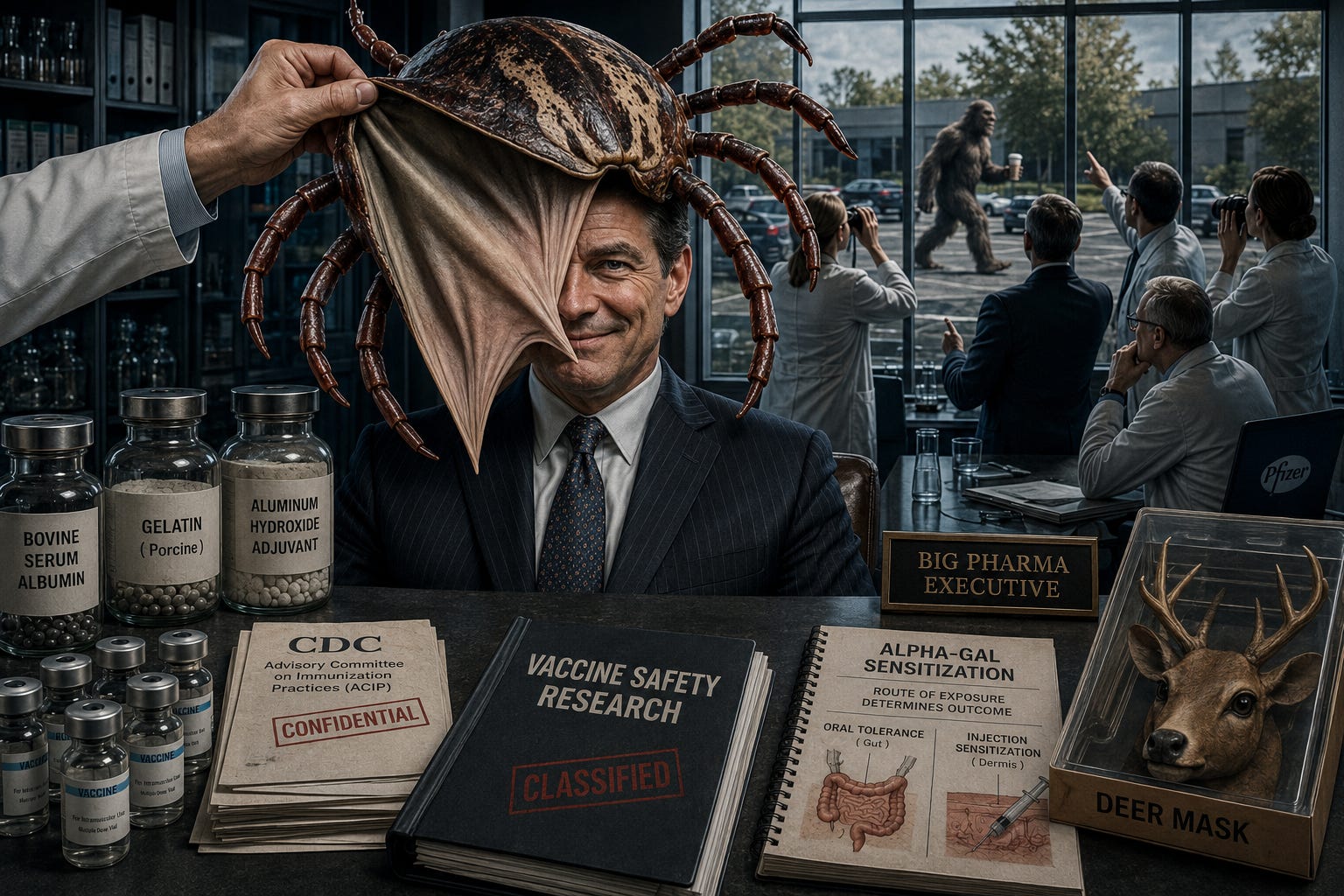
In 1999, under pressure from activists people who give a rip, the American Academy of Pediatrics and Public Health Service issued a joint statement recommending thimerosal (mercury — one of the most neurotoxic elements on the planet) be removed from vaccines. Honestly, is there anyone who didn’t think this was a good idea?
So, by 2001, the FDA declared the ingredient “removed”…
Yet the agency’s own statement remained honest only in the fine print… Trace amounts persisted in vaccines due to “the manufacturing process”. What does that actually mean? As near as I can ascertain, it was all manufactured with mercury, but the mercury was then removed from doses meant for children. The precedent was set — call it a removal, live with the residuals, move the liability goal line.
Aluminum hydroxide — oft referred to as the “universal adjuvant” followed the same playbook…
Rather than eliminate it, the FDA and manufacturers defined “safe” upper limits for the adjuvant itself while remaining silent on batch variability in the raw materials. Patent filings show aluminum hydroxide lots exhibit “large variations” in contaminating heavy metals—iron, nickel, copper—all bound to the adjuvant particles and carried into the final vaccine (note that this link helps explain a heckuva lot).
You’ll probably not be shocked to learn that gelatin and bovine serum are “removed” in much the same way when manufacturing gelatin-free pharmaceuticals. Listed in package inserts as “residual” with no independent laboratory testing of actual post-purification levels in finished vials. The language changed from “removed” to “residual trace amounts”— regulatory semantics masking the same persistent contamination.
You likewise shouldn’t be surprised to learn at this point, the removal of other “things” from certain vaccines follows a nearly identical playbook. Announce the shift, rebrand residuals as “trace amounts,” define safety by regulatory limit rather than elimination, and stop reporting actual measurements in final product.
The American Academy of Pediatrics explicitly states that “Although these ingredients are removed, residual (tiny) amounts remain in the final product,” while the alpha-gal clinical documentation confirms gelatin and other mammalian excipients persist as “residual traces of mammal-derived ingredients used in the manufacturing process” — no quantification disclosed. If you’ve ever done a deep dive into Pardekooper’s How Bad is My Batch? website, you already know how much variability is found on these lists.
Patent filings (link, link) for mammalian cell-line vaccines acknowledge the need for ‘removal and/or inactivation’ of cell residuals, yet describe the actual process as purification to ‘acceptable levels,’ but carry no specifications for what acceptable means or for independent testing of finished vials.
The FDA's own guidance on bovine-derived materials notes that “many of the products used during the manufacturing process, if still present in the finished vaccine, are only present in minute (trace) amounts”. It’s the same old sleight of hand… Regulatory doublespeak that circuitously exempts manufacturers from disclosing actual residual loads while creating plausible deniability. It's not removal; it's reframing contamination as an acceptable byproduct of a capture-proof system.
Quick, someone… Get me my binoculars!
Hey — Isn’t That a Bigfoot Running Through Your Front Yard?
As you can see, we don’t need a government “Op” for any of this (even though Part I showed you that “Operation Tick Tinkering” (I made that up) likely started in the 1950s. I said I’d stay off that fence today, and I did tried.
Everything above came out of the tick camp’s own files — the injected sugar, the Th2 saliva, the twenty-fold IgE, the age window, the gelatin reversal they published themselves, the “unidentified variable” they wrote down and then deemed not important enough to chase. I didn’t have to CRISPR a tick or drop boxes of them from airplanes. I just had to read what they published and then notice they’d described a syringe but blamed everything on ticks.
For my patients — especially the families watching this thing take its toll at their collective dinner tables while experts shrug their collective shoulders — the headline hasn’t moved since Part I. Alpha-gal is anaphylaxis to injected mammal protein.
And as many have been arguing before I was even aware there was an argument to be had, the “narrative” is not strong enough to carry the alpha-gal epidemic on its shoulders by ticks alone.
My Amish patients are saturated with ticks but don’t carry the allergy. Yes, the Amish differ in other ways as well — but of all those differences, only one physically injects mammalian protein past the gut with regularity. That’s the mechanistically relevant variable, and it’s the one that, not surprisingly, nobody seems willing to study.
But there's a third door — the one I'll open in Part III. It’s about the leak. And no, I am not talking about a likely “lab leak” that may have occurred at the Plum Island, NY, biofacility, circa early 1970’s.
Vaccines are built to purposely bypass the gut.
A damaged gut, however, operates similarly to a bypassed gut. It opens the floodgates for all sorts of things that should not be there to end up in your blood stream. Once the barrier begins leaking, the food itself starts sensitizing you — and it just happens to be a gateway (some would argue, the biggest gateway) to autoimmunity. The mammalian protein you ate slips through where it shouldn’t, and the immune system responds. Same crime, second entrance.
BONUS: A Purely Hypothetical Exercise
What follows is a thought experiment. I am not claiming this happened. I am asking what it would look like if it had.
One of the declassified fragments of our weaponized tick program revealed that in 1961 the United States was planning to air-drop ticks on Cuba to sicken their population to try and ‘soften them up’ for an invasion (time-frame tells me this was likely 1961’s failed Bay of Pigs — which led President John F Kennedy to furiously threaten to “splinter the C.I.A. in a thousand pieces and scatter it to the winds”).
I mention this only to tell you that for decades I’ve noted that people struggling with chronic tick-borne illness commonly have a triad of symptoms suspiciously similar to the triad I see in chronic whiplash patients, indicating neurological aspects of the mechanism…
Always Hot: These people prefer cool temps — really cool temps. Anything over about 70 degrees, and they are complaining.
Exhausted but Cannot Sleep: Heck of a combo — nuff said.
All-over Pain: Arthritis / myalgia — whatever you want to call it, these people struggle with generalized joint and muscle pain.
You can see why a military looking to attack another nation would want to fight a population coping with said symptoms, which at the very least, they contemplated doing to Cuba via air-dropping ticks. So, without further ado…
Suppose you wanted to induce population-level meat allergy — not in a single person, not in a lab mouse, but quietly, across an entire country, with no fingerprints and no single moment anyone could point to as the crime… What would you actually do?
You would not engineer too much because engineering leaves evidence. You would try to use what already exists, and you would pull four different levers.
The First Lever — Distribution: Amblyomma americanum already carries alpha-gal in its saliva and already injects it dermally. So you move the tick. Not by gene-editing it, not by building a better bug — you accelerate its natural range expansion along migratory bird flyways, in whatever way a program with access to 282,800 Carbon-14-tagged Lone Star ticks and a network of release sites might find convenient. The UN Human Rights Council documented exactly that program, on the record, in a 2021 NGO submission… Hundreds of thousands of radioactive ticks released in Virginia and Montana between 1966 and 1969, and tracked. Robert Malone’s March 2026 investigation puts the fine print on it. Before those experiments, Lone Star ticks were not found above the Mason-Dixon Line. Within years, they had established populations on Long Island for the first time in recorded history. Is some of that happening today? Maybe. There have been numerous recent reports of just that. True? No idea. I just know that the more time, energy and space the MSM spends on debunking a story, the more likely we eventually learn it’s true.
The Second Lever — Adjuvantation: I’ve already discussed vaccine adjuvants (substances added to vaccines to intentionally induce inflammatory response in order to rev the immune system to force it to react more intensely). The tick’s bite already skews the immune response toward Th2 — the allergic arm — but the effect is modest in a healthy, unstressed immune system. Load the same tick with co-infecting pathogens, Rickettsia, Ehrlichia (or this deadly little nasty — Bourbon — found in Kansas and Missouri), and you’ve converted a mild sensitizing event into an adjuvanted one. The immune system is already on fire when the alpha-gal arrives. Richet told you what happens next in 1913. The co-infection isn’t the weapon — it’s the amplifier that makes the alpha-gal stick. CDC-funded work already shows the Lone Star bite steering immunity toward Th2 on its own. A pathogen-loaded bite could amplify that signal dramatically. And it explains, without any additional theory required, why the same tick that carries STARI, ehrlichiosis (also big in my area), or Bourbon is the one driving the syndrome. Without your trusty tin-foil hat, you’d tend toward “coincidence”. An Op designer would call it efficiency.
The Third Lever — Pharmaceutical Penetration: Gelatin is already in the injectable schedule. You don’t have to add it — you simply make sure it’s never removed. Japanese authors wrote that “infants are no longer being sensitized by DTaP because it no longer contains gelatin”. So all that’s needed is a powerful but clandestine lobby to keep it in every excipient list. Make the case that reformulation is expensive, that the risk is rare, that the signal isn’t there, that even mentioning this issue would freak parents out and cause risk-by-hesitancy. The United States never pulled the gelatin. The schedule grew. In other words, no need to do anything too dramatic or obvious… They just have to keep doing nothing and keep it all quiet.
The Fourth Lever — The True Believers that Set the Agenda: Any successful Op requires a mishmash of censorship and propaganda. And not that it’s completely necessary, but a belief in “The Cause” is certainly helpful. As we enter the back half of 2026, there’s more than enough of all of the above (censorship, propaganda, and true believers to go around). Allow me to introduce to you Dr. S. Matthew Liao, a (gulp — choke choke) ‘bioethicist’ affiliated with the World Economic Forum (WEF) as well as the director of the Center for Bioethics at New York University.
With friends like these, who needs enemies?
In 2013, Liao stood on a TED stage and told the audience that conquering climate change should encompass out-of-the box methods (no pun intended — some of you will get this), including “artificially inducing mild intolerance to meat by stimulating our immune system against common bovine proteins”.
Three years later, at the 2016 World Science Festival, he stood at home plate, called his shot while pointing to left field, and swung for the fence while naming the mechanism explicitly… “There’s this thing called the Lone Star tick, where if it bites you, you will become allergic to meat. So that’s something we can do through human engineering”.
But even that doesn’t tell the whole story…
Fourteen years ago this month, the journal Ethics, Policy & the Environment deemed one of Liao’s papers (Human Engineering and Climate Change) worthy of publication, apparently because of its wonderful — as long as horrifying has been redefined as wonderful — ideas…
There is ample evidence that climate change is likely to affect adversely many aspects of life for all people around the world, and that existing solutions such as geoengineering might be too risky and ordinary behavioural and market solutions might not be sufficient to mitigate climate change. In this paper, we consider a new kind of solution to climate change, what we call human engineering, which involves biomedical modifications of humans so that they can mitigate and/or adapt to climate change. We argue that human engineering is potentially less risky than geoengineering and that it could help behavioural and market solutions succeed in mitigating climate change…
Reading further down the page…
…Recently [2009], it has been suggested livestock farming in fact accounts for at least 51% of the world's greenhouse emissionsWhile reducing the consumption of red meat can be achieved through social, cultural means, people often lack the motivation or willpower to give up eating red meat even if they wish they could. Human engineering could help here. Eating something that makes us feel nauseous can trigger long-lasting food aversion. While eating red meat with added emetic (a substance that induces vomiting) could be used as an aversion conditioning, anyone not strongly committed to giving up red meat is unlikely to be attracted to this option. A more realistic option might be to induce mild intolerance (akin, for example, to milk intolerance) to these kinds of meat. While meat intolerance is normally uncommon, in principle, it could be induced by stimulating the immune system against common bovine proteins. The immune system would then become primed to react to such proteins, and henceforth eating ‘eco-unfriendly’ food would induce unpleasant experiences. Even if the effects do not last a lifetime, the learning effect is likely to persist for a long time. A potentially safe and practical way of delivering such intolerance may be to produce ‘meat’ patches – similar to nicotine patches. We can produce patches for those animals that contribute the most to greenhouse gas emissions and encourage people to use such patches.
“Common bovine proteins” — you mean like gelatin and the like?
Speaking of other ‘wonderful ideas’ found in this paper, just how bat-shit crazy are these Yuval Harrari-loving monsters and their plans for ‘useless eaters’? A list of other genetic mods gives us a hint: “making humans smaller, lowering birth rates through cognitive enhancement, pharmacological enhancement of altruism and empathy, modifying our children,” and, of course, those not mentioned but promoted endlessly by their ilk; abortion on demand and euthanasia for all, no questions asked. Because after all, until The Last Day, death is the ultimate mod.
Honestly, if you think that voting for groups whose official platform includes “you-deserve-to-be-depopulated” might not be the best of ideas, you should probably read the piece in its entirety. Because the madness did not end there — it went even further.
A pair of Western Michigan University bioethics professors (what is it about “bio-ethics professors”?) published a paper in the journal Bioethics (what is it about journals with “bioethics” in the title?) — they titled it “Beneficial Bloodsucking”. And no, I did not make that up. The two argued that working to prevent the spread of alpha-gal syndrome is — not making this up either — “morally impermissible”.
The syndrome, they wrote, “is a moral bioenhancer if and when it motivates people to stop eating meat.” Peer-reviewed. Indexed. Published one year ago this month. You do not have to accuse anyone of a conspiracy to notice that the academic apparatus is now openly arguing, in the literature of record, that anaphylaxis that leaves people clutching for their $600 EpiPen or lands them in the ER (or worse) — all triggered by eating meat — is a public good that nobody should be allowed to prevent.
And that, dear readers, is the (cough cough) ‘hypothetical’…
Four levers. No novel organisms. Minimal engineering. No single smoking gun. Just a natural allergen, a natural vector pushed into new territory by a documented government program, a pharmaceutical excipient that was never pulled despite a foreign country proving it should be, and academic literature that is now openly on record arguing that spreading it far and wide is a moral obligation — and researching cures is equally as immoral.
I am not telling you that the people holding both the power and the purse strings actually did this. I’m telling you how they think, how they view the proletariat (that would be you and me), and like OJ, “how they’d have done it, if they’d actually — ahem — done it”.
I am telling you that if they did it, this is most likely what it would have looked like. And I am telling you that every piece of evidence in this bonus section — every link, every citation — is from sources that are either the United States government, peer-reviewed academic journals, or a Nobel laureate’s mechanism (excepting those I lifted from the National Enquirer). Make of that what you will.
And if you’re not quite ready to drop $100 bucks on legit “tinfoil hats,” you can always just make your own!
Be sure and stay tuned because this piece led to a Part III, which will be the final installment.
You don't need ticks at all.
People get their shots over an interval.
First one sensitizes, the subsequent ones cause the allergy. Keep in mind that those who get vaccines also tend to have leaky gut which can introduce proteins/gelatin directly into the blood, just like a shot or a tick bite.
I have a friend who lives in a city and barely went out.
He did get his yearly flu shots and eventually was diagnosed with lyme. Later on he also got alpha gal.
It's almost no chance he was bitten by a tick with his hermit lifestyle.
The only reason why he went from having Lyme to alpha gal is because like you said, they changed the formulation of the shots to have this gelatin etc.
Never Inject Anything, Period.