


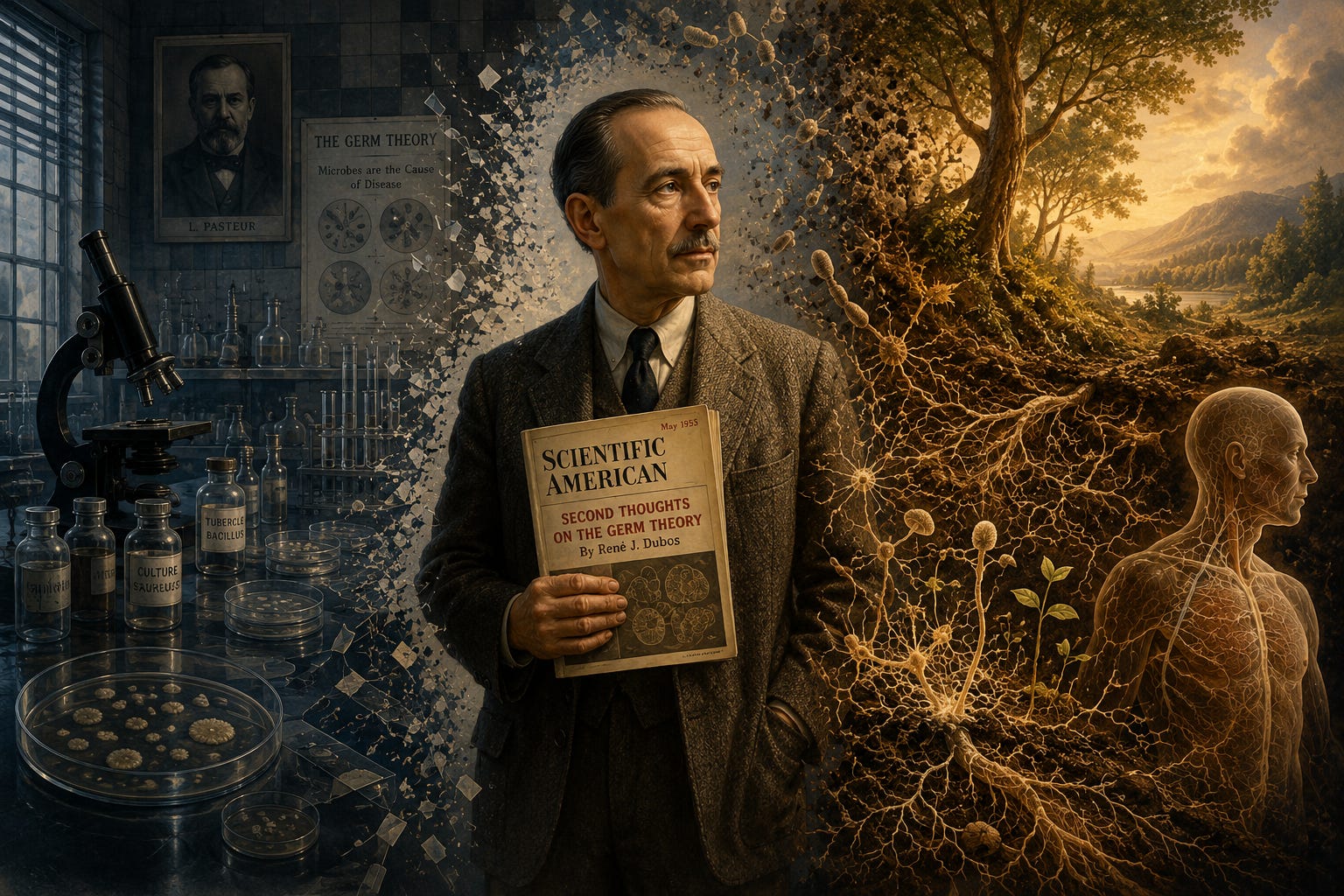
“It’s not that germs don’t play a part in disease, it’s just that the part they play is not the part we’ve been led to believe they play.” Me from a previous post (link below)
“Everyone harbors disease germs, yet not everyone is sick. This is ascribed to ‘resistance,’ suggesting that germs are less important in disease than other factors affecting the condition of the host.” -Rene Dubos from the 1955 issue of Scientific American, Second Thoughts on the Germ Theory
Audio and Video Overviews
Standing on the Shoulders of Quacks Giants: When Heretics Turn Out to be Right
After reading Unbekoming’s kick-ass post yesterday morning (The Generational Debt: An Essay on What Pottenger and Price Tell Us About Inheritance and Recovery), my mind started racing (BTW, if you have children or grandchildren, I cannot recommend his article highly enough!). The unrelated experiments by Pottenger and Price (an MD and dentist, respectively) have staggering implications for the simple reason that they are multi-generational. In other words, the health choices you make today could will affect your great-grandchildren.
Which led me to start thinking about germ theory and its opposite — “germ theory denialism” (the name created by detractors) or “terrain/soil theory” (more accurate).
For the record, I’ve read Cowan’s work (I have two or three of his books), as well as many others touting similar ideas, including Antoine Béchamp, who will garner some discussion today. Whether or not either side’s ideas give us a completely accurate model doesn’t matter for today’s post. Functionally speaking, the end result is the same — good advice is good advice, regardless.
Born in France in 1901, Rene Jules Dubos’ life was dramatically affected by infectious disease; him contracting a severe case of Rheumatic Fever that left him paralyzed for a year of his youth (not to mention its most classic sign — a lifetime of heart valve problems), and his father dying in the flu pandemic of WWI that killed 50 to 100 million people worldwide, depending on whose statistics you believe. You will see another tragic example that occurred later in Dubos’ life, when his wife succumbed to tuberculosis, all of which makes his story even more incredible.
Dubos attended university in Paris (The Institute of Agronomics), where he excelled in the field of, you guessed it, agricultural economics. But despite his successes, ag econ was not his true calling. Dubos’ 1989 biography discussed how his intellectual focus changed a few years after the Great War…
“In 1922, Rene obtained a position in Rome on the staff of the International Institute of Agriculture, a branch of the League of Nations. For two years, as associate editor of the International Review of the Science and Practice of Agriculture for the Bureau of Agricultural Intelligence and Plant Diseases, he abstracted journal and agricultural reports from all over the world. He now spoke Italian and English as well as French and German.
Rene recalled his days in Rome as very pleasant. He was a handsome young man with a bushy head of hair who was particularly attracted to English girls, ostensibly to improve his language skills. At this time he was undecided about career goals, considering occupations as divergent as journalist and scientist.”
After being exposed to a scientific paper by Paris’s renowned soil biologist / microbiologist, Serge Winogradsky, Dubos changed professions, eventually landing at Rutgers after earning enough money to make the cross-Atlantic trip by translating studies on agriculture and forestry from several languages into French. Once in America, it didn’t take long to establish himself as an intellectual force, earning his Ph.D in microbiology in 1927 (his thesis was on the way in which bacteria in soil decomposed the fibrous part of plants called cellulose).
After landing at The Rockefeller Institute (the institution that, interestingly enough, was responsible for helping destroy what we today call ‘alternative’ medicine via the Flexner Report), he began a major survey and study of soil throughout both the United States and Canada, earning academic acclaim for three new and distinct ideas.
The idea that bacteria nourished in the proper environment can produce enzymes specific to themselves.
The idea that in infectious diseases, bacterial by-products stimulate immunity to said bacteria.
The idea that environmental stressors affect the development of the organism as a whole (today we would probably refer to these stressors as Epigenetic Factors).
The authors went on to reveal the result of Dubos’ new way of thinking…
“His interests progressed from studies of pneumonia and tuberculosis to the whole pattern of disease and, finally, to the quality of human life on earth. The unifying thread in this seeming diversity was his perception that any living organism, whether microbe, man, or society, can be understood only in the context of the entire web of relationships it forms with everything else.”
Dubos is discussing a concept I have dealt with extensively on my site concerning both whole food nutrition and fascia. Modern, Westernized science breaks things down (organisms, soil, humans, bacteria, plants, food, etc), separating them into their tiniest microscopic components, always looking for a compound or chemical that will prove to be the magic bullet in the quest against cancer, obesity, or who-knows-what-else. The problem is, monotherapies (chemicals or compounds in isolation) rarely do what’s claimed of them.
In other words, Dubos believed that the whole (organism, food, field, forest, etc) was much greater than the sum of its individual parts, which provides us with a good description of what is arguably the chief difference between mechanism & vitalism. Mechanistic (Western) medicine believes that all of ill health’s secrets will one day be unlocked by purely mechanical ‘cause-and-effect’ thinking, while vitalists realize that there are aspects of living organisms and ecosystems that cannot be understood apart from the whole.
What’s equally as interesting along these same lines is that even though Alexander Fleming gets the credit for discovering antibiotics, not only did Dubos do a great deal of the early heavy lifting in this field, he also predicted that bacteria would eventually become “resistant” to these various antibacterial compounds; a concept we are all too familiar with today.
Unlike many of his peers, Dubos was not under the delusion that antibiotics would wipe sickness and disease off the face of the earth, as became widely promoted by the scientific community in the 1950’s, not to mention by LBJ’s Great Society in the 1960’s. It was Johnson’s Surgeon General, William Stewart, who is reported to have said circa 1967 that it’s “time to close the book on infectious diseases”. An idea that hasn’t quite worked out as planned.
During WWII, Dubos’ wife died of the recurrence of a latent TB infection, leading him to start heavily researching infectious tuberculosis. Notice, however, the ‘epigenetic’ manner in which he thought about this disease. “Rene began with the conviction that tuberculosis became an important social disease only under certain social conditions”.
We talked about some of these conditions in my last post, which, although happened to be on autism, could just as easily been about any of the 85-90% of all diseases that are not genetic (yes; far too many doctors continue to promote a genetic etiology of lifestyle diseases to their patients — mostly, I would argue, because it’s easier than confronting them about lifestyle choices). Not surprisingly, in the myriad of papers Dubos published on TB, one of his favorite areas of study was “the effect of diet on the course of experimental tuberculosis in laboratory animals.”
In other words, Dubos continued to modify Pasteur’s idea that germs themselves were the cause of disease (the “Germ Theory”), while standing on the shoulders of scientific giants like Claude Bernard, Antione Bechamp, Ilya Illyich Meshnikov, and Rudolph Virchow, all of whom were alive when he was; and all promoting similar ideas — ideas that were being hijacked by industry right under their very noses back then.
What’s important to remember is that, despite their collective scientific achievements, in many ways these men became pariahs because of their belief that the health of the organism (“the soil”) was far more important than whether or not they had been exposed to some germ or another. Not surprising considering what the authors wrote about Dubos’ original mentor, Serge Winogradsky…..
“Winogradsky stated that microorganisms should be studied not in a pure laboratory culture but in their own environment in competition with other bacteria. He emphasized interactions of organisms under natural conditions and the significance of the role played by the environment in these interactions. Rene said his scholarly life began with these ideas—ideas he restated in many forms throughout his life.”
There it is again, folks; the whole is greater than the sum of its parts!
But, as medicine’s emphasis on treating infectious disease shifted from long-term solutions (looking at epigenitic factors that affected the health and immunity of the host) to short-term bandaids (drugs that killed germs or altered symptoms without really ever addressing underlying pathophysiology or immunity), Dubos became increasingly frustrated, turning his attention towards environmental advocacy, lecturing, and writing several books (he won a Pulitzer Prize in 1969).
Listen to what these authors said of him concerning this era…
“The key book resulting from Dubos’s thoughts about illness, and his most popular work, was Mirage of Health (1959). Embodied in its title is his ecological view that man will never be free from disease because he must continuously adapt to environments in flux: Disease results from the dynamic process of life. In Dreams of Reason (1961), he questioned over-confidence in science’s ability to eliminate disease, advocating, instead, using the means and knowledge of science to determine the kind of health society wants.
A more explicit, scientific statement of his views on environmental biomedicine appeared a few years later in Man Adapting (1965), which emphasized that states of health or disease are organisms’ adaptive responses to environmental challenges.”
I bring up the 1950’s because of an article that expert in hormones and mitochondrial dysfunction, Dr. Chandler Marrs, posted the other day. You see, back in May of 1955, Dubos wrote a piece for the oldest science publication in the United States, Scientific American, concerning this very topic. The article’s provocative title? Second Thoughts on the Germ Theory. It is an article that today, the big dogs of big tech would censor to the max. Free thought? Surely you jest.
Remember that Louis “germ theory” Pasteur was not only primary of Dubos many scientific heroes, but Dr. Dubos actually published a biography on Pasteur in 1950 titled Louis Pasteur: Free Lance of Science. Understand that for Dubos to write a 450-page book with this sort of title goes not only against current thought, but against the current thought for that era as well, not to mention the fact that it was essentially a rebuttal of some of the biggest aspects of Pasteur’s work.
Need proof? Take a peek at the quote at the top of the first page of Dubos’ short article — the quote I provided at the top of the post. Why would this have been so controversial within the scientific community of that day? Because it’s almost exactly what ‘quacks’ like the developer of the chiropractic profession (Dr. BJ Palmer) repeatedly said during their careers. It also forms the foundation of a field of study known as epigenetics.
We grew up being told that the field of genetics was, like the fields of microbiology, bacteriology, and virology before it, going to solve all of humankind’s health woes. Not only has this not panned out, but infectious diseases are being fingered as a chief culprit in growing numbers of diseases, many of which have been long-touted as genetic. How important has the field of epigenetics become?
In Y2K, there were ten studies published on the subject. In 2008, PubMed showed 240 studies with the word “epigenetic” in the title. Today, there are nearly 32,000 such studies. Epigenetics is important because it’s the best modern example of the concept Dubos was trying to get through to his readers seventy-one years ago this month.
Dubos opened his 1955 paper by arguing that the germ theory of disease — germs find susceptible hosts and multiply — was grossly oversimplified. He pointed out that the Pasteur / Koch theory had no shortage of critics from the moment it was proposed in the 1870's, with one of the most damning objections being something we've all witnessed firsthand: healthy people and animals are constantly surrounded by the sick, and yet, more often than not, they don't get sick themselves. He went on to describe the true believers of germ theory as having three distinct characteristics.
Remember, this was 1955 — long before today’s emphasis on (no matter how twisted or oxymoronical) evidence-based medicine…
They are “almost cultish” in their love of and defense of the germ theory.
They are “undisturbed by the inconsistencies” of the germ theory.
They are “not too exacting about evidence” concerning the germ theory.
Now, pay attention to how another ‘quack,’ Dr. DD Palmer — the founder of chiropractic back in the late 1800’s (BJ’s father) — described this same phenomenon in relation to the humble beginnings of the profession.
“For ten years I had been looking, thinking, asking myself and others the question, why does one person have a certain ailment and another remain well, although both may be eating the same food at the same table, sleeping in the same bed and working side by side? At last Harvey Lillard assisted me in answering my question. He told me that while he was in a cramped position he felt something give way in his back and from that time he was deaf. Upon examination I found a vertebra out of alignment, racked out of its normal position. I replaced it by two adjustments and restored his hearing.”
The point here is not that chiropractic adjustments are the cure for deafness (although, sometimes they can be), or that germs aren’t associated with disease on some level (they are). It’s that, exactly as BJ Palmer said over 100 years ago, “The germ might well be the agent of disease, but the cause is much more complex than that. Otherwise, eventually no one would be alive to tell you about it!”
Listen to the way Dubos described this same phenomenon. “Is it not possible that bacteria are only the secondary cause of disease — opportunistic invaders of tissues already weakened by crumbling defenses?” And this, my friends, is the crux of the debate.
Do germs actually cause disease, or do diseased (in many cases, asymptomatic) organisms simply attract germs in the same way that spoiled fruit attracts flies or rotting grain attracts rats? Like Dr Fred Barge’s famous “Rats in the Dump” lecture. As is often the case, the truth falls somewhere in the middle; although he (and I) would argue closer to the latter.
But as far as the former goes (the point that germs are actually the cause of disease), Dubos was not silent. He went on to talk about various historical plagues that killed horrifying numbers of people. “These instances provide tragic evidence that a microbial agent may strike down the weak and healthy alike when introduced to a susceptible population.”
However, the fact that not only did everyone exposed to these plagues not die, but not anywhere near the majority, helps prove that Dubos was on the right track. And once natural immunity develops within the population, death rates plummet despite regularly being exposed. “Theories of disease must account for the fact. that in any community, a large percentage of healthy individuals continually harbor potentially pathogenic microbes without suffering any symptoms or lesions.”
Dubos went on to declare that most of his readers were harboring “virulent” staph and tuberculin themselves, yet would never know it because it would never manifest.
This itself raises an interesting question. Despite our best efforts to “cure” infectious disease, why are rapidly growing numbers of people plagued with illnesses that are increasingly believed to be the result of what Dubos referred to as “latent infections” (Alzheimer’s, disc herniations, EBV, PANDAS/PANS, IBS, flaccid paralysis, diseases from root canals or other oral infections, and on and on and on)?
He answered this by revealing that the most likely scenario is that these ‘sleeping dogs’ (my term, not his) will continue to lie until something wakes them. What might awaken a dormant infection? Here is Dubos’ list (most of these are direct quotes or nearly so).
Diabetes or other sugar dysregulation issues (link and link, not to mention, sugar feeds infection), being interned in a concentration camp or gulag, overwork, over-indulgence (both of which can lead to Sympathetic Dominance), damp drafts, unhappy marriages, exeptionally high fevers, radiation (not nessacarily this kind) chemical toxicity (or here), surgery, menstruation, improper food, etc, etc, etc.
Honestly, what do these collectively remind me of? This list appears to be made up of the very elements that modern researchers would include in parentheses just after mentioning epigenetic factors. Not to mention, topics I have discussed on my various sites at length for decades.
There is, however, an even deeper question raised by Dubos’ paper: what are the results of a cradle-to-grave barrage of antibiotics, corticosteroids, vaccines (flu shots included), Biologics, and other drugs (all of which are unarguably based on incessant immune system suppression)? Interestingly, Dubos provided an answer. Listen to how true his words still ring today.
“It has been repeatedly observed that vigorous treatment with drugs of almost any type of virulent infection in a human being may have the paradoxical effect of bringing about another type of infection, caused by the proliferation of otherwise innocuous fungi and bacteria. We are beginning, in fact, to witness the appearance of man-made diseases, caused by the rapid changes in human ecology, brought about by these new therapeutic procedures.”
Realize that he’s not even talking about the absurd numbers side effects of drugs taken for non-infectious diseases, let alone the astronomical amount of medication (or absurd number of vaccines) that the average citizen would one day become conditioned to believe is normal. I don’t think even a visionary like Dubos could have foreseen our current pharmaceutical flood looming just below the horizon (link or link).
A mastermind group that I am part of (there are brilliant people from a wide range of academic, athletic, and medical backgrounds — and then there’s me) recently had a debate (blow-up would be more descriptive) over vaccines. At least partially in response, I wrote a short post on legal issues raised by the then brand new testimony concerning the vaccine / autism debate.

The point of my post was that, unfortunately, you can’t, at least in most cases, know up front whether or not your child will be the one who reacts, as well as the fact that many of these reactions may not fully manifest for decades. Although Dubos was writing about antibiotics in the quote below, he could just as easily have been writing instead about vaccines (our government’s national vaccine campaign did not begin until 1963 — 7 years after he wrote this article).
“The classical doctrines of immunity throw no light on precisely what mechanisms determine whether dormant microbes will remain inactive or begin to act up. What is needed to analyze this problem is an understanding of the agencies needed for natural resistance to infection, and of the factors that interfere with these agencies. Fortunately, interest into research in this area is increasing rapidly.”
While his last sentence may still be true today on some level, don’t kid yourself; it’s only really true in terms of industry creating new drugs — a fact driven home by a recent discussion within the above-mentioned group (mostly by MD’s) on the abhorrent state of nutrition education in the medical profession.
The truth, however, is exactly as Dr. Dubos stated after telling his readers that disease is all about the ecology of one’s environment, both internal and external. “Whether man lives in equilibrium with microbes depends on the circumstances under which he encounters them.” I love the word “equilibrium” here, implying homeostasis between man and germ — the very thing required / necessitated / demanded for health as per the Hygiene Hypothesis.
What might I suggest you do with this information?
Firstly, realize that Dubos is correct in his assertion that “we cannot possibly eliminate all the microbes that are potentially capable of causing us harm.” Trying to do so has created more damage than the average person could ever begin to comprehend (Bob Hind’s book, Ozark Pioneers, has a section explaining this phenomenon in relation to the fact that this region was the nation’s biggest apple-producer 130 years ago, with zero orchards today).
Secondly, it’s critical to grasp that you wouldn’t want to kill all the germs even if it were possible (see HH link above, as well as information on both microbiome & dysbiosis and their relationship to autoimmunity).
Thirdly, realize that even though this information is not exactly new, you can leverage its main ideas to start taking your life and health back. After all, no one else — not even your doctor — can do it for you.
Although there are some of you that will require some very specific and uniquely customized approaches to your return-to-health plan (your “Exit Strategy” if you will), for most of you — that would be over 50% of you — a Generic Health Restoration Template will get you started.
"far too many doctors continue to promote a genetic etiology of lifestyle diseases to their patients — mostly, I would argue, because it’s easier than confronting them about lifestyle choice" - yes! This! 👍🇨🇦