



Video Overview
Back in the day, kids played…
They rode bikes, got dirty, climbed trees and fell out of trees — then got back up and did it again. It was just another day. The school yard was the same thing. Playing baseball (with a real baseball), football (sans safety equipment), dodge ball, monkey bars, jungle gyms, red rover, smear the , and a variety of others. And in the process, they were building functional neurology, strength, posture, coordination, and relationships — the whole package, free of charge, without a single app.
Then came the tech explosion…
TV’s in bedrooms, VCRs, computers, cell phones, DVRs, video games. Plenty has been written about what that did to kids’ heads — Jonathan Haidt’s The Anxious Generation: How the Great Rewiring of Childhood Is Causing an Epidemic of Mental Illness is arguably the modern reference point. And highly recommended.
What I want to show you today is something similar, something that’s intimately related to this subject. But something that takes it to the next level. I want to show you how tightly the physical and mental decline of our population is bound to two sides of the same coin. Sitting too much and poor posture — mostly thanks to the modern world’s relationship to electronics. Postura Electronica. Or in pig Latin, itty-shay osture-pay.
We can’t really delve into this subject without a short history. And the history is where this gets interesting, because the story of what we knew — and when we stopped being required to do anything about it — is not the story most people think it is.
A Short History of a Problem Nobody Wants to Own
Forty years of institutional memory sit in the timeline below, and the thing to watch isn't the science. Because the science was never in doubt…
Head in forward posture can add up to thirty pounds of abnormal leverage on the cervical spine. This can pull the entire spine out of alignment. Forward head posture (FHP) may result in the loss of 30% of vital lung capacity. Would you be surprised that your neck and shoulders hurt if you had a 20-pound watermelon hanging around your neck? -René Cailliet M.D., renowned author and former director of the department of physical medicine and rehabilitation at the University of Southern California (from my site)
Dr Cailliet published Neck and Arm Pain in 1964, arguing that head position governs the entire postural chain — that the body follows the head, and that a head tilted forward loads the cervical spine with an insane amount of leverage it was never built to withstand.
Fourteen years later, Panjabi & White’s Clinical Biomechanics of the Spine (one of my textbooks) put hard engineering numbers to it. Neither author was fringe or alternative, and neither was working from ideology. They described the mechanism before the exposure existed at scale.
And then the exposure arrived…
What's worth watching in the dates below isn't the discovery. It's who’s handed the bill at each stage — because it changes. And every time it starts drifting toward what's actually doing the damage, big money intervenes. Stay with me, and you’ll see how the trick is done.
Early 1980s — the Australian RSI (“Repetitive Strain Injury”) epidemic. The first mass computer-injury event in human history. Typewriters gave way to light-touch video-display-terminal keyboards, and female keyboard operators, telephonists, and public servants started coming down with arm, hand, and neck pain — often severe — often with little to nothing visible to show for it in terms of positive medical tests.
Telecom Australia alone logged roughly 4,000 RSI cases in five years. This is where the modern argument over whether tech-posture injury is “real or psychosomatic” was born. A debate that’s inexplicably still known to raise its head today if necessity arises.
1990 — the federal government put a name to it. Labor Secretary Elizabeth Dole announced OSHA ergonomics guidelines to protect workers from repetitive motion injuries and carpal tunnel syndrome. The problem crossed over from an Australian curiosity to an official American public-health concern.
The early 1990s — carpal tunnel goes mainstream. As computers landed on every desk in America, “repetitive trauma” disorders became the fastest-growing category of US occupational illness, running nearly 300,000 reported cases a year at the peak. Carpal tunnel, tendinitis, and cumulative trauma disorder entered the national vocabulary. And the problem was growing even faster than these stats show as computers became the norm, not just at work, but in people’s homes.
November 2000 to March 2001 — the ergonomics standard, born and buried. OSHA issued the final Ergonomics Program Standard on November 14, 2000, written to cover some 27 million workers. Shortly after that, Congress killed it, using the Congressional Review Act for the first time in that law’s history. Ten years of worker-protection science erased by a procedural weapon and an estimated $100-billion lobbying effort (nearly a quarter trillion in today’s dollars).
Understand what happened in that time encompassing “shortly after” because everything from that point forward is downstream of it…
Two months before the vote, a National Academy of Sciences panel had just confirmed the science — workplace factors cause musculoskeletal disorders, and ergonomic intervention prevents them. Behind their conclusions was over a decade of work, 714 witnesses, 11,000 written comments, and a projected 4.6 million injuries prevented across 102 million workers. Congress killed it 56-44 on a $100-billion price tag that came not from economists but from an industry-funded foundation — against OSHA’s own estimate of $4.5 billion savings via injury prevention.
Two months before the vote, a National Academy of Sciences panel had just confirmed the science — workplace factors cause musculoskeletal disorders, and ergonomic intervention prevents them. Behind their conclusions was over a decade of work, 714 witnesses, 11,000 written comments, and a projected 4.6 million injuries prevented across 102 million workers. Congress killed it 56-44, not on OSHA's numbers but on numbers from industry-funded sources…
OSHA projected $4.5 billion annually to implement the standard and $9.1 billion in annual savings, but the Employment Policy Foundation—cited by Congress—claimed costs would hit $126 billion, an estimate the Heritage Foundation amplified in real time as lobbying cover. The actual price tag Congress used was industry fiction, not economics.
Among those lobbying hardest was UPS, the company OSHA had fielded more complaints about than any other since 1972 — and whose trucks have always been ‘utilitarian’ in regards to driver ergonomics. Case in point; approximately three decades ago, my clinic’s UPS driver (also a patient) wanted me to understand why he was having so many spinal issues. He took me out to the parking lot and showed me his truck, and my jaw hit the floor — the seat was offset at least a foot laterally from the steering wheel. A career of spinal rotation thanks to obvious ‘I-could-not-care-less-about-our-drivers’ engineering.
And here’s what nobody tells you. The Congressional Review Act didn’t just kill the rule; it barred the agency from ever issuing a substantially similar one again. Not merely repealed but salted. That means that in ergonomic world, everything ‘governmental’ (research grants, state universities, virtually everything) from here forward must be viewed through this lens.
2004 — “Sedentary Death Syndrome” is coined. Frank Booth, at our very own University of Missouri, branded physical inactivity as a killer. The first time in history that sitting was lableled as a deadly pathology.
January 2007 — “tech neck” appears in print. Not in a journal. Not in a clinic. Merriam-Webster’s earliest citation for the term is a Reuters piece about high-end Manhattan day spas selling “tech neck” massages to office workers wrecked by laptops and BlackBerrys. The injury had become a service on a menu.
2008 — “text neck” is coined. Chiropractor Dean Fishman named it after seeing a reversed cervical curve on a teenager’s X-ray — the kind of degeneration you’d expect in a 60-year-old, in a 17-year-old girl slumped over her phone. He founded the Text Neck Institute the following year. Remember this. Not because it was a chiropractor, but because we are going to start seeing this mechanism — Forward Head Posture (FHP) — pop up with increasing regularity.
2005-2010 — sitting is the new smoking. In 2005, Mayo’s James Levine coined the term ‘sitting is the new smoking,’ immortalizing it in 2009’s Move a Little, Lose a Lot. It was not, however, until 2010 that the mortality data actually landed and the phrase went mainstream. The load-bearing source was the American Cancer Society study, which showed that sitting predicts death independent of exercise. Read that again. Independent of exercise.
2014 — text neck declared an epidemic. Hansraj et. al published the cervical-load numbers — 60 pounds of effective head weight at 60 degrees of cervical flexion (FHP) — and they went viral. Worth noting is that he could not have done this without Cailliet's postural chain and Panjabi's engineering. The 2014 paper didn't ‘discover’ the mechanism — it put a number on fifty-year-old research, pushing it into everyday speech.
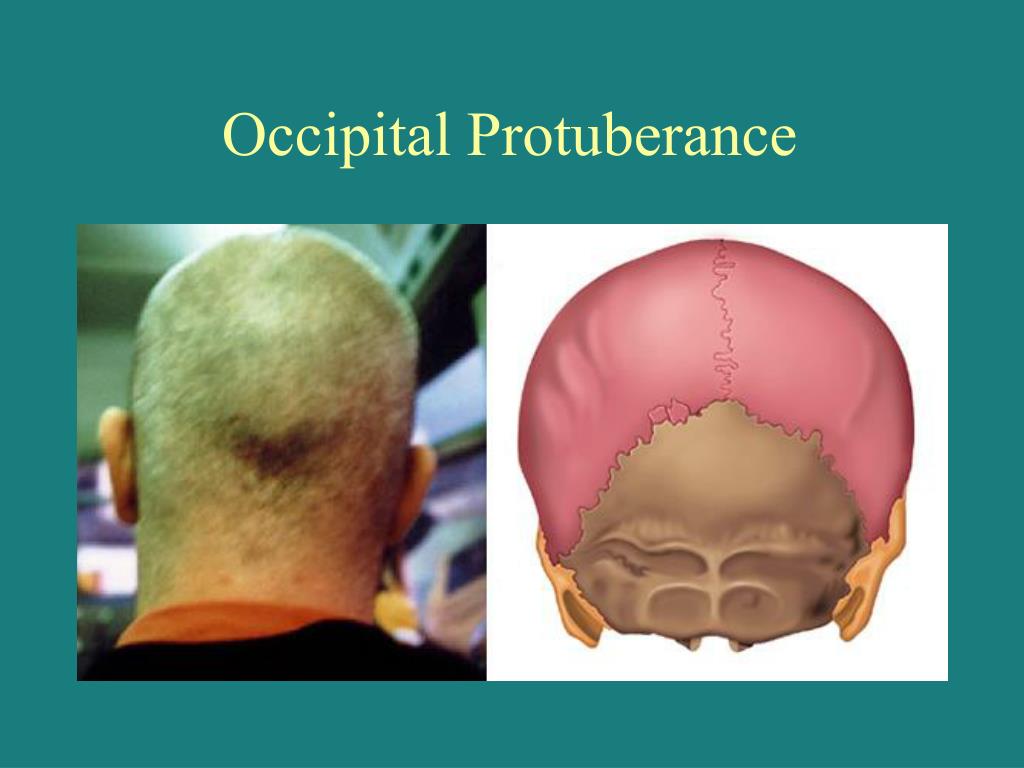
2018–2019 — FHP is reshaping the skeleton. Although I’ve seen this phenomenon in segments of the adult population for 35 years, Shahar and Sayers reported enlarged external occipital protuberances — bone spurs on the back of the skull — in young adults, hypothesizing ‘phone posture’ as the driver. When BBC Future and the Washington Post picked it up in 2019, “phones are growing horns on kids” went global. It was the moment that skeletal deformation (Wolff’s Law) jumped from clinics to conversations.
2020 — COVID and work-from-home. The utterly moronic lockdowns detonated an already-bad situation. Screen time and sitting spiked simultaneously, while kids’ recreation collapsed almost entirely onto devices. For a hundred million people, this became known as “Pandemic Posture” (too many links to count).
2024 — Haidt published The Anxious Generation. The great-rewiring thesis went bestseller, cementing the phone-childhood link in the mainstream — on the mental-illness side. Although worth its own column, the best part of Haidt’s book isn’t the anti-tech argument; it’s his defense of risky play (review, review, review). My mom passed away two years ago still not entirely aware of some of the “risky” stuff my brother and I managed to survive, growing up in rural Kansas.
“Risky stuff,” however, is what kids used to do. Build resilience, bones, muscle and courage at the same time. Now they're staring at a screen. Usually down at a screen — head forward, their vertebrae loading like a repetitively bent nail. And here's the thing that should make you furious… We didn't stumble into this by accident. Every institutional player involved knew exactly what they were doing at every step. Watch the dates, watch the money, and watch how the liability changed.
The Blame Game in Three Moves
Look at that timeline again and watch the blame game in real time...
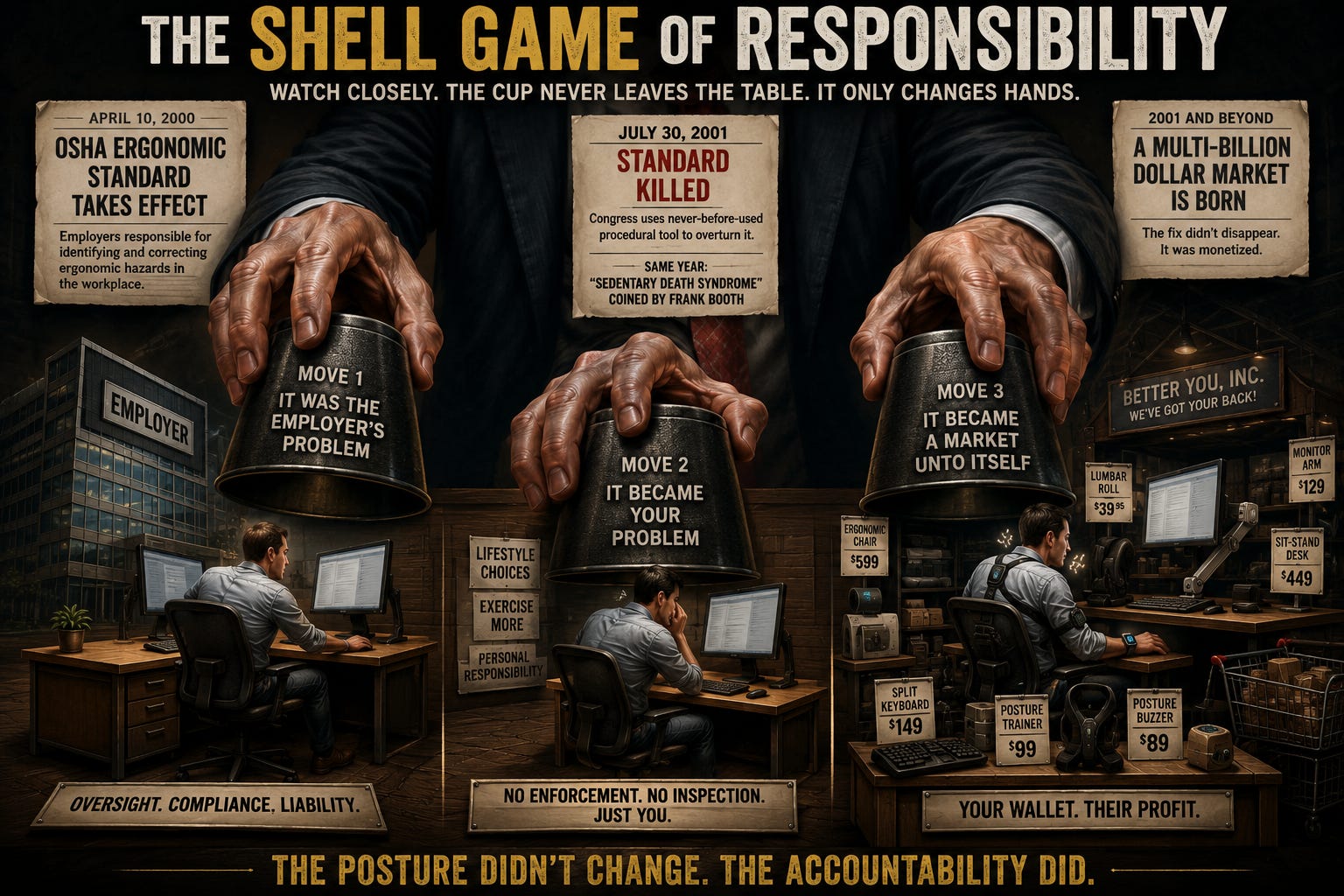
Move 1 — It was the employer’s problem: Strip the bureaucratic language off the 2000 OSHA standard and it meant one thing: somebody has to walk over and look at the desks. Why was this kind of oversight needed? I spent years watching people work at corner stations with the keyboard on one leg of the L and the monitor on the other — necks rotated 45 degrees, eight hours a day, every day, always the same direction. My bank had monitors recessed into the desk surface, so cervical flexion wasn’t an accident of furniture placement, but a design specification. And I’ve already mentioned my UPS driver. Those are careers of sustained biomechanical devastation. No injury history. No accident. Just forced postures, slowly degrading spines.
Move 2 — Almost immediately after, it became your problem: Less than four months after that standard took effect, it was gone, killed with a procedural tool Congress had never used before. That same year, Frank Booth coined Sedentary Death Syndrome. Read those two events side by side and watch the blame shift. The workstation vanished from the conversation, and your lifestyle took its place. Liability didn’t disappear in 2001 — it changed addresses. It moved off the company and onto you, and it’s never moved back.
Move 3 — Ergonomics became a market unto itself: The fix didn’t disappear. It was monentized. Ergonomic chairs, mouses of every type imaginable, neck rolls, lumbar supports, monitor arms, split keyboards, sit-stand desks, figure-eight braces, and eventually wearable posture buzzers that vibrate when you slump — the identical physical remedy the dead standard would have required, now available for purchase by the person on the receiving end. No compliance, no enforcement, no inspector. Just a checkout cart.
Three Years of Studies — Two Sides of the Same Coin
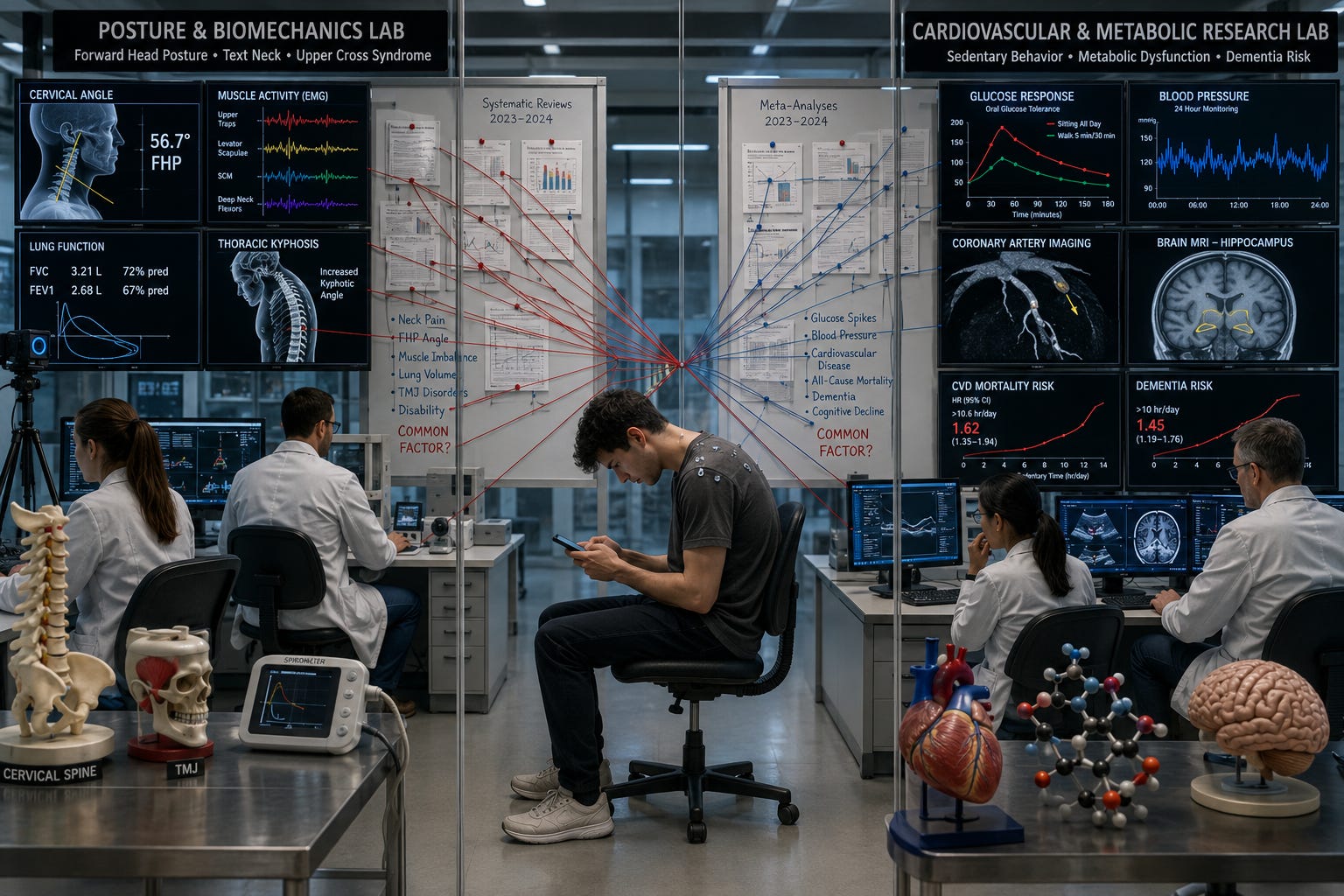
Here’s what makes this section worth your time…
Every study below was published less than three years ago. In other words, this is not dusty, contested, decades-old literature where the evidence is muddy and everybody argues. This is three years of fresh, large (some of it massive), mostly meta-analytic evidence, all pointing in the same direction and arriving at similar conclusions — while the problem accelerates.
The studies can be lumped into two piles. One pertains to studies on forward posture — what the load does to your neck, your lungs, your jaw, your (insert body part of choice here_____________)…. The other pile pertains to studies on sitting — what the stillness does to your blood sugar, your arteries, and your neurology. Two separate literatures, two separate sets of researchers, two separate vocabularies. Two sides of the same coin.
The problem, though, is that the two piles have never seriously talked to each other. Keep that in mind, because at the bottom of this post, it matters enormously.
FORWARD POSTURE / TEXT NECK / FHP
Prevalence and Neck Pain
We kick things off with a meta-analysis of seven studies, including some 10,715 participants. Smartphone overusers carried a significantly higher risk of neck pain — pooled adjusted odds ratio 2.34. Takeaway: Heavy phone use more than doubles your odds of neck pain.
Next, let’s peek at a systematic review and meta-analysis of ‘text neck’ syndrome in university students by the same authors as above. What was the prevalence of this syndrome? 64.73% of female students and 37.02% of males, with no evidence of publication bias. Takeaway: Among college women, this is now the majority condition. Not a subgroup. The majority.
Respiratory Consequences: The Problem Almost Everybody Misses
A 2024 systematic review of FHP as related to lung volume revealed that Forced Vital Capacity (the total amount of air you can exhale before you cannot do any more) dropped between 0.25 and 0.81 liters, and FEV1 (how much air you can exhale in one second) fell between 0.16 and 0.93 liters in forward-head subjects, respectively. Takeaway: Posture is a critical respiratory variable. You are measurably breathing less air with FHP.
There’s more to it than that, though. A 2023 study showed that forward head posture, neck disability, and lung function are intersecting variables. Takeaway: Independent replication of the same finding — the neck and the lungs are part of the same system.
TMJ and Jaw
Temporomandibular disorders (TMD) are related to posture — a systematic review with meta-analysis. Takeaway: Where the head sits changes how the jaw works. TMJ and posture are not separate complaints.
Correcting forward head posture with a cervical extension traction orthotic produced clinically superior TMJ/TMD improvements versus standard care alone. Takeaway: Fix the posture, the jaw often follows.
Correction and Treatment
A systematic review and meta-analysis of therapeutic exercise for upper-crossed syndrome revealed that combined strengthening-and-stretching protocols outperformed single-modality approaches. Takeaway: UCS is correctable — but stretching alone won’t do it. You have to strengthen what’s long, not just loosen what’s short.
SITTING / SEDENTARY BEHAVIOR
Mechanism first — Sitting is active harm, not simply the absence of exercise…
Eleven adults sat eight hours in a lab under five conditions. A 5-minute walk every 30 minutes was the only regimen that significantly lowered both blood pressure and blood sugar — cutting post-meal glucose spikes by roughly 58% versus sitting all day. Every walking dose dropped blood pressure 4–5 mmHg, which Diaz compared to six months of daily exercise. Walking every 60 minutes, at any duration, produced no glucose benefit at all. Takeaway: Sitting isn’t neutral time. It’s metabolically active damage, accruing in real time — and the 30-minute interval isn’t a round number somebody picked at random (like six-foot social distancing); it’s the only one that worked.
Cardiovascular — The Headline
UK Biobank followed nearly 90,000 accelerometer-tracked adults. More than 10.6 hours/day spent sedentary, heart-failure risk rose 45% and cardiovascular mortality 62% — and both associations persisted even in people meeting recommended exercise levels. Takeaway: You cannot out-exercise the chair.
All-Cause Mortality
This study followed a whopping 481,688 participants. Conclusions? Prolonged occupational sitting is associated with higher all-cause and cardiovascular mortality across all physical-activity levels. Takeaway: Nearly half a million people. Same as above.
8,337 low-income, predominantly black, older Americans were studied as to sitting’s relationship to death by any cause. Sitting more than 10 hours/day versus under 4 hours/day increased all-cause mortality by 15%, independent of leisure activity. Takeaway: This isn’t a white-collar problem or a demographic artifact. It crosses every line we usually use to explain away findings.
This study was made up of a combined four studies of a total of 12,000 adults older than 50. More than 12 sedentary hours a day carried a 38% higher mortality risk versus 8 hours — but only among those getting fewer than 22 daily minutes of moderate-to-vigorous activity. The problem is that if you are sitting 12 hours a day, you are not likely also exercising “vigorously”. Takeaway: 22 minutes buys you a great deal, but let’s be honest with ourselves... And it also doesn’t buy your way out of 12 hours of spinal flexion.
Brain and Cognition
UK Biobank looked at nearly 50,000 adults 60+. Sedentary time showed a nonlinear tie to dementia, with risk climbing past a 10-hour/day threshold — and how the sitting was broken up didn’t matter. Only the total. Takeaway: Past ten hours, your brain is on the clock.
32,875 adults this time. Sedentary time’s association with cognitive performance turned null-to-negative above a 10–12 hour/day threshold. Takeaway: Essentially the same as above.
Dose-Response
A J-shaped relationship (risk remains stable until threshold, then accelerates rapidly) between sedentary time and fatal and non-fatal cardiovascular disease — and swapping a single sitting hour for light activity dropped CVD risk by about a fifth. Takeaway: One hour. Twenty percent reduction. But how many are doing it?
The Thread That Ties It All Together
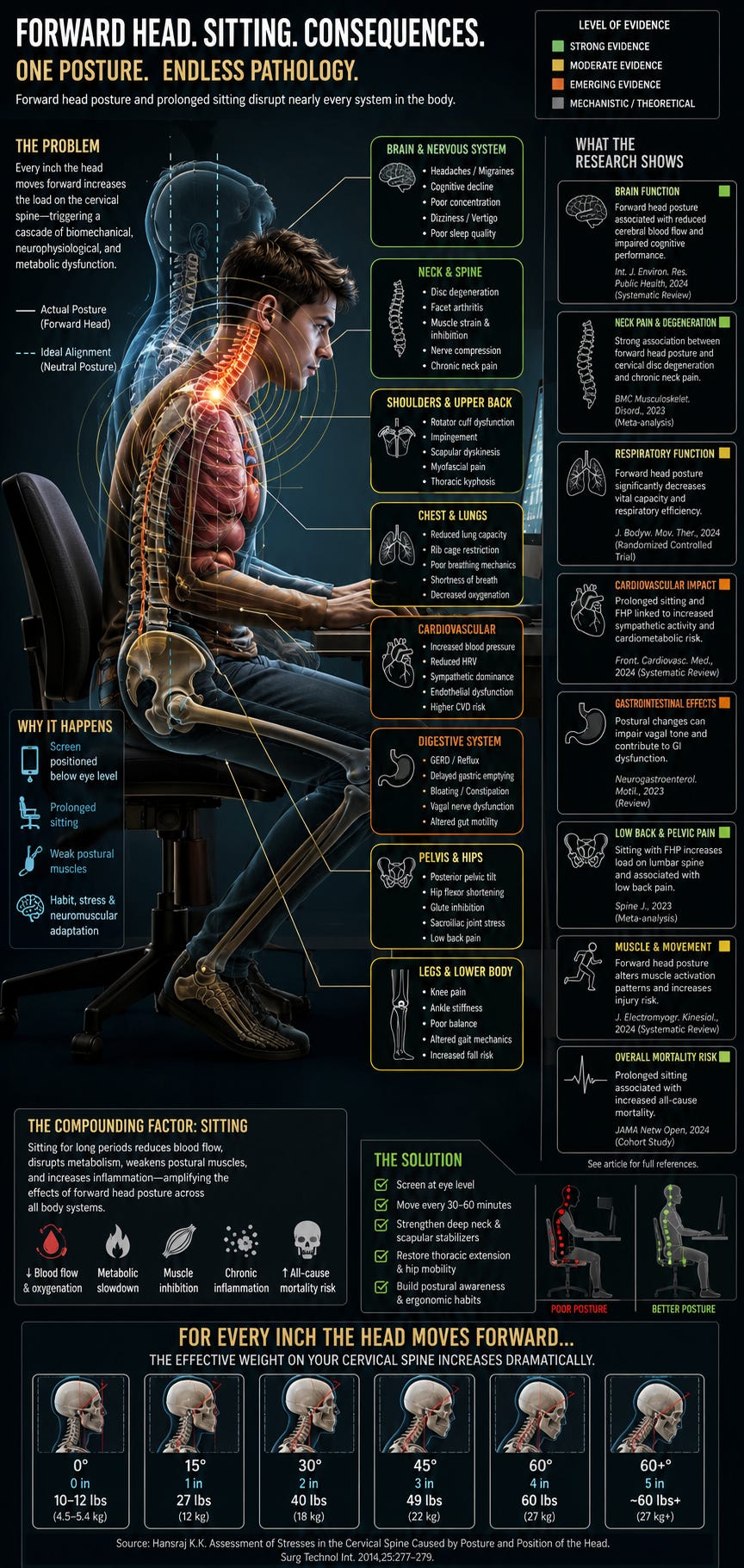
Now look at the numbers the sedentary literature keeps landing on, independently, from different cohorts and different research groups…
Dementia risk inflects at 10 hours. Cognition craters at 10–12 hours. Cardiovascular death spikes at 10.6 hours. Nobody coordinated that. Those numbers come from three separate teams chasing three separate endpoints, all of them running into the same wall — a wall labeled “Ten Hours”.
But here’s what none of them measured…
For the modern human, most of those 10 hours are spent in flexion. Head forward (FHP). Thoracic spine rounded (think “hump back” here). Hip flexors shortened. Scapulae protracted. Ribcage compressed — which is why the lung volumes drop precoptiously, and breathing becomes increasingly difficult.
Pay close attention…
The two sciences have been studying the same body, in the same position, for the same ten hours, and calling it two different things. The posture researchers measure what the load does to the cervical spine and the lungs. The sedentary researchers measure what the stillness does to blood glucose levels, cardiovascular health, and the brain. Same chair. Same ten hours.
Now weigh that against the timeline trajectory…
In 1985 we had four thousand injured keyboard operators and a fight over whether they were faking. In 2001 we had a federal standard, and then we didn’t. By 2025 we have meta-analyses covering hundreds of thousands of people, converging on a ten-hour threshold for dementia and cardiac death, and text neck prevalence among female college students of sixty-five percent.
We know exponentially more than we did forty years ago. And it is exponentially worse. And I see the results of it every week — particularly in younger patients…
When adolescents and teens come into my clinic, a significant portion of the time, their posture is beyond horrific — emphasis on “beyond”. And not only is it rare for the kid to care about what you are telling them, most of the time, explaining it to the parents is useless as well, typically falling on equally deaf ears. Because in today’s society, kids too often set the agenda — and that agenda rarely includes doing what it takes to address their terrible posture; becoming active and putting the devices down.
Which begs the question, are there actually solutions? Glad you asked!
Five Solutions That Actually Work
1. Raise the monitor before you buy anything else. A standing desk with the screen still at navel level is a standing desk that gives you forward head posture while standing. You changed your legs and fixed nothing above the shoulders. Get the top of the screen at eye level, roughly an arm’s length away, so your chin stays parallel to the floor. In my home office, my monitor is big and mounted to the wall, so whether I am sitting or standing, I am actually looking slightly up, my neck in a bit of extension instead of flexion. Search “adjustable keyboard / monitor / laptop platforms” if mounting to a wall is off-limits.
2. Fix the phone, not just the desk. Most people spend more hours flexed over a five-inch screen than they do at work. Bring the phone up to your face instead of dropping your face to the phone. It looks ridiculous. Do it anyway. You cannot correct at the workstation what you re-create on the couch every night. There are actually a variety of gizmos and mounts designed to do this. You’ll have to search and find them on your own.
3. Break the stillness every 30 minutes. Not “exercise more” — interrupt the sitting and FHP. Duran and Diaz tested this directly: five minutes of walking every half hour was the only dose of exercise that moved both glucose and blood pressure, and hourly breaks did nothing for glucose at all. Set a timer, because you will not remember.
4. Stretch what’s short, strengthen what’s long. Forward head posture is a pattern — tight pecs, upper traps, and suboccipitals; weak deep neck flexors, lower traps, and rhomboids. Sepehri’s meta-analysis favors combined protocols over either alone. Too many YouTube videos to list. Watch some of these instead of doomscrolling.
5. For your kids: less screen, more dirt. This is the one nobody wants to hear, and the only one that prevents rather than manages. Bikes, trees, tag, trampolines, dogs & dirt, unstructured outdoor time — what Haidt calls risky play. Bad posture at 14 is a bad habit. At 40 it’s architecture. And architecture is much more difficult to remodel.
BONUS: The Correction Section
This is where most people, and too many practitioners, blow it. Chronic neck problems have three underlying drivers — chemical, mechanical, structural. Let’s look at the chemical driver first…
Inflammation is the name given to the collective chemicals your body releases in response to tissue damage. So while inflammation is nessecary for healing to take place, it always leads to some degree of fibrosis (microscopic scarring). And while there are many drivers, the biggest driver of systemic inflammation is what you eat. Eat garbage and stay inflamed. Stay inflamed, and you’re laying down new scar tissue faster than anyone can break it up.
In other words, the chemical portion of the chain, leads to the mechanical portion — soft tissue (fascial) adhesions, which I discussed at length in an earlier post…


How big a deal is not addressing this issue? Another post addressed that question as well…
What if there were a "Universal Cause" of Disease Few People Have Heard of?

Video and Audio Overviews
After dealing with underlying fascial adhesions we can now adjust. Adjust into a matrix that’s still tethered, and the tissue drags it right back, which is how patients end up on maintenance plans that never end. That’s the 150-visits joke, and my profession earned it.
Here’s the anatomy nobody explains. Forward head posture isn’t just slumping — your head is being pulled there. When the SCM and platysma develop fascial adhesions, they go into sustained hyper-contraction, and those muscles run down the front of your neck. Contract them and the head goes forward and down, and it will not go back until they’re released.
That’s why posture cues fail. You cannot willpower your way out of a soft-tissue contracture. Myofascial pain accounts for up to 85% of back pain and better than half of all neck pain and headaches — so this isn’t a niche finding; it’s the majority case. Since at least 1986.
Only then does structure come into play, and the physics is unforgiving. Stretching addresses muscle. Your problem is ligament, tendon, fascia — and collagen doesn’t respond to a thirty-second hold. Viscoelastic deformation takes twenty to thirty minutes of sustained low-force daily loading, which is precisely why certain types of cervical traction devices exist.
The force has to exceed the scar tissue but stay under the threshold of the healthy tissue: too little and nothing changes, too much and you cause more problems than you are solving. An adjustment lasts a fraction of a second, and Mark Payne — a chiropractor — states flatly there is essentially nothing in the literature showing adjustments alone change spinal structure.
Howver…
Beyond crappy diets (see Weston Price’s book, Nutrition and Physical Dengeration), degenerative arthritis has a known cause: abnormal joint motion. Joints that don’t move properly wear out, and as they wear out they move worse. The cycle feeds itself. Wolff’s Law is neutral — bone remodels to whatever load you give it.
Here's the part that should make you angry — the science was settled over forty years ago…
Cailliet had the mechanism, Panjabi had the numbers — and every institution that could have acted spent four decades figuring out how to blame you and then hand you the bill. The employer owned it, until a procedural knife killed the standard and barred anyone from ever bringing it up again. That same year, the term Sedentary Death Syndrome was coined. And just like that, the chair wasn't the problem anymore — you were, your lifestyle, your choices.
But the body was never confused. It doesn't know the posture researchers and the sitting researchers work in different labs in separate buildings, never citing or referencing each other….
It just takes the load, ten hours a day, head forward, ribcage compacted, and hands back to you the inescapable reality of physics. The neck of a sixty-year-old on a seventeen-year-old girl. Lungs less able to oxygenate. A cardiovascular system, blood sugar regulation, and gray matter all slamming into the same ten-hour wall that three separate teams came up with.
Same chair, same ten hours, two sciences, one spine — and the only person left in the room with the power to change it is you, which, if you've read the last forty years correctly, was the point all along.
Thank you for the wake up. While it's not surprising, I was too busy looking down to see it.
Lots of good information and insight.
Wow, I understood the general sense of this, but you filled some huge knowledge gaps for me. Fortunately I’m not stuck at a desk all day, and my work has me moving around a lot. Years ago I stopped using the terrible chairs at my work completely and just stand to use the UI carts (which adjust nicely) and it was a major improvement in my back pain. Proper strength training took care of the rest.