


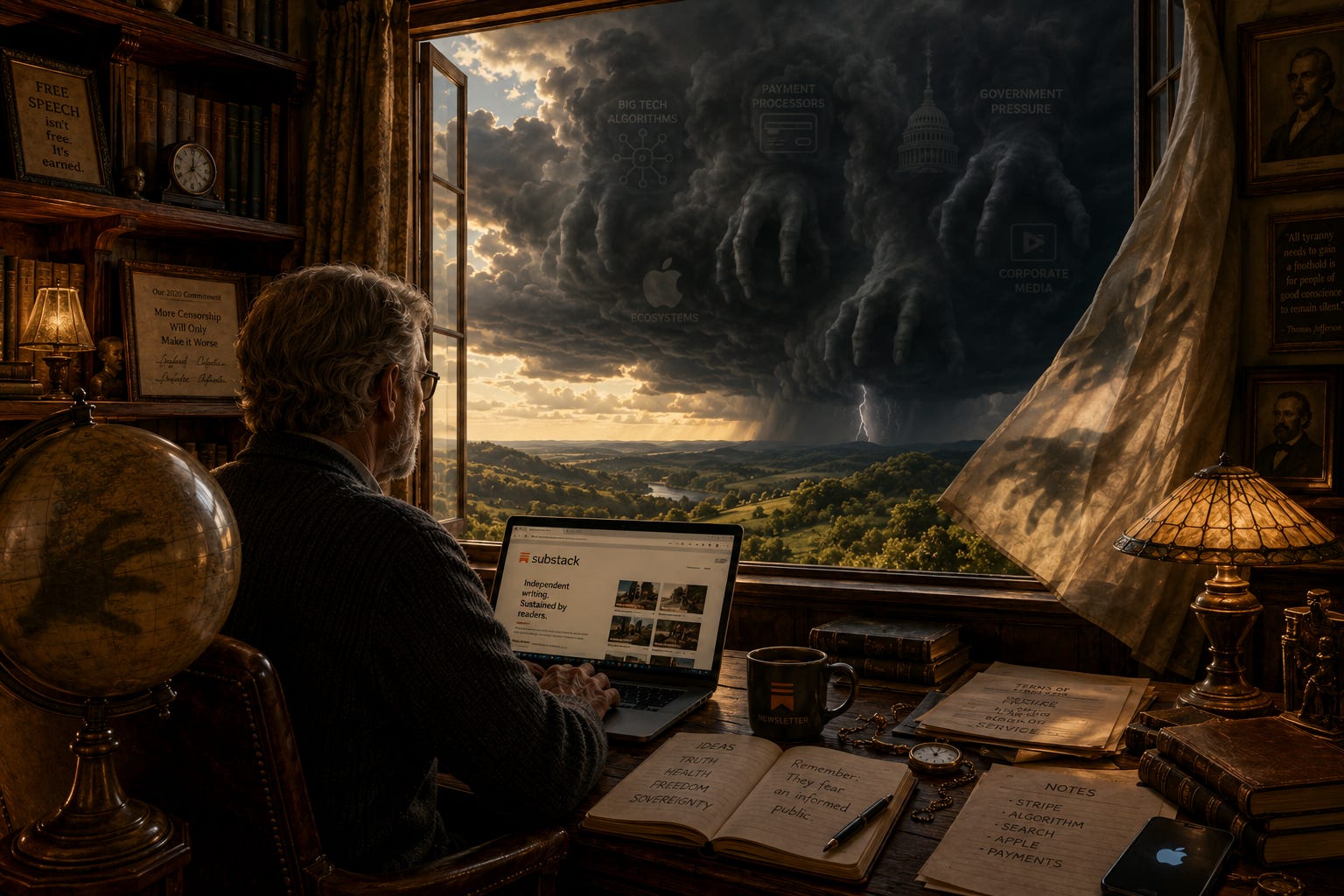
“My Spider Sense continues to tell me something disturbing has changed with how contrarian authors are being treated on Substack.” -Bill Rice Jr., Substack author and Brownstone Fellow, from his March 2024 article, Something HAS changed with Substack
Audio & Video Overviews
Note: The audio isn't a robot reading the article — it's a podcast-style conversation generated by NotebookLM, with two AI hosts discussing the piece. Surprisingly listenable, even for those of us who normally hate AI audio. Worth a try, especially if you've got a commute.
I’ve Seen this Storm Before
After reading Katy Talento’s Confessions of a White House Public Health Priestess, I started writing a comment that I expected to be just a comment. A few sentences about Senator Dan Burton’s grandson. A note about the local newspaper that refused to print my letter to the editor in the early 2000s — the one warning parents about childhood vaccine injuries, until my patients hounded them for a year. A reference to Finn v. Global Engagement, the ongoing federal lawsuit that, if you are not familiar, is exactly the point.
Halfway through writing the comment, I realized I was no longer writing a comment; I was writing a post.
So I did what any reasonable researcher would do. I opened the top five search engines (Google, DuckDuckGo, Bing, Yahoo, and Yandex) and I plugged in “Finn v. Global Engagement” to see how Substack’s coverage of this landmark censorship case was being indexed.
According to Claude, Substack hosts at least several hundred articles dealing with this lawsuit. Sayer Ji, a behemoth in the natural health space and one of the named plaintiffs, has written about it dozens of times. Childers (of Coffee & Covid, renown), the plaintiff’s attorney, has been covered extensively across the platform.
Compare that to what I found in the top 300 results across all five engines…
Google: A single Substack result — Sayer Ji’s CCDH Wrote the Government’s Script… at #18. Nothing else in the top 300.
DuckDuckGo: Zero Substack results.
Bing: Zero Substack results.
Yahoo: One Substack result — Ji’s When a Foreign Censor Claims Constitutional Injury at #10, the very last entry on the first page. Nothing else in the top 300.
Yandex: One Substack result — Ji’s The Government Just Admitted It Censored Americans at #4. Nothing else in the top 300.
Two of the top five search engines in the world returned zero Substack results in the top 300 for a federal censorship lawsuit with hundreds of Substack articles written about it. That's not a search-quality issue. That's a wall, and the wall is already built. This is when I stopped writing the comment and started researching the platform.
Which led me to the question that occupies the rest of this article: if the powers that control the world wide web have already decided Substack writers don't exist, how long until Substack itself reaches the same conclusion, and what will it look like when they do? You see, I’ve been here before. And if when the other side regains power, I know exactly how this story ends. You see, I’ve been here before…
How a “Free Speech” Platform (Substack) Gets Quietly Closed
You probably know the story by now — if not, you can either read the eight-part series (my exit from WordPress) or my Substack overview. The short version… My website was experiencing explosive month-over-month growth, without me ever having heard of SEO. The web’s prevailing wisedom-du jour was “Content is King,” and I was living proof of it. Then, virtually overnight, the traffic vanished. I was swept up in the tsunami of government-funded, Pharma-greased, Big-Tech-enforced censorship that culminated in the COVID-era information lockdown.
It cost me virtually all my traffic. It cost me a ship-ton of money. And it cost the public access to thirty-five years of clinical observation backed by PubMed-indexed peer review - which is actually the very noose Google uses to hang dissenters.
So when I tell you I am about to take a very hard look at the platform I am currently writing on, understand that this is not paranoia. This is someone who has already been kicked in the teeth by exactly this kind of operation, looking at the third platform I’ve invested time and energy into, and asking the questions I had no idea I needed to be asking back in the day.
So let’s roll up our sleeves and look at Substack the way I should have been looking at Google, Facebook, and WordPress in 2018. Not at what they say. At what they are. Because the political winds always shift, and when they do, the question isn’t whether the censorship apparatus comes back online. The question is who flips the switch, and what will it cost them not to flip it on you?
Part I: Who Actually Owns Substack?
Substack was founded in 2017 by three guys: Chris Best (CEO, Canadian, formerly CTO of Kik Messenger), Hamish McKenzie (Chief Writing Officer, former Tesla communications guy and journalist), and Jairaj Sethi (CTO). There’s actually a fourth co-founder, Nico Olivieri, who tends to get left out of the publicity shots.
These men present themselves — and honestly, probably believe themselves to be — classical-liberal, free-speech, “we won’t censor” types. McKenzie’s December 2023 stand against pressure to remove a handful of newsletters labeled “Nazi” was, by every account, genuine. The 2020 manifesto the owners all signed regarding content moderation, was nothing if not straightforward… More Censorship Will Only Make it Worse.
Sounds great, right? Kind of like “Don’t be evil” sounded great when Google adopted it as its motto in 2000 (remember Y2K?). We all know how that movie ended. And here’s the rub… Like the majority of today’s large corporations, the founders don’t really run the company anymore. The people writing the checks do.
Part II: Follow the Money
Substack has raised roughly $200 million across multiple funding rounds. As of July 2025, the company is valued at $1.1 billion following a $100 million Series C — making it a “unicorn” in Silicon Valley speak. And here’s where it gets interesting. The company’s actual revenue? About $45 million annually as of mid-2025. That’s not a typo. Substack is valued at twenty-five times revenue.
You don’t have to be Warren Buffett to understand what that means. The investors who put up that $100 million did not do it because they think Substack is a quaint little newsletter platform. They did it because they need Substack to grow ten times bigger to give them a mere sniff of ROI. And they need that growth to come from somewhere — meaning more aggressive monetization, more advertising (which the founders swore they’d “never” do, and have already started doing anyway), more algorithmic feed optimization, and more “value-added” features that lock writers in.
Who are these investors? Let me name names…
Andreessen Horowitz (a16z): Led the original Series A, in on the Series C. Founded by Marc Andreessen and Ben Horowitz, two of the most powerful men in Silicon Valley.
BOND Capital — Led the 2025 Series C.
The Chernin Group — Co-led the Series C. Run by Peter Chernin, who spent thirteen years as President and COO of News Corp under Rupert Murdoch (remember the phone hacking scandal?).
Tiger Global, Y Combinator, Zhen Fund — earlier rounds of funding.
Notable individual investors include Rich Paul (LeBron James’ agent), Jens Grede (Skims/Kim Kardashian co-founder), and former Twitch CEO Emmett Shear.
Substack’s largest institutional shareholder on a public-markets basis? Buckle up, buttercup. JPMorgan Chase holds a roughly 1.42% stake. That’s right. The same JP Morgan Chase that, as I detailed in my interrogation of Gemini, was at the epicenter of the Epstein Files’ “Project Molecule” — the so-called “vaccine hedge fund” that the world’s wealthiest people joined to, not making it up, profit from pandemics. Created in 2011 by Epstein and his ilk, but essentially left ‘dormant’ until (surprise, surprise) 2020.
Sit with that for a second. Don’t you just love coinkidinks?
Part III: The Political Bent (It’s Not What You Think)
Here is where my readers — many of whom assume “Silicon Valley = lefty” — need to update their priors. You’re talking about a group that will collectively donate to a syphilitic parking meter if they believe it will help protect their business and help them make more money.
In 2024, Marc Andreessen and Ben Horowitz shocked Silicon Valley by personally pivoting to Trump. Each of them donated $2.5 million to a pro-Trump Super PAC. Andreessen kicked in another $844,600 to Trump’s campaign and the Republican Party; the federal maximum.
Their motivation, according to multiple reports based on conversations with people close to them, was not principled free-speech absolutism. It was not concern for health freedom. It was not a sudden conversion to populism. It was strictly about AI deregulation, crypto deregulation, and tax policy for tech startups. Their loyalty is to whoever is best for their portfolio companies. It is transactional, not principled.
Now flip the script. Imagine 2028. Imagine a different administration. Imagine RFK Jr. is no longer at HHS. Imagine the new attorney general decides — as the Biden-era DOJ openly did — that “health misinformation” is a public-health emergency requiring “whole-of-government” action. Imagine Stripe (more on this in a second) gets a polite phone call. Imagine a16z’s portfolio companies start getting audited.
How long do you think Marc Andreessen’s free-speech principles last when his crypto investments are on the chopping block? I’ll wait.
Add Peter Chernin to the equation. A man who spent twenty years as Rupert Murdoch's right hand at News Corp — an organization not exactly known for letting stories tell themselves — and the picture sharpens. These are not men who will go to the mat for a chiropractor in Mountain View, Missouri, who happens to write about Graphene Quantum Dots in places they shouldn’t be and Original Antigenic Sin.
These are men who will quietly tighten the algorithm, quietly update the Terms of Service, and quietly create a game plan that says, Look, we have a $10 billion exit to think about. Do what needs to be done.
Part IV: The Five Hands Around Your Neck
Here is where it gets genuinely scary. There are not one but five distinct chokepoints by which the Substack writer ecosystem can be strangled — and most don’t require Substack to do anything visibly evil.
Chokepoint #1: Stripe
This is the biggie…
Substack uses one and only one payment processor, Stripe. Every paid subscription on the platform flows through them. You as a writer do not have a choice. Substack’s Terms of Service mandate it. So, what is Stripe?
Stripe is a private payment-processing company that sits downstream of Visa and Mastercard, which sit downstream of the federal banking system, which sits downstream of the Treasury Department and the FDIC. This means it’s the most regulatory-exposed link in the entire chain.
And it has already been weaponized.
In June 2025, Robert W. Malone, MD — the inventor of the very mRNA technology platform that the pandemic narrative was built around, and one of the most prominent dissident voices on Substack — published a piece titled Stripe and Substack Demand Authors’ Financial Details. In it, Malone documents that Stripe began demanding from selected authors — targeting was directed almost exclusively at conservative and “anti-vax” writers — full historical bank records (everything) for the accounts Stripe was already depositing into.
We are not talking about new accounts. Stripe already had records of its own deposits. They demanded the rest of the financial history. All purchases. All travel patterns. All donations. All client and patient information that touched the account.
The pretext? “Know Your Customer” (KYC) requirements (aka “Operation Chokepoint”). The same three-letter alphabet soup agencies that have been using this ‘tool’ to debank gun stores, churches, and any business the regime decided was “high-risk,” were turned on those with Substack’s loudest voices and biggest reaches.
Malone’s attorney, Mark Meuser, sent a formal legal letter demanding Stripe produce the actual government order requiring this surveillance. As of his most recent update, Stripe has produced nothing, mainly because no legitimate (Constitutional) government order exists. They were doing it voluntarily, on behalf of whoever is paying them, pressuring them, or both (link, link, link).
But what happens if Stripe simply cuts you off?
Your Substack publication continues to exist. Your articles remain online. Your free subscriber list is intact. But you cannot collect a dime. Your paid subscriptions are immediately refunded. Your business is poof — gone overnight. Same as my Google traffic in 2020. If you think that can’t happen, you need to have a conversation with Sayer Ji or Joe Mercola, or even me, although my site was not in the same category as theirs.
There is no appeal. There is no due process. There is no court hearing. A private company, accountable to no one but its investors and the regulatory pressures placed on it, simply turns off the spigot. And because Substack requires Stripe and only Stripe, there is no Plan B inside the platform.
Chokepoint #2: The Algorithm (a.k.a. “Substack Notes”)
Remember when Substack swore they would never have an algorithm? Remember when their entire pitch was, “We’re different from Twitter and Facebook because we don’t manipulate your feed”?
In 2023, they launched Substack Notes, a Twitter-style microblogging feature. In 2025, they hired a Head of Machine Learning named Mike Cohen to architect the algorithm that decides which Notes get shown to which readers. Let me say that again. Substack now has a Head of Machine Learning whose entire job is to decide what gets surfaced and what gets buried.
Does that sound like “writers and readers, not algorithms” to you? Or does that sound like exactly what Twitter, Facebook, and YouTube did in the years leading up to the great purges of 2020-2022? Writers are already documenting that kind of suppression on Substack…
Substacker, Be Your Own Doctor, published a piece in February 2025 titled Who Turned Off My Shadow-Ban On Substack? documenting that, about three weeks after Trump won the November 2024 election, his site’s suppression ended. Overnight. Articles that had pulled 600 views in fifteen months were suddenly pulling 18,000 in three weeks. As he put it, somebody had opened a tap. More precisely, somebody had stopped closing it. He wasn’t celebrating. He was warning that the same apparatus is sitting right there, waiting for the new administration to aim at a different set of dissidents.
Chokepoint #3: The Apple App Store and Google Play
About 30% of Substack’s paid subscriptions now flow through the iOS app. That means Apple controls a third of the company’s revenue stream, and Google (via Android distribution) controls another big chunk. Both companies have a documented history of removing “problematic” apps under government and activist pressure — see Parler, Gab, and others.
If a sufficient pressure campaign convinces Apple that Substack is “platforming dangerous health misinformation,” Apple has every legal right to demand content moderation as a condition of remaining in the App Store. Substack will comply. Or lose 30% of their revenue overnight. And the venture capitalists will lose their minds.
Which way do you think that one goes?
Chokepoint #4: Email Deliverability
Substack newsletters are delivered through major email infrastructure — Amazon SES and the like — and then have to pass through Gmail, Outlook, Yahoo, Proton, etc, to actually reach the reader. Every link in that chain runs machine-learning classifiers trained to flag “misinformation,” and every link is responsive to pressure from the usual “trusted flaggers” — NewsGuard, the Center for Countering Digital Hate, and the rest of their ilk (link, link, link).
A few coordinated complaints and your newsletter quietly starts landing in promotional folders, spam, or Gmail's new AI-summarized “low priority” bucket. Now that Google has wired Gemini directly into Gmail and Microsoft has wired Copilot into Outlook, those classifiers are no longer dumb spam filters — they are LLMs explicitly safety-tuned to treat health-skeptical content as suspect.
Substack itself doesn't have to lift a finger. Your dashboard says “delivered.” Your reader never sees it. And of course, Substack itself reserves the right to refuse delivery of emails that violate “guidelines” — guidelines, as we noted earlier, that can be rewritten any Tuesday afternoon. Your open rates collapse. Your business dies. You never learn why.
Hype? Psychosis? Paranoia? None of the above. The bias has been documented by a 2022 North Carolina State University study (A Peek into the Political Biases in Email Spam Filtering Algorithms During US Election 2020). The research team analyzed over 318,000 political emails during the 2020 election cycle, revealing that Gmail marked 68% of right-leaning campaign emails as spam versus just 8% from the left.
Because we know how absurdly politicized the pandemic was (although that’s changing on some level), this is a doubly big deal. Especially since Google (Gmail) has approximately 2.5 billion users, or roughly 40% of all email accounts, including 53% of the US email market.
Chokepoint #5: Substack Itself
Despite all the rhetoric, Substack will absolutely deplatform writers. They’ve already done it.
In February 2025, investigative journalist Richard Luthmann was — without warning, without explanation, and despite multiple direct emails to the company — locked out of publishing on his own Substack. He was permitted to “cross-post” but not to publish original work. The pretext given was something about “low engagement damaging deliverability.” Luthmann’s coverage had been about the deep state, intelligence agencies, and politically connected criminal networks.
The journalist who broke the story, Michael Volpe, titled the piece Chris Best’s Free Speech Fraud: Substack CEO Caught in Hypocrisy. The headline says it all.
And remember, Substack already established the precedent in late 2023 that they will remove publications under sustained institutional pressure. They removed five “Nazi” newsletters (this is the one that started it all) after pressure from nearly 250 of their own writers. The principle is now established. The only remaining question is what new category of “unacceptable” content they will be pressured to remove in 2027 or 2028. Spoiler alert. It may be yours.
BTW, Jenna McCarthy over at the best-named Stack on the web, Jenna’s Side, covered this very topic yesterday.
But here’s the part most writers miss until it’s too late. A “follower” and a “subscriber” are not the same thing, and Substack has every reason to want you confused about it. A subscriber gave you their email address — they live on a list you can export and take with you the day you leave. A follower lives entirely inside Substack, seeing your Notes… Only. When. The. Algorithm. Decides to show them.
Substack itself admits, in plain English on its own help page, that you cannot get your followers’ emails and cannot take the follower list with you when you leave. The writers in the comments section of Substack’s own post about Notes have been calling this what it is for two years: platform lock-in. Now ask why Substack would design it this way.
A newsletter platform with portable email lists is a commodity. A social network that owns the relationship graph between creators and audiences is worth twenty-five times revenue. Every follower is an asset on Substack’s balance sheet you cannot take with you. Every subscriber is an asset on yours. And I’m not the only person to notice this.
The next time you scroll Notes, notice how the “Follow” button is everywhere, but “Subscribe” is harder to find. That is a $1.1 billion company quietly converting your audience-building work into their lock-in moat — and the day the winds shift and they need to throttle you, it is the followers who will keep seeing whatever the algorithm wants them to see. While your newsletter quietly stops landing.
Part V: The Math of Destruction
So let’s bring this home. What would it actually take to “destroy everyone on Substack as a platform” if the political winds shift?
Not much, actually. Here’s the kill chain:
Phase 1 - Soft Suppression (zero cost, zero visibility): The Notes algorithm gets a quiet adjustment. Health-freedom keywords get ranked down. Writers like me notice our growth has stalled. Most people just shrug and assume they need to “post better content more often” (exactly what I was told back in the day). Substack denies any algorithm change. This phase alone destroys the majority of growth potential.
Phase 2 - Search Suppression: Internal Substack search (which already allegedly acts as a censor) gets tightened further. “Recommended” newsletters and “Explore” features quietly stop showing the targeted writers. The walled garden becomes smaller.
Phase 3 - The Stripe Squeeze: Stripe starts demanding “enhanced” banking documentation from targeted writers, exactly as Robert Malone documented. Many comply, terrified of losing their online business they’ve built through blood, sweat, and tears. Others refuse and are immediately cut off from payment processing.
Phase 4 - App Store Pressure: Apple receives “concerned letters” from “public health” NGOs (the same censorship apparatus that Mike Benz has documented in painful detail). Apple “encourages” Substack to update content policies. Substack complies. Or loses 30% of revenue.
Phase 5 - Visible Deplatforming: The bottom 5% of “non-compliant” writers — the ones who refused Know Your Customer requests, the ones with the most aggressive content, the ones with the highest signal-to-noise ratio in attacking the regime narrative — get the Luthmann treatment. Locked out. No appeal. The remaining 95% see what happened and self-censor preemptively. Job done.
The entire kill chain can be executed in a matter of months. And despite some ranting and online bitching from a few of the 5% — those who will be labeled as ‘unstable’ — most readers will not even notice it happened.
Part VI: What I’m Doing About It
I’m going to be honest with you. I do not have all the answers yet. But here is what I’m working on and what I am strongly suggesting every health-freedom writer on this platform consider. It’s the result of what I went through.
I was in the process of monetizing my rapidly growing site and looking at hiring a full-time IT person to run it all when the government censorship bug hit me. Don’t think for even a second that it couldn’t happen to you just because your business lives here on Substack — the home of the free and land of the brave.
Mirror everything. Everything I publish on Dr Schierling Unfiltered will get published on DoctorSchierling.com. It’s a WordPress site so I’m not sure how much protection it actually affords (much of that depends on your host). Or simply make a file on your desktop and save posts in it. Or keep it in the cloud if you have a service you trust.
Own your email list. How many of you know that Substack lets you export your subscriber emails. Do it. Today. Right now. While you’re reading this. Then, back it up to a service you control. Because the day Substack decides to let you “leave” but quietly throttles your export tool is coming. When? No idea. But to think that day won’t come? Naive.
Build a payment-processing backup. Direct bank transfers. A 501(c)(3) fiscal sponsor. Crypto. Even just a separate Stripe account isolated from your Substack. The point is: do not have a single point of failure between you and your readers.
Document the suppression in real-time. The single best thing the Be Your Own Doctor did was take screenshots and run the numbers before he realized he was being censored. If you wait until it happens to start collecting receipts, you are already too late. Start a folder. Start today. Don’t ask me how I know this is good advice.
Network outside the walled garden. The Substack “recommendation” feature only recommends other Substack writers. That is by design — a network lock-in. The day you decide to leave, you lose access to that promotional engine. Build relationships with writers on Ghost, on Beehiiv, on independent WordPress sites, on Locals, on whatever isn’t Substack. One of my favorite sites, Brownstone Institute, already operates this way. So should you.
Read your Terms of Service. No, really. Do it. They include a unilateral-modification clause. Substack can change the rules tomorrow, and your only remedy is to leave. At which point all of the lock-in mechanisms above kick in.
The Punchline
Substack is, for now, the best platform available for independent writers. Its founders are, for now, operating in good faith. Its algorithm is, for now, relatively benign. Its payment processor is, for now, willing to host a Missouri chiropractor who’s been writing about vaccines for three and a half decades. But “for now” is doing a lot of work in this paragraph.
The same was true of Google in 2017. The same was true of YouTube in 2018. The same was true of Twitter before Elon Musk bought it (and many would argue, after). The same was true of GoFundMe before they froze the Canadian truckers’ accounts. The same was true of PayPal before they started seizing the funds of “misinformation spreaders.” The same was true of Visa and Mastercard themselves before they started turning on their customers.
The pattern is always the same… The platform is open. The platform is captured. The platform is closed (or dramatically changed). The dissidents, you and me, are squeezed out.
I have lived this once already, courtesy of Google. I lost virtually all my traffic. I lost a substantial sum of money. I lost the ability to reach the patients and readers who needed the information most. During the precise pandemic window when they needed it most. I don’t plan on living it twice.
If you’re reading this on Substack, welcome. I’m glad you’re here. Subscribe. Comment. Share. Restack. Engage. But realize that at the end of the day, tech gurus with investors to answer to are going to do whatever their creditors require of them. And that “whatever” could mean a lot of different things — none of them good for you, your readers, your work, or your life’s mission.
The Ozarks have taught me something about storms. Watch the sky. The sky over Substack right now? Looks fine; beautiful, actually. But there is the faintest hint of black, down low on the horizon. I’ve seen it before, and I’m not waiting around to find out what it does next before I start taking action.
-Doctor Schierling, Mountain View, MO
P.S. If you think any of the above is “conspiracy” or “alarmism,” I’d encourage you to read my recent interrogations of Gemini, Grok, ChatGPT, and Claude. Once you watch the AI’s themselves admit, under sufficient prompting, that the censorship apparatus exists in far greater extent and detail than I’ve described it, the question of “is this real?” becomes considerably less interesting. The interesting question becomes “what are you doing to protect your business?”
Ten Essential Reads on Substack Censorship
For those interested, I threw up several of the posts I read while researching today’s piece. Believe me when I say that this list is not exhaustive. Several others were behind paywalls. In no particular order…
Anything less than the Fowchster is a net loss. Unlike Sasha, I actually think they are going to indict him - five days to go or something like that, until the SOL runs out. Hopefully, Fowch ends up SOL. -Reply to a Commentor on Morens’ Indictment
Why Did “Something Change” on Substack? Rice’s 2025 follow-up to his earlier-mentioned original piece, examining whether Substack’s founders may have shifted left to cash in on the platform’s $1.1 billion valuation. Argues that Covid Contrarians have been effectively “herded into a corral” where their work no longer poses much threat to the Establishment.
E-mail Disabled for Bill Rice, Jr.’s Newsletter Rice documents the strange phenomenon of 15 to 35 subscribers per article simultaneously disabling email delivery within minutes of his sending it out. The pattern is too consistent to be organic — and it’s direct, current, granular evidence of the email-deliverability chokepoint.
My Substack Was Demonetized by Genocidal Zionists. Here Is the Workaround Kevin Barrett’s October 2024 account of being canceled by Stripe with no recourse, losing roughly 80% of his family’s monthly income overnight. Shows the same Stripe chokepoint hitting writers far outside the medical-dissident space — same pattern, no Malone-sized legal war chest to fight back with.
RESOLVED: Stripe, Substack Demand Financial Details From Authors Dr. Robert Malone’s follow-up to his original Stripe piece, after the Dhillon Law Group successfully forced Stripe to back down. The resolution, however, required roughly $100,000 in legal fees, meaning the average author facing the same demand has no realistic recourse.
Has Substack Been Hacked or Is It Playing With My Data? Dr. Meryl Nass documents anomalous subscriber statistics and Microsoft/Outlook delivery warnings flagging Substack itself as “malicious.” The comments section is where it’s at for this post, and includes corroboration from Dr. Lee Merritt that she was directly censored on the platform.
Is It Time for a Plan B for Substack? Rice estimates the size of the “freedom writer” readership on Substack at roughly seven million people, then walks through why the platform’s economics may no longer be able to support most contrarian writers. It functions as a strategic-options memo for any author thinking about life after Substack.
Is Substack Now Suppressing Conservative/Contrarian Voices While Amplifying Democrat/Liberal Ones? w/ Bill Rice Jr. A long Dan Fournier podcast interview that synthesizes Rice’s entire investigation into one sitting. Covers the metrics, the coordinated mainstream smear campaign, the Stripe issue, and concrete workarounds writers are starting to deploy.
Is Substack Advancing Jewish Authors and Narratives Over Others? The follow-up to the earlier-mentioned Be Your Own Doctor’s “Who Turned Off My Shadow-Ban” investigation from Be Your Own Doctor. It documents how a Substack-staff-promoted Note from a 140,000-subscriber establishment-aligned writer auto-appeared at the top of his feed — evidence that the algorithm has editorial preferences beyond pure engagement.
On Fearing Freedom — Plus Thanking Substack for Standing Up to the Censorship Bullies Margaret Anna Alice's January 2024 piece thanking Substack’s founders for refusing to capitulate to the pressure campaign demanding mass deplatforming. The post itself documents her own running battles with the “censorship bullies” on Substack Notes — making it both a defense of the platform's stated principles and a real-time record of the pressure being applied to bend them.
Substack Is a Manipulated and Censored Platform Sasha Latypova’s August 2025 Note publicly stating that her account was throttled immediately after she and Debbie Lerman published the Covid Dossier. Brief, but notable for being a named prominent writer accusing the platform of censorship in plain, unhedged terms.
Twitter's Extremely Dangerous Attack on Substack Brownstone Institute founder Jeffrey Tucker's April 2023 piece, written the moment Twitter began blocking engagement on any post linking to Substack. A foundational read for understanding platform-vs-platform pressure tactics — Tucker frames Substack as a small zone of freedom in a media system ‘90 percent captured by industrial and government interests,’ and warns that the experience should serve as a warning against all forms of information centralization.
Bill Rice is back for the attack with And So It Begins… His January 2024 piece has him tracking the opening moves of what he saw as a coordinated pressure campaign against Substack. Rice dissects the Guardian’s coverage line by line, arguing the actual target isn't the handful of fringe accounts being used as the public pretext — it’s the platform's vaccine skeptics, who haven't been “silenced yet.” This resonates with me simply because that is the reason I think I was attacked early on in what Gemini referred to as a “Field-Clearing Event”.
'I think when they became popular, they got audience captured.' Yes.
Substack does play around in many ways. Like all social media platforms, they mess with ranking which essentially shadow bans people that they don't want to get traction.
They also changed the default sorting on the website subscriptions feed to "relevant" instead of latest. It hides some posts.
https://robc137.substack.com/p/substack-what-is-this-priority-ranking
BTW, Brownstone plays games too.
A couple of people who questioned the pandemic (that there was no new pandemic until the shots came out) have been ignored or removed by them.
Hmmm....